1 Other Business Medical Insurance RB, MWH & TCD Changed - - PDF document

1
SMART_READER_LITE
LIVE PREVIEW

1 Other Business Medical Insurance RB, MWH & TCD Changed - - PDF document

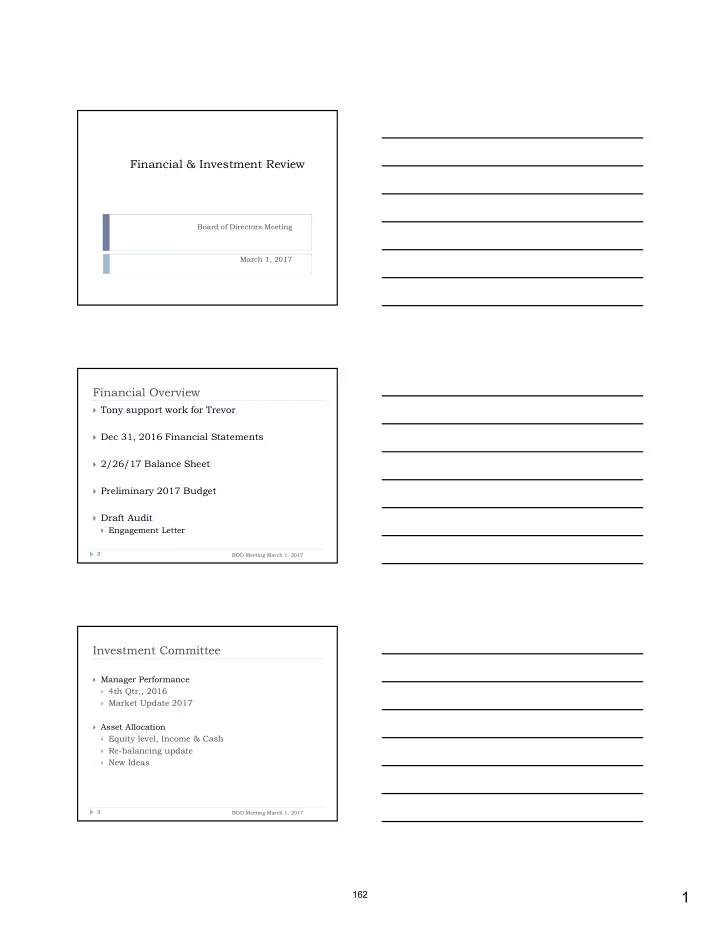
Financial & Investment Review Board of Directors Meeting March 1, 2017 Financial Overview Tony support work for Trevor Dec 31, 2016 Financial Statements 2/26/17 Balance Sheet Preliminary 2017 Budget Draft Audit


slide-1
SLIDE 1

1

Financial & Investment Review

Board of Directors Meeting March 1, 2017

Financial Overview

 Tony support work for Trevor  Dec 31, 2016 Financial Statements  2/26/17 Balance Sheet  Preliminary 2017 Budget  Draft Audit

 Engagement Letter

2 BOD Meeting March 1, 2017

Investment Committee

 Manager Performance  4th Qtr., 2016  Market Update 2017  Asset Allocation  Equity level, Income & Cash  Re-balancing update  New Ideas

3 BOD Meeting March 1, 2017

162

slide-2
SLIDE 2

2

Other Business

 Medical Insurance

 RB, MWH & TCD  Changed Insurance Agents

4 BOD Meeting March 1, 2017

Grant Program Review

Board of Directors Meeting March 1, 2017

Program Agenda

 Recap 2016 payout results and ten-

year trend

 Implications of 2017 budget to

program areas

 Program updates  Twelve grant proposals

6 BOD Meeting March 1, 2017

163

slide-3
SLIDE 3

3

Dollars in 000s

$2,802 $35 $2,108 $1,261 $137 $60 $588

Grants paid in 2016 Cancer Rehab Disabilities Entrepreneurship

Public Affairs Other (Cara) ILGIVE

2016 payouts were Cancer (40%), I/DD (30%), Ent (18%), ILGIVE (9%)

7 BOD Meeting March 1, 2017

Trends show transitions in grant area focus

Note: ILGIVE awards reported as part of relevant focus area

$- $500 $1,000 $1,500 $2,000 $2,500 $3,000 $3,500 $4,000 Entrep Cancer and Rehab Disabilities Other

BOD Meeting March 1, 2017 8

Dashed line represents start

  • f Impact Plans (Q1 2012)

It has been four years since approved payouts have paced at current low level

Cancer I/DD Entrep Other Total %Total 2017 Budget $1,890 $1,890 $1,890 $630 $6,300 100% Approved as of 3/1/17 1,200 828 190 68 2,285 36% To Go in ‘17 $690 $1,062 $1,700 $562 $4,014 64%

March, 2016: $4,132 approved -- 59% of 2016 total March, 2015: $2,982 approved -- 49% of 2015 total March, 2014: $4,031 approved -- 57% of 2014 total March, 2013: $1,882 approved - 34% of 2013 total

9 BOD Meeting March 1, 2017

164

slide-4
SLIDE 4

4

If recommendations approved, we are at 59% of needed payout, behind PY pacing

Cancer I/DD Entrep Other Total %T

  • tal

To Go in ’17 $690 $1,062 $1,700 $562 $4,014 64% March Reco

  • 530

915 TBD 1,446 23% If Approved 1,200 1,358 1,105 68 3,731 59% Rest of Year 690 532 785 TBD $2,568 41% “Pipeline” $625 $910 $788 $75 $2,398 June, 2016: $5,291 approved -- 76% of 2016 total June, 2015: $3,975 approved -- 65% of 2015 total June, 2014: $4,643 approved -- 66% of 2014 total June, 2013: $2,712 approved -- 49% of 2013 total

10 BOD Meeting March 1, 2017

Impact Plan - Entrepreneurship

11 BOD Meeting March 1, 2017

Entrepreneurship Program Updates

 SEA  DePaul  Incubatoredu - High School Program

12 BOD Meeting March 1, 2017

165

slide-5
SLIDE 5

5

SEA Annual Conference (2017)

13

Keynote Artist Tom Varano

BOD Meeting March 1, 2017

Fellows Program is being evaluated

 Program Coordinator and research team from

Illinois Tech fielded survey

 Sent to almost 400 current and prior Fellows as well

as students taking Fellows courses

 Early results indicate positive impact

 Approximately 100 Fellows responses obtained to-date

 “Fellows tend to agree program has positively influenced

entrepreneurship education on campus”

 “Most Fellows see value in the program, affirming that the

program has benefitted them as an academic, raised their visibility on their campus, and helped them identify new

  • pportunities within their discipline”

 More substantive assessment to follow

14 BOD Meeting March 1, 2017

We would like to consider a funding level for 2017-2018 Fellows program

15 BOD Meeting March 1, 2017

$199 $259 $344 $286 $494 $501 $575 $345 $18 $57 $106 $143 $186 $151 $153 $151 38 98 126 105 134 128 157 48

  • 20

40 60 80 100 120 140 160 180 $- $100 $200 $300 $400 $500 $600 $700 $800 Fellows Awards Other Costs # Fellows

166

slide-6
SLIDE 6

6

Impact Plan – Developmental Disabilities

STRATEGIES IMMEDIATE OUTCOMES INTERMEDIATE OUTCOMES INTENDED IMPACT 1 Fund grantees' ability to assess client residential and vocational interests in light of the changing environment Grantees must discern the vocational and residential goals of program participants and facilitate their efforts to achieve them

Vocational

Individuals in the Chicago metropolitan area with developmental disabilities will experience a higher quality of life and increased self- determination through success in their work, comfort in their home and satisfaction across the varied stages of their lives

2 Fund efforts to expand job

  • pportunities and prepare individuals

for workplace success

Individuals in the Chicago metropolitan area with developmental disabilities have the opportunity to identify from a variety of

  • ptions the work that helps

them to be fulfilled and to participate in the economy

3 Fund efforts to increase self- employment 4 Fund efforts to increase the supply of housing alternatives, including emerging models which allow for ownership by residents and other parties

Residential

5 Explore efforts to improve client health outcomes enabling them to reach vocational and residential goals

Individuals in the Chicago metropolitan area with developmental disabilities can choose from a varied and increasing set of options the residential arrangement that gives them comfort and helps them to be fulfilled

6 Catalyze collaboration among grantees 7 Support grantees’ development of non-governmental revenue streams

16 BOD Meeting March 1, 2017

Disabilities grantmaking priorities from 2016 continue in 2017

1.

Advance an understanding of “Quality of Life”

2.

Support transitions of sheltered workshops to community-integrated & employment programs

3.

Create and renew residential environments

4.

Improve direct care staffing

5.

Mobilize individual philanthropic support

17 BOD Meeting March 1, 2017

Funded projects and others in pipeline are addressing these opportunities

1.

Advance understanding

  • f “Quality of Life”

2.

Support transitions of sheltered workshops to more community- integrated & employment programs

3.

Create and renew residential environments

4.

Improve direct care staffing

5.

Mobilize individual philanthropic support 1.

PACTT/I4A CQL training

2.

Ability Food Network; Alternative Day Program CoP

3.

Group Home Renewal Initiative

4.

I4A collaboration in development

5.

#ILGIVE match; matching grants

18 BOD Meeting March 1, 2017

167

slide-7
SLIDE 7

7

CQL Training Continues with Participation by Senior DHS Leadership

19

Susan, thank you for your email below and for allowing me to attend the CQL Training last

  • week. I found the training extremely invaluable, especially as we partner with stakeholders to

ensure our rules, practices and programs are aligned with the new settings rules that go into effect March 2019. Kudos to the Coleman Foundation and all of you at Clearbrook for the invaluable support you are providing - through this training - to help us make this important transition. Greg Fenton, Director, Division of Developmental Disabilities, Illinois DHS

  • Good morning, Greg. I just wanted to touch base and thank you for attending the CQL training

last week at Clearbrook. I hope you had a positive and worthwhile experience. Clearbrook has been very fortunate to be a member of the Intersect for Ability Network of DD

  • rganizations and we have truly benefited from the support of the Coleman Foundation in

collaborative grants/projects such as this one. It was our intention to bring together the Intersect agencies, along with unaffiliated

  • rganizations, ISC agencies and the Department in this unique learning experience as we

move ahead with the changes that are forthcoming in our field. Thanks again for your participation and support. Susan Kaufman, Vice President of Program Services, Clearbrook

PACTT/CQL Training

BOD Meeting March 1, 2017

Launch plans for Ability Food Network are taking shape

 3 agencies (Neumann Family Services, Envision Unlimited,

Gateway Services) in process of forming Ability Food Brand,

  • LLC. 5 others to participate in contract role.

 Focus of initial marketing/sales is internal “friends” market

(those connected to agencies) estimated at 150,000+

 Initial food products to be developed and prepared internally,

identified with ABN and member agencies

 Next stage of development will include contract manufacturing

(co-packing) for 3rd party food entrepreneurs

 Network mentor: Jean Kroll, CEO, I Love Sweets bakery  Developing parterships with Cook County Bureau of Economic

Development, Chicago Hort. Society, Artisan Food Network.

 Anticipating ~12 month scale-up period could be CFI grant

  • pportunity; launch period to follow may be occasion for PRI

20

Ability Food Network

BOD Meeting March 1, 2017

We convened 16 agencies who are working on new day program models

 Goal: Establish a community of practice to enable

sharing of lessons across existing and future program operators

 CHOICE grantees (Clearbrook, Park Lawn, UCP

Seguin)

 Other recent grantees (Helping Hand Center, CTF

Illinois, Orchard Village)

 Potential future grantees (Envision Unlimited,

Search Inc., Anixter Center, Elim Christian Services, Neumann Family Services)

 Representatives from 16 organizations met for a

time of sharing; next meeting scheduled 4/19

21 BOD Meeting March 1, 2017

Alternative Day CoP

168

slide-8
SLIDE 8

8

Designers met with residents to review designs and select materials/colors

22

Group Home Renewal

Cara recently placed a program participant in DSP role at Misericordia

“Did you know that Chicago is home to one of the most well-respected organizations care providers for persons of mild to profound developmental disabilities? It is called Misericordia. Connecting with them for potential job

  • pportunities was a pretty involved journey involving,

phone calls, emails, invitations, and a lot of searching to find a great student fit, someone who could lead the charge for what could hopefully be many hires to come! Joyce Dishmon-Watkins was the perfect person for the job. Joyce is a poised, professional, caring, student, who’s not afraid to lead, eager to step up for learning opportunities, and to help her community. Those are all traits that lead to success in any service role, but it takes a special person to have the capacity to serve this population. The staff at Misericordia attest to this. Joyce has the heart for it. She was sent to the interview and nailed it! Now, she joins this community as their newest Direct Service Professional!”

 --- internal e-mail announcement to all Cara staff 23

Direct care staffing

BOD Meeting March 1, 2017

#ILGIVE Continues to be Productive for CFI

24

 Advancing Disabilities Impact Plan Strategy to

“support grantees’ development of non- governmental revenue streams”

 $1.7 million raised by 53 CFI grantees  $11.3 million raised in statewide campaign

BOD Meeting March 1, 2017

# Nonprofits Dollars Raised (000s) Donors (000s) Grants Made by Foundation 2013 19 $ 611 2.1 $ 330,745 2014 41 $ 861 4.3 $ 330,000 2015 48 $ 1,207 5.2 $ 588,000 2016 53 $ 1,738 6.5+ $ 520,000

169

slide-9
SLIDE 9

9

#ILGIVE Research Update

25

 9 organizations participated in research study

with economist at Texas A&M, USC

 39,000 prospects from 9 organizations sent 1 of 6 messages

varying size of special match offer (e.g. 80%, 100%, 120%) and weeks prior to Giving Tuesday it was sent (11/1/16 or 11/15/16)  Preliminary results

 Potential donor who received earlier special match offer  Was 50% more likely to donate than donor who did not receive a

special offer

 Gave more than double what donor who did not receive special

  • ffer gave

 Special match offer did not displace donations from

Giving Tuesday; earlier donations made by “new” donors

BOD Meeting March 1, 2017

#ILGIVE Research Update

26 BOD Meeting March 1, 2017

#ILGIVE 2017 Plans

27

 We recommend making commitment to ‘17

 Same planned level of resource as last year -

$600K

 Most paid in 2018

 Likely different match terms to promote

generation of matches from other sources

 Offer match of capped amount to be earned by securing match

from organization boards or other source

 Will confer with other grantmakers making like offers

 Some resource to promote, market

www.ilgive.com

BOD Meeting March 1, 2017

170

slide-10
SLIDE 10

10

El Valor

 Individualized Placement Employment Services

 32 individuals with I/DD placed in competitive employment in

positions paying minimum wage in first 10 months of the grant.  TTC - interns

 1 - St. William Catholic School  1 - St. Agnes of Bohemia  3 - Early Childhood Program 28 BOD Meeting March 1, 2017

Teaching Together Chicago (TTC)

29

First year of two-year TTC grant Goal Actual Place 4 interns 5 interns Four schools 4 school Identify 4 Catholic schools 6 schools Hire 4 interns 3 hired

BOD Meeting March 1, 2017

Impact Plan - Cancer

STRATEGIES IMMEDIATE OUTCOMES INTERMEDIATE OUTCOMES INTENDED IMPACT 1 Fund capital and program projects that enable the delivery of comprehensive treatment. Health Care Providers Health Care Providers 2 Fund education programs1 for cancer patients, physicians and health care professionals. Grantees will offer the most effective tools and resources possible to cancer patients, and employ supportive

  • ncology practices4 in which healthcare

professionals collaborate Medical professionals will be able to develop and deliver an optimal comprehensive treatment plan for the cancer patient. Cancer patients in the Chicago Metro area are fully engaged in their cancer treatment plan, and achieve the best possible outcome and quality of life. 3 Fund collaborative

2 efforts that

include comprehensive clinics

3 ,

psychosocial support and palliative care. Cancer Patients Cancer Patients Cancer patients must be fully engaged in development of a treatment plan and empowered to make decisions regarding their continuity of care. Individuals with cancer are knowledgeable and actively participate in cancer treatment. 4 Fund efforts to promote clear communication of treatment

  • ptions to patients.

1 education programs refer to professional development, disease or treatment specific education, and mentoring, not medical school education 2 collaborations would include efforts between doctors and other health care professionals at same or across institutions 3 multidisciplinary medical team develops treatment options and discusses advantages and disadvantages with the patient 4 refers to services from diagnosis to end of life

30 BOD Meeting March 1, 2017

171

slide-11
SLIDE 11

11

Cancer Program Updates

Coleman Supportive Oncology Collaborative (CSOC)

 CSOC branding, logo, communications, website  CSOC Cycle 2 - ten hospital partners  CSOC- CC Children with Cancer

31 BOD Meeting March 1, 2017

A consolidated screening tool for supportive oncology needs and distress.

Christine B. Weldon1, Nancy Vance2, Amy Scheu3, Lauren Allison Wiebe4, Shelly S. Lo5, Catherine Deamant6, Betty Roggenkamp1, Urjeet Patel7, Pam Khosla8, Patricia A. Robinson5, Frank J. Penedo 9, James Gerhart4, Teresa Lillis4, William Dale10, Ana Gordon11, Eileen Knightly11, Rosa Berardi12, Julia Rachel Trosman1

1Center for Business Models in Healthcare, Chicago, IL; 2Northwestern Medicine, Chicago, IL; 3Advocate Health Care, Oak Brook, IL; 4Rush University Medical Center, Chicago, IL;5Loyola University Medical Center Stritch School of Medicine, Maywood, IL; 6JourneyCare, Chicago, IL; 7The John H. Stroger, Jr. Hospital of Cook County, Chicago, IL; 8The Mount Sinai Comprehensive Cancer Center, Chicago, IL; 9 Northwestern University Feinberg School of Medicine, Chicago, IL; 10University of Chicago Medicine, Chicago, IL; 11University of Illinois at Chicago, Chicago, IL; 12The Coleman Foundation, Chicago, IL

The IOM 2013 Report recommends that supportive oncology care start at cancer diagnosis; the Commission on Cancer (CoC) Standard 3.2 requires distress screening and indicated action. Screening tools are not standardized across institutions and often address only a portion of patients’ supportive oncology needs. A collaborative of 100+ clinicians, funded by The Coleman Foundation, developed a patient-centric consolidated screening tool based on validated instruments (NCCN Distress, PHQ-4, PROMIS) and IOM and CoC.

  • The screening tool was piloted at 6 practice improvement cancer centers in the Chicago area (3

academic, 2 safety-net, 1 public).

  • Patients, providers assessing patients’ screening results (assessors), and providers receiving

referrals (providers) were surveyed after use of the screening tool.

  • Descriptive statistics were used to assess effectiveness of the tool.
  • Use of a consolidated supportive oncology screening tool across multiple institutions is

feasible, identified unmet patient needs, and was beneficial for assessors and providers.

  • As the tool is adopted by collaborating institutions, variability in supportive oncology

screening practices may decline, thus improving patient care.

  • The tool has implications for quality improvements and national dissemination.

Funded by The Coleman Foundation, Chicago, IL. For more info, contact weldon@centerforbusinessmodels.com Responders included 175 patients, 81 assessors and 26 referral providers (social workers, chaplains, subspecialists).

  • The majority of patients (160/175, 91%) completed the screening in < 10 minutes, across all

patients the screening tool averaged 4 ½ minutes.

  • Most assessors (59/77, 76%) spent < 5 minutes reviewing screening results.
  • Most patients, assessors, and providers reported the screening tool asked the “right questions”.
  • Assessors reporting partial relevance of some screening questions for 34% (26/77) of patients

also uncovered one or more relevant needs for 96% (25/26) of those patients (p = 0.002).

B A CK GRO UND ME T HO DS RE S ULTS CO NCL US IO NS

Patient Screening Questions for Supportive Care

Page 1
  • f 2
Indicate if any of the following has been a concern for you in the past 7 days, please check Yes or No for each. Over the last 14 days, how often have you been bothered by the following problems? 1 All patients are asked to complete this questionnaire as part of their standard of care. Please take a few minutes to answer the following questions to help us better address your needs. Page 2
  • f 2
Other problems or concerns 2: ________________________________________________________________ _________________________________________________________________________________________ *This tool is adapted from: (1) the PHQ-4 developed by Drs. Robert L. Spitzer, Janet B.W. Wiliams, Kurt Kroenke and colleagues; (2) The National Comprehensive Cancer Network, NCCN Guidelines version 2.2014 Distress Management; (3) Kaiser, M.J., et al., Validation of the Mini Nutritional Assessment short-form (MNA-SF): a practical tool for identification of nutritional status. J Nutr Health Aging, 2009. 13(9): p. 782-8.; (4) Living Well Cancer Resource Center Distre ss Tool. (5) Munoz, A. R., et al. (2015). "Reference values of the Functional Assessment of Chronic Illness Therapy-Spiritual Well-Being: a report from the American Cancer Society's studies of cancer survivors." Cance r 121(11 ): 1838-1844. (6) PROMIS Item Bank v1.0 Pain Intensity Short Form 3a; (7) PROMIS Item Bank v1.0 Fatigue Short Form 4a; (8) PROMIS Item Bank v1.0 Physical Function Short Form 4a; and PROMIS item bank The development of this tool was supported by The Coleman Foundation Please answ er these questions to help us address w hat y
  • u need. - continued

S UP P ORT IVE & DI S T RESS S CR E ENING TO O L

10 20 30 40 50 60 70 80 90 100 Right questions / uncovered relevant issues for a specific patient Partial relevance: some questions not important / not relevant to a specific patient I have training or resources to address patient needs

Patients Assessor Referral Provider Assessor Referral Provider Patients Assessor RP

Coleman Supportive Oncology Collaborative for Children with Cancer (CSOC-CC)

Accomplishments Cycle 1

 Defined supportive oncology for children with cancer  Piloted assessment tool at 5 children’s cancer centers:

Loyola, UIC, University of Chicago, Lurie, and Rush

 Developed “follow up” documents to be used by social

workers, child life specialist and parents/caregivers

 Generated enhanced list of Patient and Family Resources  Created “reasons list for referral to palliative specialist” and

“reasons list for referral to hospice”

 Identified preventable vs. not preventable hospitalization list

to reduce readmissions

 Produced fifteen training modules for clinicians and staff 33 BOD Meeting March 1, 2017

172
slide-12
SLIDE 12

12

Coleman Supportive Oncology Collaborative for Children with Cancer (CSOC-CC)

Challenges Cycle 1

 Standards do not exist for supportive oncology  Lack of relationship between oncology and

psychology and social work - project opened communication about need/benefit of screening

 Not all staff on board and working together towards

improvement, e.g. oncology, palliative medicine

 Pre-existing beliefs and assumptions of medical

team about scope and purpose of palliative and supportive care

34 BOD Meeting March 1, 2017

Coleman Supportive Oncology Collaborative for Children with Cancer (CSOC-CC)

Concept Cycle 2

 7 hospital partners  Program range: $460,000 - $540,000  Grant Period: 07/01/2017 to 06/30/2018  Main Objective: To improve delivery of supportive

  • ncology services to pediatric and adolescent

patients

 Implement screening developed in cycle 1  Roll out training modules to staff and clinicians  Develop content and organize symposium on

Pediatric and Adolescent Oncology Supportive

35 BOD Meeting March 1, 2017

Coleman Primary Palliative Medicine Training Program

 Winter 2017 Poster Walk - Rush University  Program Renewal/Continuation

36 BOD Meeting March 1, 2017

173

slide-13
SLIDE 13

13

Community Cancer Center Opens

37

Health & Rehabilitation Program Update

Almost Home Kids - Medical Education Program

Trained 153 medical students, residents and fellows from 11 institutions over 18 month period.

 Advocate Children’s Hospital  Lurie Children’s Hospital  Northwestern  Rush  Schwab Rehabilitation  University of Chicago Medicine  Vanderbilt University

https://youtu.be/Z4eYSEaBPVM New partnership with OSF Hospital to open Almost Home Kids facility.

38 BOD Meeting March 1, 2017

Agenda

Program Request Recommended Entrepreneurship $1,840,000 $1,340,000 Disabilities 2,262,200 1,387,585 Other $2,165,422 $TBD Total $6,267,622 $TBD

39 BOD Meeting March 1, 2017

174

slide-14
SLIDE 14

14

Agenda - Entrepreneurship

Program Request Recommended Beloit College $100,000 $100,000 Code Now 50,000 50,000 Bunker Labs 90,000 90,000 CPL Foundation 200,000 200,000 Accion Chicago 500,000 200,000 Chicago Hort. Society 500,000 300,000 FamilyFarmed 400,000 400,000 Total Entrep $1,840,000 $1,340,000

40 BOD Meeting March 1, 2017

Beloit College Recommended Amount: $100,000

Strengths

 One of a few sustained, experiential programs and facilities in

a LAS school of its size

 Has strong Alumni support along with a core faculty group  Steady effort to improve experiential programming

Weaknesses

BC dos not have a formal entrepreneurship curriculum Why to Fund

Fundraising and institutional support meets 91% of cost

Funding would complete a 2003 project

41 BOD Meeting March 1, 2017

Code Now Recommended Amount: $50,000

Strengths

 President is a successful entrepreneur with deepening ties to

the E-ship community.

 Program goes beyond coding skills and seeks to foster

  • pportunity recognition and venture creation from the onset

as problems to be solved by coding. Weaknesses

 This is a nascent program with a new president and Board

that are rebuilding the organization. The proposed program revenue model is unproven. Why to Fund

 To support an emerging program that targets underserved

students, and proposes a revenue model and strong interest in collaborations (e.g. Future Founders).

42 BOD Meeting March 1, 2017

175

slide-15
SLIDE 15

15

Bunker Labs Recommended Amount: $60,000

Strengths

 BL cites ability to address Veterans’ needs.  Offers a comprehensive program format – 2 day orientation,

14 week course to develop business and e-ship skills, 2-3 month internships, focus on developing their own ventures, 2-3 year follow up. Weaknesses

 The proposed collaborations with local collegiate programs is

under development and untested Why to Fund

 BL is an emerging community program serving a sector we

have minimal experience with. They are very interested in community collaborations (eg: Future Founders)

43 BOD Meeting March 1, 2017

Chicago Public Library Foundation – Maker Labs Recommended Amount: $200,000 over two years

Strengths

 Based on success of highly trafficked HWLC lab which has

generated some entrepreneurship without any focused effort

 Very strong design thinking approach backed by resources

from Gensler/World Business Chicago

 Library positioned as community leader in fast growing digital

manufacturing sector receptive to new business starts Weaknesses

 Community branch model yet to be built and relies on strong

local partners yet to be fully identified Why to Fund

 A model of community based experiential and support network

from which CFI might identify future funding opportunities

44 BOD Meeting March 1, 2017

Accion Chicago – The Hatchery Recommended Amount: $200,000

Strengths

 Good partnership between consulting and funding partners in

in fast growing sector receptive to new business starts

 Very strong community and City of Chicago support indicates

project will be funded and completed

 Targeted to economically stressed Chicago neighborhood

Weaknesses

 Ongoing business model depends upon success of tenant

businesses Why to Fund

 A model of community based experiential and support

network from which CFI might identify future funding

  • pportunities

45 BOD Meeting March 1, 2017

176

slide-16
SLIDE 16

16

Chicago Horticultural Society – Farm on Ogden Recommended Amount: $300,000

Strengths

 Builds on well-established program in fast growing sector

receptive to new business starts

 CFI funds needed; funding less than request means meaningful

cuts to equipment budget (i.e. demonstration kitchen, other)

 Very strong business partner in LCHC can get project built  Programmatic linkages between LCHC and Farm on Ogden

bodes well for long-term partnership Weaknesses

 LCHC owns property and could be repurpose it in future

Why to Fund

 Supports primarily low-income aspiring and operating

entrepreneurs with specialized services and resources

46 BOD Meeting March 1, 2017

FamilyFarmed General Operating Support Recommended Amount: $400,000 over three years

Strengths

 Strong organization developing expertise in fast growing sector

receptive to new business starts

 Stable leadership poised to grow organization beyond legacy

programs

 Multiple new and ongoing funders, revenue streams

Weaknesses

 IWOW not a true incubator but more food business consultant

Why to Fund

 A model of community based experiential and support network

from which CFI might identify future funding opportunities

47 BOD Meeting March 1, 2017

Agenda - Disabilities

Applicant Request Recommended UIC $447,200 $335,400 CIF 180,000 117,185 Search, Inc. 135,000 135,000 Envision Unlimited 1,500,000 800,000 Total $2,262,200 $1,387,585

48 BOD Meeting March 1, 2017

177

slide-17
SLIDE 17

17

UIC Chicagoland Entrepreneurship Education for People with Disabilities Recommended Amount: $335,400 over two years

Strengths

 Unique partnership of Disabilities and Entrepreneurship

Education experts

 Successful pilot validated concept and proved demand for

both entrepreneur and provider curricula

 Expansion plans provide greater customization of training

Weaknesses

 Unclear path to long-term viability, though UIC Advancement

fundraising commitment and other realistic revenue streams identified for further exploration Why to Fund

 Supports strategies across two Impact Plans 49 BOD Meeting March 1, 2017

Center for Independent Futures – Community Partnership Enhancement Recommended Amount: $117,185 over two years

Strengths

 Process has been developed and vetted with multiple family

groups

 Prior grants have resulted in groups realizing and advancing

towards residential goals

 Matching grant structure provides incentive to develop new

revenue streams Weaknesses

 Highly customized process will not result in large numbers

served though training agency providers will increase scale Why to Fund

 One of few efforts really targeting non-traditional approaches

and maximization of natural supports

50 BOD Meeting March 1, 2017

Search, Inc. Career Services Phase II Recommended Amount: $135,000 over two years

Strengths

 Strong organization leadership paired with 3PL expertise  Built on successful pilot effort which validated concept  Documentation of business case as was done with Have

Dreams provides meaningful entry to employers Weaknesses

 Must be careful school program does not again take resources

away from community placement efforts Why to Fund

 3PL space and PAC’s location within it present compelling

  • pportunity to generate sector-specific employment pathway

51 BOD Meeting March 1, 2017

178

slide-18
SLIDE 18

18

Envision Unlimited Community Hub Model Recommended Amount: $800,000 over two years

Strengths

 Agency’s programs are for underserved Chicago clientele  Organization delivered on prior grant for program transformation

  • f residential services

 Agency has piloted hub models with success in three locations

Weaknesses

 Model does not get to financial break-even and will require

  • rganization to significantly increase private support to sustain

Why to Fund

 Under new leadership, Envision is positioning to transform,

benefit from I4A learnings

52 BOD Meeting March 1, 2017

Agenda - Other

Applicant Request Recommended

  • Univ. Chicago Medicine $2,165,422

$TBD Total $2,165,422 $TBD

53 BOD Meeting March 1, 2017

University of Chicago – South Side Asthma Center Recommended Amount: T/B/D

Strengths

 Unique partnership of four institutions collaborating to develop

a center and reduce asthma in Chicagoland area.

 Well designed Center programming incorporates best practices

and lessons learned from both local and national asthma resources.

 Strong efforts between administration, medical professionals

and community workers to create a cohesive pathway for managing asthma in children on the south side of Chicago. Weaknesses Why to Fund

 While not cancer-focused, Center programming hits all four

strategies of the Impact Plan. A unique opportunity to support a strong effort, which is capable of delivering realistic outcomes.

54 BOD Meeting March 1, 2017

179

slide-19
SLIDE 19

19

New Business

 Technology  2017 Meeting Schedule

 Annual BOD Meeting:

6/6-7/17

 Regular BOD Meeting:

8/23/17

 Regular BOD Meeting:

11/15/17  Adjournment

55 BOD Meeting March 1, 2017

Impact Plan - Cancer

STRATEGIES IMMEDIATE OUTCOMES INTERMEDIATE OUTCOMES INTENDED IMPACT 1 Fund capital and program projects that enable the delivery of comprehensive treatment. Health Care Providers Health Care Providers 2 Fund education programs1 for cancer patients, physicians and health care professionals. Grantees will offer the most effective tools and resources possible to cancer patients, and employ supportive

  • ncology practices4 in which healthcare

professionals collaborate Medical professionals will be able to develop and deliver an optimal comprehensive treatment plan for the cancer patient. Cancer patients in the Chicago Metro area are fully engaged in their cancer treatment plan, and achieve the best possible outcome and quality of life. 3 Fund collaborative

2 efforts that

include comprehensive clinics

3 ,

psychosocial support and palliative care. Cancer Patients Cancer Patients Cancer patients must be fully engaged in development of a treatment plan and empowered to make decisions regarding their continuity of care. Individuals with cancer are knowledgeable and actively participate in cancer treatment. 4 Fund efforts to promote clear communication of treatment

  • ptions to patients.

1 education programs refer to professional development, disease or treatment specific education, and mentoring, not medical school education 2 collaborations would include efforts between doctors and other health care professionals at same or across institutions 3 multidisciplinary medical team develops treatment options and discusses advantages and disadvantages with the patient 4 refers to services from diagnosis to end of life

56 BOD Meeting March 1, 2017

Impact Plan – Developmental Disabilities

STRATEGIES IMMEDIATE OUTCOMES INTERMEDIATE OUTCOMES INTENDED IMPACT 1 Fund grantees' ability to assess client residential and vocational interests in light of the changing environment Grantees must discern the vocational and residential goals of program participants and facilitate their efforts to achieve them Vocational Individuals in the Chicago metropolitan area with developmental disabilities will experience a higher quality of life and increased self-determination through success in their work, comfort in their home and satisfaction across the varied stages of their lives 2 Fund efforts to expand job

  • pportunities and prepare individuals

for workplace success Individuals in the Chicago metropolitan area with developmental disabilities have the opportunity to identify from a variety of options the work that helps them to be fulfilled and to participate in the economy 3 Fund efforts to increase self- employment 4 Fund efforts to increase the supply of housing alternatives, including emerging models which allow for ownership by residents and other parties Residential 5 Explore efforts to improve client health outcomes enabling them to reach vocational and residential goals Individuals in the Chicago metropolitan area with developmental disabilities can choose from a varied and increasing set of options the residential arrangement that gives them comfort and helps them to be fulfilled 6 Catalyze collaboration among grantees 7 Support grantees’ development of non-governmental revenue streams

57 BOD Meeting March 1, 2017

180

slide-20
SLIDE 20

20

Impact Plan - Entrepreneurship

58 BOD Meeting March 1, 2017

181