1 Fractals - Mandelbrot Set Fractals The Mandelbrot Set Plot of a - - PDF document

1
SMART_READER_LITE
LIVE PREVIEW

1 Fractals - Mandelbrot Set Fractals The Mandelbrot Set Plot of a - - PDF document

Proceduralism in Computer Graphics Fixed models/primitives not robust enough Procedural Modeling Quest for extensibility and programmability Use a function or procedure to define the surface or structure of an object. Procedural


slide-1
SLIDE 1

1

Procedural Modeling

Proceduralism in Computer Graphics

Fixed models/primitives not robust enough Quest for extensibility and programmability Use a function or procedure to define the

surface or structure of an object.

Procedural Methods

Shading Modeling Animation

Procedural Models

Topics

Fractals

Fractal terrains L-Systems

Volumetric Models

Hypertexture Particle Systems

Fractals

A language of form for shapes and

phenomena common in Nature

“Geometrical complex object, the

complexity of which arises through the repetition of form over some range of scale”.

Statistical self-similarity at all scales

Why Fractals?

Procedural way to add complexity to a scene Elements of nature posses fractal properties. Used to model nature

Terrain Clouds Coastlines Trees / Landscaping

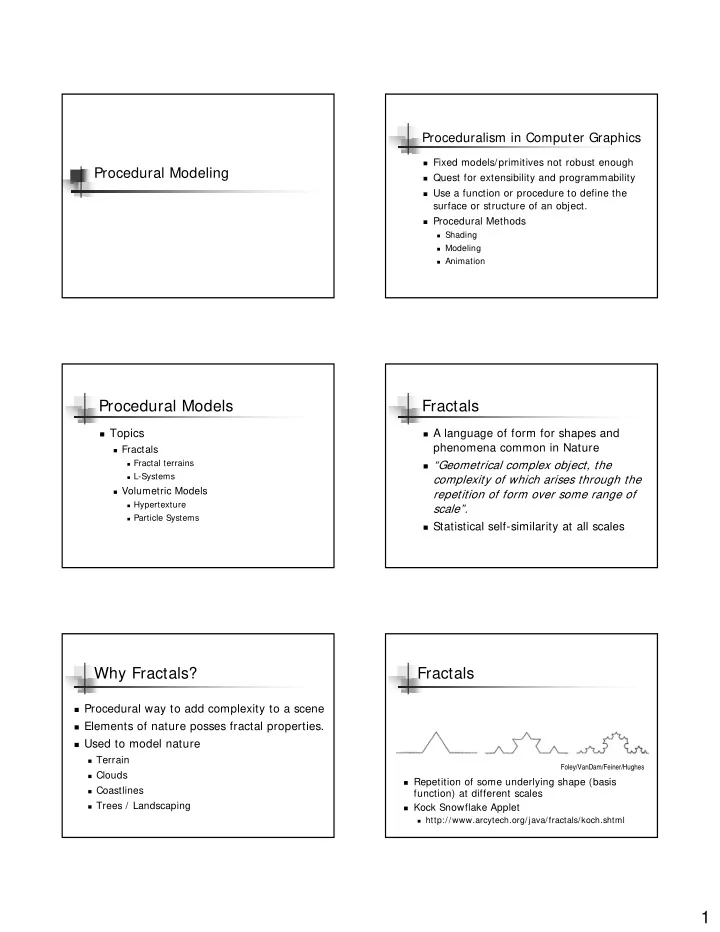
Fractals

Repetition of some underlying shape (basis

function) at different scales

Kock Snowflake Applet

http://www.arcytech.org/java/fractals/koch.shtml

Foley/VanDam/Feiner/Hughes

slide-2
SLIDE 2

2

Fractals – The Mandelbrot Set

Fractals - Mandelbrot Set

Plot of a recursive mathematical function in the complex

plane

Zn = Zn- 1

2 + C For each complex number, the function will:

Move quickly to infinity (outside of the set) Move slowly to infinity (on the border of the set) Remain near the origin (inside the set)

Create image by coloring based on how many iterations

it takes to indicate divergence towards infinity.

Function is self-similar as we zoom into different areas

  • f the plot on the complex plane.

Fractals

Fractals - Mandelbrot Set

Fractint

Fractal Terrain

Fractals -- a simple example Foley/VanDam/Feiner/Hughes

Fractal Terrain

Fractals - a simple example [Fournier82]

Fractal Terrain

Fractals - extend to 2d Foley/VanDam/Feiner/Hughes

slide-3
SLIDE 3

3

Fractal Terrain

Paul Bourke

Fractal Terrain Fractal Terrain

Fractal Terrain -Vol Libre Ridge

Foley/VanDam/Feiner/Hughes

Fractal Terrain

my favorite fractal landscape

[F. Kenton Musgrave]

Fractals

Fractal comes from fractal dimension

a.b

a = Euclidean dimension b = fraction of filling up next dimension

slide-4
SLIDE 4

4

Fractal Modeling

Fractal modeling

Like Mandelbrot set, can zoom infinitely Render at resolution that is most

appropriate

Instant anti-aliasing. Can model a whole planet procedurally

Fractal Modeling

[Musgrave]

Fractals

“If one assumes that a certain error (e.g., pixel-sized) in the ray-surface intersection is acceptable, one can directly ray-trace a procedurally-defined height field with essentially perfect level

  • f detail.”
  • - Ken Musgrave

Gaea Zoom

[Musgrave]

Fractal Modeling

http://www.pandromeda.com

Explore fractal worlds on-line Mojo World

F.K. Musgrave

Fractals

For more info:

[Fournier82] Pietgen, The Science of Fractal Images Pietgen, The Beauty of Fractals Ebert, et al, Modeling & Texturing...

slide-5
SLIDE 5

5

Grammar Based Systems

Building of models based on formal

language grammars

Method for creating fractals Grammar consists of:

Set of characters Productions rules Starting word

Grammar Based Systems - Example

Characters: {A, B,[, ]} Rules: A -> AA B->A[B]AA[B] Start word B Iterations: 0: B 1: A[B]AA[B] 2: AA[A[B]AA[B]]AAAA[A[B]AA[B]]

Grammar Based Systems

But how does this help us create models? Assign a drawing action to each character: L-System (Lindenmeyer) used to create tree-like

structures:

F move forward and draw f move forward and do not draw + increase angle with angle increment

  • decrease angle by angle increment

[ push state (i.e. branch) ] pop state (i.e finish branch)

Grammar Based Systems

L-Systems

F= F[+ F]F[-F]F Applet

http://www-sfb288.math.tu-

berlin.de/vgp/javaview/vgp/tutor/l system/PaLSystem.html

L-System Ferns

Grammar Based Systems

L-Systems

Note that structures created using L-

Systems are fractal like in the sense that they are self-similar at different levels

Self-similarity achieved by repeatedly

applying production rules

slide-6
SLIDE 6

6

Grammar Based Systems

Koch curve as an L-system

F= F+ F- -F+ F http://www.arcytech.org/java/fractals/lsystems

.shtml

Foley/VanDam/Feiner/Hughes

L-Systems - Trees

Foley/VanDam/Feiner/Hughes

L-System Trees

Foley/VanDam/Feiner/Hughes

Grammar-Based Systems

For more info:

Prusinkiewicz, Lindenmayer systems, fractals,

and plants

Prusinkiewicz and Lindenmeyer, The

Algoritmic Beauty of Plants

Questions?

Volumetric Models

Not all objects are “solid” models

water fire clouds Rain

Objects exists in a volume

Hypertexture Particle Systems

Hypertexture [Perlin89]

Extension of procedural textures Between surface + texture, i.e., spatial

filling/volumetric

Objects modeled as distribution of density

hard region - objects completely solid soft region - object shape is malleable using a

toolkit of shaping functions and CSG style

  • perators to combine shapes
slide-7
SLIDE 7

7

Hypertexture Uses

Model shapes that don’t have a well-

defined boundary surface

Fur/hair Fire/clouds/smoke

Complex surface volumetics

Fluid flow Erosion effects

Hypertexture

D(x) - Object Density Function over R3

D (x) for all points x in 3D space [0,1] Density of 3D shape D (x) = 0 for all points outside the surface D (x) = 1 for hard region of the object 0 < D (x) < 1 for soft region of the object

(fuzzy region)

Hypertexture

Toolbox of base DMFs

Bias – up / down control Gain – controls gradiant Noise (controlled randomness)

Won Ken an Academy Award!

Turbulence

Sum of noise at variety of frequencies

Mathematical functions

Hypertexture Noise Examples

2* frequency, 1/2 amplitude

[Perlin89]

High Amplitude, Noisy Sphere Noisy Fractal, noise - Σ many f’s

Hypertexture Example - Fire

))) ( 1 ( ) ( x turbulence sphere(x x D + =

[Perlin89] Red = low density Yellow = high

Hypertexture Example - Fur/Hair

[Perlin89]

Tribble

Here noise displaces x before projecting; uses variable to control curliness

slide-8
SLIDE 8

8

Animated Hypertexture – Pyroclastic

[Musgrave]

Animated Hypertexture – Fireball1

[Musgrave]

Animated Hypertexture – Cloud Dog

[Musgrave]

Hypertexture

Further Reading

[Perlin89] Ebert, et. al,Texturing & Modeling: A

Procedural Approach.

Particle Systems [Reeves83]

Another volumetric modeling technique Abstraction provides control of animation and

specification of objects

Good for modeling volumetric natural phenomena:

water fire clouds Rain Snow Grass Trees

What are Particle Systems?

A collection of geometric particles Algorithms governing creation,

movement and death

Attributes AND, randomness … can be applied to

any of the above!

slide-9
SLIDE 9

9

Attributes of Particles

  • Initial Position
  • Movement (velocity, rotation, acceleration, etc.)
  • Color and Transparency
  • Shape
  • Volume
  • Density
  • Mass
  • Lifetime (for particles)

Particle Systems

The first example of particle systems

was in the movie Star Trek II: The Wrath of Khan

Particle systems were used to represent

a wall of fire.

Particle Systems - The Wrath Of Kahn

[Reeves 83]

Particle Systems - The Wrath Of Kahn

[Reeves 83]

Why use Particle Systems?

Excellent way to model complex natural

  • bjects.

Allow us to model detailed man-made

  • bjects.

Provides a solution to fuzzy object

modeling problem.

Application of Particle Systems

slide-10
SLIDE 10

10

Particle Systems - Fireworks

[Reeves 83]

Particle Systems - Plants: White Sand

[Reeves 83] Fire and Smoke Andreason & Zucca, CG2 -19962 Comet Andreason & Zucca, CG2 -19962 Water Andreason & Zucca, CG2 -19962 Death Star Andreason & Zucca, CG2 -19962

slide-11
SLIDE 11

11

Procedural Models

Summary

Use of a function to define objects Types

Fractals/L-Systems Volumetric Models Hypertexture Particle Systems

Good for

Natural objects Landscapes Non-solid type objects