1 Memory Read Transaction (1) Memory Read Transaction (2) CPU - - PDF document

1
SMART_READER_LITE
LIVE PREVIEW

1 Memory Read Transaction (1) Memory Read Transaction (2) CPU - - PDF document

Today Storage technologies and trends Locality of reference The Memory Hierarchy Caching in the memory hierarchy CSci 2021: Machine Architecture and Organization March 30th-April 1st, 2020 Your instructor: Stephen McCamant Based on


slide-1
SLIDE 1

1

1 Bryant and O’Hallaron, Computer Systems: A Programmer’s Perspective, Third Edition

The Memory Hierarchy

CSci 2021: Machine Architecture and Organization March 30th-April 1st, 2020 Your instructor: Stephen McCamant Based on slides originally by: Randy Bryant, Dave O’Hallaron

2 Bryant and O’Hallaron, Computer Systems: A Programmer’s Perspective, Third Edition

Today

 Storage technologies and trends  Locality of reference  Caching in the memory hierarchy

3 Bryant and O’Hallaron, Computer Systems: A Programmer’s Perspective, Third Edition

Random-Access Memory (RAM)

 Key features

  • RAM is traditionally packaged as a chip.
  • Basic storage unit is normally a cell (one bit per cell).
  • Multiple RAM chips form a memory.

 RAM comes in two varieties:

  • SRAM (Static RAM)
  • DRAM (Dynamic RAM)

4 Bryant and O’Hallaron, Computer Systems: A Programmer’s Perspective, Third Edition

SRAM vs DRAM Summary

Trans. Access Needs Needs per bit time refresh? EDC? Cost Applications SRAM 4 or 6 1X No Maybe 100x Cache memories DRAM 1 10X Yes Yes 1X Main memories, frame buffers

5 Bryant and O’Hallaron, Computer Systems: A Programmer’s Perspective, Third Edition

Nonvolatile Memories

 DRAM and SRAM are volatile memories

  • Lose information if powered off.

 Nonvolatile memories retain value even if powered off

  • Read-only memory (ROM): programmed during production
  • Programmable ROM (PROM): can be programmed once
  • Eraseable PROM (EPROM): can be bulk erased (UV, X-Ray)
  • Electrically eraseable PROM (EEPROM): electronic erase capability
  • Flash memory: EEPROMs. with partial (block-level) erase capability
  • Wears out after about 100,000 erasings

 Uses for Nonvolatile Memories

  • Firmware programs stored in a ROM (BIOS, controllers for disks,

network cards, graphics accelerators, security subsystems,…)

  • Solid state disks (replace rotating disks in thumb drives, smart

phones, mp3 players, tablets, laptops,…)

  • Disk caches

6 Bryant and O’Hallaron, Computer Systems: A Programmer’s Perspective, Third Edition

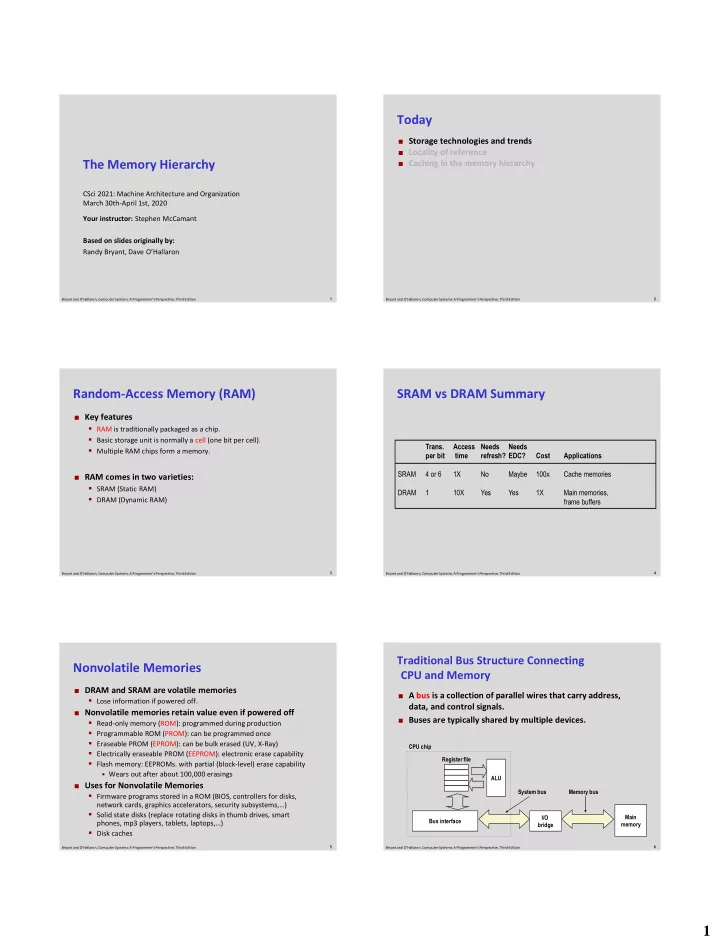
Traditional Bus Structure Connecting CPU and Memory

 A bus is a collection of parallel wires that carry address,

data, and control signals.

 Buses are typically shared by multiple devices. Main memory I/O bridge Bus interface ALU Register file CPU chip

System bus Memory bus

slide-2
SLIDE 2

2

7 Bryant and O’Hallaron, Computer Systems: A Programmer’s Perspective, Third Edition

Memory Read Transaction (1)

 CPU places address A on the memory bus. ALU Register file Bus interface A A x Main memory I/O bridge %rax Load operation: movq A, %rax

8 Bryant and O’Hallaron, Computer Systems: A Programmer’s Perspective, Third Edition

Memory Read Transaction (2)

 Main memory reads A from the memory bus, retrieves

word x, and places it on the bus.

ALU Register file Bus interface x A

x

Main memory %rax I/O bridge Load operation: movq A, %rax

9 Bryant and O’Hallaron, Computer Systems: A Programmer’s Perspective, Third Edition

Memory Read Transaction (3)

 CPU read word x from the bus and copies it into register

%rax.

x

ALU Register file Bus interface

x

Main memory A %rax I/O bridge Load operation: movq A, %rax

10 Bryant and O’Hallaron, Computer Systems: A Programmer’s Perspective, Third Edition

Memory Write Transaction (1)

CPU places address A on bus. Main memory reads it and waits for the corresponding data word to arrive.

y

ALU Register file Bus interface A Main memory A %rax I/O bridge Store operation: movq %rax, A

11 Bryant and O’Hallaron, Computer Systems: A Programmer’s Perspective, Third Edition

Memory Write Transaction (2)

CPU places data word y on the bus.

y

ALU Register file Bus interface

y

Main memory A %rax I/O bridge Store operation: movq %rax, A

12 Bryant and O’Hallaron, Computer Systems: A Programmer’s Perspective, Third Edition

Memory Write Transaction (3)

Main memory reads data word y from the bus and stores it at address A.

y

ALU Register file Bus interface

y

main memory A %rax I/O bridge Store operation: movq %rax, A

slide-3
SLIDE 3

3

14 Bryant and O’Hallaron, Computer Systems: A Programmer’s Perspective, Third Edition

What’s Inside A Disk Drive?

Spindle Arm Actuator Platters Electronics (including a processor and memory!) SCSI connector

Image courtesy of Seagate Technology

15 Bryant and O’Hallaron, Computer Systems: A Programmer’s Perspective, Third Edition

Disk Geometry

 Disks consist of platters, each with two surfaces.  Each surface consists of concentric rings called tracks.  Each track consists of sectors separated by gaps. Spindle Surface Tracks Track k

Sectors Gaps

16 Bryant and O’Hallaron, Computer Systems: A Programmer’s Perspective, Third Edition

Disk Geometry (Muliple-Platter View)

Aligned tracks form a cylinder.

Surface 0 Surface 1 Surface 2 Surface 3 Surface 4 Surface 5 Cylinder k Spindle Platter 0 Platter 1 Platter 2

17 Bryant and O’Hallaron, Computer Systems: A Programmer’s Perspective, Third Edition

Disk Capacity

 Capacity: maximum number of bits that can be stored.

  • Vendors express capacity in units of gigabytes (GB), where

1 GB = 109 Bytes.

 Capacity is determined by these technology factors:

  • Recording density (bits/in): number of bits that can be squeezed

into a 1 inch segment of a track.

  • Track density (tracks/in): number of tracks that can be squeezed

into a 1 inch radial segment.

  • Areal density (bits/in2): product of recording and track density.

18 Bryant and O’Hallaron, Computer Systems: A Programmer’s Perspective, Third Edition

Recording zones

 Modern disks partition tracks

into disjoint subsets called recording zones

  • Each track in a zone has the same

number of sectors, determined by the circumference of innermost track.

  • Each zone has a different number
  • f sectors/track, outer zones

have more sectors/track than inner zones.

  • So we use average number of

sectors/track when computing capacity.

Spindle

19 Bryant and O’Hallaron, Computer Systems: A Programmer’s Perspective, Third Edition

Computing Disk Capacity

Capacity = (# bytes/sector) x (avg. # sectors/track) x (# tracks/surface) x (# surfaces/platter) x (# platters/disk) Example:

  • 512 bytes/sector
  • 300 sectors/track (on average)
  • 20,000 tracks/surface
  • 2 surfaces/platter
  • 5 platters/disk

Capacity = 512 x 300 x 20000 x 2 x 5 = 30,720,000,000 = 30.72 GB

slide-4
SLIDE 4

4

20 Bryant and O’Hallaron, Computer Systems: A Programmer’s Perspective, Third Edition

Disk Operation (Single-Platter View)

The disk surface spins at a fixed rotational rate By moving radially, the arm can position the read/write head over any track. The read/write head is attached to the end

  • f the arm and flies over

the disk surface on a thin cushion of air. spindle spindle spindle spindle spindle

21 Bryant and O’Hallaron, Computer Systems: A Programmer’s Perspective, Third Edition

Disk Operation (Multi-Platter View)

Arm Read/write heads move in unison from cylinder to cylinder Spindle

22 Bryant and O’Hallaron, Computer Systems: A Programmer’s Perspective, Third Edition

Tracks divided into sectors

Disk Structure - top view of single platter

Surface organized into tracks

23 Bryant and O’Hallaron, Computer Systems: A Programmer’s Perspective, Third Edition

Disk Access

Head in position above a track

24 Bryant and O’Hallaron, Computer Systems: A Programmer’s Perspective, Third Edition

Disk Access

Rotation is counter-clockwise

25 Bryant and O’Hallaron, Computer Systems: A Programmer’s Perspective, Third Edition

Disk Access – Read

About to read blue sector

slide-5
SLIDE 5

5

26 Bryant and O’Hallaron, Computer Systems: A Programmer’s Perspective, Third Edition

Disk Access – Read

After BLUE read

After reading blue sector

27 Bryant and O’Hallaron, Computer Systems: A Programmer’s Perspective, Third Edition

Disk Access – Read

After BLUE read

Red request scheduled next

28 Bryant and O’Hallaron, Computer Systems: A Programmer’s Perspective, Third Edition

Disk Access – Seek

After BLUE read Seek for RED

Seek to red’s track

29 Bryant and O’Hallaron, Computer Systems: A Programmer’s Perspective, Third Edition

Disk Access – Rotational Latency

After BLUE read Seek for RED Rotational latency

Wait for red sector to rotate around

30 Bryant and O’Hallaron, Computer Systems: A Programmer’s Perspective, Third Edition

Disk Access – Read

After BLUE read Seek for RED Rotational latency After RED read

Complete read of red

31 Bryant and O’Hallaron, Computer Systems: A Programmer’s Perspective, Third Edition

Disk Access – Service Time Components

After BLUE read Seek for RED Rotational latency After RED read

Data transfer Seek Rotational latency Data transfer

slide-6
SLIDE 6

6

32 Bryant and O’Hallaron, Computer Systems: A Programmer’s Perspective, Third Edition

Disk Access Time

 Average time to access some target sector approximated by :

  • Taccess = Tavg seek + Tavg rotation + Tavg transfer

 Seek time (Tavg seek)

  • Time to position heads over cylinder containing target sector.
  • Typical Tavg seek is 3—9 ms

 Rotational latency (Tavg rotation)

  • Time waiting for first bit of target sector to pass under r/w head.
  • Tavg rotation = 1/2 x 1/RPMs x 60 sec/1 min
  • Typical Tavg rotation = 7200 RPMs

 Transfer time (Tavg transfer)

  • Time to read the bits in the target sector.
  • Tavg transfer = 1/RPM x 1/(avg # sectors/track) x 60 secs/1 min.

33 Bryant and O’Hallaron, Computer Systems: A Programmer’s Perspective, Third Edition

Disk Access Time Example

 Given:

  • Rotational rate = 7,200 RPM
  • Average seek time = 9 ms.
  • Avg # sectors/track = 400.

 Derived:

  • Tavg rotation = 1/2 x (60 secs/7200 RPM) x 1000 ms/sec = 4 ms.
  • Tavg transfer = 60/7200 RPM x 1/400 secs/track x 1000 ms/sec = 0.02 ms
  • Taccess = 9 ms + 4 ms + 0.02 ms

 Important points:

  • Access time dominated by seek time and rotational latency.
  • First bit in a sector is the most expensive, the rest are free.
  • SRAM access time is about 4 ns/doubleword, DRAM about 60 ns
  • Disk is about 40,000 times slower than SRAM,
  • 2,500 times slower then DRAM.

34 Bryant and O’Hallaron, Computer Systems: A Programmer’s Perspective, Third Edition

Logical Disk Blocks

 Modern disks present a simpler abstract view of the

complex sector geometry:

  • The set of available sectors is modeled as a sequence of b-sized

logical blocks (0, 1, 2, ...)

 Mapping between logical blocks and actual (physical)

sectors

  • Maintained by hardware/firmware device called disk controller.
  • Converts requests for logical blocks into (surface,track,sector)

triples.

 Allows controller to set aside spare cylinders for each

zone.

  • Accounts for the difference in “formatted capacity” and “maximum

capacity”.

35 Bryant and O’Hallaron, Computer Systems: A Programmer’s Perspective, Third Edition

I/O Bus

Main memory I/O bridge Bus interface ALU Register file CPU chip System bus Memory bus Disk controller Graphics adapter USB controller Mouse Keyboard Monitor Disk I/O bus Expansion slots for

  • ther devices such

as network adapters.

36 Bryant and O’Hallaron, Computer Systems: A Programmer’s Perspective, Third Edition

Reading a Disk Sector (1)

Main memory ALU Register file CPU chip Disk controller Graphics adapter USB controller mouse keyboard Monitor Disk I/O bus Bus interface

CPU initiates a disk read by writing a command, logical block number, and destination memory address to a port (address) associated with disk controller.

37 Bryant and O’Hallaron, Computer Systems: A Programmer’s Perspective, Third Edition

Reading a Disk Sector (2)

Main memory ALU Register file CPU chip Disk controller Graphics adapter USB controller Mouse Keyboard Monitor Disk I/O bus Bus interface

Disk controller reads the sector and performs a direct memory access (DMA) transfer into main memory.

slide-7
SLIDE 7

7

38 Bryant and O’Hallaron, Computer Systems: A Programmer’s Perspective, Third Edition

Reading a Disk Sector (3)

Main memory ALU Register file CPU chip Disk controller Graphics adapter USB controller Mouse Keyboard Monitor Disk I/O bus Bus interface

When the DMA transfer completes, the disk controller notifies the CPU with an interrupt (i.e., asserts a special “interrupt” pin on the CPU)

39 Bryant and O’Hallaron, Computer Systems: A Programmer’s Perspective, Third Edition

Solid State Disks (SSDs)

 Pages: 512B to 4KB, Blocks: 32 to 128 pages  Data read/written in units of pages.  Page can be written only after its block has been erased  A block wears out after about 100,000 repeated writes.

Flash translation layer I/O bus

Page 0 Page 1 Page P-1

Block 0

Page 0 Page 1 Page P-1

Block B-1 Flash memory Solid State Disk (SSD)

Requests to read and write logical disk blocks

40 Bryant and O’Hallaron, Computer Systems: A Programmer’s Perspective, Third Edition

SSD Performance Characteristics

 Sequential access faster than random access

  • Common theme in the memory hierarchy

 Random writes are somewhat slower

  • Erasing a block takes a long time (~1 ms)
  • Modifying a block page requires all other pages to be copied to

new block

  • In earlier SSDs, the read/write gap was much larger.

Sequential read tput 550 MB/s Sequential write tput 470 MB/s Random read tput 365 MB/s Random write tput 303 MB/s Avg seq read time 50 us Avg seq write time 60 us

Source: Intel SSD 730 product specification.

41 Bryant and O’Hallaron, Computer Systems: A Programmer’s Perspective, Third Edition

SSD Tradeoffs vs Rotating Disks

 Advantages

  • No moving parts  faster, less power, more rugged

 Disadvantages

  • Have the potential to wear out
  • Mitigated by “wear leveling logic” in flash translation layer
  • E.g. Intel SSD 730 guarantees 128 petabyte (128 x 1015 bytes) of

writes before they wear out

  • In 2015, about 30 times more expensive per byte

 Applications

  • MP3 players, smart phones, laptops
  • Beginning to appear in desktops and servers

42 Bryant and O’Hallaron, Computer Systems: A Programmer’s Perspective, Third Edition

The CPU-Memory Gap

The gap between DRAM, disk, and CPU speeds.

0.0 0.1 1.0 10.0 100.0 1,000.0 10,000.0 100,000.0 1,000,000.0 10,000,000.0 100,000,000.0 1985 1990 1995 2000 2003 2005 2010 2015 Time (ns) Year Disk seek time SSD access time DRAM access time SRAM access time CPU cycle time Effective CPU cycle time

DRAM CPU SSD Disk

43 Bryant and O’Hallaron, Computer Systems: A Programmer’s Perspective, Third Edition

Locality to the Rescue!

The key to bridging this CPU-Memory gap is a fundamental property of computer programs known as locality

slide-8
SLIDE 8

8

44 Bryant and O’Hallaron, Computer Systems: A Programmer’s Perspective, Third Edition

Today

 Storage technologies and trends  Locality of reference  Caching in the memory hierarchy

45 Bryant and O’Hallaron, Computer Systems: A Programmer’s Perspective, Third Edition

Locality

 Principle of Locality: Programs tend to use data and

instructions with addresses near or equal to those they have used recently

 Temporal locality:

  • Recently referenced items are likely

to be referenced again in the near future

 Spatial locality:

  • Items with nearby addresses tend

to be referenced close together in time

46 Bryant and O’Hallaron, Computer Systems: A Programmer’s Perspective, Third Edition

Locality Example

 Data references

  • Reference array elements in succession

(stride-1 reference pattern).

  • Reference variable sum each iteration.

 Instruction references

  • Reference instructions in sequence.
  • Cycle through loop repeatedly.

sum = 0; for (i = 0; i < n; i++) sum += a[i]; return sum;

Spatial locality Temporal locality Spatial locality Temporal locality

47 Bryant and O’Hallaron, Computer Systems: A Programmer’s Perspective, Third Edition

Qualitative Estimates of Locality

 Claim: Being able to look at code and get a qualitative

sense of its locality is a key skill for a professional programmer.

 Question: Does this function have good locality with

respect to array a?

int sum_array_rows(int a[M][N]) { int i, j, sum = 0; for (i = 0; i < M; i++) for (j = 0; j < N; j++) sum += a[i][j]; return sum; }

48 Bryant and O’Hallaron, Computer Systems: A Programmer’s Perspective, Third Edition

Locality Example

 Question: Does this function have good locality with

respect to array a?

int sum_array_cols(int a[M][N]) { int i, j, sum = 0; for (j = 0; j < N; j++) for (i = 0; i < M; i++) sum += a[i][j]; return sum; }

49 Bryant and O’Hallaron, Computer Systems: A Programmer’s Perspective, Third Edition

Locality Example

 Question: Can you permute the loops so that the function

scans the 3-d array a with a stride-1 reference pattern (and thus has good spatial locality)?

int sum_array_3d(int a[M][N][N]) { int i, j, k, sum = 0; for (i = 0; i < M; i++) for (j = 0; j < N; j++) for (k = 0; k < N; k++) sum += a[k][i][j]; return sum; }

slide-9
SLIDE 9

9

50 Bryant and O’Hallaron, Computer Systems: A Programmer’s Perspective, Third Edition

Memory Hierarchies

 Some fundamental and enduring properties of hardware

and software:

  • Fast storage technologies cost more per byte, have less capacity,

and require more power (heat!).

  • The gap between CPU and main memory speed is widening.
  • Well-written programs tend to exhibit good locality.

 These fundamental properties complement each other

beautifully.

 They suggest an approach for organizing memory and

storage systems known as a memory hierarchy.

51 Bryant and O’Hallaron, Computer Systems: A Programmer’s Perspective, Third Edition

Today

 Storage technologies and trends  Locality of reference  Caching in the memory hierarchy

52 Bryant and O’Hallaron, Computer Systems: A Programmer’s Perspective, Third Edition

Example Memory Hierarchy

Regs L1 cache (SRAM) Main memory (DRAM) Local secondary storage (local disks)

Larger, slower, and cheaper (per byte) storage devices

Remote secondary storage (e.g., Web servers)

Local disks hold files retrieved from disks

  • n remote servers

L2 cache (SRAM)

L1 cache holds cache lines retrieved from the L2 cache. CPU registers hold words retrieved from the L1 cache. L2 cache holds cache lines retrieved from L3 cache

L0: L1: L2: L3: L4: L5:

Smaller, faster, and costlier (per byte) storage devices

L3 cache (SRAM)

L3 cache holds cache lines retrieved from main memory.

L6:

Main memory holds disk blocks retrieved from local disks.

53 Bryant and O’Hallaron, Computer Systems: A Programmer’s Perspective, Third Edition

Caches

 Cache: A smaller, faster storage device that acts as a staging

area for a subset of the data in a larger, slower device.

 Fundamental idea of a memory hierarchy:

  • For each k, the faster, smaller device at level k serves as a cache for the

larger, slower device at level k+1.

 Why do memory hierarchies work?

  • Because of locality, programs tend to access the data at level k more
  • ften than they access the data at level k+1.
  • Thus, the storage at level k+1 can be slower, and thus larger and

cheaper per bit.

 Big Idea: The memory hierarchy creates a large pool of

storage that costs as much as the cheap storage near the bottom, but that serves data to programs at the rate of the fast storage near the top.

54 Bryant and O’Hallaron, Computer Systems: A Programmer’s Perspective, Third Edition

General Cache Concepts

1 2 3 4 5 6 7 8 9 10 11 12 13 14 15 8 9 14 3

Cache Memory

Larger, slower, cheaper memory viewed as partitioned into “blocks” Data is copied in block-sized transfer units Smaller, faster, more expensive memory caches a subset of the blocks

4 4 4 10 10 10

55 Bryant and O’Hallaron, Computer Systems: A Programmer’s Perspective, Third Edition

General Cache Concepts: Hit

1 2 3 4 5 6 7 8 9 10 11 12 13 14 15 8 9 14 3

Cache Memory

Data in block b is needed

Request: 14

14

Block b is in cache: Hit!

slide-10
SLIDE 10

10

56 Bryant and O’Hallaron, Computer Systems: A Programmer’s Perspective, Third Edition

General Cache Concepts: Miss

1 2 3 4 5 6 7 8 9 10 11 12 13 14 15 8 9 14 3

Cache Memory

Data in block b is needed

Request: 12

Block b is not in cache: Miss! Block b is fetched from memory

Request: 12

12 12 12

Block b is stored in cache

  • Placement policy:

determines where b goes

  • Replacement policy:

determines which block gets evicted (victim)

57 Bryant and O’Hallaron, Computer Systems: A Programmer’s Perspective, Third Edition

General Caching Concepts: Types of Cache Misses

 Cold (compulsory) miss

  • Cold misses occur because the cache is empty.

 Conflict miss

  • Most caches limit blocks at level k+1 to a small subset (sometimes a

singleton) of the block positions at level k.

  • E.g. Block i at level k+1 must be placed in block (i mod 4) at level k.
  • Conflict misses occur when the level k cache is large enough, but multiple

data objects all map to the same level k block.

  • E.g. Referencing blocks 0, 8, 0, 8, 0, 8, ... would miss every time.

 Capacity miss

  • Occurs when the set of active cache blocks (working set) is larger than

the cache.

58 Bryant and O’Hallaron, Computer Systems: A Programmer’s Perspective, Third Edition

Examples of Caching in the Mem. Hierarchy

Hardware MMU On-Chip TLB Address translations TLB Web browser 10,000,000 Local disk Web pages Browser cache Web cache Network buffer cache Buffer cache Virtual Memory L2 cache L1 cache Registers

Cache Type

Web pages Parts of files Parts of files 4-KB pages 64-byte blocks 64-byte blocks 4-8 bytes words

What is Cached?

Web proxy server 1,000,000,000 Remote server disks OS 100 Main memory Hardware 4 On-Chip L1 Hardware 10 On-Chip L2 NFS client 10,000,000 Local disk Hardware + OS 100 Main memory Compiler CPU core

Managed By Latency (cycles) Where is it Cached?

Disk cache Disk sectors Disk controller 100,000 Disk firmware

59 Bryant and O’Hallaron, Computer Systems: A Programmer’s Perspective, Third Edition

Summary

 The speed gap between CPU, memory and mass storage

continues to widen.

 Well-written programs exhibit a property called locality.  Memory hierarchies based on caching close the gap by

exploiting locality.