1 Investment and Policy Clusters What Role is Bioengineering - - PDF document

1
SMART_READER_LITE
LIVE PREVIEW

1 Investment and Policy Clusters What Role is Bioengineering - - PDF document

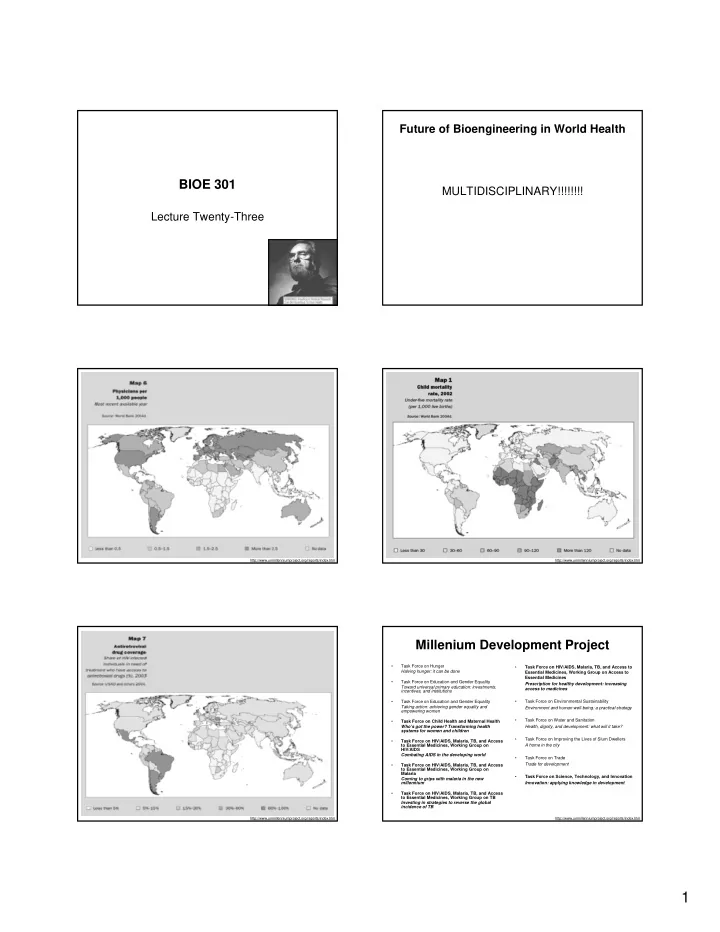
Future of Bioengineering in World Health BIOE 301 MULTIDISCIPLINARY!!!!!!!! Lecture Twenty-Three http://www.unmillenniumproject.org/reports/index.htm http://www.unmillenniumproject.org/reports/index.htm Millenium Development Project Task


slide-1
SLIDE 1

1

BIOE 301

Lecture Twenty-Three Future of Bioengineering in World Health MULTIDISCIPLINARY!!!!!!!!

http://www.unmillenniumproject.org/reports/index.htm http://www.unmillenniumproject.org/reports/index.htm http://www.unmillenniumproject.org/reports/index.htm

Millenium Development Project

  • Task Force on Hunger

Halving hunger: it can be done

  • Task Force on Education and Gender Equality

Toward universal primary education: investments, incentives, and institutions

  • Task Force on Education and Gender Equality

Taking action: achieving gender equality and empowering women

  • Task Force on Child Health and Maternal Health

Who’s got the power? Transforming health systems for women and children

  • Task Force on HIV/AIDS, Malaria, TB, and Access

to Essential Medicines, Working Group on HIV/AIDS Combating AIDS in the developing world

  • Task Force on HIV/AIDS, Malaria, TB, and Access

to Essential Medicines, Working Group on Malaria Coming to grips with malaria in the new millennium

  • Task Force on HIV/AIDS, Malaria, TB, and Access

to Essential Medicines, Working Group on TB Investing in strategies to reverse the global incidence of TB

http://www.unmillenniumproject.org/reports/index.htm

  • Task Force on HIV/AIDS, Malaria, TB, and Access to

Essential Medicines, Working Group on Access to Essential Medicines Prescription for healthy development: increasing access to medicines

  • Task Force on Environmental Sustainability

Environment and human well-being: a practical strategy

  • Task Force on Water and Sanitation

Health, dignity, and development: what will it take?

  • Task Force on Improving the Lives of Slum Dwellers

A home in the city

  • Task Force on Trade

Trade for development

  • Task Force on Science, Technology, and Innovation

Innovation: applying knowledge in development

slide-2
SLIDE 2

2

Investment and Policy Clusters

  • Health systems: ensuring universal access to essential services

– Best provided through an integrated district health system centered on primary care and first-level referral hospitals – Practical investments and policies for a functioning health system include

  • training and retaining competent, motivated health workers
  • strengthening management systems
  • providing adequate supplies of essential drugs
  • building clinics and laboratory facilities
  • Science, technology, and innovation: building national capacities

– Creating science advisory bodies to the national government – Expanding science and engineering faculties in universities and polytechnics – Strengthening development and entrepreneurial focus in science and technology curricula – Promoting business opportunities in science and technology – Promoting infrastructure development as a technology learning process

http://www.unmillenniumproject.org/reports/index.htm

What Role is Bioengineering Playing?

  • Biotechnology has emerged as one of the

methods to address health and other challenges in developing world

– Molecular diagnostics – Recombinant vaccines – Vaccine and drug delivery – Bioremediation – Bioinformatics – Nutritionally enriched genetically modified crops

Lancet 2005; 365: 1105-07. Nature 7101 (442), 27 July 2006 p 329-484

Need for Innovative Diagnostic Platforms for these Diseases

  • Initial funding by Bill and Melinda Gates

Foundation

  • 4 common central laboratory techniques

– Blood chemistry – Immunoassays – Nucleic-acid amplification – Flow cytometry

  • However, central laboratory model not

applicable to the developing world!

Nature 7101 (442), 27 July 2006 p 329-484

Benefits of POC Diagnostics

  • Access to diagnostic tools previously

unavailable

  • Faster and more accurate
  • Better epidemiological data for disease

modeling

  • Define economics of a healthcare system
  • Better utilization of minimally trained

personnel

  • Better use of existing therapeutics

Nature 7101 (442), 27 July 2006 p 329-484

Lateral Flow or Immunochromatographic Strip

  • Clin. Vaccine Immunol. Biagini et al. 13 (5): 541
slide-3
SLIDE 3

3

Some ICS Available Tests

  • Diphtheria
  • STI’s

– Gonorrhea – Syphilis – Chancroid – Chlamydia

  • Vitamin A deficiency
  • P. Falciparum malaria
  • HIV
  • Hepatitis B
  • Pregnancy
  • Fecal leukocytes
  • Proteinuria

Nature 7101 (442), 27 July 2006 p 329-484

Microfluidic Diagnostics

Nature 7101 (442), 27 July 2006 p 329-484

Discuss the article you read, Application of Microchip Assay System for the Measurement of C-reactive Protein in Human Saliva, Lab Chip. 2005, 5, 261-269.

  • What is the biggest advantage of this

platform for the developing world?

  • What was the most convincing piece of

data presented for the ETC platform?

DALYs Saved with New Diagnostics

Nature S1, 23 November 2006

Requirements of New Diagnostic Techniques

Nature S1, 23 November 2006

Lastly, but Certainly not Least…

  • Don’t forget the larger issues

– Social – Economic – Political – Ethical

slide-4
SLIDE 4

4

For More Detailed Discussion

  • http://www.unmillenniumproject.org/reports/inde

x.htm

  • Nature 7101 (442), 27 July 2006 p 329-484
  • Nature S1, 23 November 2006

Exam Review

For the Developing world, order the following problems from the greatest to least cause of mortality in the age range 0-4 yrs.

  • Malaria
  • Perinatal conditions
  • Diarrheal diseases
  • Lower respiratory infections

Leading causes of mortality: ages 0-4

  • Developing world
  • 1. Perinatal conditions
  • 2. Lower respiratory infections
  • 3. Diarrheal diseases
  • 4. Malaria
  • Developed world
  • 1. Perinatal conditions
  • 2. Congenital anomalies
  • 3. Lower respiratory infections
  • 4. Unintentional injuries

Back in January, you heard the story of a young woman from rural Haiti who died from AIDS-related opportunistic infections. She was at-risk for dying from AIDS long before she met the man who gave her the

  • virus. In other words, she was a victim of

“structural violence.” Define structural violence, and list its components.

What are the major health problems worldwide?

Geoff Preidis MD/PhD candidate, BCM preidis@post.harvard.edu

slide-5
SLIDE 5

5

Structural Violence

  • Non-physical violence imposed by the

powerful upon the weak, which structures the victim’s living situation such that his/her choices in life are limited. – Poverty – Gender – Education – Racism – And many others…

Lecture 5 & 6 Review

  • In which health system does the market

have the least influence?

  • Which health system is most associated

with low income developing nations?

  • Developed vs developing world: which has

the highest % out of pocket expenses? Welfare Developing world leads to poverty! None- health systems reflect cultural, political & economic values

  • Name 4 reasons for increasing health care costs in the US:

Lecture 5 & 6 Review

  • Which of the following did NOT contribute to the Oregon plan:

a. Increased use of managed care plans b. Increased tax revenues c. Individual mandate to obtain health insurance d. Community value decisions

  • In what ways does technology actually DECREASE health care

costs:

  • 1. Aging population
  • 2. Increased technology use
  • 3. Prescription drug costs
  • 4. Administrative burden
  • 1. Increased outpatient procedures
  • 2. Longer productive life spans
  • c. Associated with the Massachusetts plan

List the steps in the engineering design method in the proper order.

– Evaluate solutions – Communicate results – Develop solutions – Identify a need – Define the problem (goals, constraints) – Gather information

Engineering Design Method

  • Fashioning a product made for a practical

goal in the presence of constraints

  • Six design steps:
  • 1. Identify a need
  • 2. Define the problem (goals, constraints)
  • 3. Gather information
  • 4. Develop solutions
  • 5. Evaluate solutions
  • 6. Communicate results
  • Papers, patents, marketing

Refine Design SPECS FMEA

Review: Pathogens and the Immune System

  • How does the innate immune system

defend against bacteria on a rusty nail?

  • How does the adaptive immune system

defend against the flu virus?

slide-6
SLIDE 6

6

Bacteria vs. Innate immune system

  • Produces general response when

pathogens pass physical barriers

  • Macrophages and other professional

phagocytes

– Kill invaders – Signal other immune cells – Present antigen to adaptive immune system

  • Complement proteins

– Attach to and tag pathogens for destruction – Recruit more immune cells Flu virus vs. Adaptive immune system

  • Antibody-mediated

– Antigen forms bridge between pathogen and killer cells and phagocytes

  • Cell-mediated

– Upon first exposure and infection, body builds up “memory” of immune cells – Memory B and T cells recognize pathogen, rapidly clone

  • T cells – helper or killer
  • B cells – produce more antibodies

What is this centrally located sub- Saharan country in Africa w here 1 million people are living w ith HIV?

DEMO DEMOCRATIC CRATIC REP REPUBLIC BLIC OF C OF CONGO NGO You are seeing the results of five Western blots. Person 1 has HIV. Person 3 does

  • not. Does person

5 have HIV? Person 2 does, but w e cannot say for Person 4 and 5. P24 is positive, But p17 and gp120 are negative.

What are the two major challenges for biomarker based cancer screening?

  • Cost of the test
  • Lack of instrumentation
  • Improper validation due to small clinical trials
  • Variability among Patient’s
  • Lack of complete understanding of

pathophysiology

  • Late stage biomarkers dominate

Answer

  • Lack of complete understanding of

pathophysiology limits the discovery of early biomarkers, and with our models and tools we are very biased towards late stages of the disease

  • The other factors such as cost, patient’s

variability are also important factors but not the most significant ones

slide-7
SLIDE 7

7

Arrange the following physiological changes in cancer development, starting with the earliest changes to late stage of the disease

  • Blood vessels
  • Increase in size of nuclei
  • Mutation/ Mutations
  • Chromosomal changes
  • Metastasis
  • Overexpression of growth receptors

Answer

  • Mutations
  • Growth factor overexpression
  • Chromosomal Alterations
  • Increase in size of nuclei
  • Blood Vessel- Angiogenesis
  • Metastasis

Question

The inner layer of heart muscle is known as the A) Endocardium B) Epicardium C) Myocardium

Answer

The inner layer of heart muscle is known as the A) Endocardium

In the heart, the endocardium is the innermost layer of tissue that lines the chambers of the heart. Its cells, embryologically and biologically, are similar to the endothelial cells that line blood vessels. The endocardium overlies the much more voluminous myocardium, the muscular tissue responsible for the contraction of the heart. The outer layer of the heart is termed epicardium and the heart is surrounded by a small amount of fluid enclosed by a fibrous sac called the pericardium.

Drug Eluting Stent – Sample Size

  • Treatment group:

– Receive stent

  • Control group:

– Get angioplasty

  • Primary Outcome:

– 1 year restenosis rate

  • Expected Outcomes:

– Stent: 10% – Angioplasty: 45%

  • Error rates:

– p = .05 – Beta = 0.2 – Standardized difference = 0.784

Drug Eluting Stent – Sample Size

Expected Outcomes:

Stent: 10% Angioplasty: 45% Standardized difference = 0.784

Error rates:

p = .05 Beta = 0.2

Question: what is the sample size and patients in each arm?

  • a. Sample size 55 patients; 55 in each

arm.

  • b. Sample size 23 patients; 23 in each

arm.

  • c. Sample size 55 patients; 23 in each

arm.

  • d. Sample size 23 patients; 55 in each

arm.

slide-8
SLIDE 8

8

Drug Eluting Stent – Sample Size

  • Connect

Standardized difference 0.784 and power 0.8

  • Sample size is

roughly 55 patients

  • So 23 patients in

each arm/group

  • Medical device classes were established

by the device amendments to the FD&C

  • Act. Which class of medical device does

the following describe?

  • Not life sustaining, but must meet performance standards
  • Examples include blood pressure monitors, guide wires
  • Includes 60% of devices
  • A. Class I
  • B. Class II
  • C. Class III
  • D. Class IV

Class II