1 3/31/2020 Submitting Questions Webinar platform Type and submit - - PDF document

1
SMART_READER_LITE
LIVE PREVIEW

1 3/31/2020 Submitting Questions Webinar platform Type and submit - - PDF document

3/31/2020 Essential AND Functional: The Importance of Essential Job Functions for Disability Law Compliance and Inclusion Session will begin at 2 pm ET Audio and visual are provided through the on-line webinar system. This session is closed


slide-1
SLIDE 1

3/31/2020 1

Essential AND Functional: The Importance of Essential Job Functions for Disability Law Compliance and Inclusion

Session will begin at 2 pm ET Audio and visual are provided through the on-line webinar system. This session is closed captioned. Individuals may also listen via telephone: 1-857-232-0476 Access Code: 368564 This is not a toll-free number.

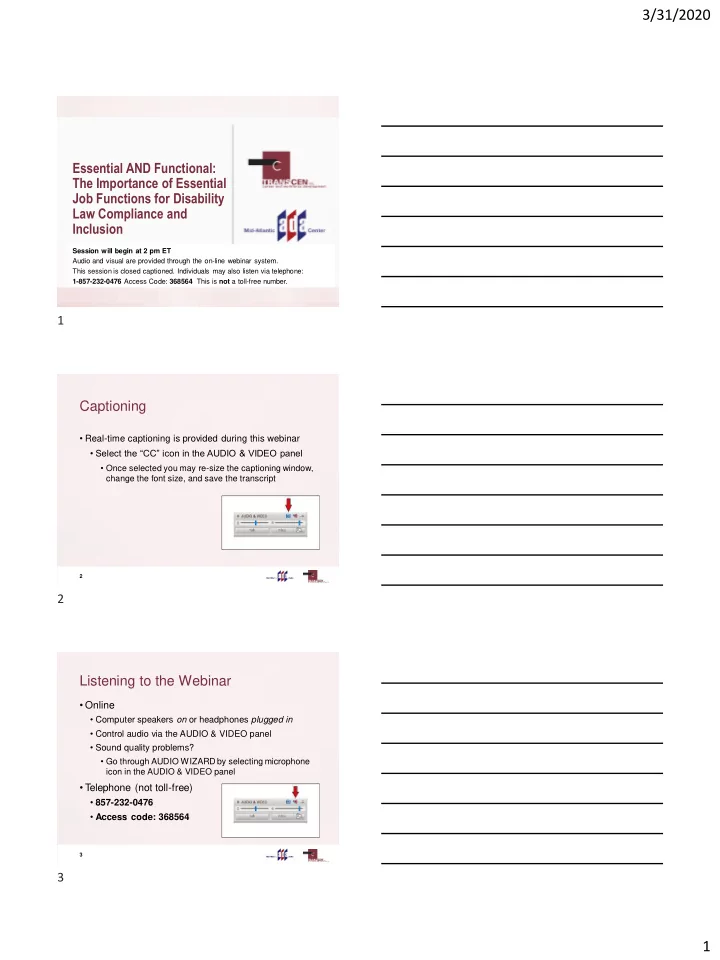
Captioning

  • Real-time captioning is provided during this webinar
  • Select the “CC” icon in the AUDIO & VIDEO panel
  • Once selected you may re-size the captioning window,

change the font size, and save the transcript

2

Listening to the Webinar

  • Online
  • Computer speakers on or headphones plugged in
  • Control audio via the AUDIO & VIDEO panel
  • Sound quality problems?
  • Go through AUDIO WIZARD by selecting microphone

icon in the AUDIO & VIDEO panel

  • Telephone (not toll-free)
  • 857-232-0476
  • Access code: 368564

3

1 2 3

slide-2
SLIDE 2

3/31/2020 2

Submitting Questions

  • Webinar platform
  • Type and submit questions in

the CHAT area text box

  • Your questions and comments

will only be visible to session moderators

  • Mobile device
  • CHAT area within the app
  • Email

ADAtraining@transcen.org

4

Technical Difficulties?

  • CHAT box
  • E-mail ADAtraining@transcen.org
  • Call 301-217-0124

5

Archive

  • This webinar is being recorded
  • You will receive an email about how to

access the archive when it becomes available

6

4 5 6

slide-3
SLIDE 3

3/31/2020 3

Certificates and Credits

  • Certificates of participation or credits can only be

given to those who submitted required payment along with registration for this session

  • Listen for the CODE announced at the end of

the session

  • After we confirm your attendance, we will provide

the certificate of participation or the appropriate credit

7

About Your Hosts…

  • TransCen, Inc.
  • Improving the lives of people with disabilities through meaningful

work and community inclusion

  • Mid-Atlantic ADA Center, a project of TransCen, Inc.
  • Funded by National Institute on Disability, Independent Living,

and Rehabilitation Research (NIDILRR), Administration for Community Living, U.S. Department of Health and Human Services

8

Essential AND Functional:

The Importance of Essential Job Functions for Disability Law Compliance and Inclusion

Jana Burke, PhD, ADAC Mariposa Professional Services

719/229-0629 jburkeinco@gmail.com

9

7 8 9

slide-4
SLIDE 4

3/31/2020 4

Learning Objectives/Agenda

  • Introduce ADA Title I employment provisions related to

essential and marginal job functions (EJFs and MJFs)

  • Understand the importance and utility of essential and

marginal job functions (EJFs and MJFs) for your

  • rganization’s disability law compliance and inclusion

activities

  • Discuss job analysis strategies for identifying job

functions

  • Evaluate common strategies for developing “ADA

compliant” job descriptions

10

An Overview of Essential Job Functions

11

Qualified Individual

  • Satisfies the skill, experience, education, and other

job-related requirements

  • Can perform the essential functions of the position

with or without reasonable accommodation

  • General rule: An employer is NOT required to hire
  • r retain an individual who is not qualified to

perform a job

12

10 11 12

slide-5
SLIDE 5

3/31/2020 5

Essential Functions

  • Fundamental job duties of the employment position
  • Does not include marginal or peripheral functions
  • ALL functions ≠ essential job functions
  • Specifies what needs to be done, not how

13

Example of Job Functions: Mail Clerk

  • Essential (what) – The mail clerk must process

incoming and outgoing mail for the company

  • Marginal (what) – The mail clerk also provides

back-up support to the office receptionist position when that person is on break, vacation, or out sick

  • Preferred skills (how) – Complete tasks by

managing priorities, self-motivating, and working well under deadlines

14

Example of Job Functions: Firefighter

  • Essential (what) - Respond to fire alarms, medical

emergencies, hazardous materials, urban rescue and other calls to protect life and property

  • Marginal (what) - Participate in fire station

housekeeping

  • Preferred skills (how) – Work under strict discipline,

remain calm in hazardous, high-stress situations

15

13 14 15

slide-6
SLIDE 6

3/31/2020 6

Quantifying EJFs

  • Permissible under the ADA as long as they are

ACTUALLY necessary and required for the position

  • Actually imposed on employees
  • Cannot adopt production levels that screen out or

tend to screen out candidates with disabilities

  • Example – Successfully complete 20 customer

service calls per hour

16

Functions are typically essential if…

  • The position exists for performance of the function
  • A limited number of employees can perform the

function and it, therefore, can’t be reassigned

  • The function is specialized and requires certain

expertise to perform it

17

Evidence of Essential

  • Employer’s judgment
  • Amount of time performing function
  • If infrequently performed, serious consequences if not

performed when needed

  • Terms of collective bargaining agreement
  • Other employees in same position
  • Nature of the work operation or organizational structure
  • Written job description

18

16 17 18

slide-7
SLIDE 7

3/31/2020 7

Why Identify EJFs?

  • Avoid inconsistent and unfair employment

decisions

  • Define positions
  • Ensure the employees understand what’s expected
  • f them
  • Help managers with performance management

19

EJF Best Practice

  • List the tasks of the positions and group tasks that are

related into major function areas

  • Put those major function areas in order of importance
  • Determine the percent of time spent on each major

function

  • “Other duties as assigned” is not a job function
  • Ask every candidate, “can you perform the essential

functions of the position, with or without reasonable accommodation?”

20

Job Requirements

21

19 20 21

slide-8
SLIDE 8

3/31/2020 8

Three Categories of Requirements

  • Summary of the position
  • Essential Job Functions
  • Job Specifications/Qualifications

22

Summary of the Position

  • Reason for or function of the position within the
  • rganization
  • What purpose does it serve?
  • What role does it fill?
  • How does it fit in with the rest of the operations of

the organization?

  • Can also include a brief overview of your
  • rganization

23

Examples – Position Summaries

  • Firefighter – Respond to fire alarms, medical emergencies,

hazardous materials, urban rescue and other calls to protect life and property; participates in fire prevention and training; and maintains the fire station and firefighting equipment.

  • Car sales associate - sells automobiles at car dealerships and

helps customers to find the right purchase for their needs.

  • Carpenter - Responsible for designing, building, installing, and

repairing structures, fixtures, furniture, and other items using different types of materials including wood and steel.

24

22 23 24

slide-9
SLIDE 9

3/31/2020 9

Essential Job Functions

  • May include performance standards that describe

HOW EJFs must be completed

  • Process – methods, techniques, procedures and/or

tools to complete the job

  • Time – how much time is allowed to perform a

function

  • Quantity – how often a function is performed
  • Quality – how success is measured

25

Examples - EJFs

  • Mail Clerk - Ensuring proper labeling and packaging for outgoing

post.

  • Firefighter - Respond to fire alarms with assigned company; lay

and connect hose; maintain pumping apparatus; hold nozzles and direct water streams; raise and climb ladders; ventilate burning structures; enter buildings to evacuate occupants.

  • Car Sales Associate - Communicate with customers via email,

telephone, and in person.

  • Carpenter - Utilize chisels, planes, saws, drills, and sanders to

repair and erect structures.

26

Job Specifications

  • Qualifications, skills, and abilities required to meet

the job descriptions

  • Educational criteria
  • Necessary certification/licensure requirements
  • Specialized knowledge or experience
  • Environmental, psychological, and/or physiological

requirements

27

25 26 27

slide-10
SLIDE 10

3/31/2020 10

Examples – Job Specifications

  • Mail Clerk - Proficiency with sorting machines.
  • Firefighter – Successful completion of the Fire

Academy.

  • Car Sales Associate - Strong customer service and

negotiation skills.

  • Carpenter – May work in cramped spaces and be

exposed to variable weather conditions.

28

The Role of Job Analysis

29

What is Job Analysis?

  • Strategic planning tool and investigative process of

gathering, examining, and interpreting data about a position’s tasks and responsibilities

  • Includes specifics about the work-site, workstation, and

activities

  • Results in detailed analysis of tasks and

responsibilities, risks and hazards, functions and duties, tools and equipment to be used

  • Identify expected output
  • Evaluation of the JOB, not the PERSON doing the job

30

28 29 30

slide-11
SLIDE 11

3/31/2020 11

Areas Typically Covered

  • Mental/physical tasks involved
  • How the job will be done including methods and

equipment/tools

  • Reason the job exists including job goals and how

they relate to other positions

  • Qualifications needed including training,

knowledge, skills, and personality traits

31

Activities Typically Involved

  • Tracking an employee’s duties
  • Duration of each task
  • Observing the employee performing his/her job
  • Interviewing the employee, manager, and others

who interact with the position

  • Comparing the job to other jobs in the same

department and job grade/family

32

Ideal Outcome of an Analysis

  • Thorough understanding of the EJFs
  • List of all duties and responsibilities
  • Percentage of time spent for each group of tasks
  • Knowledge, skills, and abilities needed to perform

the job

  • Conditions under which the work is completed

33

31 32 33

slide-12
SLIDE 12

3/31/2020 12

Analysis Best Practice

  • Have employees complete job analysis forms
  • Interview employees
  • Obtain log sheets from employees
  • Complete desk audits
  • Interview supervisors/managers and other

employees

  • Compare the position to other positions in the

department and other job grades/families

34

Job Descriptions

35

The Utility of Job Descriptions

  • ADA does not require employers to develop or maintain

job descriptions

  • That being said, job descriptions help employers:
  • Identify candidates that can perform the tasks of a

position

  • Determine salary ranges and levels or grades
  • Establish job titles
  • Create employees’ job goals and objectives
  • Conduct effective performance evaluations
  • Defend against possible disability discrimination charges

36

34 35 36

slide-13
SLIDE 13

3/31/2020 13

Job Description Basics

  • Objective listing of the job title, tasks, and

responsibilities involved in a job

  • BROAD statement of purpose, scope, duties, and

responsibilities

  • Use clear, concise, non-technical language
  • Avoid gender-specific language, jargon, technical

language, proprietary names, and ambiguity

  • Avoid language the screens out or tends to screen
  • ut individuals with disabilities

37

“ADA Compliant” Language

Job Demand “ADA Compliant” Words Stand or sit Stationary position Walk Move or traverse Use hands/fingers to handle or feel Operate, activate, use, prepare, inspect, detect, position Climb Ascend/descend, traverse Stoop, kneel, crouch, or crawl Position self (to), move Talk/hear Communicate, Convey, Express oneself, Exchange information See Detect, Perceive, Identify, Recognize, Observe, Inspect, Assess Carry, lift Transport, Move, Position, Put, Install

38

Job Description Contents

  • Job Title
  • Location
  • Department/section
  • Supervisor information
  • Objective
  • Principal duties and responsibilities – use the terms

essential and marginal functions

  • Special working conditions
  • Job specifications/qualifications

39

37 38 39

slide-14
SLIDE 14

3/31/2020 14

Job Description Best Practice

  • Keep your job descriptions up-to-date
  • Use job descriptions to attract candidates, not

weed out employees you don’t want

  • Distribute job descriptions to applicants and

employees

  • Maintain internal consistency
  • Include disclaimer language about possible

updates

40

Resources

Key organizations to visit with your questions

41

Certificates and Credits: Code

*****

  • Check the reminder email you received about this session for

instructions on obtaining a certificate of participation or credits for this webinar

  • Please email the code above to ADAtraining@transcen.org

by 5 PM E.T. on Monday, April 13, 2020.

42

40 41 42

slide-15
SLIDE 15

3/31/2020 15

ADA National Network

  • Ten regional centers provide guidance, training,

and materials on the ADA

  • 1-800-949-4232
  • www.ADAta.org

43

Key Organizations

  • Equal Employment Opportunity Commission

800/669-4000 (V) www.eeoc.gov

  • Department of Labor’s Office of Disability Employment Policy

www.dol.gov/odep/

  • Job Accommodation Network 800/526-7234 (V, TTY)

www.askjan.org

  • Cornell University Employment & Disability Institute

www.hrtips.org

  • Society for Human Resource Management (SHRM)

www.shrm.org

44

Jana Burke, PhD, ADAC President Mariposa Professional Services

719/229-0629 jburkeinco@gmail.com

45

43 44 45

slide-16
SLIDE 16

3/31/2020 16

Thank You!

Mid-Atlantic ADA Center TransCen, Inc. Toll-Free: 800-949-4232 (DC, DE, MD, PA, VA, WV) Local: 301-217-0124 ADAinfo@transcen.org www.ADAinfo.org

46

46