1 Suicides in old and new EU Member States: 2007=1 1.35 1.3 1.25 - - PDF document

1
SMART_READER_LITE
LIVE PREVIEW

1 Suicides in old and new EU Member States: 2007=1 1.35 1.3 1.25 - - PDF document

The health effects of a financial crisis: epidemiology on a large scale Martin McKee Hong Kong, August 2016 Twitter: @martinmckee What happened? GDP per capita (2007=1) 1.10 1.05 1.00 0.95 Germany What happened to health? United States


slide-1
SLIDE 1

1

Martin McKee Hong Kong, August 2016 Twitter: @martinmckee

The health effects of a financial crisis: epidemiology on a large scale

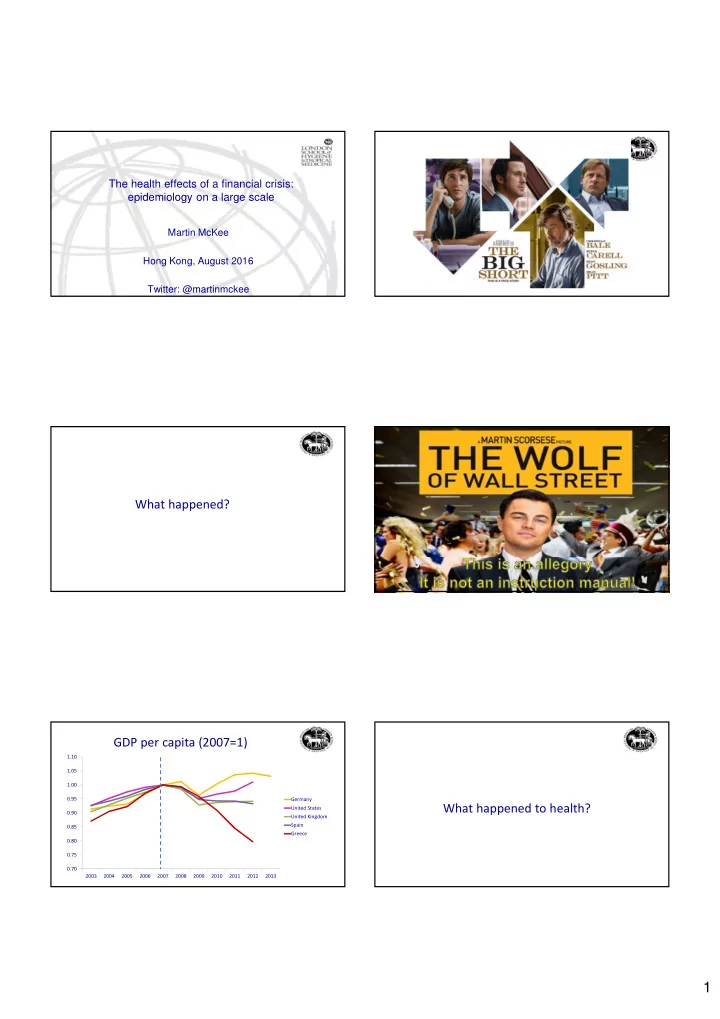
What happened? GDP per capita (2007=1)

0.70 0.75 0.80 0.85 0.90 0.95 1.00 1.05 1.10 2003 2004 2005 2006 2007 2008 2009 2010 2011 2012 2013 Germany United States United Kingdom Spain Greece

What happened to health?

slide-2
SLIDE 2

2

Suicides in old and new EU Member States: 2007=1

1 1.05 1.1 1.15 1.2 1.25 1.3 1.35 2000 2001 2002 2003 2004 2005 2006 2007 2008 2009 2010 2011 2012 2013 EU members before May 2004 EU members since May 2004

Deaths on the roads

5 10 15 20 25 30 2000 2001 2002 2003 2004 2005 2006 2007 2008 2009 2010 2011 2012 2013 deaths/100,000 Hungary Lithuania Netherlands

Suicides in England

  • Each 10% increase in the

number of unemployed men was significantly associated with a 1.4% (0.5% to 2.3%) increase in male suicides.

  • About two fifths of the recent

increase in suicides among men (increase of 329 suicides, 126 to 532) during the 2008-10 recession can be attributed to rising unemployment.

Barr B, Taylor-Robinson D, Scott-Samuel A, McKee M, Stuckler D. Suicides associated with the 2008-2010 recession in the UK: a time-trend analysis. BMJ 2012: 345 doi: 10.1136/bmj.e5142

“We estimate that the Great Recession is associated with at least 10,000 additional economic suicides between 2008 and 2010.”

Reeves A, McKee M, Stuckler D. The attack on Universal Health Coverage in Europe: recession, austerity, and unmet needs. Eur J Publ Health 2016

Reversal in long term decline in unmet need

Increase in unmet medical need in Portugal, by economic status, 2010 to 2012

slide-3
SLIDE 3

3

Pre-austerity Austerity

  • Health of all Greeks worsened

during austerity after 2010

  • However, impact of job loss on

chance of reporting worse health much greater during austerity

Epidemiological issues

  • Data availability & accuracy
  • Defining exposure

– What is a financial crisis or a recession?

  • Understanding causality in

complex situations

– Causal pathways – Time lags

  • Understanding effect modifiers

– What makes things worse – What makes things better

  • Natural experiments
  • Multi-disciplinarity
  • What is the treatment?

Data availability & accuracy A question of priorities

Country Last year of mortality data (June 2016) Iceland 2009 Ireland 2010 France 2011 Estonia 2011 Belgium 2012

  • Financial data

– Instantaneous

  • Mortality data

– Within the decade

Another source?

  • Cyclical trends in search activity

for suicide and depression- related terms, with peaks in autumn and winter months, and a trough in summer months

  • Significant association with

suicides among:

– 25-24 age group – 45-54 year old women

(older women tend to overdose so search for details, men tend to hang themselves)

Beware incentives to distort data

Benford’s Law on the distribution of the first significant digit in a collection of numerical data

0.05 0.1 0.15 0.2 0.25 0.3 0.35 1 2 3 4 5 6 7 8 9

P (d) d P(d) ≈ log10 ([d + 1]/d)

slide-4
SLIDE 4

4

Benford’s Law applied to EU 27 and Greek financial statistics

(average 133 observations/ country/ year)

0.05 0.1 0.15 0.2 0.25 0.3 0.35 1 2 3 4 5 6 7 8 9 P (d) d P(d) P(d) EU27 P(d) Greece Source: Rauch, Göttsche, Brähler, & Engel, 2011

Defining and interpreting exposure Recession: a definition

  • A rule of thumb....
  • “a decline in the

seasonally and calendar adjusted real gross domestic product (GDP) in at least two successive quarters”

Julius Shiskin, NY Times 1974

NBER definition

“a significant decline in [the] economic activity spread across the country, lasting more than a few months, normally visible in real GDP growth, real personal income, employment, industrial production, and wholesale-retail sales”

The need for a multidisciplinary approach Who is publishing? Different disciplines

  • Systematic search of

Web of Science for literature on recessions and health

  • 461 articles & 14,401

cited documents

  • Network analysis of co-

citation pattern by disciplines, journals and backgrounds of the authors

Stuckler D, Reeves A, Karanikolos M, McKee M. The health effects of the global financial crisis: can we reconcile the differing views? A network analysis of literature across disciplines. Health Econ Pol Law 2015; 10: 83-89.

slide-5
SLIDE 5

5

Few reading each other’s work

Economics Psychiatry Medicine Addiction Public health

Cause and effect A fair experiment

Population Control Intervention

Koch’s Postulates

  • The microorganism must be isolated

from a diseased organism and grown in pure culture.

  • The cultured microorganism should

cause disease when introduced into a healthy organism.

  • The microorganism must be reisolated

from the inoculated, diseased experimental host and identified as being identical to the original specific causative agent.

Bradford Hill’s criteria of causality

  • Strength of association
  • Consistency
  • Specificity
  • Temporal relationship
  • Biological gradient
  • Experiment
  • Analogy
  • Biological plausibility
  • Coherence

30

Timing

When might we expect to see an effect?

slide-6
SLIDE 6

6

31

Some effects occur almost instantly:

Injuries, poisoning and violence mortality (excluding acute alcohol poisoning) Russia: Men aged 30-59 10 11 12 13 14 15 16 300 600 1965 1970 1975 1980 1985 1990 1995

Age-standardised rate per 100,000 Per capita consumption litres pure alcohol/year Mortality rate Alcohol consumption

32

Smoking and lung cancer in British men A lagged effect

200 400 600 800 1000 1200 1400 1600 500 1000 1500 2000 2500 3000 3500 4000 4500 1911- 1921- 1931- 1941- 1951- 1961- 1971- 1981-

Age-standardised mortality rate per million Cigarettes per year per capita

Cigarettes per capita per year Lung cancer mortality rate Data for men aged 15+

Source : HOAB and Wald

33

Time

  • Some things we can predict …

– A change in drinking pattern can have an impact almost at once

  • Some things are more difficult

– Smoking rates today predict lung cancer mortality years in the future – We can only expect to detect effects with short lags – Many other effects will be lost in the noise

Mechanisms

  • We used longitudinal data to evaluate the impact of housing payment

problems on health status among home-owners and renters in 27 EU states

  • Multi-level and fixed-effects models applied to a retrospective cohort drawn

from the EU-SILC data

  • Sample of employed persons without housing arrears in base year 2008,

followed through to 2010 (n=45,457 persons, 136,371 person-years)

  • Multi-variate models tested impact of transitioning into housing arrears on

self-reported health

  • Arrears associated with a significant deterioration in health of renters but not
  • wners, after adjusting for individual fixed effects
  • Effect independent of and greater than the impact of job loss for the full

sample

  • Magnitude varied across countries

– largest adverse associations in Belgium, Austria, and Italy.

  • Why have rates of homelessness claims in England risen since 2010?
  • We used variations in rates across local authorities to test the impact of economic

downturns and budget cuts.

  • Using cross-area fixed effects models of data from 323 UK local authorities between 2004

and 2012, we evaluated associations of changes in statutory homelessness rates with economic activity, unemployment, and local and central government expenditure.

  • Each 10% fall in economic activity was associated with an increase of 0.45 homelessness

claims per 1000 households

  • Increasing rates of homelessness also strongly linked with government reductions in

welfare spending

  • Disaggregating types of welfare expenditure, we found that strongest associations with

reduced homelessness claims were spending on social care, housing services, discretionary housing payments and income support for older persons.

slide-7
SLIDE 7

7

Effect modifiers

  • Are there things that might protect people from economic

crises?

– Social support, friends, marriage – Welfare systems

  • Are there things that might worsen the effects of economic

crises?

– Easy access to harmful substances – Lack of protection (e.g. Breakdown of law and order)

The impact of a 1% increase in unemployment on mortality

External Causes Suicide Suicide (0-64) Homicide Drug Abuse Alcohol Poisoning Accidents Drowning Poisoning Ill-Defined Causes Transport Accidents Falls Cardiovascular Disease Cardiovascular Disease (0-64) Ischaemic Heart Disease Cerebrovascular Disease Psychiatric Disorders Liver Cirrhosis Ulcer Neoplasms Lung Cancer Alzheimer Diabetes Diabetes (15-44) Maternal Mortality Infant Mortality Infectious Diseases Respiratory Infections Tuberculosis All-Cause Cause of Death 662 657 657 496 261 203 516 506 504 611 515 516 662 662 660 662 490 662 514 662 661 500 655 499 584 671 660 511 462 521 Country-Years

  • 0.25 (-0.68, 0.18)

0.49 (-0.04, 1.02) 0.79 (0.16, 1.42) 0.79 (0.06, 1.52)

  • 3.75 (-7.67, 0.17)

0.81 (-5.93, 7.54)

  • 0.45 (-0.88, -0.02)
  • 0.16 (-1.34, 1.04)
  • 0.09 (-1.90, 1.73)
  • 1.48 (-3.51, 0.54)
  • 1.39 (-2.14, -0.64)

0.11 (-0.42, 0.65) 0.03 (-0.25, 0.30) 0.13 (-0.16, 0.42) 0.31 (-0.15, 0.77)

  • 0.16 (-0.45, 0.14)
  • 0.71 (-3.47, 2.05)

0.12 (-0.78, 1.02) 0.24 (-0.44, 0.91) 0.04 (-0.07, 0.16) 0.05 (-0.14, 0.24) 0.12 (-1.71, 1.96) 0.54 (-0.33, 1.40) 0.46 (-1.68, 2.60)

  • 0.17 (-3.06, 2.73)
  • 0.06 (-0.59, 0.47)
  • 0.31 (-1.18, 0.56)

1.89 (0.02, 3.76) 0.18 (-0.58, 0.94) 0.05 (-0.19, 0.29) Size (95% CI) Effect

  • 0.25 (-0.68, 0.18)

0.49 (-0.04, 1.02) 0.79 (0.16, 1.42) 0.79 (0.06, 1.52)

  • 3.75 (-7.67, 0.17)

0.81 (-5.93, 7.54)

  • 0.45 (-0.88, -0.02)
  • 0.16 (-1.34, 1.04)
  • 0.09 (-1.90, 1.73)
  • 1.48 (-3.51, 0.54)
  • 1.39 (-2.14, -0.64)

0.11 (-0.42, 0.65) 0.03 (-0.25, 0.30) 0.13 (-0.16, 0.42) 0.31 (-0.15, 0.77)

  • 0.16 (-0.45, 0.14)
  • 0.71 (-3.47, 2.05)

0.12 (-0.78, 1.02) 0.24 (-0.44, 0.91) 0.04 (-0.07, 0.16) 0.05 (-0.14, 0.24) 0.12 (-1.71, 1.96) 0.54 (-0.33, 1.40) 0.46 (-1.68, 2.60)

  • 0.17 (-3.06, 2.73)
  • 0.06 (-0.59, 0.47)
  • 0.31 (-1.18, 0.56)

1.89 (0.02, 3.76) 0.18 (-0.58, 0.94) 0.05 (-0.19, 0.29) Size (95% CI) Effect Decreases MR Increases MR

  • 6
  • 4
  • 2

2 4 6

Percentage Change

Suicide Transport accidents Stuckler et al..Lancet 2009; 374: 315-323

Association (Spain) or lack (Sweden) of unemployment and suicides

Unemployment – red, suicides - blue Stuckler et al..Lancet 2009; 374: 315-323

Something can be done...

Below Median Spending <€100 per capita Suicide Rate Unemployment Rate

Active Labour Market Programmes

Something can be done...

Above Median Spending >€100 per capita Suicide Rate Unemployment Rate

Active Labour Market Programmes

  • Multivariate statistical models used to evaluate changes in suicide rates in 20 EU

countries from 1981–2011

  • Male suicide increases were significantly associated with each percentage point

rise in male unemployment, by 0.94%, and indebtedness, by 0.54%. Spending on active labour market programmes (0.26%) and high levels of social capital (0.048%) moderated the unemployment–suicide association.

  • There was no interaction of the volume of anti-depressant prescriptions, monetary

benefits to unemployed persons or total social protection spending per capita.

  • Active labour market programmes and social capital were estimated to have

prevented 540 and 210 male suicides, respectively, arising from unemployment in the countries studied European Journal of Public Health 2014; 25: 404–409
slide-8
SLIDE 8

8

Employment protection policies may counteract labour market inequalities between healthy and unhealthy people, but additional programmes are likely needed to protect vulnerable groups during severe recessions.

  • Data on household food insecurity for 21 EU countries (2004 –

2012) from Eurostat 2015 edition and OECD

  • Cross-national first difference models used to evaluate how rising

unemployment and declining wages related to changes in prevalence of food insecurity and role of social protection expenditure in modifying observed effects.

  • Economic hardship strongly associated with greater food insecurity,

with each 1 percentage point rise in unemployment associated with estimated 0.29 percentage point rise in food insecurity

  • Each $1000 decrease in annual average wages associated with 0.62

percentage point increase in food insecurity

Prev Med 2016: 89:44-50

Change in food insecurity associated with 1% increase in unemployment

  • Rising unemployment and

falling wages are strong statistical determinants of increasing food insecurity, but at high levels of social protection, these associations could be prevented

Natural experiments Housing benefit and mental health

  • In April 2011 the UK government reduced financial support for low-

income persons renting private-sector housing (mean reduction ~ £1,220 per year)

  • Data from UK Annual Population Survey (repeated quarterly cross-

sectional survey)

  • Analysis of renters in private sector

– intervention group receiving housing benefit (n = 36,859) – control group not receiving housing benefit (n = 142,205).

  • Main outcome binary measure of self-reported mental health problems

Reeves A, Clair A, McKee M, Stuckler D. Reductions in housing benefit increases symptoms of depression in low-income UK

  • households. Am J Epidemiol (in press)

Housing benefit and mental health

  • Extrapolating these findings, ~ 26,000 (95% CI: 14,000 to 38,000) people newly experienced

depressive symptoms in association with cuts to housing benefit Reeves A, Clair A, McKee M, Stuckler D. Reductions in housing benefit increases symptoms of depression in low-income UK households. Am J Epidemiol (in press) 0.005 0.01 0.015 0.02 0.025 0.03 0.035 0.04 Non recipients Housing benefit recipients Change in probability of self- reported depression before & after April 2011

slide-9
SLIDE 9

9

National minimum wage and mental health

  • UK government implemented minimum wage legislation in 1999, increasing hourly

wages to £3.60

  • We used longitudinal data from the British Household Panel Survey to compare
  • therwise similar persons:

– Intervention, who moved up to the minimum wage – Controls, who were likely unaffected because

  • their wages were between 100% and 110% of the eligibility threshold
  • their firms did not increase wages to meet the threshold
  • Assessed the probability of mental ill-health using 12 item General Health

Questionnaire (GHQ-12)

  • The intervention group, whose wages rose above the minimum wage, experienced

lower probability of mental ill-health compared with both controls

  • Improvement represented 0.37 of a standard deviation, comparable to the effect of

anti-depressants (0.39 of a standard deviation) on depressive symptoms.

Reeves A, McKee M, Mackenbach J, Whitehead M, Stuckler D. Introduction of a national minimum wage reduced depressive symptoms in low-wage workers: a quasi-natural experiment in the UK. Health Econ 2016: doi: 10.1002/hec.3336

National minimum wage and mental health

Not everyone will agree The role of mass privatisation

  • Mass privatisation programmes associated with an

increase in short-term adult male mortality rates of 12·8%

  • Unemployment rates increased substantially by mass

privatisation (56·3%)

  • Each 1% increase in the percentage of population who

were members of at least one social organisation decreased the association of privatisation with mortality by 0·27%;

  • When more than 45% of a population was a member
  • f at least one social organisation, privatisation was

no longer significantly associated with increased mortality rates

On the effect of mass privatisation in the former USSR

  • “polemic that will not withstand

epidemiological scrutiny”

  • “Don’t they know that the most

important reason for poor health in Russia is diet”

53 62 63 64 65 66 67 68 69 70 71 1970 1980 1990 2000 2010 Life expectancy at birth, in years

Real data As seen by The Economist

Data torture

  • Interpreting every result as

confirming your hypothesis

  • Lack of biological plausibility
  • Failure to report number of

comparisons made

  • Dropping subjects without

justification

  • Inappropriate classification of

exposure and disease

slide-10
SLIDE 10

10

Greek Tragedy

  • 40% rise in

homelessness

  • 50% increase in unmet

medical needs

  • 40% increase in infant

mortality

  • 30% rise in stillbirths
  • 60% rise in suicides

Source: Kentikelenis A, Karanikolos M, Papanicolas I, Basu S, McKee M, Stuckler D. Health effects of financial crisis: omens of a Greek tragedy. Lancet 2014

The growth of foodbanks

Source: Loopstra et al BMJ 2015

Reasons?

  • “not able to manage their finances” (Michael Gove, Education

Minister)

  • “[Food bank use can] become a habit” (Paul Maynard, Conservative

MP)

  • “food from a food bank is by definition a free good and there’s

almost infinite demand” (Lord Freud, Conservative minister)

  • “have more money to spend on alcohol, cigarettes” (Councillor

Steward (Conservative))

  • Trussell Trust is “Scaremongering” (Iain Duncan Smith, Work &

Pensions minister)

  • One percentage point increase in

unemployment increased likelihood

  • f food bank opening in subsequent

year by 1.08 (95% CI 1.02 to 1.14)

  • Each 1% cut in central government

spending on welfare benefits in local authority increased odds of a food bank opening within two years by 1.6 (95% CI 1.25 to 2.03).

  • Each 1% increase in the rate of

benefit sanctions associated with significant increase of 0.09 percentage points (95% CI 0.01 to 0.17)

  • 1. Conspiracy - Suggesting opponents have an ulterior motive for their

position or are part of a conspiracy.

  • 2. Cherry picking - Selecting an anomalous critical paper supporting their

idea, or using outdated, flawed, and discredited papers in order to make their opponents look like they base their ideas on weak research.

  • 3. False Experts - Paying an expert in the field, or another field, to lend

supporting evidence or credibility; bypassing the peer review process.

  • 4. Moving the Goalpost - Dismissing evidence presented in response to

a specific claim by continually demanding some other (often greater) piece of evidence. Denialists use the absence of complete and absolute knowledge to prevent the implementation of sound policies,

  • r the acceptance of an idea or theory.
  • 5. Other Logical Fallacies - Usually one or more of false analogy, straw

man, red herring or quote mining, and even plain lies and insults.

Source: Diethelm, PA and McKee, M (2009). "Denialism: what is it and how should scientists respond?". European Journal of Public Health 19 (1): 2–4

Denialism is characterized by:

Denialism

Treatment

slide-11
SLIDE 11

11

Real choices

Source: ONS 2014

Red = reduced spending Blue = increased spending

“we’re all in this together”

2.4 43 5.2 5 10 15 20 25 30 35 40 45 50 Private sector workers FTSE directors Inflation % Increase in income in UK, 2010-2011 27 1.2 5 10 15 20 25 30 CEOs All private sector % Increase in income in USA, 2009-2010

… and then

  • Olivier Blanchard, Chief Economist
  • f the IMF has recalculated the

fiscal multiplier – the impact of additional spending on GDP growth

  • Larger than previously thought –

about 1.6

  • So maybe increased government

spending would actually make things better?

Protect health, education, and social protection spending

Reeves A, Basu S, McKee M, Meissner C, Stuckler D. Does investment in the health sector promote or inhibit economic growth? Globalization Health. 2013; 9(43).

Natural Experiment: stimulus versus austerity Natural Experiment: stimulus versus austerity

slide-12
SLIDE 12

12

What can we do? Have we been here before?

  • How to solve a slump: "A solid majority of economists" agree:
  • The government borrows more and invests the cash either in building

schools and hospitals or in providing benefits and tax cuts

  • This boosts demand and generates employment
  • This can be paid for by borrowing – wartime UK government ran

"astronomical budget deficits", while "the rate of interest has shown no rise since the beginning of 1940“

  • If it becomes too costly to keep on top of the national debt then

ministers should raise more funds, not by taxing ordinary pay or spending, which would slow the economy, but with a levy on “idle wealth”

  • A booming economy and healthy profits would be good for the "leaders
  • f industry", but they will never support such government intervention
  • The main sources of resistance are "so-called 'economic experts' closely

connected with banking and finance" and "big business". Michał Kalecki, 1942

So what should we prioritise to maintain health?

  • Active labour market interventions:

– public employment programmes (welfare to work) – training and skills development – programmes for youth transitioning from school to work – programmes to get the unemployed back to work – programmes to provide employment for disabled people – support for people with low level mental health

  • And don’t forget that health services are major employers – they do

good by employing people as well as by treating them

Thank you for your attention