1 Two-Dimensional Parity Internet Checksum Use 1-dimensional - - PDF document

1
SMART_READER_LITE
LIVE PREVIEW

1 Two-Dimensional Parity Internet Checksum Use 1-dimensional - - PDF document

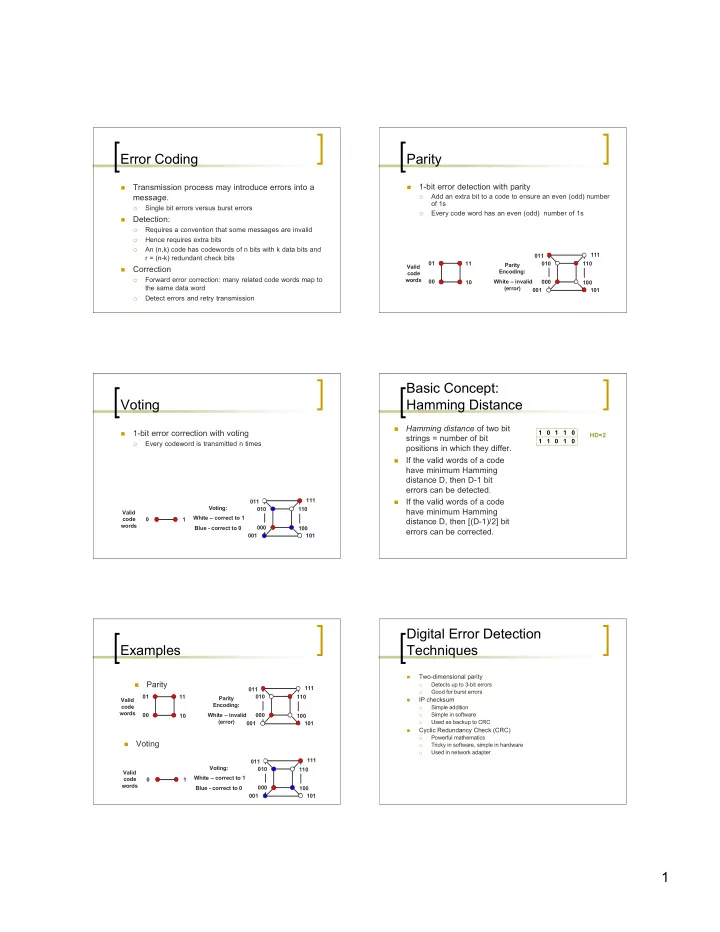
Error Coding Parity 1-bit error detection with parity Transmission process may introduce errors into a message. Add an extra bit to a code to ensure an even (odd) number of 1s Single bit errors versus burst errors Every


slide-1
SLIDE 1

1 Error Coding

Transmission process may introduce errors into a message.

Single bit errors versus burst errors

Detection:

Requires a convention that some messages are invalid

Hence requires extra bits

An (n,k) code has codewords of n bits with k data bits and r = (n-k) redundant check bits

Correction

Forward error correction: many related code words map to the same data word

Detect errors and retry transmission

Parity

1-bit error detection with parity

Add an extra bit to a code to ensure an even (odd) number

  • f 1s

Every code word has an even (odd) number of 1s

01 11 10 00 Valid code words 010 110 100 000 011 111 101 001 Parity Encoding: White – invalid (error)

Voting

1-bit error correction with voting

Every codeword is transmitted n times

010 110 100 000 011 111 101 001 Voting: White – correct to 1 Blue - correct to 0 1 Valid code words

Basic Concept: Hamming Distance

Hamming distance of two bit strings = number of bit positions in which they differ.

If the valid words of a code have minimum Hamming distance D, then D-1 bit errors can be detected.

If the valid words of a code have minimum Hamming distance D, then [(D-1)/2] bit errors can be corrected.

1 0 1 1 0 1 1 0 1 0 HD=2

Examples

Parity

01 11 10 00 Valid code words 010 110 100 000 011 111 101 001 Parity Encoding: White – invalid (error) 010 110 100 000 011 111 101 001 Voting: White – correct to 1 Blue - correct to 0 1 Valid code words 

Voting

Digital Error Detection Techniques

Two-dimensional parity

Detects up to 3-bit errors

Good for burst errors

IP checksum

Simple addition

Simple in software

Used as backup to CRC

Cyclic Redundancy Check (CRC)

Powerful mathematics

Tricky in software, simple in hardware

Used in network adapter

slide-2
SLIDE 2

2 Two-Dimensional Parity

Use 1-dimensional parity

Add one bit to a 7-bit code to ensure an even/odd number of 1s

Add 2nd dimension

Add an extra byte to frame

Bits are set to ensure even/odd number of 1s in that position across all bytes in frame 

Comments

Catches all 1-, 2- and 3-bit and most 4-bit errors

1 1 1 1 1111011 Parity Bits Parity Byte 0101001 1101001 1011110 0001110 0110100 1011111 Data

Internet Checksum

Idea

Add up all the words

Transmit the sum

Internet Checksum

Use 1’s complement addition on 16bit codewords

Example

Codewords:

  • 5
  • 3

1’s complement binary: 1010 1100

1’s complement sum 1000 

Comments

Small number of redundant bits

Easy to implement

Not very robust

IP Checksum

u_short cksum(u_short *buf, int count) { register u_long sum = 0; while (count--) { sum += *buf++; if (sum & 0xFFFF0000) { /* carry occurred, so wrap around */ sum &= 0xFFFF; sum++; } } return ~(sum & 0xFFFF); }

Cyclic Redundancy Check (CRC)

Goal

Maximize protection, Minimize extra bits

Idea

Add k bits of redundant data to an n-bit message

N-bit message is represented as a n-degree polynomial with each bit in the message being the corresponding coefficient in the polynomial

Example

Message = 10011010

Polynomial

= 1 ∗x7 + 0 ∗x6 + 0 ∗x5 + 1 ∗x4 + 1 ∗x3 + 0 ∗x2 + 1 ∗x + 0 = x7 + x4 + x3 + x

CRC

Select a divisor polynomial C(x) with degree k

Example with k = 3:

C(x) = x3 + x2 + 1 

Transmit a polynomial P(x) that is evenly divisible by C(x)

P(x) = M(x) + k bits

CRC - Sender

Steps

T(x) = M(x) by xk (zero extending)

Find remainder, R(x), from T(x)/C(x)

P(x) = T(x) – R(x) ⇒ M(x) followed by R(x)

Example

M(x) = 10011010 = x7 + x4 + x3 + x

C(x) = 1101 = x3 + x2 + 1

T(x) = 10011010000

R(x) = 101

P(x) = 10011010101

slide-3
SLIDE 3

3 CRC - Receiver

Receive Polynomial P(x) + E(x)

E(x) represents errors

E(x) = 0, implies no errors

Divide (P(x) + E(x)) by C(x)

If result = 0, either

No errors (E(x) = 0, and P(x) is evenly divisible by C(x))

(P(x) + E(x)) is exactly divisible by C(x), error will not be detected

CRC – Example Encoding

1001 1101 1000 1101 1011 1101 1100 1101 1000 1101 1101 k + 1 bit check sequence c, equivalent to a degree-k polynomial 101 1101 Remainder m mod c 10011010000 Message plus k zeros

Result: Transmit message followed by remainder: 10011010101

C(x) = x3 + x2 + 1 = 1101 Generator M(x) = x7 + x4 + x3 + x = 10011010 Message

CRC – Example Decoding – No Errors

1001 1101 1000 1101 1011 1101 1100 1101 1101 1101 1101 k + 1 bit check sequence c, equivalent to a degree-k polynomial 1101 Remainder m mod c 10011010101 Received message, no errors

Result: CRC test is passed

C(x) = x3 + x2 + 1 = 1101 Generator P(x) = x10 + x7 + x6 + x4 + x2 + 1 = 10011010101 Received Message

CRC – Example Decoding – with Errors

1000 1101 1011 1101 1101 1101 1101 k + 1 bit check sequence c, equivalent to a degree-k polynomial 0101 1101 Remainder m mod c 10010110101 Received message

Result: CRC test failed

Two bit errors C(x) = x3 + x2 + 1 = 1101 Generator P(x) = x10 + x7 + x5 + x4 + x2 + 1 = 10010110101 Received Message

CRC Error Detection

Properties

Characterize error as E(x)

Error detected unless C(x) divides E(x)

(i.e., E(x) is a multiple of C(x)) 

What errors can we detect?

All single-bit errors, if xk and x0 have non-zero coefficients

All double-bit errors, if C(x) has at least three terms

All odd bit errors, if C(x) contains the factor (x + 1)

Any bursts of length < k, if C(x) includes a constant term

Most bursts of length ≥ k

CRC Error Detection

Odd number of bit errors can be detected if C(x) contains the factor (x + 1) Proof:

C(x) = (x + 1) C’(x) => C(1) = 0 ( C(x) has an even number of terms)

P(x) = C(x) f(x) = (x + 1) C’(x) f(x) => P(1) = 0 ( P(x) has an even number of terms)

E(x) has an odd number of terms (odd number of error bits)  E(1) = 1 => P(1) + E(1) = 0 + 1 = 1 …………………………….. (1)

Assume E(x) cannot be detected by CRC with C(x)  P(x) + E(x) = C(x)g(x) => P(1) + E(1) = C(1)g(1) = 0 ………………………………(2) (1) contradicts (2) => E(x) must be detected by C(x)

slide-4
SLIDE 4

4 CRC Error Detection

Any error bursts of length < k will be detected if C(x) includes a constant term Proof:

E(x) = xi (xk-1 + ... + 1), where i >= 0

C(x) = x f(x) + 1

No power of x can be factored out of C(x) => C(x) is not a factor of xi …………………….(1)

C(x) has a degree of k: it cannot be a factor of polynomial with smaller degree (up to k-1) => C(x) is not a factor of xk-1 + ... + 1 …………………….(2) (1) (2) => C(x) cannot be a factor of E(x)

Common Polynomials for C(x)

x32 + x26 + x23 + x22 + x16 + x12 + x11 + x10 + x8 + x7 + x5 + x4 + x2 + x1 + 1

CRC-32 x16 + x12 + x5 + 1 CRC-CCITT x16 + x15 + x2 + 1 CRC-16 x12 + x11 + x3 + x2 + x1 + 1 CRC-12 x10 + x9 + x5 + x4 + x1 + 1 CRC-10 x8 + x2 + x1 + 1 CRC-8 C(x) CRC

Cyclic Redundancy Codes (CRC)

Commonly used codes that have good error detection properties.

Can catch many error combinations with a small number or redundant bits

Based on division of polynomials.

Errors can be viewed as adding terms to the polynomial

Should be unlikely that the division will still work

Can be implemented very efficiently in hardware.

Examples:

CRC-32: Ethernet

CRC-8, CRC-10, CRC-32: ATM

Error Detection vs. Error Correction

Detection

Pro: Overhead only on messages with errors

Con: Cost in bandwidth and latency for retransmissions

Correction

Pro: Quick recovery

Con: Overhead on all messages

What should we use?

Correction if retransmission is too expensive

Correction if probability of errors is high