1 ADP: The Acyclic- -Dependencies Dependencies ADP: The Acyclic - - PDF document

1
SMART_READER_LITE
LIVE PREVIEW

1 ADP: The Acyclic- -Dependencies Dependencies ADP: The Acyclic - - PDF document

REP: The Reuse Release Equivalence Release Equivalence REP: The Reuse Six Principles of Package Design Six Principles of Package Design Principle Principle 1. Reuse Reuse Release Equivalence Release Equivalence 1. Principle


slide-1
SLIDE 1

1 Six Principles of Package Design Six Principles of Package Design

1.

  • 1. Reuse

Reuse– –Release Equivalence Release Equivalence Principle Principle 2.

  • 2. Common

Common-

  • Reuse Principle

Reuse Principle 3.

  • 3. Common

Common-

  • Closure Principle

Closure Principle 4.

  • 4. Acyclic

Acyclic-

  • Dependencies Principle

Dependencies Principle 5.

  • 5. Stable

Stable-

  • Dependencies Principle

Dependencies Principle 6.

  • 6. Stable

Stable-

  • Abstractions Principle

Abstractions Principle

Coupling Coupling Cohesion Cohesion

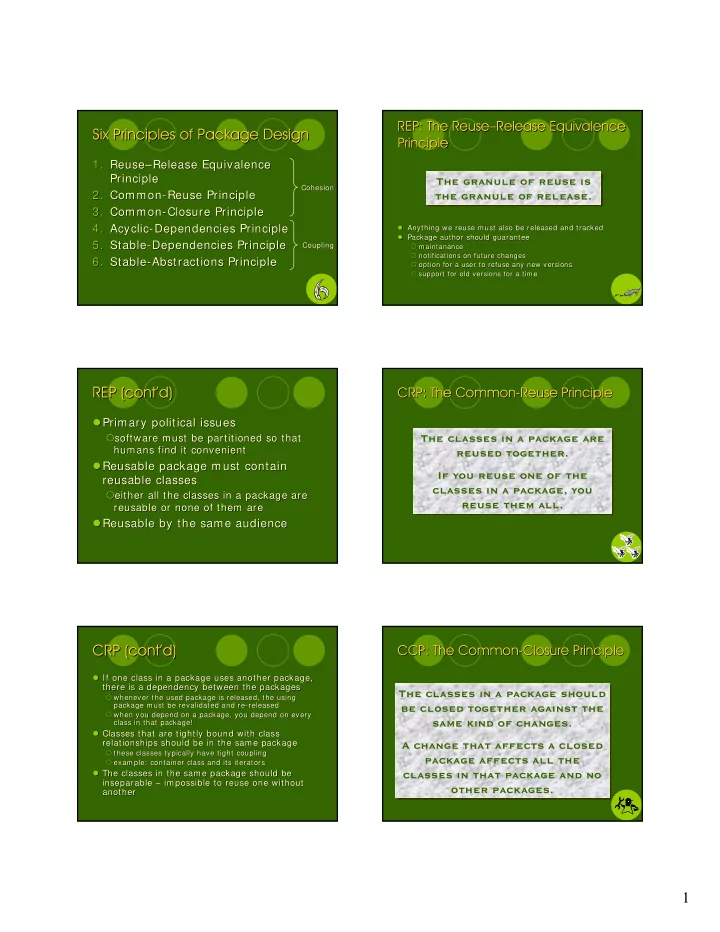
REP: The Reuse REP: The Reuse– –Release Equivalence Release Equivalence Principle Principle

  • Anything we reuse must also be released and tracked

Anything we reuse must also be released and tracked

  • Package author should guarantee

Package author should guarantee

  • maintanance

maintanance

  • notifications on future changes

notifications on future changes

  • ption for a user to refuse any new versions
  • ption for a user to refuse any new versions
  • support for old versions for a time

support for old versions for a time

The granule of reuse is the granule of release. The granule of reuse is The granule of reuse is the granule of release. the granule of release.

REP (cont’d) REP (cont’d)

  • Primary political issues

Primary political issues

  • software must be partitioned so that

software must be partitioned so that humans find it convenient humans find it convenient

  • Reusable package must contain

Reusable package must contain reusable classes reusable classes

  • either all the classes in a package are

either all the classes in a package are reusable or none of them are reusable or none of them are

  • Reusable by the same audience

Reusable by the same audience

CRP: The Common CRP: The Common-

  • Reuse Principle

Reuse Principle

The classes in a package are reused together. If you reuse one of the classes in a package, you reuse them all. The classes in a package are The classes in a package are reused together. reused together. If you reuse one of the If you reuse one of the classes in a package, you classes in a package, you reuse them all. reuse them all.

CRP (cont’d) CRP (cont’d)

  • If one class in a package uses another package,

If one class in a package uses another package, there is a dependency between the packages there is a dependency between the packages

  • whenever the used package is released, the using

whenever the used package is released, the using package must be revalidated and re package must be revalidated and re-

  • released

released

  • when you depend on a package, you depend on every

when you depend on a package, you depend on every class in that package! class in that package!

  • Classes that are tightly bound with class

Classes that are tightly bound with class relationships should be in the same package relationships should be in the same package

  • these classes typically have tight coupling

these classes typically have tight coupling

  • example: container class and its iterators

example: container class and its iterators

  • The classes in the same package should be

The classes in the same package should be inseparable inseparable – – impossible to reuse one without impossible to reuse one without another another

CCP: The Common CCP: The Common-

  • Closure Principle

Closure Principle

The classes in a package should be closed together against the same kind of changes. A change that affects a closed package affects all the classes in that package and no

  • ther packages.

The classes in a package should The classes in a package should be closed together against the be closed together against the same kind of changes. same kind of changes. A change that affects a closed A change that affects a closed package affects all the package affects all the classes in that package and no classes in that package and no

  • ther packages.
  • ther packages.
slide-2
SLIDE 2

2 CCP (cont’d) CCP (cont’d)

  • SRP restated for packages

SRP restated for packages

  • a package should not have multiple reason to change

a package should not have multiple reason to change

  • Maintainability often more important than

Maintainability often more important than reusability reusability

  • changes should occur all in one package

changes should occur all in one package

  • minimizes workload related releasing, revalidating and

minimizes workload related releasing, revalidating and redistributing redistributing

  • Closely related to OCP

Closely related to OCP

  • strategic closure: close against types of changes that

strategic closure: close against types of changes that are probable are probable

  • CCP guides to group together classes that are open to

CCP guides to group together classes that are open to the same type of change the same type of change

ADP: The Acyclic ADP: The Acyclic-

  • Dependencies

Dependencies Principle Principle

  • Without cycles it is easy to compile, test and release ‘bottom

Without cycles it is easy to compile, test and release ‘bottom -

  • up’

up’ when building the whole software when building the whole software

  • The packages in a cycle will become

The packages in a cycle will become de facto de facto a single package a single package

  • compile

compile-

  • times increase

times increase

  • testing becomes difficult since a complete build is needed to te

testing becomes difficult since a complete build is needed to test a st a single package single package

  • developers can step over one another since they must be using

developers can step over one another since they must be using exactly the same release of each other’s packages exactly the same release of each other’s packages

Allow no cycles in the package dependency graph. Allow no cycles in the Allow no cycles in the package dependency graph. package dependency graph.

The ‘Morning The ‘Morning-

  • After Syndrome’

After Syndrome’

  • Developers are modifying the same source files

Developers are modifying the same source files trying to make it work with the latest changes trying to make it work with the latest changes somebody else did somebody else did → → no stable version no stable version

  • Solution # 1: the weekly build

Solution # 1: the weekly build

  • developers work alone most of the week and integrate

developers work alone most of the week and integrate

  • n Friday
  • n Friday
  • works on medium

works on medium -

  • sized projects

sized projects

  • for bigger projects, the iteration gets longer (monthly

for bigger projects, the iteration gets longer (monthly build?) build?) → → rapid feedback is lost rapid feedback is lost

  • Solution # 2:

Solution # 2:

  • partition the development environment into releasable

partition the development environment into releasable packages packages

  • ensure ADP

ensure ADP

Release Release-

  • Control

Control

  • Partition the development environment into releasable

Partition the development environment into releasable packages packages

  • package = unit of work

package = unit of work

  • developer modifies the package privately

developer modifies the package privately

  • developer releases the working package

developer releases the working package

  • everyone else uses the released package while the developer

everyone else uses the released package while the developer can continue modifying it privately for the next release can continue modifying it privately for the next release

  • No developer is at the mercy of the others

No developer is at the mercy of the others

  • everyone works independently on their own packages

everyone works independently on their own packages

  • everyone can decide independently when to adapt the

everyone can decide independently when to adapt the packages to new releases of the packages they use packages to new releases of the packages they use

  • no ‘big bang’ integration but small increments

no ‘big bang’ integration but small increments

  • To avoid the ‘morning

To avoid the ‘morning-

  • after syndrome’ the dependency tree

after syndrome’ the dependency tree must not have any cycles must not have any cycles

Package Structure as a Directed Package Structure as a Directed Acyclic Graph Acyclic Graph

MyApplication MyApplication Message Message W indow W indow Task Task W indow W indow MyTasks MyTasks Database Database Tasks Tasks MyDialogs MyDialogs W indow s W indow s

Breaking the Cycle with DIP Breaking the Cycle with DIP

MyApplication MyApplication

Y Y

MyDialogs MyDialogs

X X

MyApplication MyApplication

Y Y

MyDialogs MyDialogs

X X

«interface» «interface» X Server X Server

slide-3
SLIDE 3

3

Breaking the Cycle with a New Breaking the Cycle with a New Package Package

MyApplication MyApplication Message Message W indow W indow Task Task W indow W indow MyTasks MyTasks Database Database Tasks Tasks MyDialogs MyDialogs W indow s W indow s

New Package New Package

Breaking the Cycle Breaking the Cycle – – a Corollary a Corollary

  • The package structure cannot be

The package structure cannot be designed top designed top– –down but it evolves as down but it evolves as the system grows and changes the system grows and changes

  • Package depency diagrams are not

Package depency diagrams are not about the function of the application about the function of the application but they are a map to the but they are a map to the buildability buildability

  • f the application
  • f the application

SDP: The Stable SDP: The Stable-

  • Dependencies

Dependencies Principle Principle

  • Designs cannot be completely static

Designs cannot be completely static

  • some volatility is required so that the design can be maintained

some volatility is required so that the design can be maintained

  • CCP: some packages are sensitive to certain types of changes

CCP: some packages are sensitive to certain types of changes

  • A volatile package should not be depended on by a package that

A volatile package should not be depended on by a package that is difficult to change is difficult to change

  • a package designed to be easy to change can (accidentally)

a package designed to be easy to change can (accidentally) become hard to change by someone else hanging a dependency become hard to change by someone else hanging a dependency

  • n it!
  • n it!

Depend in the direction

  • f stability.

Depend in the direction Depend in the direction

  • f stability.
  • f stability.

Stable and Instable Packages Stable and Instable Packages

‘Stable’ = not easy to change Stable’ = not easy to change

  • how much effort is needed to change a package: size,

how much effort is needed to change a package: size, complexity, clarity, incoming dependencies complexity, clarity, incoming dependencies

  • If other packages depend on a package, it is hard

If other packages depend on a package, it is hard to change (i.e. stable) to change (i.e. stable)

X X Y Y

Stability Metrics Stability Metrics

  • Affarent couplings

Affarent couplings C Ca

a

  • the number of classes

the number of classes

  • utside this package
  • utside this package

that depend on classes that depend on classes within this package within this package

  • Efferent couplings

Efferent couplings C Ce

e

  • the number of classes

the number of classes inside this package inside this package that depend on classes that depend on classes

  • utside this package
  • utside this package
  • Instability

Instability I I

  • I

I = = C Ce

e / (

/ ( C Ca

a +

+ C Ce

e)

)

  • I

I = 0: maximally = 0: maximally stable package stable package

  • I

I = 1: maximally = 1: maximally instable package instable package

  • Dependencies

Dependencies

  • C+ + :

C+ + : #i ncl ude #i ncl ude

  • Java:

Java: i m por t i m por t , qualified , qualified names names

SDP SDP

  • The

The I I metric of a package should be larger metric of a package should be larger than the than the I I metrics of the packages that metrics of the packages that depends on depends on

Stable Stable

I nstable I nstable I nstable I nstable I nstable I nstable

I I = 1 = 1 I I = 1 = 1 I I = 1 = 1 I I = 0 = 0 Flexible Flexible I I > 0 > 0

slide-4
SLIDE 4

4

Fixing the Stability Violation Using DIP Fixing the Stability Violation Using DIP

Flexible Flexible

C C

Stable Stable

U U

Flexible Flexible

C C

Stable Stable

U U

«interface» «interface» I U I U UI nterface UI nterface

SAP: The Stable SAP: The Stable-

  • Abstractions Principle

Abstractions Principle

  • A stable package should be abstract so that stability does not

A stable package should be abstract so that stability does not prevent it from being extended prevent it from being extended

  • An instable package should be concrete since the instability all

An instable package should be concrete since the instability allows

  • ws

the concrete code to be changed easily the concrete code to be changed easily

  • SDP + SAP = DI P for packages

SDP + SAP = DI P for packages

  • dependencies run in the direction of abstractions

dependencies run in the direction of abstractions

  • Since packages have varying degrees of abstractness, we need a

Since packages have varying degrees of abstractness, we need a metric to measure the abstractness of a package metric to measure the abstractness of a package

A package should be as abstract as it is stable. A package should be as A package should be as abstract as it is stable. abstract as it is stable.

Measuring Abstractness Measuring Abstractness

  • The number of classes in the package

The number of classes in the package N Nc

c

  • The number of abstract classes in the

The number of abstract classes in the package package N Na

a

  • abstract class = at least one pure interface and

abstract class = at least one pure interface and cannot be instantiated cannot be instantiated

  • Abstractness

Abstractness A A

  • A

A = = N Na

a /

/ N Nc

c

  • A

A = 0: no abstract classes = 0: no abstract classes

  • A

A = 1: only abstract classes = 1: only abstract classes

The Abstractness The Abstractness– –Instability Graph Instability Graph

A A I I

The Main Sequence The Main Sequence Zone Zone

  • f
  • f

Pain Pain Zone Zone

  • f
  • f

Uselessness Uselessness

(0,1) (0,1) (1,1) (1,1) (1,0) (1,0) (0,0) (0,0)

Package Cohesion and Coupling Package Cohesion and Coupling

  • REP, CRP, and CCP: cohesion within a package

REP, CRP, and CCP: cohesion within a package

  • ‘bottom

‘bottom – –up’ view of partitioning up’ view of partitioning

  • classes in a packages must have a good reason to be

classes in a packages must have a good reason to be there there

  • classes belong together according to some criteria

classes belong together according to some criteria

  • political factors

political factors

  • dependencies between the packages

dependencies between the packages

  • package responsibilities

package responsibilities

  • ADP, SDP, and SAP: coupling between packages

ADP, SDP, and SAP: coupling between packages

  • dependencies accross package boundaries

dependencies accross package boundaries

  • relationships between packages

relationships between packages

  • technical

technical

  • political

political

  • volatile

volatile

F FACTORY

ACTORY

  • DIP: prefer dependencies on abstract

DIP: prefer dependencies on abstract classes classes

  • avoid dependencies on concrete (and volatile!)

avoid dependencies on concrete (and volatile!) classes classes

  • any line of code that uses the

any line of code that uses the new new keyword keyword violates DI P: violates DI P: Ci r cl e Ci r cl e c = c = new new Ci r cl e Ci r cl e( or i gi n, 1) ; ( or i gi n, 1) ;

  • the more likely a concrete class is to change,

the more likely a concrete class is to change, the more likely depending on it will lead to the more likely depending on it will lead to trouble trouble

  • How to create instances of concrete

How to create instances of concrete

  • bjects while depending only on abstract
  • bjects while depending only on abstract

interfaces interfaces → → F FACTORY

ACTORY

slide-5
SLIDE 5

5

Example: Creating Shapes Violates Example: Creating Shapes Violates DIP DIP

Application Application « «interface interface» » Shape Shape Square Square Circle Circle «creates» «creates»

Example: Shapes Using F Example: Shapes Using FACTORY

ACTORY

+ + makeSquare() makeSquare() + makeCircle() + makeCircle() « «interface interface» » ShapeFactory ShapeFactory Application Application ShapeFactory ShapeFactory I m plem entation I m plem entation « «interface interface» » Shape Shape Square Square Circle Circle «creates» «creates»

Example: Removing the Example: Removing the Dependency Cycle Dependency Cycle

publ i c i nt er f ace publ i c i nt er f ace ShapeFact or y ShapeFact or y { { publ i c publ i c Shape Shape m ake( m ake( Cl ass Cl ass<? <? ext ends ext ends Shape Shape> t ) ; > t ) ; } } publ i c cl ass publ i c cl ass ShapeFact or yI m pl em ent at i on ShapeFact or yI m pl em ent at i on i m pl em ent s i m pl em ent s ShapeFact or y ShapeFact or y { { publ i c publ i c Shape Shape m ake( m ake( Cl ass Cl ass<? <? ext ends ext ends Shape Shape> t ) { > t ) { i f i f ( t == ( t == Ci r cl e Ci r cl e. . cl ass cl ass) ) r et ur n new r et ur n new Ci r cl e Ci r cl e( ) ; ( ) ; el se i f el se i f ( t == ( t == Squar e Squar e. . cl ass cl ass) ) r et ur n new r et ur n new Squar e Squar e( ) ; ( ) ; t hr ow new t hr ow new Er r or Er r or ( ) ; ( ) ; } } } } ShapeFact or y ShapeFact or y sf = sf = new new ShapeFact or yI m pl em ent at i on ShapeFact or yI m pl em ent at i on( ) ; ( ) ; Shape Shape s1 = sf . m ake( s1 = sf . m ake( Ci r cl e Ci r cl e. . cl ass cl ass) ; ) ; Shape Shape s2 = sf . m ake( s2 = sf . m ake( Squar e Squar e. . cl ass cl ass) ; ) ;

Benefits of F Benefits of FACTORY

ACTORY

  • Implementations can be substituted easily

Implementations can be substituted easily

  • Allows testing by spoofing the actual

Allows testing by spoofing the actual implementation implementation

« «interface interface» » ShapeFactory ShapeFactory Application Application ShapeFactory ShapeFactory I m plem entation 2 I m plem entation 2 « «interface interface» » Shape Shape Square Square Circle Circle

«creates» «creates»

ShapeFactory ShapeFactory I m plem entation 1 I m plem entation 1 ShapeFactory ShapeFactory I m plem entation 3 I m plem entation 3

«creates» «creates» «creates» «creates»

F FACTORY

ACTORY –

– the Flip Side the Flip Side

  • Factory is a powerful abstraction

Factory is a powerful abstraction

  • strictly thinking DIP entails that you

strictly thinking DIP entails that you should use factories for every volatile should use factories for every volatile class class

  • Do not start out using factories

Do not start out using factories

  • can cause unnecessary complexity

can cause unnecessary complexity

  • add them when the need becomes great

add them when the need becomes great enough enough

Reading for the Next Week Reading for the Next Week

  • Section 5: The Weather Station Case

Section 5: The Weather Station Case Study Study

  • Chapter 23: C

Chapter 23: COMPOSITE

OMPOSITE

  • Chapter 24: O

Chapter 24: OBSERVER

BSERVER –

– Backing into a Pattern Backing into a Pattern

  • Chapter 25: A

Chapter 25: ABSTRACT

BSTRACT S

SERVER

ERVER, A

, ADAPTER

DAPTER, and

, and B BRIDGE

RIDGE

  • Chapter 26: P

Chapter 26: PROXY

ROXY and S

and STAIRWAY

TAIRWAY TO TO H

HEAVEN

EAVEN:

: Managing Third Party API s Managing Third Party API s

  • Chapter 27: Case Study: Weather Station

Chapter 27: Case Study: Weather Station