1 Sudden Cardiac Death: Definitions Sudden Cardiac Death: - - PDF document

1
SMART_READER_LITE
LIVE PREVIEW

1 Sudden Cardiac Death: Definitions Sudden Cardiac Death: - - PDF document

Disclosures Redefining Sudden Cardiac Death: Major Insights from the Research grant: R01 HL102090 (NIH / NHLBI) San Francisco POST SCD Study Research grant: R01 HL126555 (NIH / NHLBI) Research grant: DP14-1403 (CDC)


slide-1
SLIDE 1

1

Redefining Sudden Cardiac Death: Insights from the San Francisco POST SCD Study

10 September 2016 California Heart Rhythm Symposium

Zian H. Tseng, M.D., M.A.S. Associate Professor of Medicine in Residence Murray Davis Endowed Professor Cardiac Electrophysiology Section University of California, San Francisco

Disclosures

  • Major

– Research grant: R01 HL102090 (NIH / NHLBI) – Research grant: R01 HL126555 (NIH / NHLBI) – Research grant: DP14-1403 (CDC) – Research grant: R24 A1067039 (NIH)

  • Minor

– Honorarium: Biotronik

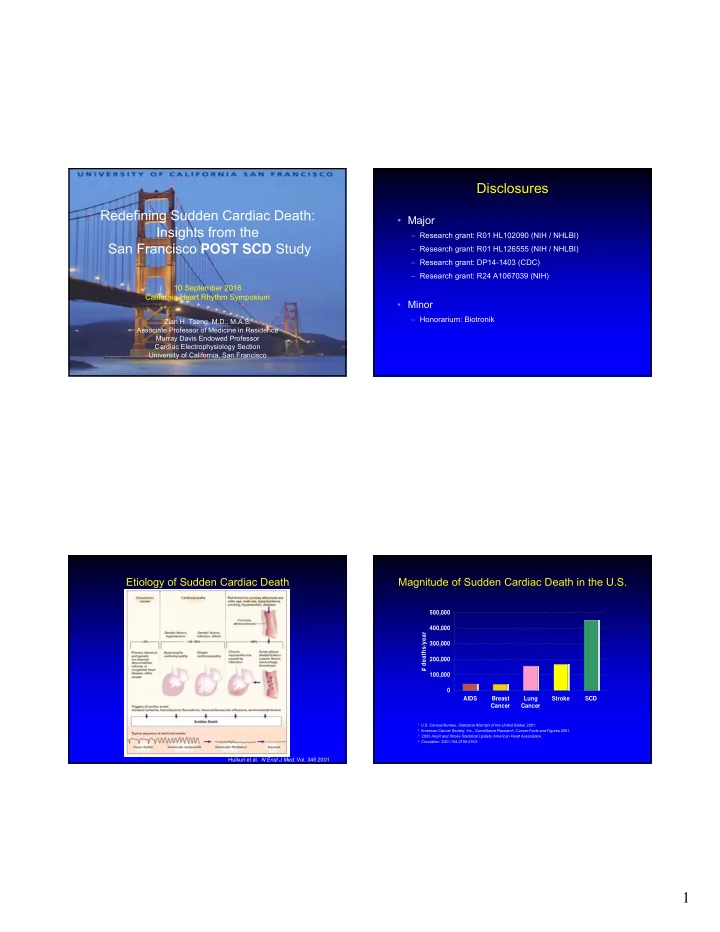
Etiology of Sudden Cardiac Death

Huikuri et al. N Engl J Med, Vol. 345 2001

Magnitude of Sudden Cardiac Death in the U.S.

100,000 200,000 300,000 400,000 500,000 AIDS Breast Cancer Lung Cancer Stroke SCD # deaths/year

1 U.S. Census Bureau, Statistical Abstract of the United States: 2001. 2 American Cancer Society, Inc., Surveillance Research, Cancer Facts and Figures 2001. 3 2002 Heart and Stroke Statistical Update, American Heart Association. 4 Circulation. 2001;104:2158-2163.

slide-2
SLIDE 2

2

ACC/AHA/HRS, 2006:

“SCA is the sudden cessation of cardiac activity so that the victim becomes unresponsive, with no normal breathing and no signs of circulation. If corrective measures are not taken rapidly, this condition progresses to sudden cardiac death.”

Sudden Cardiac Death: Definitions Sudden Cardiac Death: Definitions

  • VALIANT trial: Valsartan after acute MI and HF

– “The cause of death was considered as SCD if death occurred suddenly and unexpectedly in a patient in otherwise stable condition, with no premonitory HF, MI, or another clear cause of

  • death. These could have been witnessed deaths (with or without

documentation of arrhythmias) or unwitnessed deaths if the patient had been seen within 24 hours before death.”

  • MERIT-HF trial: Metoprolol for Heart Failure

– “SCD: Witnessed instantaneous death in the absence of progressive circulatory failure lasting for 60 min or more, unwitnessed death in the absence of pre-existence progressive circulatory failure or other causes of death”

World Health Organization (WHO), 1969:

– Unexpected death within 1 h of symptom onset if witnessed – Unexpected death within 24 h of having been observed alive and sx-free if unwitnessed

  • Out-of-hospital
  • Presumed sudden pulseless condition
  • Absence of obvious noncardiac condition

Sudden Cardiac Death: Definitions Methodological Issues in Population Studies of SCD

  • Estimates in the US range from 184,000-

450,000 annually due to subjective/inconsistent methods of data collection

  • Most data predates modern era of PPCI, statins, etc
  • Derived from homogenous populations
  • Where does the data come from?
  • Death record review of listed COD
  • Retrospective review of paramedic/ER narratives
  • Incomplete medical records
  • Which definition should we use for SCD?
  • WHO (Hinkle-Thaler) criteria?
  • Documented VF?
slide-3
SLIDE 3

3

Comprehensive Surveillance of SCD

  • Oregon–SUDS (Chugh, JACC, 2004)
  • WHO criteria
  • Portland, OR: population 1,000,000
  • Track dozens of ambulance companies and area

hospitals

  • Review of all available records
  • SCA+SCD: 53/100,000

Chugh SS et al JACC 2004

Autopsy rate: 11%

Sudden Cardiac Arrest vs. Sudden Cardiac Death

SCA SCD

Sudden Cardiac Arrest vs. Sudden Cardiac Death

SCA SCD?

Sudden “Cardiac” Death

SCA Valvular CAD DCM HCM 1o electrical disease Tamponade Neurologic Ao Dissection Hemorrhage

slide-4
SLIDE 4

4

Sudden Arrhythmic Death

SCA

Valvular

CAD DCM HCM 1o electrical disease

Tamponade Neurologic Hemorrhage Ao Dissection

San Francisco POST SCD Study

POstmortem Systematic InvesTigation of Sudden Cardiac Death SF Medical Examiner SF Cardiology UC

All out of hospital and ER deaths reported by law to ME Every Incident SCD 2011-

Study Design

  • 1. Complete capture of all OOH SCDs for accurate population

incidence

  • Single surveillance source, County ME, to which all OOH deaths are

reported by law

  • SF DPH death certificate cross-check to confirm complete capture
  • 2. Comprehensive autopsy of all SCDs to refine to arrhythmic deaths
  • Cranial vault, cardiac mass, LV measurements, Ccoronary vessels

sectioned every 5mm, histology

  • 3. Prediction model to help refine external registry SCDs to

arrhythmic SDs

  • Future precision genotype-phenotype correlations within POST SCD

cases

  • 4. Identify pathologic correlates and predictors of arrhythmic SD

Case Adjudication

IRBs with all county hospitals All outside medical records obtainable via medicolegal authority

  • PMH (active problems, prescriptions, recent visits)
  • Medications (e.g., QT-prolonging, methadone)
  • Paramedic runsheets and rhythms
  • Autopsy findings (including toxicology and histology)
  • CIED interrogations if present

Adjudication panel

  • Dr. Phil Ursell

Chief Cardiac Pathologist UCSF

  • Dr. Ellen Moffatt

Medical Examiner, City and County of San Francisco

  • Dr. Zian H. Tseng

Study PI Cardiac Electrophysiologist, UCSF

  • Dr. Jeff Olgin

Chief of Cardiology, UCSF

  • Dr. Anthony Kim

Neurologist Director of UCSF Stroke Center

slide-5
SLIDE 5

5

Deaths in San Francisco 2/1/2011-3/1/2014 N=20441 Not Reported to ME N= 7769 Deaths Reported to ME: all ER, OOH, Unexpected Inpatient Death N= 12672 Non-Natural Deaths N= 2021 Natural Deaths N= 10651 Excluded- Age <18 or >90 N= 2005 Excluded- Inpatient/Hospice N= 3851 All OOH Deaths, 18-90yo N= 4795 Potential SCD, Eligible for Autopsy N= 3675 MD Signed Death Certificate, Ineligible for Autopsy N= 1120 Sudden Death w/o Autopsy N= 89 Non-Sudden Deaths N= 1031 Excluded at Initial Presentation (Non-Sudden Death) N= 2781 Sudden Death Refused Autopsy N= 16 Autopsied Potential SCDs N= 878 Excluded after comprehensive records review (Non-Sudden Death) N= 275 Adjudicated Autopsied Potential SCDs N= 603 Excluded at Adjudication (Non-Sudden Death) N= 78 Adjudicated Autopsied SCDs N= 525 Potential SCD referred for autopsy N= 894 Overall POST SCD Autopsy Rate = Adj Autopsy SCDs / (Adj Autopsy SCDs + No Autopsy SCDs) Overall SCD Autopsy Rate = 525 / (525+89+16) = 83.3% (See Table 1A) (See Table 1B) ME SCD Autopsy Rate = Adj Autopsy SCDs / (Adj Autopsy SCDs + No Autopsy SCDs)_ ME SCD Autopsy Rate = 525/ (525+16) = 97.0% Age-Matched Trauma Controls N=104 (See Table 1C) (See Table 1C) (See Table 1C) (See Table 1C) Key for Case Review: DC Only DC + ME Report All Records (all medical records, ambulance run sheets and ME records) Adjudication SCD Criteria Witnessed: Symptoms <1 hour of death Unwitnessed: Observed well within 24 hours of death Excluded: Known metastatic CA, ESRD on HD, Hospice, Hospitalization <1 mo

Table 1: Non-Sudden Deaths

Table 1: Non-Sudden Deaths 1A: Deaths not Reported to ME Total (%) Inpatient Death 5462 (70.3%) SNF/Hospice Death 2094 (27.0%) Death OOH – Under Physician Care 197 (2.5%) ER/OP Death – Under Physician Care 16 (0.2%) 1B: Non-Natural Deaths Total (%) Accidental Overdose 818 (40.5%) Trauma Death 572 (28.3%) Suicide 355 (17.6%) Homicide 228 (11.3%) Other Accidental Death 48 (2.4%) 1C: Excluded Natural Deaths Total (%) Nursing Home/Hospice 3861 (38.5%) ES Disease/Metastatic CA 2249 (22.4%) Age (<18, >90) 2012 (20.1%) Non-sudden presentation (includes OD at scene) 1009 (10.1%) Recent Complaints 427 (4.2%) Recent Major Procedure/Hospitalization(<1month) 395 (3.9%) DNR/Refused Treatment 39 (0.4%) Arrested Out of County 29 (0.3%)

Table 2: Cause of Sudden Deaths without Autopsy

Table 2: Cause of Sudden Deaths without Autopsy 2A: Sudden Deaths withoutAutopsy Total (%) Cardiac Causes 85 (95%) Complications of Diabetes Mellitus 1 (1%) Complications of Stroke 2 (2%) Respiratory Failure 1 (1%) 2B: Sudden Deaths Refused Autopsy Total (%) Cardiac Causes 16 (100%) SCD with Autopsy SCD without Autopsy p* SCD with Autopsy vs. without Autopsy SF Adult Population 2011 US Adult Population 2011 N 525 105

  • 690,689

232,556,019 Age, mean ±SD 62.8 ± 14.5 73.1 ± 11.6

  • 18-90

37-89

  • Male, n (%)

362 (69%) 74 (70%) 0.82 350,179 (51%) 112,848,136 (49%) Race (%) White 279 (53%) 44 (42%) 0.001 290,089 (42%) 149,300,964 (64%) Black 81 (15%) 8 (8%) 40,751 (6%) 28,371,834 (12%) Hispanic 40 (8%) 8 (8%) 102,913 (15%) 37,441,519 (16%) Asian 110 (21%) 37 (35%) 232762 (34%) 11,395,245 (5%) Other 15 (3%) 8 (8%) 24,174 (3%) 6,046,457 (3%) Median Income Tertile 1 248 (50%) 43 (45%) 0.3446 266,642 (39%) 184,288,905 (79%) Tertile 2 82 (16%) 14 (13%) 230,900 (33%) 16,631,720 (7%) Tertile 3 171 (34%) 43 (42%) 193,147 (28%) 31,635,394 (14%)

  • for age, t-test assuming unequal variance; for categorical, Fisher's exact test
  • Population data from American Community Survey 2011

POST SCD Demographics
slide-6
SLIDE 6

6

All SCD Weighted SAD IRR P-value IRR P-value Male vs. Female 2.4 <0.00005 3.37 <0.00005 Hispanic vs. White 0.46 <0.00005 0.39 <0.00005 Asian vs. White 0.55 0.002 0.49 0.0007 Black vs. White 2.15 0.0006 1.54 0.093 Other vs. White 1.13 0.28 0.86 0.51 57.4% 63.0% 44.6% 62.2% 54.2% 56.5% 45.0% 47.9% 5 10 15 20 25 30 35 40 45 50 55 60 65 70 75 80 Total Male Female White Hispanic Asian Black Other Adjusted Incidence Rates

SCD and SAD Event Rates per 100,00 person-years

Key:

SAD Weighted SCD Observed SAD Unweighted

SCD Case Study #1

  • 74 yo Filipino gentleman

– 4 V CABG 2002 – EF 22%, fixed defect anterior, inferior walls – Diabetes

  • Admitted for fever and bronchitis, receiving IV

antibiotics

  • Troponin negative, slightly fluid overloaded
  • Called to consult on several asymptomatic

runs of NSVT (5-7 beats) and to consider primary prevention ICD

SCD Case Study #1

  • Recommended uptitration of ß blocker, ICD

implant as an outpatient after completing antibiotic treatment

  • ICD scheduled for 1 month after discharge
  • 2 weeks later patient found dead in the

morning by wife

  • Pt had returned to usual state of health, no

complaints the night before

“Non-Cardiac SCD”

  • Referring MD
  • At autopsy, 2.5 L fresh

blood in stomach and duodenum

  • Heart: no acute coronary

lesions

  • Cause of death:

exsanguination

  • ICD would not have

prevented SCD, pt may not have survived procedure

slide-7
SLIDE 7

7

Acute CAD N=54 (10%, 18%) Chronic CAD N=115 (22%, 39%) Cardiomyopathy N=53 (10%, 18%) Hypertrophy N=45 (9%, 15%) Primary Electrical Disease N=7 (1%, 2%) Other Cardiac, Arrhythmic N=20 (4%, 7%) Cardiac, Non Arrythmic N=22* (4%, 100%) Acute Renal Failure N=6 (1%, 3%) Aortic Dissection N=14 (3%, 7%) Aspiration/Asphyxia N=5 (1%, 2%) Chemical Overdose N=71 (14%, 34%) GI Hemorrhage/Other GI N=11 (2%, 5%) Hypo/Hyperglycemia/DKA N=9 (2%, 4%) Infection N=24 (2%, 11%) Neurological N=28 (5%, 13%) Pulmonary Embolism N=19 (4%, 9%) Other Non‐Cardiac N=22 (4%, 11%)

Adjudicated Etiologies of SCD: 44% are Non-Arrhythmic

Cardiac, Arrhythmic N=294 (56%) Cardiac, Non-Arrhythmic N=22 (4%) Non-Cardiac N=209 (40%)

N=525

SCD Case Study #2

  • 78 yo Caucasian man

– Dilated cardiomyopathy, stable EF 25% – Paroxysmal AF – Primary prevention ICD implanted 3 years ago, no shocks

  • In usual state of health when wife went

shopping

  • 3 hours later wife found him unresponsive
  • Paramedics called, asystole on arrival, no

resuscitation attempted

ICD Interrogation

x 30

VF ≠ Sudden Arrhythmic Death

  • At autopsy

– Massive subarachnoid hemorrhage (requires perfusing rhythm) – Heart 760 g

  • Neurocardiogenic injury

– VF due to acute adrenergic surge

  • Despite rhythm documentation of

VF, cause of death was neurologic

slide-8
SLIDE 8

8

Sudden Neurologic Death

13% of Non-Cardiac Causes

Chemical Overdose (N=65) 34% Other Non-Cardiac (N=25) 13% Infection (N=23) 12% Pulmonary Embolism (n=18) 9% Aortic Aneurysm/ Dissection (N=18) 9% Intracranial Hemorrhage (N=18) 9% SUDEP (N=6) 3% CVA/Stroke (N=1) 1% Hyperglycemia (N=6) 3% GI Hemorrhage (N=5) 3% Other Pulmonary (N=4) 2% Other Trauma (N=2) 1% Other GI (N=2) 1%

13% of non-cardiac SCDs (5% overall) Kim AS….Tseng ZH. Neurology 2016 in press

Presenting Rhythms at EMS Arrival:

Witnessed and Unwitnessed SCDs

*Other: NSR (STEMI), AF/L (STEMI), Sinus Brady (STEMI and NSTEMI)

Other 13% Agonal/Idioventricula r 4% Asystole 34% PEA 13% VF 33% VT 3%

Witnessed N=120

Other 2% Agonal/Idioventricular 0% Asystole 94% PEA 2% VF 2%

Unwitnessed N=405

Time from Arrest to Initial Rhythm

Collapsed and Trimmed *witnessed cases only

COD by Initial Rhythm

Witnessed cases only

Initial Rhythm Arrhythmic COD N=78 Non- Arrhythmic COD N=42 Fisher’s Exact Total Agonal/Idioventricular 3 (60%) 2 (40%) 1.0 5 Asystole 26 (63%) 15 (37%) 0.84 41 NSR 3 (60%) 2 (40%) 1.0 5 PEA 2 (13%) 13 (87%) <0.0001 15 Sinus Brady 2 (40%) 3 (60%) 0.34 5 VT/VF 39 (91%) 4 (9%) <0.0001 43 Other 2 (67%) 1 (33%) 1.0 3 Unknown 1 (33%) 2 (67%) 0.61 3

slide-9
SLIDE 9

9

Sudden Cardiac Death in Patients with HIV Infection Mortality Rates by Cause and Year

  • 230 deaths over 3.7 median years’ follow-up
  • 13% SCDs, 86% (30/35) of all cardiac deaths
  • Mean HIV SCD rate: 2.6/1,000 PY (95% CI 1.8-3.8), 4.5-fold

higher than expected on the basis of the San Francisco population and background SCD rate

Tseng ZH et al. JACC 2012 59(21):1891-6

SCD Case Study #3

  • 76-year-old male with mild CAD history of

CHB with DDD PPM implanted in 2008

  • Underlying rate < 30 bpm

– ERI reached 3 weeks prior

  • Without complaint, found dead by his wife the

morning before scheduled generator change

SCD Case Study #3

  • 74 yo man with CAD, PPM for CHB
  • Gen change scheduled for 5 weeks after ERI
  • Did not show up to UCSF EP lab: died in sleep
  • Autopsy negative (no MI, PE, or bleed)
slide-10
SLIDE 10

10

Sudden Death in Patients with CIEDs

SCD with CIED device (22, 4.5%)

Tseng ZH, Hayward R, Clark N et al JAMA-IM 2015

ICD Lead Fracture During Shock Resulting in SCD

  • Improved post-market surveillance
  • More accurate device failure rates
  • Opportunities MD practice improvement: device selection,

programming

Tseng ZH et al, JAMA-IM 2015

Autopsy-Proven Sudden Cardiac Death

SCA Valvular CAD DCM HCM 1o electrical disease Tamponade Neurologic HIV CIEDs

Magnitude of Sudden Cardiac Death in the U.S.

100,000 200,000 300,000 400,000 500,000 AIDS Breast Cancer Lung Cancer Stroke SCD # deaths/year

1 U.S. Census Bureau, Statistical Abstract of the United States: 2001. 2 American Cancer Society, Inc., Surveillance Research, Cancer Facts and Figures 2001. 3 2002 Heart and Stroke Statistical Update, American Heart Association. 4 Circulation. 2001;104:2158-2163.

>2-fold

  • verestimate
slide-11
SLIDE 11

11

Etiology of Sudden Cardiac Death

Adapted from Huikuri et al. N Engl J Med, Vol. 345 2001

2-fold

  • verestimate

Early and Anticipated Insights

  • Incidence and underlying causes vary widely by race, gender
  • SCD rates are up to 4-fold higher in HIV+
  • CIED problems underestimated
  • Sudden neurologic death most common non-cardiac cause after

OD

  • Precise phenotypes for future genetic association studies
  • Evaluation of imyocardial fibrosis, cardiac mass, CAD, valvular

disease as risk factors

  • Precision EMS protocols
  • Prediction modeling for true arrhythmic causes in existing SCD

cohorts

  • Hemorrhage risk with anticoagulants, antiplatelets

Acknowledgements

  • SF Medical Examiner’s Office

– Ellen Moffatt

– Amy Hart

  • UCSF Pathology

– Phil Ursell

  • UCSF EP Section

– Jeff Olgin – Robert Hayward – Brian Moyers – Nina Clark – Rana Khan

  • UCSF Epidemiology/Biostatistics

– Eric Vittinghoff

  • SFGH

– Priscilla Hsue – Diane Havlir

  • UCSF Pediatrics

– Ronn Tanel

  • SF VAMC

– Joseph Wong

  • UCSF Cardiology

– Elyse Foster – Ian Harris

  • UCSF Neurology

– Anthony Kim – Michael Wilson

  • SFFD/SFGH Emergency Medicine

– Karl Sporer – Clement Yeh

  • UCSF Human Genetics

– Brad Aouizerat – Pui-Yan Kwok

  • UCSF Medical Ethics

– Bernie Lo