1 Signal transduction in nociceptors VR1/VRL-1 ASIC TRPV1 CMR1 - - PDF document

1
SMART_READER_LITE
LIVE PREVIEW

1 Signal transduction in nociceptors VR1/VRL-1 ASIC TRPV1 CMR1 - - PDF document

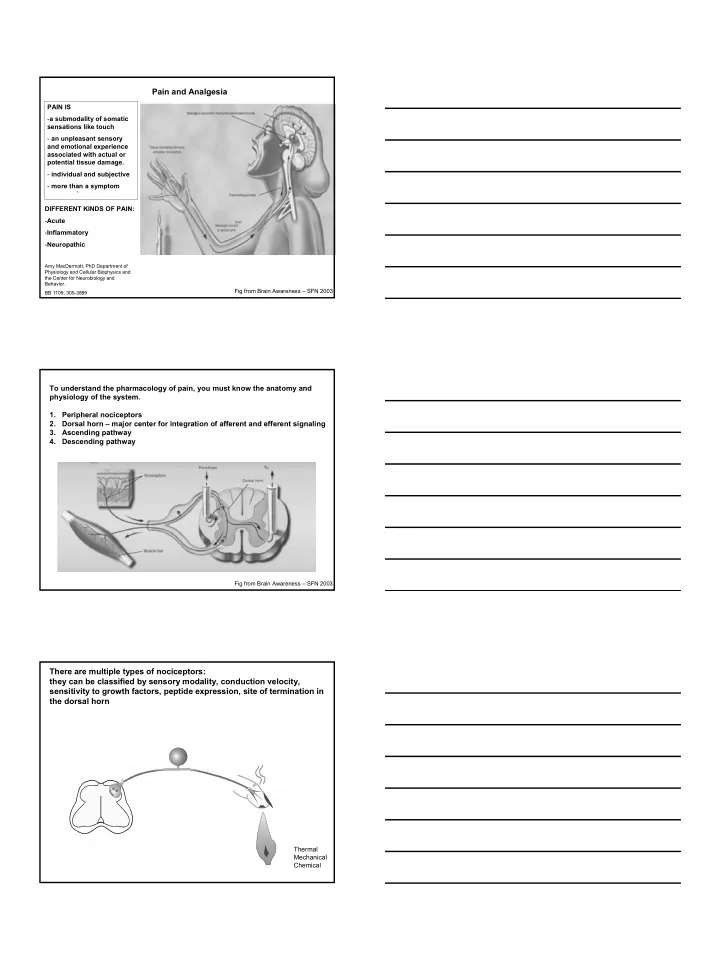
Pain and Analgesia PAIN IS - a submodality of somatic sensations like touch - an unpleasant sensory and emotional experience associated with actual or potential tissue damage. - individual and subjective - more than a symptom ` DIFFERENT


slide-1
SLIDE 1

1

Amy MacDermott, PhD Department of Physiology and Cellular Biophysics and the Center for Neurobiology and Behavior. BB 1109, 305-3889

Pain and Analgesia

PAIN IS

  • a submodality of somatic

sensations like touch

  • an unpleasant sensory

and emotional experience associated with actual or potential tissue damage.

  • individual and subjective
  • more than a symptom

` DIFFERENT KINDS OF PAIN:

  • Acute
  • Inflammatory
  • Neuropathic

Fig from Brain Awareness – SFN 2003

To understand the pharmacology of pain, you must know the anatomy and physiology of the system.

  • 1. Peripheral nociceptors
  • 2. Dorsal horn – major center for integration of afferent and efferent signaling
  • 3. Ascending pathway
  • 4. Descending pathway

Fig from Brain Awareness – SFN 2003

DRG Primary Afferent Terminal Peripheral Nerve Ending Spinal Cord Dorsal Root Nociceptor Thermal Mechanical Chemical

There are multiple types of nociceptors: they can be classified by sensory modality, conduction velocity, sensitivity to growth factors, peptide expression, site of termination in the dorsal horn

slide-2
SLIDE 2

2

Signal transduction in nociceptors

Modified from Julius and Basbaum, 2001

VR1/VRL-1 TRPV1 ENaC/DEG ASIC

VR1 – vanilloid receptor 1 or TRPV1 CMR1 – cold and menthol activated receptor 1 or TRPM8 ASIC – acid sensing ion channel Degenerin family

CMR1 TRPM8

TRP

Nociceptor-specific Na+ channels

Dib-Hajj et al, 2002

Afferent fiber conduction and pain

Julius and Basbaum, 2001
  • - Nociceptors include both Aδ and C fibers
  • - Most, but not all, small diameter fibers are nociceptors. Some are thermal

and low threshold mechanoreceptors

slide-3
SLIDE 3

3

Adapted from Fields, 1987

DH

L5

Nociceptive inputs go to lamina I, II and V in the dorsal horn

Adult mammalian spinal cord

Two populations of nociceptors project to different sub- regions of the superficial dorsal horn

Hunt and Mantyh, 2001

(Inflammation) (Chronic pain)

The spinal cord dorsal horn has a heterogeneous cell population including:

  • projection neurons
  • excitatory interneurons
  • inhibitory interneurons
slide-4
SLIDE 4

4

Dorsal horn neurons expressing receptor for substance P, the NK1 receptor.

Lamina I Lamina II Lamina III Lamina I projection neuron

Hunt and Mantyh, 2001

The spinal cord dorsal horn has a heterogeneous cell population including:

  • projection neurons
  • excitatory interneurons
  • inhibitory interneurons

Synaptic transmission in the dorsal horn

  • Nociceptors synapse with dorsal horn neurons in lamina I,

II, and V

  • Nociceptors and local excitatory interneurons release

glutamate as the fast transmitter, some also release co- transmitters such as peptides with slower excitatory action

  • Local inhibitory interneurons release GABA and glycine as

fast transmitters, some also release co-transmitters.

  • Descending inputs synapse with projection neurons,

interneurons, and terminals of the nociceptors

slide-5
SLIDE 5

5

Glutamate receptor families

NMDA receptors (NMDARs) AMPA receptors Kainate receptors metabotropic Glu receptors OUT IN

G L U , N M D A GLU, KA

K+ K+ Na+,Ca2

+

Na+,(Ca2+?)

GLU GLU, KA α γ β ∗ Synaptic transmission between nociceptors and dorsal horn neurons Sensitization in the pain pathway may result in hyperalgesia (hypersensitivity to a noxious stimulus) and allodynia (pain that results from a non-noxious stimulus).

  • Peripheral sensitization

skin and viscera

  • Central sensitization

dorsal horn higher centers

slide-6
SLIDE 6

6

Thermal injury can cause hyperalgesia

Kandel, Schwartz Jessell Ch 24

Mechanical thresholds for pain were tested at sites A,B, and C before and after burns at sites A and D. 53oC stimulus at both sites for 30 sec

Peripheral terminals of primary afferent nociceptors respond to inflammatory mediators

Julius and Basbaum, 2001

ATP, Ach and serotonin released from damaged endothelial cells and platelets Histamine from mast cells Bradykinin from plasma kininogen

Central sensitization is sometimes due to neural plasticity in the spinal cord dorsal horn:

  • Activation of nociceptive dorsal horn neurons
  • Modulation producing long lasting central sensitization
slide-7
SLIDE 7

7

Activation of neural plasticity in the spinal cord dorsal horn: fast EPSPs

Woolf and Salter, 2000

Modulation of neural plasticity in the spinal cord dorsal horn: altered connectivity and cell death

Woolf and Salter, 2000

Prostanoids and central sensitization

slide-8
SLIDE 8

8

Ascending nociceptive pathway

Wall and Melzack, Ch 7

–Spinothalamic tract (STT)

  • Lamina I – mostly high threshold

input, fibers cross to lateral funiculus – many projections ascend to the thalamus – carry pain and temperature info

  • Lamina V – some low and high

threshold input, fibers cross to anterior STT – many projections as ascends to thalamus - also important in pain signaling

–Spinoreticular (SRT) and –Spinomesencephalic tract (SMT) –Spinohypothalamic tract (SHT)

Descending pathway that regulates nociceptive signaling in dorsal horn

Wall and Melzack, Ch 11 Kandel, Schwartz, Jessell Ch 24
  • Descending Pathway

–Periaqueductal grey (PAG) –Dorsolateral pontomesencephalic tegmentum (DLMT) –Rostral ventromedial medulla (RVM)

–Nucleus raphe magnus –Reticular formation

–Dorsal horn

Descending brainstem connections for pain modulation: on and off cells

Wall and Melzack,
slide-9
SLIDE 9

9

Opioids are important regulators of nociceptive signaling and they act at many levels of the nervous system:

  • primary afferents
  • dorsal horn neurons
  • higher centers
Kandel Schwartz Jessell Ch 24 Norepinephrine Serotonin Nociceptor Projection neuron

(RVM)

Opioid receptors – 3 gene families

Bonica’s Management of Pain Ch 4

µ opioid receptor – activated by morphine, β endorphin and enkephalins κopioid receptor activated by dynorphin δ opioid receptors activated by enkephalins and β endorphin

Opioid receptor action

Bonica’s Management of Pain Ch 4
slide-10
SLIDE 10

10

Local circuit interneurons

Kandel, Schwartz, Jessell Ch 24 DRG Primary Afferent Terminal Peripheral Nerve Ending Spinal Cord Dorsal Root Nociceptor
  • There are multiple types of nociceptors: they can differ by sensitivity to

growth factors, peptide expression, conduction velocity, sensory modality

  • All nociceptors release glutamate thus glutamate receptors are potential

targets for pain management

  • Sensitization occurs peripherally and centrally
  • Dorsal horn neurons project to multiple higher levels in the brain and

receive descending regulatory input from those same areas

  • There are good targets for pain management on peripheral and central

terminals of nociceptors as well as through regulation of inhibition in the dorsal horn

Summary: