1 BCSE: Review of manuscripts BCSE: Review of manuscripts review - - PDF document

1
SMART_READER_LITE
LIVE PREVIEW

1 BCSE: Review of manuscripts BCSE: Review of manuscripts review - - PDF document

CSE: Background Improving Scientific Writing The Chemical Society of Ethiopia (CSE) the BCSE Experience founded in 1983 a leading scientific society in Ethiopia B.S. Chandravanshi development and promotion of chemistry in


slide-1
SLIDE 1

1

Improving Scientific Writing – the BCSE Experience

B.S. Chandravanshi Editor-in-Chief, Bulletin of the Chemical Society of Ethiopia (BCSE) bcse@chem.aau.edu.et AuthorAID @ INASP Workshop March 8, 2008

2

CSE: Background

The Chemical Society of Ethiopia (CSE)

  • founded in 1983
  • a leading scientific society in Ethiopia
  • development and promotion of chemistry in
  • education
  • industry
  • agriculture
  • environment
  • research
  • major activities: publication of the Bulletin of

the Chemical Society of Ethiopia (BCSE)

3

Bulletin of the Chemical Society of Ethiopia (BCSE)

The BCSE was established in 1987 Aim

  • to provide a national and international platform

for exchange of information through scientific publication Frequency

  • Biannual (June and December, 1987-2006)
  • Triannual (April, August, December, from 2007)
  • Quarterly (March, June, September, December,

from 2011 ?)

4

Bulletin of the Chemical Society of Ethiopia (BCSE) Field

  • all fields of basic and applied chemistry

Types of contribution

  • Full papers
  • Short communications
  • Reviews
  • Feature articles

5

Bulletin of the Chemical Society of Ethiopia (BCSE)

Reputability

  • Gained wide national and international

recognition

  • Indexed and abstracted by international

institutions

  • Chemical Abstracts
  • Chemical Citation Index
  • Environmental Abstracts
  • Renowned ISI index (only science journal in

Africa, excluding South Africa ??)

6

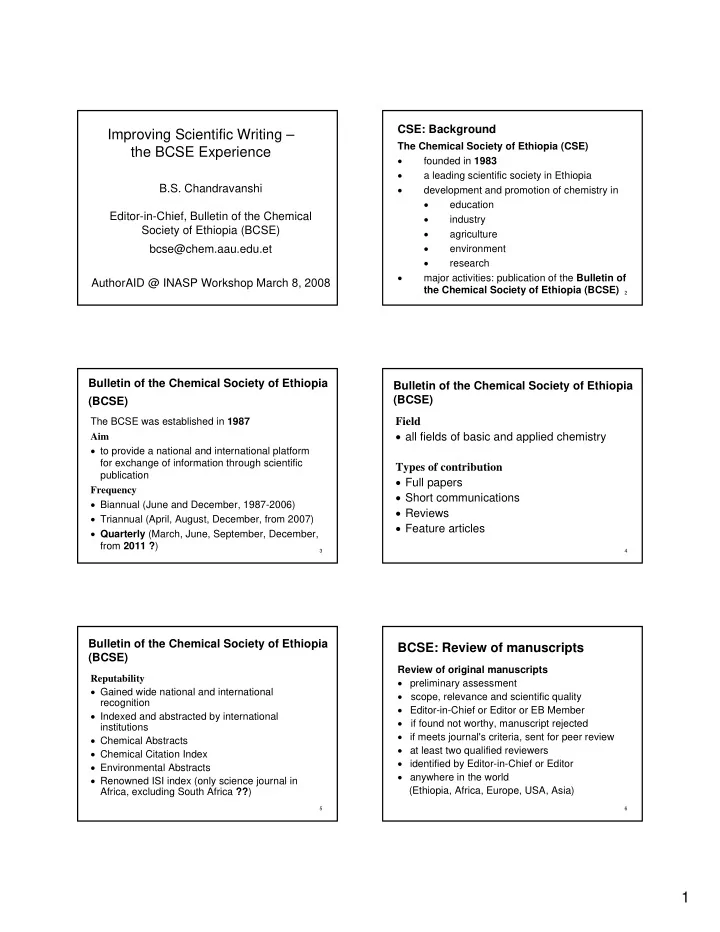
BCSE: Review of manuscripts

Review of original manuscripts

  • preliminary assessment
  • scope, relevance and scientific quality
  • Editor-in-Chief or Editor or EB Member
  • if found not worthy, manuscript rejected
  • if meets journal's criteria, sent for peer review
  • at least two qualified reviewers
  • identified by Editor-in-Chief or Editor
  • anywhere in the world

(Ethiopia, Africa, Europe, USA, Asia)

slide-2
SLIDE 2

2

7

BCSE: Review of manuscripts

  • review conducted against established criteria to

determine scientific and technical quality

  • if both referees recommend rejection,

manuscript rejected

  • if both referees recommend acceptance,

manuscript accepted

  • if one referee recommends acceptance with

modification and other recommends rejection

  • Editor-in-Chief/Editorial Board Member may

review

  • r manuscript will be sent to a third referee

8

BCSE: Review of manuscripts

Review of revised manuscripts

  • Editor-in-Chief or Editor or Editorial Board

Member

  • if necessary (major modification), sent to one or

both referees

  • if referee(s) recommend acceptance, manuscript

accepted

  • if referee(s) recommend rejection, manuscript

rejected

9

BCSE: Review of manuscripts

Accepted manuscripts

  • Acceptance letter sent to author
  • Galley proof sent to author
  • Galley proof corrections made
  • Manuscript published
  • Reprints sent to author

10

BCSE: Manuscripts received 1987-2007

Year/Region Ethiopia Africa Others Total ms/year 1987-1991 15 141 12 168 34 1992-1996 21 134 9 164 33 1997-2001 37 161 22 220 44 2002-2006 39 325 128 492 98 Total 112 761 171 1044 -- % of total 11 73 16 100 -- 2007 9 64 70 143 143 % of total 6 45 49 100 --

11

BCSE: Manuscripts published 1987-2007

Year/Region Ethiopia Africa Others Total ms/issue 1987-1991 21 51 17 89 9 1992-1996 12 56 12 80 8 1997-2001 31 62 11 104 10-11 2002-2006 17 108 26 151 15 Total 81 277 66 424 -- % of total 19 65 16 100 -- 2007 9 29 21 53 18 % of total 5 55 40 100 --

12

BCSE: Online availability

  • Abstracts on African Journals OnLine website:

www.ajol.info (1997 onwards)

  • Full text: www.ingentacomnnect.com

(subscribers) (2001 -2007)

  • Full text: www.ajol.info

(subscribers) (2008 onwards)

slide-3
SLIDE 3

3

13

BCSE: Quality of original manuscripts

Writing quality of original manuscripts

  • 20% very poor
  • 40% poor
  • 30% good
  • 10% very good

14

BCSE: Quality of original manuscripts

Scientific quality of original manuscripts

  • 10% trivial (rejected by initial screening)
  • 20% very poor ((rejected by internal review)
  • 70% good and sent to external (peer) reviewers
  • 25% rejected after peer review
  • 45% accepted after peer review and published

15

BCSE: Experience with authors

Original manuscripts

  • A few authors were found to be plagiarized.

(copied others’ published work and submitted it under their

  • wn names as original work).
  • A few authors submitted the published work as new study

presumably because of inadequate literature survey.

  • Some authors submitted manuscripts with very old literature

(dating back to 1930s, 1940s, 1950s, …).

  • Some authors submitted manuscripts about studies that have

no relevance at present.

  • Some authors submitted 2, 3, or 4 manuscripts (one author

submitted 7 manuscripts) at the same time.

16

BCSE: Experience with authors

Original manuscripts

  • Some authors submitted manuscripts that have been

rejected by other journal (with the name and address of the editor of that journal and specific format of that journal).

  • Some authors submitted manuscripts which are based only
  • n the results collected by technician (without any

discussion) and have no scientific value.

  • Some authors submitted manuscripts that lack originality and

novelty in any aspect of the study.

  • Some authors submitted manuscripts with very poor quality
  • f text, drawing, illustrations and figures.
  • Some authors submitted manuscripts with the results

presented simultaneously both as figures and tables (i.e., repetition of the results).

17

BCSE: Experience with authors

Original manuscripts

  • Many authors submitted manuscripts without following

the format of the journal (the BCSE).

  • Many authors submitted manuscripts without consulting

their co-authors (mainly from Europe and America).

  • Some authors submitted manuscripts to get the

reviewers’ comments, revised the manuscripts and submitted to other journals (better ones on their own rating).

  • Some authors submitted manuscripts of fragmented

nature (divided the manuscript into two or three parts) to get multiple publications.

  • Some authors submitted manuscripts written in French

(including the covering letter).

18

BCSE: Experience with authors

Revised manuscripts

  • Some authors do not submit the revised manuscripts

(they revise and submit to other journals).

  • Some authors do not submit the revised manuscripts on
  • time. They submit the revised manuscripts after 4-6

months (sometimes after one year).

  • Some authors do not revise the manuscript according to

the reviewers’ comments (correct only typos and language) they think that it is sufficient for an African journal.

  • Some authors do not correct the figures, illustrations and
  • drawings. They think that this is the job of the Editor or

the journal has all the software to improve the quality of that figures.

slide-4
SLIDE 4

4

19

BCSE: Experience with authors

Revised manuscripts

  • Some authors includes figures with large dimensions but

with smaller font size of letters in the units and labels or vice versa, which are not possible to edit or correct.

  • Also very frequently they group the figure captions with

the figures, precluding editing or correction.

  • Some authors include large tables with large numbers of

columns and rows that can not fit with the size and format of the journal.

  • Some authors do not correct the references despite

being clearly asked by the Editor, presumably because they do not have the original references. They cited the references from another article.

20

BCSE: Experience with authors

Galley proof of manuscripts

  • One author asked us to withdraw the manuscript when

he received the galley proof, presumably he had simultaneously submitted the revised manuscript to another journal and got a positive response.

  • Some authors do not answer the queries raised with the

galley proof. They think that once the manuscript has been accepted we do not need to answer any questions.

  • Some authors do not reply to galley proof. They think

that either there is no need to read it again or there is not any correction.

  • Some authors do not reply to galley proof because they

do not receive it due to change of e-mail address. They do not inform the journal of their new e-mail address.

21

BCSE: Experience with authors

After publication of manuscripts

  • Some authors ask for reprints after six months or one

year because they did not receive the reprints because

  • f not updating their e-mail address and/or not giving the

full air mail address.

  • Some authors ask for reprints after 3-5 years. They think

that the journal (BCSE) is obliged to send reprints whenever the authors need them.

22

Improving Scientific Writing

  • Identify the problem and set the objectives of the study.
  • Carry out thorough literature survey and identify what

problems persist with existing or reported study.

  • How these problems could be solved and re-set the
  • bjectives of the scientific study.
  • The scientific study should be original and have to have

novelty at least in some expect of the study.

  • Identify suitable journal to publish the results of study.
  • Find the guidelines of that journal and write the

manuscript according to its format.

23

Improving Scientific Writing

The general format of articles in chemistry journals

  • Abstract
  • Key words
  • Introduction
  • Experimental
  • Results and Discussion
  • Conclusion
  • Acknowledgements
  • References
  • The text includes figures, tables, structures,

formulas, equations, etc.

24

Improving Scientific Writing

  • The authors should do an adequate literature search

before writing their manuscript to check whether the same study has been published.

  • Manuscript should be written in simple scientific

language (English).

  • The non-English speaking authors should consult

someone with better English to improve the manuscript

  • The authors should write and submit only one

manuscript at one time to a particular journal.

slide-5
SLIDE 5

5

25

Improving Scientific Writing

  • Do not submit the same manuscript to another journal

simultaneously.

  • Revise and re-write the manuscripts that have been

rejected by other journal before submitting to a new journal according to its guidelines.

  • Consult all the co-authors before submitting the

manuscript to a particular journal.

  • Never copy others’ published work and write a

manuscript on your own name and submit it as original study for publication in a journal published from other part of the world.

26

Improving Scientific Writing

  • The manuscripts should be written with best

possible quality of drawing, illustrations and figures, structures, formulas, and equations.

  • The authors should not present the results

simultaneously both as figures and tables (i.e., repetition of the results).

  • The authors should use standard units (SI units).

27

Improving Scientific Writing

  • Do not write and submit manuscripts to any

journal if the study has no relevance at present.

  • Do not write and submit manuscripts to any

journal that are based only on the results collected by technician (without any discussion) and have no scientific value.

  • Write a complete manuscript, i.e. do not divide

the manuscript into two or three parts to get multiple publications.

  • Do not submit manuscripts, just to get the

reviewers comments, revise them and submit them to other journals.

28

Improving Scientific Writing

  • Revise the manuscripts on time. Do not submit the

revised manuscripts to other journals without formerly withdrawing the manuscripts with valid reasons.

  • Revise the manuscript according to the reviewers’

comments (correcting not only typos and language but also revising the manuscript for its scientific contents).

  • Do not submit the revised manuscript to any other

journal unless the manuscript is rejected by the journal to which the original manuscript was submitted.

29

Improving Scientific Writing

  • Correct the figures, illustrations and drawings whenever

asked by the reviewers or the editors of the journal. The preparation of the whole manuscript is your own responsibility.

  • Do not includes figures with large dimensions with

relatively smaller font size of letters in the units and labels or vice versa,

  • Do not group the figure captions with the figures. List the

captions separately.

  • Always check and correct the references whenever

asked by the reviewer or Editor.

30

Improving Scientific Writing

  • Never cite references which are not available to you.
  • Never cite references from another article (cross reference)

without having access to them.

  • Do not include large sized tables with large numbers of

columns and rows, which can not fit with the size of the journal.

  • The large tables can be divided into two tables if necessary.
slide-6
SLIDE 6

6

31

Improving Scientific Writing

Galley proof of manuscripts

  • Do not ask the journal to withdraw the manuscript after

receiving the galley proof.

  • Answer all the queries raised with the galley proof.
  • Read the galley proof carefully and reply to the journal

even if there is not any correction.

  • If your e-mail address or air mail address changes, tell the

journal (and the publisher), so that the galley proof and reprints reach you.

32

AuthorAID @ INASP Workshop

Acknowledgements

  • The INASP
  • Prof. Barbara Gastel
  • Ms Julie Walker
  • Mrs Sioux Cumming
  • Bulletin of the Chemical Society of Ethiopia
  • The Chemical Society of Ethiopia