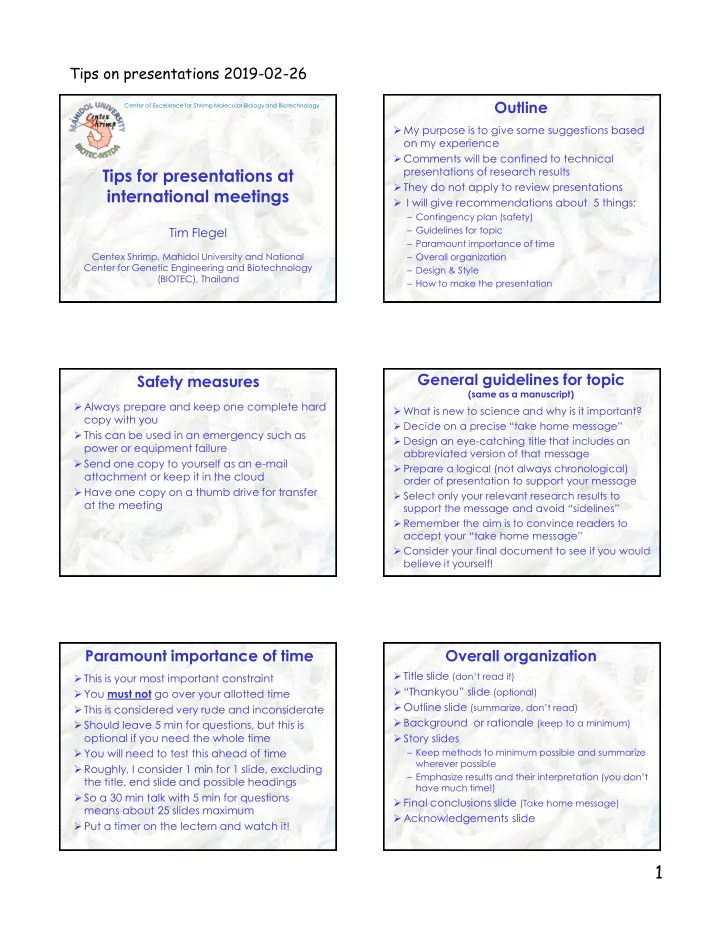

SLIDE 1
Tips on presentations 2019-02-26
1 Tips for presentations at international meetings
Tim Flegel
Centex Shrimp, Mahidol University and National Center for Genetic Engineering and Biotechnology (BIOTEC), Thailand
Center of Excellence for Shrimp Molecular Biology and Biotechnology
Outline
- My purpose is to give some suggestions based
- n my experience
- Comments will be confined to technical
presentations of research results
- They do not apply to review presentations
- I will give recommendations about 5 things:
– Contingency plan (safety) – Guidelines for topic – Paramount importance of time – Overall organization – Design & Style – How to make the presentation
Safety measures
- Always prepare and keep one complete hard
copy with you
- This can be used in an emergency such as
power or equipment failure
- Send one copy to yourself as an e-mail
attachment or keep it in the cloud
- Have one copy on a thumb drive for transfer
at the meeting
General guidelines for topic
(same as a manuscript)
- What is new to science and why is it important?
- Decide on a precise “take home message”
- Design an eye-catching title that includes an
abbreviated version of that message
- Prepare a logical (not always chronological)
- rder of presentation to support your message
- Select only your relevant research results to
support the message and avoid “sidelines”
- Remember the aim is to convince readers to
accept your “take home message”
- Consider your final document to see if you would
believe it yourself!
Paramount importance of time
- This is your most important constraint
- You must not go over your allotted time
- This is considered very rude and inconsiderate
- Should leave 5 min for questions, but this is
- ptional if you need the whole time
- You will need to test this ahead of time
- Roughly, I consider 1 min for 1 slide, excluding
the title, end slide and possible headings
- So a 30 min talk with 5 min for questions
means about 25 slides maximum
- Put a timer on the lectern and watch it!
Overall organization
- Title slide (don’t read it)
- “Thankyou” slide (optional)
- Outline slide (summarize, don’t read)
- Background or rationale (keep to a minimum)
- Story slides
– Keep methods to minimum possible and summarize wherever possible – Emphasize results and their interpretation (you don’t have much time!)
- Final conclusions slide (Take home message)
- Acknowledgements slide