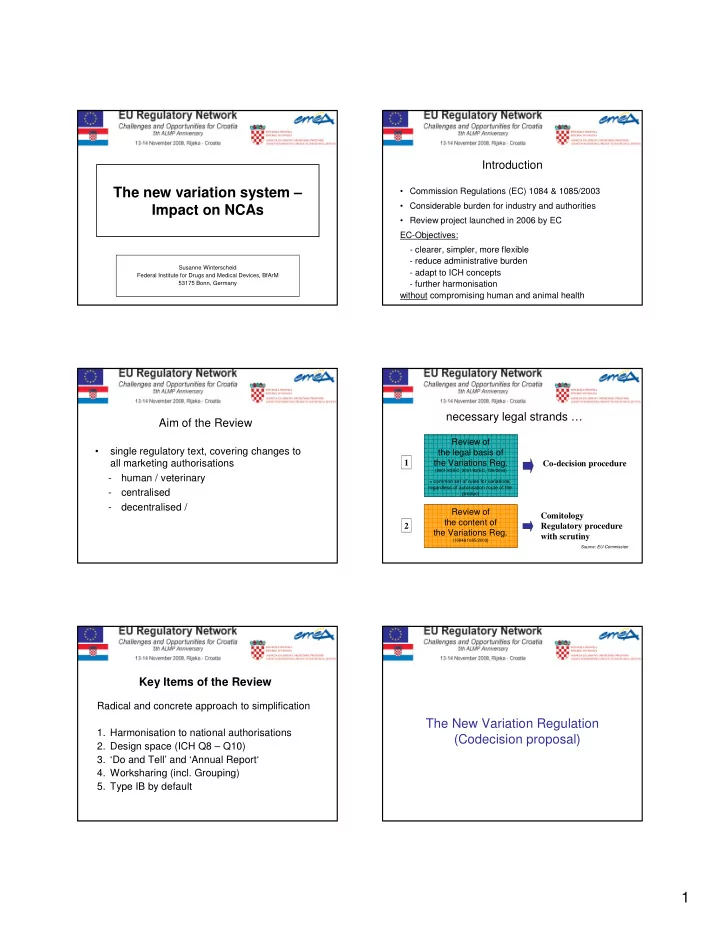
1 Key Item 1: Harmonisation Initial Marketing Authorisation - - PDF document

1
SMART_READER_LITE
LIVE PREVIEW

1 Key Item 1: Harmonisation Initial Marketing Authorisation - - PDF document

Introduction The new variation system Commission Regulations (EC) 1084 & 1085/2003 Considerable burden for industry and authorities Impact on NCAs Review project launched in 2006 by EC EC-Objectives: - clearer, simpler,


slide-1
SLIDE 1

1

The new variation system – Impact on NCAs

Susanne Winterscheid Federal Institute for Drugs and Medical Devices, BfArM 53175 Bonn, Germany

  • Commission Regulations (EC) 1084 & 1085/2003
  • Considerable burden for industry and authorities
  • Review project launched in 2006 by EC

EC-Objectives:

  • clearer, simpler, more flexible
  • reduce administrative burden
  • adapt to ICH concepts
  • further harmonisation

without compromising human and animal health

Introduction Aim of the Review

  • single regulatory text, covering changes to

all marketing authorisations

  • human / veterinary
  • centralised
  • decentralised /

Review of the legal basis of the Variations Reg.

(2001/83/EC, 2001/82/EC, 726/2004)

= common set of rules for variations, regardless of autorisation route of the product

1 Co-decision procedure Review of the content of the Variations Reg.

(1084&1085/2003)

2 Comitology Regulatory procedure with scrutiny

necessary legal strands …

Source: EU-Commission

Key Items of the Review

Radical and concrete approach to simplification

  • 1. Harmonisation to national authorisations
  • 2. Design space (ICH Q8 – Q10)
  • 3. ‘Do and Tell’ and ‘Annual Report‘
  • 4. Worksharing (incl. Grouping)
  • 5. Type IB by default

The New Variation Regulation (Codecision proposal)

slide-2
SLIDE 2

2

‘Purely National’ Mutual recognition Centr.

Initial Marketing Authorisation Post- authorisation changes

2001/83/EC 2001/82/EC 726/2004

Variations Regulations National variation rules

1084/2003 1085/2003

1% 15% 84%

Key Item 1: Harmonisation

Source: EU-Commission

Current situation with national variations

Independent System

  • eg. AT (§ 24 AMG), DE (§ 29 AMG)

Mixed System categorisation of changes according to CR 1084/2003 - but different time lines Full Implementation of CR 1084/2003 Current variation system in DE The current variation system in Germany is a smooth, unbureaucratic and effective system based on the legal self-responsibility of the MAH based on a defined list of major variations whole rest are simple notifications implicit approval of approval procedures after 3 months Germany has high interest in achieving a European system as simple as the national one

Co-decision part – current status

  • 1. Public Consultation (Start: 10 July 2007)
  • 2. Outcome of the Public Consultation (03

October 2007): 19 written responses

  • 3. Adoption of the Commission proposal on

variations (04 March 2008)

  • 4. Adoption by the European Parliament (22

October 2008)

  • 5. Council discussion during the Slovenien and

French Presidency Where to find published informations?

  • The New Variation Regulation

(Comitology proposal)

slide-3
SLIDE 3

3

Comitology part – current status

  • 1. Public Consultation (Start: 25 October 2007)
  • 2. Outcome of the Public Consultation (14

January 2008): 48 written responses + discussion with Pharm Committee, HMA, NtA, CMD and Industry

  • 3. First discussion of an incomplete draft of the

EC (03 April 2008) in the Standing Committees (SC‘s)

  • 4. Further SC‘s discussion on 02 June 2008
  • 5. Final discussion and voting on 10 June 2008
  • 6. Scrutiny process until 13 September 2008

Scope of the new Variation Regulation

As currently

  • ex-concertation/MRP/DCP
  • following harmonisation (Article 30 and 31(1))

for authorised medicinal products Outside:

  • change of the MAH
  • changes to registered homeopathic and

traditional herbal medicinal product (despite they are elegible for the MRP/DCP)

Key Item 2: Design space

Design space

  • implementation of ICH Q8-Q10
  • changes within the approved design space

are no notifications or variations Introduction

  • as part of an initial marketing authorisation
  • as a Type II Variation

new design space change to an approved design space

Key Item 3: „Do and Tell“ (Type IA)

  • (can be) implemented by the MAH before

notification to CA

  • reporting to CA either

– immediately (for defined Type IA eg change

  • f address, … )

– within 12 months at the latest (no fixed date, ‚Annual Report‘) – ‚Annual Report‘ alone or together with an immediate reporting

Key Item 4: Two Key Definitions … Grouping what to place in one application Worksharing how to evaluate an application therefore worksharing on a grouped application is possible Key Item 4: Grouping

  • 2-dimensional matrix

– several changes to one MA – identical change to several MA‘s – (several identical changes to several MA) at the same time for the same MAH

  • classification according to the highest level of the

individual submission type

  • ptional for the MAH all or nothing approach?

No, as you submit an application, but CA grant a variation

slide-4
SLIDE 4

4

  • for „… several MA‘s owned by the same holder.“
  • for Type IB, Type II and grouped variations
  • Coordination

– Agency - if one central MA is included – CMD (h/v) - in all other cases

  • Evaluation (‚reference authority‘)

– Agency: Scientific Committees eg. CHMP – CMD: CA of a MS concerned, chosen by CMD considering recommendation by MAH

Key Item 4: Worksharing - (1)

  • Procedure

– submission of application to all CA concerned – validation by ‚reference authority‘ – timeframe of a Type II-variation

  • possibility of a clock stop
  • scientific opinion within 60 days (standard

procedure)

  • reduction (safety, 30 days) or extension

(indications, 90 days) – relevant authorities (concerned by the application) shall recognise the opinion of the ‚reference authority‘ within 30 days or raise PSRPH (resulting in a CMD or CHMP referral)

Key Item 5: Worksharing - (2) Key Item 5: „Type IB by default“ - (1)

  • defined lists in classification Guideline for

Type IA, II and line extensions (regularly amended

by IB variations after Art. 5 procedure)

  • unlisted changes are by definition Type IB

but, if during the validation the CA consider a significant impact on quality, safety or efficacy, the application is considered a Type II variation

„Type IB by default“ - (2)

… cont.

alternative:

  • MAH can ask CMD (national MA) or Agency

(central MA) for a scientific recommendation

  • n the classification of unlisted changes
  • scientific recommendation within 45 days

from CMD or Agency

  • CMD and Agency shall cooperate and publish

the scientific recommendations following deletion of commercial confidential informations (and this will effectively lead to an update of the Guidelines)

Other items - (1)

  • National implementation of SPC, PL and labelling

after a Type II-Variation? – implicit approval within 30 days after submission of (high quality) translations

  • How long should/could be the current stock on the

market? – national issue

  • Referrals

– for Type II and Worksharing (but Article 35(2) of Directive 2001/83/EC, as amended is applicable) –

  • nly by NCA (not MAH!)

Other items - (2)

  • Implementation

– the current Variation Regulations shall continue to apply for valid notifications or pending variations – shall enter into force on the 20th day following publication – shall apply from <1 year after entry into force>, with the exception of Article 5 (Recommendation on unforeseen variations)

slide-5
SLIDE 5

5

2008 2009 2010 2011

Adoption EC proposal

Co-decision

EC adoption (MRP/CP

  • nly)

Transitional period Transitional period Application of the new rules (MRP/CP only)

Fully harmonised system applies

Inclusion of purely national variations

(3rd step comitology proposal)

Codecision Comitology

1 2 3

Source: EU-Commission; modified

Next Steps … - (1)

  • Co-decision:

– ongoing discussion in the Council – 1st reading finished in Parliament

  • Comitology:

– scrutiny procedure at EP until 13th September 2008 – formal adoption by EC and publication

  • Further work on other items:

– Key Item 1 – Fees (Council Regulation for the CP)

Next Steps … - (2)

Guidelines

  • Procedural Guideline Proposal

– CMD (h+v) subgroup – EMEA – CxMP

  • Classification Guideline Proposal

– CMD (h + v) – EMEA – QWP – BWP – IWP

Next Steps … - (3)

  • cont. Guidelines
  • The WGs on the Procedural and the

Classification Guideline Proposal are coordinated by the ‘Variation Task Force‘: –EMEA –CHMP –CVMP –CMD (h)/(v) Next Steps … - (4)

  • cont. Guidelines
  • The guidelines will be forwarded by the

‘Variation Task Force‘ to the European Commission and thereafter for external consultation

Conclusion

Commission proposal is a big step into right direction Many aspects of the simple German system have been considered New variation system is expected to disburden the NCAs from huge workload with variation procedures NCAs will be involved in further development through Variation Subgroup and other Committees and working groups Classification and Procedural Guidelines should be finalized asap and well before implementation of the new system …

slide-6
SLIDE 6

6

Thank you for your attention!

List of Abbreviations

  • CMS

= Concerned Member State(s)

  • CP

= Centralized Procedure

  • CR

= Commission Regulation

  • DCP

= Decentralized Procedure

  • MA

= Marketing Authorisation

  • MRP

= Mutual Recognition Procedure

  • NCA

= National Competent Authority

  • NtA

= Notice to Applicants

  • PIL

= Patient Information Leaflet

  • RMS

= Reference Member State

  • SPC

= Summary of Product Characteristics