1 The current landscape of trade secret law 09/30/16 4 Enactment - - PDF document

1
SMART_READER_LITE
LIVE PREVIEW

1 The current landscape of trade secret law 09/30/16 4 Enactment - - PDF document

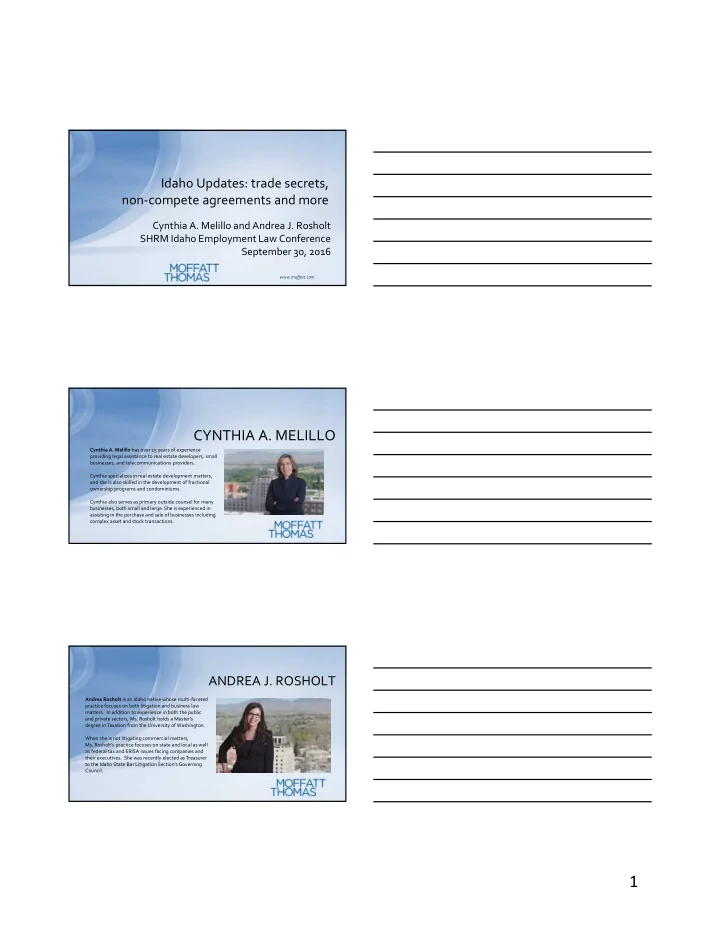
Idaho Updates: trade secrets, non-compete agreements and more Cynthia A. Melillo and Andrea J. Rosholt SHRM Idaho Employment Law Conference September 30, 2016 www.moffatt.com CYNTHIA A. MELILLO Cynthia A. Melillo has over 15 years of


slide-1
SLIDE 1

1

Cynthia A. Melillo and Andrea J. Rosholt SHRM Idaho Employment Law Conference September 30, 2016

Idaho Updates: trade secrets, non-compete agreements and more

www.moffatt.com

CYNTHIA A. MELILLO

Cynthia A. Melillo has over 15 years of experience providing legal assistance to real estate developers, small businesses, and telecommunications providers. Cynthia specializes in real estate development matters, and she is also skilled in the development of fractional

  • wnership programs and condominiums.

Cynthia also serves as primary outside counsel for many businesses, both small and large. She is experienced in assisting in the purchase and sale of businesses including complex asset and stock transactions.

ANDREA J. ROSHOLT

Andrea Rosholt is an Idaho native whose multi-faceted practice focuses on both litigation and business law

  • matters. In addition to experience in both the public

and private sectors, Ms. Rosholt holds a Master’s degree inTaxation from the University of Washington. When she is not litigating commercial matters,

  • Ms. Rosholt’s practice focuses on state and local as well

as federal tax and ERISA issues facing companies and their executives. She was recently elected asTreasurer to the Idaho State Bar Litigation Section’s Governing Council.

slide-2
SLIDE 2

2

The current landscape of trade secret law

09/30/16 4

On May 11, 2016, President Obama signed the Defend Trade Secrets Act of 2016, Pub. L. 114-153, May 11, 2016, 130 Stat. 376 (to be codified at 18 U.S.C. § 1836) (“DTSA”).

  • The creates a federal cause of action for alleged trade secret

misappropriations and provides plaintiffs with the choice between litigating in state or federal court.

  • The DTSA is not intended to preempt an employer’s rights under

the Idaho Trade Secrets Act.

  • The DTSA includes three key provisions of the DTSA that have a

direct impact on Idaho employers.

Enactment of the Defend Trade Secrets Act

09/30/16 5

  • First, the DTSA provides aggrieved employers with the right of

“seizure” of a misappropriated trade secrets in certain circumstances.

  • Second, the DTSA creates statutory immunity to employees and

independent contractors under both state and federal law.

  • Third, the DTSA requires employers to provide notice of the

statutory immunity to employees and independent contractors in any contract or agreement with an employee / independent contractor.

Three key provisions of the DTSA that have a direct impact on Idaho employers.

09/30/16 6

slide-3
SLIDE 3

3

Idaho Trade Secrets Act Federal Defend Trade Secrets Act Effective Date N/A enacted in 1981 Any act covered under the statute that

  • ccurs on or after May 11, 2016.

Where can I bring suit or be sued (Jurisdiction) Must file lawsuit in state court unless you can establish diversity of citizenship. Can file in state or federal court. See 18 U.S.C. § 1836 (c). Preemption Displacement Yes; see IDAHOCODE § 48-806. An action under the ITSA preempts / displaces any conflicting tort, restitutionary and other law

  • f the state providing civil remedies for

misappropriation of a trade secret. Limited; see 18 U.S.C. § 1838 Except as provided in § 1833(b), this chapter shall not be construed to preempt or displace any other remedies . . . for the misappropriation

  • f a trade secret.

Comparison of ITSA vs. DTSA

09/30/16 7 Idaho Trade Secrets Act Federal Defend Trade Secrets Act

What is and is not a trade secret?

information, including a formula, pattern, compilation, program, computer program, device, method, technique, or process, that: (a) Derives independent economic value, actual or potential, from not being generally known to, and not being readily ascertainable by proper means by, other persons who can obtain economic value from its disclosure or use; and (b) Is the subject of efforts that are reasonable under the circumstances to maintain its secrecy. Trade secrets as defined in this subsection are subject to disclosure by a public agency according to chapter 1, title 74, Idaho Code. IDAHO CODE § 48-801(5) all forms and types of financial, business, scientific, technical, economic, or engineering information, including patterns, plans, compilations, program devices, formulas, designs, prototypes, methods, techniques, processes, procedures, programs, or codes, whether tangible or intangible, and whether or how stored, compiled, or memorialized physically, electronically, graphically, photographically, or in writing if— (A) the owner thereof has taken reasonable measures to keep such information secret; and (B) the information derives independent economic value, actual or potential, from not being generally known to, and not being readily ascertainable through proper means by, another person who can

  • btain economic value from the disclosure or use
  • f the information.

See 18 U.S.C. § 1839(3).

09/30/16 8

AvailableRemedies Idaho Trade Secrets Act Defend Trade Secrets Act

Injunctive relief available? Yes; IDAHO CODE § 48-802(1) Yes; 18 U.S.C. § 1836(b)(3) What must employer prove to get injunctive relief? Actual or threatened misappropriation may be enjoined. Actual or threatened misappropriation may be enjoined. Scope of injunctive relief available (1) Injunction will last until the trade secret ceases to exist or for a reasonable time (2) In exceptional cases the court may condition use on payment of reasonably royalty (3) The court may impose affirmative acts to protect the trade secret. (1) On such terms as the court deems reasonable (2) In exceptional circumstances the court may condition future use on payment of reasonable royalty (3) The court may impose affirmative acts to protect the trade secret

09/30/16 9
slide-4
SLIDE 4

4

Limitation of Idaho Trade Secret Act

Idaho’s Supreme Court has rejected the “inevitable disclosure” doctrine. See, e.g., Northwest Bec-Corp v. Home Living Serv., Inc., 136 Idaho 835, 839, 41 P.3d 263, 267 (2002), providing in pertinent part:

“[T]he legislature did not intend the [ITSA] to be read so broadly as to preclude the hiring of an employee from a competitor; the legislature also did not intend that merely hiring a competitor’s employee constitutes acquiring a trade secret.” Instead, “[a]n employee will naturally take with her to a new company the skills, training, and knowledge she has acquired from her time with her previous employer. This basic transfer of information cannot be stopped, unless an employee is not allowed to pursue her livelihood by changing employers.”

Defend Trade Secrets Act

The DTSA provides the same result. An injunction under federal law cannot:

  • (I) prevent a person from entering into an

employment relationship, and that conditions placed on such employment shall be based on evidence of threatened misappropriation and not merely on the information the person knows; or

  • (II) otherwise conflict with an applicable

State law prohibiting restraints on the practice of a lawful profession, trade, or business;

Limitation on injunctive relief

09/30/16 10

The recently enacted Defend Trade Secrets Act of 2016 (“DTSA”), 18 U.S.C. § 1836, permits a party to file an ex parte application, supported by affidavit or verified complaint, for an “order requiring seizure of property necessary to prevent the propagation or dissemination of the trade secret that is the subject of the action.” 18 U.S.C. § 1836(b)(2)(A)(i).

First Major provision DTSA: Civil Seizure

09/30/16 11

Applicant must submit a sworn statement: i.e., affidavit or verified complaint, that establishes the following: 1. Injunctive relief would be inadequate; 2. Immediate and irreparable injury will occur if seizure is not

  • rdered;

3. The harm to the applicant in denying the application outweighs the harm to the legitimate interests of the person against whom seizure would be ordered;

What must an employer / competitor do to establish a right to civil seizure?

09/30/16 12

slide-5
SLIDE 5

5

1. The applicant is likely to succeed in showing that the information is a trade secret; and the person against whom seizure would be ordered misappropriated the trade secret of the applicant by improper means; or conspired to use improper means to misappropriate the trade secret of the applicant; 2. the person against whom seizure would be ordered has actual possession of the trade secret and any property to be seized; 3. the application describes with reasonable particularity the matter to be seized and, to the extent reasonable under the circumstances, identifies the location where the matter is to be seized; 4. the person against whom seizure would be ordered, or persons acting in concert with such person, would destroy, move, hide, or otherwise make such matter inaccessible to the court, if the applicant were to proceed on notice to such person; and 5. the applicant has not publicized the requested seizure.

Requirements for Seizure Continued . . .

09/30/16 13

Any person who suffers damages from wrongful seizure has a cause of action against the applicant for the following relief:

  • damages for lost profits, cost of materials, loss of good

will, and punitive damages in instances where the seizure was sought in bad faith, and, unless the court finds extenuating circumstances, to recover a reasonable attorney’s fee. Plus, the court in its discretion may award prejudgment interest

The Seizure Remedy under the FDTSA: You better be right

09/30/16 14

Idaho Trade Secrets Act Federal Defend Trade Secrets Act

What general damages are available? Yes; see IdahoCode § 48-803, providing the following general damages: damage for actual loss; damages for any unjust enrichment; imposition of a reasonable royalty for the misappropriators unauthorized use. Yes; see 18U.S.C. § 1836(b)(3), providing the following general damages: damage for actual loss; and damages for any unjust enrichment; or imposition of a reasonable royalty for the misappropriator’s unauthorized disclosure.

Remedies Continued . . .

09/30/16 15

slide-6
SLIDE 6

6

Idaho Trade Secrets Act Federal Defend Trade Secrets Act

What exemplary or punitivedamages are available? Yes; see IdahoCode § 48-803(2) awardingexemplary damages in an amountnot exceeding twiceany general damagesaward. In the event of willful and malicious injury, an awardof twotimes (2x) general damages. Can I recover my attorneyfees? No; but see IdahoCode §§ 12-120(3) and 12-121. Yes; see 18 U.S.C. § 1836(b)(3)(D). Attorneyfees are awardableto the prevailing party,but only in the following circumstances: a claim of misappropriation ismade in bad faith; a motionto terminatean injunctionis made or

  • pposed in bad faith; or

the trade secret was willfully and maliciously misappropriated 09/30/16 16

Section 1833(b), provides that an individual shall not be held criminally or civilly liable under any Federal or State trade secret law for the disclosure

  • f a trade secret that is made:
  • (1) In confidence to a Federal, State or local government official, either

directly or indirectly, or to an attorney and solely for the purpose of reporting and investigating a suspected violation of law;

  • (2) in a complaint or other document filed in a lawsuit or other

proceeding so long as filed under seal; or

  • (3) In an anti-retaliation lawsuit so long as the employee files the

document under seal and does not disclose the trade secret except under court order.

Second Major provision of the DTSA: State and Federal immunity

09/30/16 17

  • Employers are statutorily required to give notice to employees and

independent contractors of the immunities set forth in section 1833(b) in any contract or agreement with an employee that governs the use of a trade secret or other confidential information.

  • An employer who does not provide notice is not entitled to an

award of exemplary damages or attorney fees under Section 1836(b)(3) in an action against an employee to whom notice was not provided.

  • The term “employee” includes independent contractors and
  • consultants. § 1833(b)(4).

Third Major provision of the DTSA: Employer notice requirement

09/30/16 18

slide-7
SLIDE 7

7

Immunity from Liability for Disclosure of a Trade Secret. Notwithstanding anything to the contrary, an employee or individual performing work as a contractor or consultant shall not be held criminally or civilly liable under any Federal or State trade secret law for the disclosure of a trade secret that is made: (1) in confidence to a Federal, State or local government official, either directly or indirectly, or to an attorney and solely for the purpose

  • f reporting and investigating a suspected violation of law; (2) in a

complaint or other document filed in a lawsuit or other proceeding so long as filed under seal; or (3) in an anti-retaliation lawsuit so long as the employee files the document under seal and does not disclose the trade secret except under court order.

Proposed language:

09/30/16 19

  • Employers need to update their NDAs to include

the “immunity” notice for employees, contractors and consultants.

  • NDAs cannot serve as a basis, under either state or

federal law, to prohibit departing employees from working for direct competitors.

Take Away

09/30/16 20

The Restatement (Third) of Agency § 8.04states that:

Throughout the duration of an agency relationship, an agent has a duty to refrain from competing with the principal and from taking action on behalf of or otherwise assisting the principal’s

  • competitors. During that time, an agent may take action, not
  • therwise wrongful, to prepare for competition following

termination of the agency relationship.

Wesco Autobody Supply Inc. v. Ernest, 149 Idaho 881, 243 P.3d 1069 (2010).

Common law duties owed by all employees:

09/30/16 21

slide-8
SLIDE 8

8

  • Permits employers to condition a key employee or independent

contractor’s employment or continued employment on a written non-competition agreement that prohibits the key employee or key independent contractor from engaging in employment or a line of business that is in direct competition with the employer’s business after termination of employment.

  • There is a rebuttable presumption that an employee or independent

contractor who is among the highest paid five percent (5%) of the employer’s employees or independent contractors is a “key employee” or a “key independent contractor.”

Non-Competition Clauses Idaho Code § 44-2701 et seq.

09/30/16 22

A non-competition agreement or covenant will be held enforceable if it is:

  • reasonable as to its duration, geographical area,

type of employment or line of business, and

  • does not impose a greater restraint than is

reasonably necessary to protect the employer’s legitimate business interests.

Non-Competition Clauses cont…

09/30/16 23

It shall be a rebuttable presumption that:

  • (1) an agreement or covenant with a postemployment term of

eighteen (18) months or less is reasonable as to duration.

  • (2) an agreement or covenant is reasonable as to geographic area

if it is restricted to the geographic areas in which the key employee

  • r key independent contractor provided services or had a

significant presence or influence.

  • (3) an agreement or covenant is reasonable as to type of

employment or line of business if it is limited to the type of employment or line of business conducted by the key employee or key independent contractor while working for the employer.

Pursuant to the law

09/30/16 24

slide-9
SLIDE 9

9

If a court finds that a key employee or key independent contractor is in breach of an agreement or a covenant, a rebuttable presumption of irreparable harm has been established. To rebut such presumption, the key employee or key independent contractor must show that the key employee or key independent contractor has no ability to adversely affect the employer’s legitimate business interests.

Available remedies

09/30/16 25

[A]n agreement or covenant containing a postemployment restriction of direct competition that exceeds a period of eighteen (18) months from the time of the key employee’s or key independent contractor’s termination is unenforceable (i.e. void) unless consideration, in addition to employment or continued employment, is given to a key employee

  • r key independent contractor. IDAHO CODE

§ 44-2704

Restrictions

09/30/16 26

  • Idaho common law will apply.
  • Pursuant to Idaho common law, non-competition

agreements are disfavored and will be narrowly construed in favor of the employee.

  • Focus is on whether non-competition agreement is

reasonably necessary to protect the legitimate business interests of the employer.

What about employees that don’t meet the “key employee” threshold?

09/30/16 27

slide-10
SLIDE 10

10

“Legitimate business interests” include “an employer’s goodwill, technologies, intellectual property, business plans, business processes and methods of operation, customers, customer lists, customer contacts and referral sources, vendors and vendor contacts, financial and marketing information, and trade secrets as that term is defined by chapter 8, title 48, Idaho Code.”

What are “legitimate business interests?”

09/30/16 28

State General Description of Law

California (BUS. & PROF. CODE 16600-16607)

It is considered a fundamental policy of the State of California that agreements in restraint of competition are to that extent void. Exceptions: (1) Upon the sale of the “goodwill of a business” or ownership interest in a business entity. (2) Dissolution of a partnership or limited liability company. ***In addition, out of state non-compete agreements may be declared void where an employee seeks to work for a California employer.

Utah (UTAH CODE § 34-51- 101 et. seq) **effective May 10, 2016

Non-compete agreements cannot exceed 12 months. Employer liable for fees, costs, and actual damages for seeking to enforce non-compete agreement found unenforceable. Exception: post-employment restrictive covenants related to the sale of a business.

How Idaho law stacks up

09/30/16 29

State Scope of law re non-competes generally

Washington State (common law, but bills have been introduced each year to make Washington State like California). Non-compete clauses are enforceable so long as three requirements are met: (1) The restraint must be reasonably necessary to protect the business

  • r goodwill of the Employer; (2) The restraint must not impose upon the

employee any greater restraint than is reasonably necessary to protect the business or goodwill; and (3) The public cannot be unduly harmed by losing the service and skill of the employee.

  • Agreements entered after employment has commenced must be

supported by new consideration. Oregon (OR. REV. STAT. § 653.295) Yes; but non-compete covenants not meeting the following strict requirements are “voidable”

  • Employee’s annual gross salary at the time of the employee’s

termination exceeds the median family income for a four-person family.

How Idaho law stacks up cont…

09/30/16 30

slide-11
SLIDE 11

11

Oregon Continued . . .

  • Employer must notify employee in writing of covenant 2 weeks prior to hire;
  • Employee must have access to trade secrets, competitively sensitive confidential

business or professional information, or be employed as an on-air talent;

  • Employer must expend 10% of the employee’s annual salary promoting the employee;
  • Employer must compensate employee during the restrictive period by the greater of

50% of employee’s annual gross base salary and commission or 50% median income for a 4 person family;

  • Restrictive covenant cannot exceed 18 months.

Montana (MONT. CODE § 28-703-05)

Non-competition agreement must protect legitimate business interest, be reasonable in time

  • r space, and not impose unreasonable burden.

Nevada (NEV. REV. STAT. § 613.200)

Non-competition agreement must be reasonably necessary to protect the business and goodwill of the employer

How Idaho law stacks up cont…

09/30/16 31

  • Employers need to identify “key” employees and independent

contractors.

  • Non-competition clauses should be limited to the amount of time

necessary to eliminate commercial advantage that otherwise would be derived from a departing employee working for a direct competitor.

  • Cross-border employers need to be cognizant of neighboring

non-compete laws.

  • Consider less restrictive agreements: i.e., non-solicitation /

non-disparagement.

Takeaway

09/30/16 32

Cynthia A. Melillo or Andrea J. Rosholt MOFFATT THOMAS 101 S. Capitol Blvd., 10th Floor Boise, ID 83702-7710 cam@moffatt.com or ajr@moffatt.com 208-345-2000 1-800-422-2889

www.moffatt.com

For more information or questions, please contact:

33 09/30/16