1 Intra-river scale (Moy) Introduction Genetic Stock - - PDF document

1
SMART_READER_LITE
LIVE PREVIEW

1 Intra-river scale (Moy) Introduction Genetic Stock - - PDF document

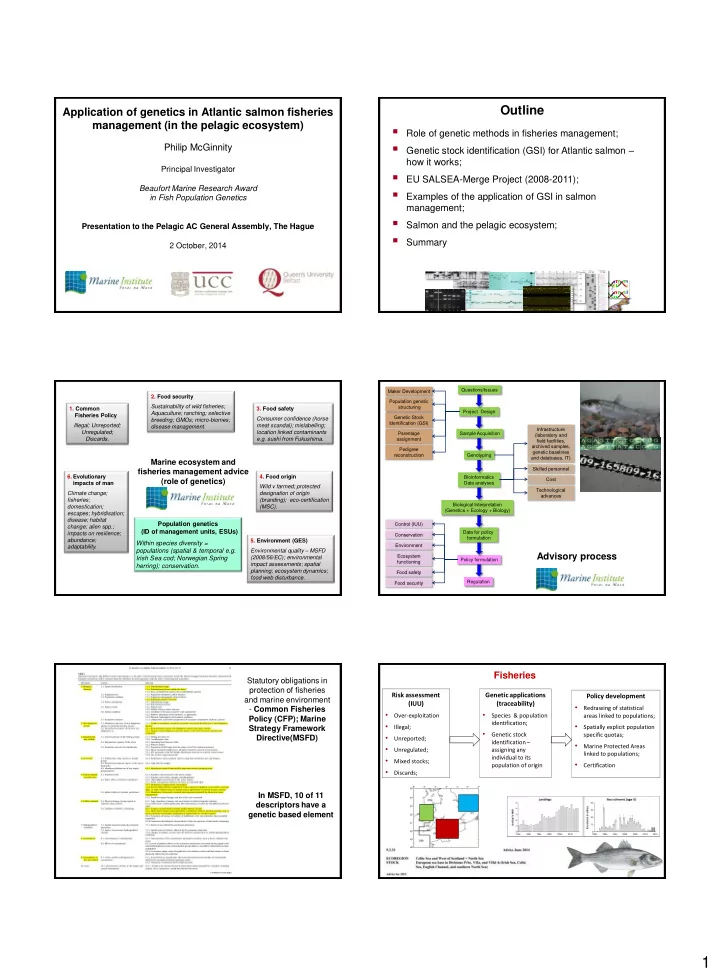
Outline Application of genetics in Atlantic salmon fisheries management (in the pelagic ecosystem) Role of genetic methods in fisheries management; Philip McGinnity Genetic stock identification (GSI) for Atlantic salmon how it


slide-1
SLIDE 1

1

Application of genetics in Atlantic salmon fisheries management (in the pelagic ecosystem)

Philip McGinnity

Principal Investigator Beaufort Marine Research Award in Fish Population Genetics Presentation to the Pelagic AC General Assembly, The Hague 2 October, 2014

Outline

  • Role of genetic methods in fisheries management;
  • Genetic stock identification (GSI) for Atlantic salmon –

how it works;

  • EU SALSEA-Merge Project (2008-2011);
  • Examples of the application of GSI in salmon

management;

  • Salmon and the pelagic ecosystem;
  • Summary

Population genetics (ID of management units, ESUs) Within species diversity = populations (spatial & temporal e.g. Irish Sea cod; Norwegian Spring herring); conservation.

  • 1. Common

Fisheries Policy Illegal; Unreported; Unregulated; Discards.

  • 2. Food security

Sustainability of wild fisheries; Aquaculture; ranching; selective breeding; GMOs; micro-biomes; disease management.

  • 3. Food safety

Consumer confidence (horse meat scandal); mislabelling; location linked contaminants e.g. sushi from Fukushima.

  • 4. Food origin

Wild v farmed; protected designation of origin (branding); eco-certification (MSC).

  • 5. Environment (GES)

Environmental quality – MSFD (2008/56/EC); environmental impact assessments; spatial planning; ecosystem dynamics; food web disturbance.

  • 6. Evolutionary

impacts of man Climate change; fisheries; domestication; escapes; hybridisation; disease; habitat change; alien spp.; impacts on resilience; abundance; adaptability.

Marine ecosystem and fisheries management advice (role of genetics)

Advisory process

Policy formulation Regulation Questions/Issues Project Design Sample Acquisition Genotyping Bioinformatics Data analyses Biological Interpretation (Genetics + Ecology + Biology) Data for policy formulation Maker Development Parentage assignment Pedigree reconstruction Population genetic structuring Genetic Stock Identification (GSI) Control (IUU) Conservation Environment Ecosystem functioning Food safety Food security Infrastructure (laboratory and field facilities, archived samples, genetic baselines and databases, IT) Skilled personnel Cost Technological advances

Statutory obligations in protection of fisheries and marine environment

  • Common Fisheries

Policy (CFP); Marine Strategy Framework Directive(MSFD) In MSFD, 10 of 11 descriptors have a genetic based element

Fisheries

Risk assessment (IUU)

  • Over-exploitation
  • Illegal;
  • Unreported;
  • Unregulated;
  • Mixed stocks;
  • Discards;

Policy development

  • Redrawing of statistical

areas linked to populations;

  • Spatially explicit population

specific quotas;

  • Marine Protected Areas

linked to populations;

  • Certification

Genetic applications (traceability)

  • Species & population

identification;

  • Genetic stock

identification – assigning any individual to its population of origin

e.g. Sea Bass as example….implement conservation measures

slide-2
SLIDE 2

2

Genetic Stock Identification (establishing a baseline for Atlantic salmon)

Introduction

Intra-river scale (Moy)

Dillane et al. (2008) Molecular Ecology 17, 4786-4800

Intra-river scale

Inter-regional scale (26,813 samples; 467 sites; 284 rivers; 85%

  • f the production)

Markers (Analogous to physical markers) Statistically derived assignments rather than absolute – so quality of assignment will be a function of the quality of the baseline, which depends on coverage and molecular differentiation of the elements

SALSEA-Merge

slide-3
SLIDE 3

3

Population specific biology Population specific growth rates Atlantic salmon fisheries

Determining the composition of the Irish drift net fishery

0.0 20.0 40.0 60.0 80.0 100.0 Dundalk Drogheda Dublin Wexford Waterford/Lismore Cork Kerry Limerick Galway Connemara Ballinakill Bangor Ballina Sligo Ballyshannon Letterkenny Northern Ire Farmed UK/Fr/Sp 0.0 20.0 40.0 60.0 80.0 100.0 D u n d a l k D r

  • g

h e d a D u b l i n W e x f

  • r

d W a t e r f

  • r

d / L i s m

  • r

e C

  • r

k K e r r y L i m e r i c k G a l w a y C

  • n

n e m a r a B a l l i n a k i l l B a n g

  • r

B a l l i n a S l i g

  • B

a l l y s h a n n

  • n

L e t t e r k e n n y N

  • r

t h e r n I r e F a r m e d U K / F r / S p 0.00 20.00 40.00 60.00 80.00 100.00 Dundalk Drogheda Dublin Wexford Waterford Lismore Cork Kerry Limerick Galway Connemara Ballinakill Bangor Sligo Ballyshannon Letterkenny Farmed UK/Fr/Sp

slide-4
SLIDE 4

4

West Greenland 2002-2012

Denise Deschamps

ICES non-maturing 1SW fish PFA predictions (2002-2012) West Greenland catch 2002-2012 assigned to country

Denise Deschamps

Development of very powerful new markers allows GSI for marine spp.

Salmon in the pelagic ecosystem & potential interactions (ecological & by- catch)

slide-5
SLIDE 5

5

Trenkel et al. 2014

ICES advice to NASCO 2014

(estimates range from 60 to 1 million post-smolts in pelagic by-catch annually – best estimate 154,482 or 5% of the PFA 2005) – since then expansion of the pelagic fisheries Iceland/Faroes)

How many smolts

slide-6
SLIDE 6

6

Screening

Future

eDNA (technology,

bio-sensors – don’t have to see the bodies)

Water is a “soup” of genetic material (metabolic waste, skin, cells, damaged tissue)

Meta-genomics

Ecosystem relationships (elucidating food webs)

Take home messages

  • Atlantic salmon are a constituent element of the pelagic ecosystem in the North

Atlantic; similar and overlapping ocean phase biology to mackerel and herring; reproductive juvenile biology very different; numbers game is different by several

  • rders of magnitude;
  • Salmon experiencing period of substantial decline (linked to factors in the marine

environment) contemporaneously with increased biomass in some pelagics (ecological) and increased catches (fisheries by-catch);

  • Post-smolts occur with variable frequency (temporal and spatial aspects) within

commercial pelagic fish catches; this could represent significant mortality to individual salmon populations;

  • Genetic methods represent extraordinarily powerful tool for identifying river/region
  • rigin of individual fish (marker assisted GSI); presence or absence (possibly

numbers) among discards; equipment; vessels (environmental DNA); potential to elucidate of various aspects of Atlantic pelagic ecosystem;

Take home messages

  • For new knowledge co-operation with pelagic fisheries sector is essential; possible

salmon indicator of ecosystem health;

  • Occurrence of salmon in the marine pelagic ecosystem (migration routes;

competitive interactions; ecosystem processes) and potential interaction with pelagic fisheries (which overlap in space and time) warrants major research actions to accurately measure impacts as per recent ICES recommendation to NASCO;

  • Impacts may or may not be significant; need good numbers to provide evidence

based management advice.

slide-7
SLIDE 7

7

This Beaufort Marine Research Award is carried out under the Sea Change Strategy and the Strategy for Science Technology and Innovation (2006-2013), with the support of the Marine Institute, funded under the Marine Research Sub-Programme

  • f the National Development Plan 2007–2013.

Beaufort Marine Research Award in Fish Population Genetics

Acknowledgement: