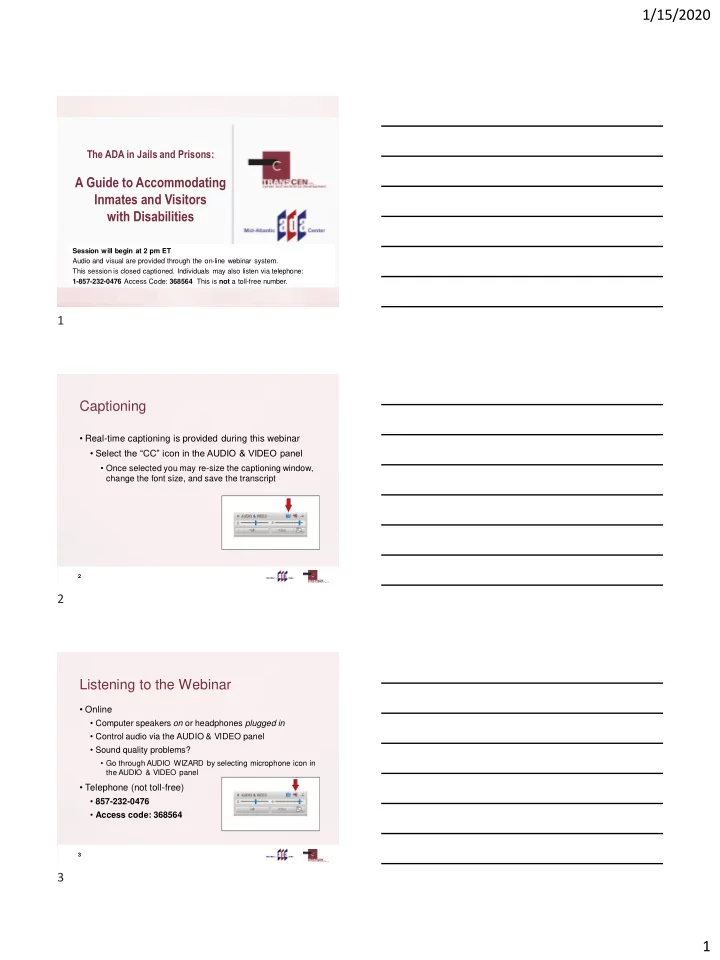
1 1/15/2020 Submitting Questions Webinar platform Type and submit - - PDF document

1
SMART_READER_LITE
LIVE PREVIEW

1 1/15/2020 Submitting Questions Webinar platform Type and submit - - PDF document

1/15/2020 The ADA in Jails and Prisons: A Guide to Accommodating Inmates and Visitors with Disabilities Session will begin at 2 pm ET Audio and visual are provided through the on-line webinar system. This session is closed captioned.


slide-1
SLIDE 1

1/15/2020 1

The ADA in Jails and Prisons:

A Guide to Accommodating Inmates and Visitors with Disabilities

Session will begin at 2 pm ET Audio and visual are provided through the on-line webinar system. This session is closed captioned. Individuals may also listen via telephone: 1-857-232-0476 Access Code: 368564 This is not a toll-free number.

2

Captioning

  • Real-time captioning is provided during this webinar
  • Select the “CC” icon in the AUDIO & VIDEO panel
  • Once selected you may re-size the captioning window,

change the font size, and save the transcript

3

Listening to the Webinar

  • Online
  • Computer speakers on or headphones plugged in
  • Control audio via the AUDIO & VIDEO panel
  • Sound quality problems?
  • Go through AUDIO WIZARD by selecting microphone icon in

the AUDIO & VIDEO panel

  • Telephone (not toll-free)
  • 857-232-0476
  • Access code: 368564

1 2 3

slide-2
SLIDE 2

1/15/2020 2

4

Submitting Questions

  • Webinar platform
  • Type and submit questions in

the CHAT area text box

  • Your questions and comments

will only be visible to session moderators

  • Mobile device
  • CHAT area within the app
  • Email

ADAtraining@transcen.org

5

Technical Difficulties?

  • CHAT box
  • E-mail ADAtraining@transcen.org
  • Call 301-217-0124

6

Archive

  • This webinar is being recorded
  • You will receive an email about how to

access the archive when it becomes available

4 5 6

slide-3
SLIDE 3

1/15/2020 3

7

Certificates and Credits

  • Certificates of participation or credits can only be

given to those who submitted required payment along with registration for this session

  • Listen for the CODE announced at the end of

the session

  • After we confirm your attendance, we will provide

the certificate of participation or the appropriate credit

8

About Your Hosts…

  • TransCen, Inc.
  • Improving the lives of people with disabilities through meaningful

work and community inclusion

  • Mid-Atlantic ADA Center, a project of TransCen, Inc.
  • Funded by National Institute on Disability, Independent Living,

and Rehabilitation Research (NIDILRR), Administration for Community Living, U.S. Department of Health and Human Services

9

Disability Related Access for Inmates and Visitors Guide

Julie Ballinger Southwest ADA Center Affiliate

For over 32 years, Julie has provided leadership in the Disability Rights field. As an Affiliate for the Southwest ADA Center (SWADAC), her work includes ADA in- depth training, technical assistance, ADA best practice approaches, and disability awareness/issues concerning employment, state/local government obligations and business/nonprofit requirements. As part of the ADA National Network, SWADAC provides training, publications and technical assistance to Region 6 consisting of NM, TX, AR, OK, and LA. To learn more go to www.southwestada.org or contact Julie at (505)797.8612 or juliedballinger@outlook.com.

7 8 9

slide-4
SLIDE 4

1/15/2020 4

10

✓More than 750,000 people with disabilities are incarcerated across the nation. ✓These inmates can, if the facility does not fully comply with the ADA and implement ADA best practices, serve harder time with less access to positive programming (such as early release) and vital services. ✓Due to discriminatory practices, inmates with disabilities can end up living in a “prison within a prison.”

We know that…

11

Additionally, we know that…

✓Approx. 85% of incarcerated youth have a disability (often undiagnosed). ✓They are referred to the juvenile justice system earlier than youth without disabilities. ✓They are referred for more serious crimes and experience shorter survival times before they recidivate.

12

Finally, we know that…

✓Facility visitors with disabilities often face barriers including a lack of accessible parking, inaccessible entrances and visitation areas, lack of effective communication or a modification of policy that would make the facility accessible to the visitor. ✓Correctional facilities do not necessarily inform visitors

  • f their ADA rights and do not always have a ADA

grievance process for visitors with disabilities.

10 11 12

slide-5
SLIDE 5

1/15/2020 5

13

The Corrections Guide

  • In response, the Southwest ADA Center’s Disability

Related Access for Inmates and Visitors Guide* is designed to be utilized by corrections to educate and train facility staff regarding their ADA responsibilities concerning inmates and visitors with disabilities.

*Material/contents of the Guide developed through the Southwest ADA Center, funded by a grant (90DP0092-01-00) from the National Institute on Disability, Independent Living, and Rehabilitation Research.

14

Can Download the Guide

Americans with Disabilities Act Disability Related Access for Inmates and Visitors Guide

www.southwestada.org/html/publications/misc/correctional.html

  • Available in HTML and fully accessible PDF
  • Let’s now examine the comprehensive Guide and consider

how it can be utilized within the correctional system.

15

Certificates and Credits: Code

  • Check the reminder email you received about this session for

instructions on obtaining a certificate of participation or credits for this webinar

  • Please email the code above to ADAtraining@transcen.org

by 5 PM E.T. on Thursday, January 23, 2020

13 14 15

slide-6
SLIDE 6

1/15/2020 6

16

ADA National Network

  • Ten regional centers provide guidance, training,

and materials on the ADA

  • 1-800-949-4232
  • www.ADAta.org

17

Thank You!

Mid-Atlantic ADA Center TransCen, Inc. Toll-Free: 800-949-4232 (DC, DE, MD, PA, VA, WV) Local: 301-217-0124 ADAinfo@transcen.org www.ADAinfo.org

16 17