1 Regret Video of Demo Q-learning Exploration Function Crawler - - PDF document

1
SMART_READER_LITE
LIVE PREVIEW

1 Regret Video of Demo Q-learning Exploration Function Crawler - - PDF document

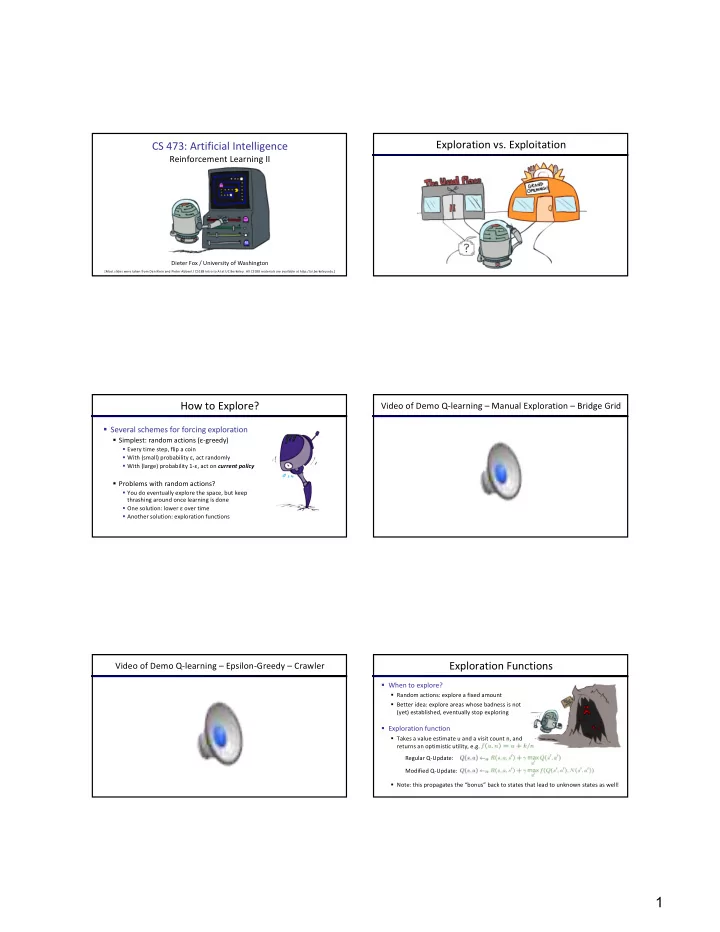
Exploration vs. Exploitation CS 473: Artificial Intelligence Reinforcement Learning II Dieter Fox / University of Washington [Most slides were taken from Dan Klein and Pieter Abbeel / CS188 Intro to AI at UC Berkeley. All CS188 materials are


slide-1
SLIDE 1

1

CS 473: Artificial Intelligence

Reinforcement Learning II

Dieter Fox / University of Washington

[Most slides were taken from Dan Klein and Pieter Abbeel / CS188 Intro to AI at UC Berkeley. All CS188 materials are available at http://ai.berkeley.edu.]

Exploration vs. Exploitation How to Explore?

§ Several schemes for forcing exploration

§ Simplest: random actions (ε-greedy)

§ Every time step, flip a coin § With (small) probability ε, act randomly § With (large) probability 1-ε, act on current policy

§ Problems with random actions?

§ You do eventually explore the space, but keep thrashing around once learning is done § One solution: lower ε over time § Another solution: exploration functions

Video of Demo Q-learning – Manual Exploration – Bridge Grid Video of Demo Q-learning – Epsilon-Greedy – Crawler

Exploration Functions

§ When to explore?

§ Random actions: explore a fixed amount § Better idea: explore areas whose badness is not (yet) established, eventually stop exploring

§ Exploration function

§ Takes a value estimate u and a visit count n, and returns an optimistic utility, e.g. § Note: this propagates the “bonus” back to states that lead to unknown states as well! Modified Q-Update: Regular Q-Update:

slide-2
SLIDE 2

2

Video of Demo Q-learning – Exploration Function – Crawler

Regret

§ Even if you learn the optimal policy, you still make mistakes along the way! § Regret is a measure of your total mistake cost: the difference between your (expected) rewards, including youthful suboptimality, and optimal (expected) rewards § Minimizing regret goes beyond learning to be optimal – it requires

  • ptimally learning to be optimal

§ Example: random exploration and exploration functions both end up

  • ptimal, but random exploration has

higher regret

Approximate Q-Learning Generalizing Across States

§ Basic Q-Learning keeps a table of all q-values § In realistic situations, we cannot possibly learn about every single state!

§ Too many states to visit them all in training § Too many states to hold the q-tables in memory

§ Instead, we want to generalize:

§ Learn about some small number of training states from experience § Generalize that experience to new, similar situations § This is a fundamental idea in machine learning, and we’ll see it over and over again

[demo – RL pacman]

Example: Pacman

[Demo: Q-learning – pacman – tiny – watch all (L11D5)] [Demo: Q-learning – pacman – tiny – silent train (L11D6)] [Demo: Q-learning – pacman – tricky – watch all (L11D7)]

Let’s say we discover through experience that this state is bad: In naïve q-learning, we know nothing about this state: Or even this one!

Video of Demo Q-Learning Pacman – Tiny – Watch All

slide-3
SLIDE 3

3

Video of Demo Q-Learning Pacman – Tiny – Silent Train Video of Demo Q-Learning Pacman – Tricky – Watch All

Feature-Based Representations

§ Solution: describe a state using a vector of features (aka “properties”)

§ Features are functions from states to real numbers (often 0/1) that capture important properties of the state § Example features:

§ Distance to closest ghost § Distance to closest dot § Number of ghosts § 1 / (dist to dot)2 § Is Pacman in a tunnel? (0/1) § …… etc. § Is it the exact state on this slide?

§ Can also describe a q-state (s, a) with features (e.g. action moves closer to food)

Linear Value Functions

§ Using a feature representation, we can write a q function (or value function) for any state using a few weights: § Advantage: our experience is summed up in a few powerful numbers § Disadvantage: states may share features but actually be very different in value!

Approximate Q-Learning

§ Q-learning with linear Q-functions: § Intuitive interpretation:

§ Adjust weights of active features § E.g., if something unexpectedly bad happens, blame the features that were on: disprefer all states with that state’s features

§ Formal justification: online least squares

Exact Q’s Approximate Q’s

Example: Q-Pacman

[Demo: approximate Q- learning pacman (L11D10)]
slide-4
SLIDE 4

4

Video of Demo Approximate Q-Learning -- Pacman Q-Learning and Least Squares

20 20 40 10 20 30 40 10 20 30 20 22 24 26

Linear Approximation: Regression*

Prediction: Prediction:

Optimization: Least Squares*

20

Error or “residual” Prediction Observation

Minimizing Error*

Approximate q update explained: Imagine we had only one point x, with features f(x), target value y, and weights w: “target” “prediction”

2 4 6 8 10 12 14 16 18 20
  • 15
  • 10
  • 5
5 10 15 20 25 30

Degree 15 polynomial

Overfitting: Why Limiting Capacity Can Help*

slide-5
SLIDE 5

5

Policy Search Policy Search

§ Problem: often the feature-based policies that work well (win games, maximize utilities) aren’t the ones that approximate V / Q best

§ E.g. your value functions from project 2 were probably horrible estimates of future rewards, but they still produced good decisions § Q-learning’s priority: get Q-values close (modeling) § Action selection priority: get ordering of Q-values right (prediction)

§ Solution: learn policies that maximize rewards, not the values that predict them § Policy search: start with an ok solution (e.g. Q-learning) then fine-tune by hill climbing

  • n feature weights

Policy Search

§ Simplest policy search:

§ Start with an initial linear value function or Q-function § Nudge each feature weight up and down and see if your policy is better than before

§ Problems:

§ How do we tell the policy got better? § Need to run many sample episodes! § If there are a lot of features, this can be impractical

§ Better methods exploit lookahead structure, sample wisely, change multiple parameters…

Policy Search

[Andrew Ng] [Video: HELICOPTER]

PILCO (Probabilistic Inference for Learning Control)

  • Model-based policy search to minimize given cost function
  • Policy: mapping from state to control
  • Rollout: plan using current policy and GP dynamics model
  • Policy parameter update via CG/BFGS
  • Highly data efficient
[Deisenroth-etal, ICML-11, RSS-11, ICRA-14, PAMI-14]

Demo: Standard Benchmark Problem

§ Swing pendulum up and balance in inverted position § Learn nonlinear control from scratch § 4D state space, 300 controller parameters § 7 trials/17.5 sec experience § Control freq.: 10 Hz

slide-6
SLIDE 6

6

Controlling a Low-Cost Robotic Manipulator

  • Low-cost system ($500 for robot arm and Kinect)
  • Very noisy
  • No sensor information about robot’s joint
configuration used
  • Goal: Learn to stack tower of 5 blocks from
scratch
  • Kinect camera for tracking block in end-effector
  • State: coordinates (3D) of block center (from
Kinect camera)
  • 4 controlled DoF
  • 20 learning trials for stacking 5 blocks (5 seconds
long each)
  • Account for system noise, e.g.,
– Robot arm – Image processing Playing Atari with Deep Reinforcement Learning Volodymyr Mnih Koray Kavukcuoglu David Silver Alex Graves Ioannis Antonoglou Daan Wierstra Martin Riedmiller DeepMind Technologies {vlad,koray,david,alex.graves,ioannis,daan,martin.riedmiller} @ deepmind.com Abstract We present the first deep learning model to successfully learn control policies di- rectly from high-dimensional sensory input using reinforcement learning. The model is a convolutional neural network, trained with a variant of Q-learning, whose input is raw pixels and whose output is a value function estimating future
  • rewards. We apply our method to seven Atari 2600 games from the Arcade Learn-
ing Environment, with no adjustment of the architecture or learning algorithm. We find that it outperforms all previous approaches on six of the games and surpasses a human expert on three of them. 1 Introduction Learning to control agents directly from high-dimensional sensory inputs like vision and speech is
  • ne of the long-standing challenges of reinforcement learning (RL). Most successful RL applica-
tions that operate on these domains have relied on hand-crafted features combined with linear value functions or policy representations. Clearly, the performance of such systems heavily relies on the quality of the feature representation. Recent advances in deep learning have made it possible to extract high-level features from raw sen- sory data, leading to breakthroughs in computer vision [11, 22, 16] and speech recognition [6, 7]. These methods utilise a range of neural network architectures, including convolutional networks, multilayer perceptrons, restricted Boltzmann machines and recurrent neural networks, and have ex- ploited both supervised and unsupervised learning. It seems natural to ask whether similar tech- niques could also be beneficial for RL with sensory data. However reinforcement learning presents several challenges from a deep learning perspective. Firstly, most successful deep learning applications to date have required large amounts of hand- labelled training data. RL algorithms, on the other hand, must be able to learn from a scalar reward signal that is frequently sparse, noisy and delayed. The delay between actions and resulting rewards, which can be thousands of timesteps long, seems particularly daunting when compared to the direct association between inputs and targets found in supervised learning. Another issue is that most deep learning algorithms assume the data samples to be independent, while in reinforcement learning one typically encounters sequences of highly correlated states. Furthermore, in RL the data distribu- tion changes as the algorithm learns new behaviours, which can be problematic for deep learning methods that assume a fixed underlying distribution. This paper demonstrates that a convolutional neural network can overcome these challenges to learn successful control policies from raw video data in complex RL environments. The network is trained with a variant of the Q-learning [26] algorithm, with stochastic gradient descent to update the weights. To alleviate the problems of correlated data and non-stationary distributions, we use

Deepmind AI Playing Atari That’s all for Reinforcement Learning!

§ Very tough problem: How to perform any task well in an unknown, noisy environment! § Traditionally used mostly for robotics, but becoming more widely used § Lots of open research areas:

§ How to best balance exploration and exploitation? § How to deal with cases where we don’t know a good state/feature representation?

Reinforcement Learning Agent Data (experiences with environment) Policy (how to act in the future)

Conclusion

§ We’re done with Part I: Search and Planning! § We’ve seen how AI methods can solve problems in:

§ Search § Constraint Satisfaction Problems § Games § Markov Decision Problems § Reinforcement Learning

§ Next up: Part II: Uncertainty and Learning!