1 FM does not replace testing! Why Use Formal Methods Reduces - - PDF document

1
SMART_READER_LITE
LIVE PREVIEW

1 FM does not replace testing! Why Use Formal Methods Reduces - - PDF document

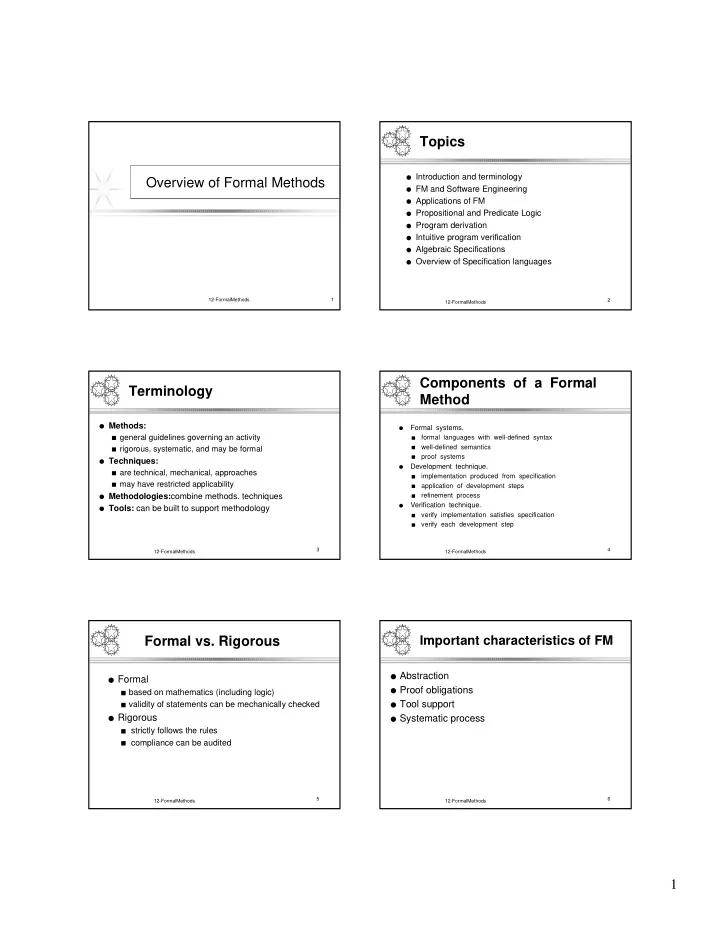
Topics Introduction and terminology Overview of Formal Methods FM and Software Engineering Applications of FM Propositional and Predicate Logic Program derivation Intuitive program verification Algebraic Specifications


slide-1
SLIDE 1

1

12-FormalMethods 1

Overview of Formal Methods

2 12-FormalMethods

Topics

  • Introduction and terminology
  • FM and Software Engineering
  • Applications of FM
  • Propositional and Predicate Logic
  • Program derivation
  • Intuitive program verification
  • Algebraic Specifications
  • Overview of Specification languages

3 12-FormalMethods

Terminology

  • Methods:

■ general guidelines governing an activity ■ rigorous, systematic, and may be formal

  • Techniques:

■ are technical, mechanical, approaches ■ may have restricted applicability

  • Methodologies:combine methods. techniques
  • Tools: can be built to support methodology

4 12-FormalMethods

Components of a Formal Method

  • Formal systems.

■ formal languages with well-defined syntax ■ well-defined semantics ■ proof systems

  • Development technique.

■ implementation produced from specification ■ application of development steps ■ refinement process

  • Verification technique.

■ verify implementation satisfies specification ■ verify each development step 5 12-FormalMethods

Formal vs. Rigorous

  • Formal

■ based on mathematics (including logic) ■ validity of statements can be mechanically checked

  • Rigorous

■ strictly follows the rules ■ compliance can be audited

6 12-FormalMethods

Important characteristics of FM

  • Abstraction
  • Proof obligations
  • Tool support
  • Systematic process
slide-2
SLIDE 2

2

7 12-FormalMethods

FM does not replace testing!

  • Reduces burden on testing phases to detect all

critical errors

  • Facilitates more effective allocation of testing

resources

  • Can guide the selection of test cases

8 12-FormalMethods

Why Use Formal Methods

  • Improve quality of software system
  • Fitness for purpose
  • Maintainability
  • Ease of construction
  • Higher confidence in software product
  • Reveal ambiguity, incompleteness, and inconsistency in

system

  • Detect design flaws
  • Determine correctness

9 12-FormalMethods

V&V and Traceability

Formal Specification Code

The Real World Validation Verification

10 12-FormalMethods

V&V and Traceability

Formal Specification Code

The Real World Validation Verification Traceability

11 12-FormalMethods

Traditional verification techniques not successful.

Why not?

  • Too much like math? (proofs, ugh!)
  • Notation too hard to use
  • Notation too hard to write out
  • "Simple" things take a lot of effort
  • "Complex" things seem impossible
  • Program verification is an undecidable problem
  • "If it works, why mess with it?"

12 12-FormalMethods

Potential solutions?:

  • Need experimental evidence on large projects.
  • Construction of support tools
  • Early education!?!?
  • Integration of formal methods in more than one phase of

software engineering

  • Improved (automated) theorem proving strategies
  • Handle more than just functional properties
  • MOST IMPORTANTLY: do not verify "after the fact"
slide-3
SLIDE 3

3

13 12-FormalMethods

When and Where?

  • Introduce FM into existing systems

■ Verify critical properties ■ Facilitate maintenance and reimplementation

  • Introduce FM into new systems

■ Capture requirements precisely ■ Reduce ambiguity ■ Guide software development process ■ Basis for testing ■ Formalize requirements analysis and design 14 12-FormalMethods

Rushby’s “Levels of Rigor”

  • Level 0: No use of formal methods.

■ structured walk throughs, ‘formal’ inspections

  • Level 1: Use of concepts and notation from discrete mathematics.

■ cleanroom, SCR (software cost reduction)

  • Level 2: Use of formalized specification languages with some

mechanized support tools.

■ specification languages, ‘rigorous’ proofs

  • Level 3: Use of fully formal specification languages with

comprehensive support environments, including mechanized theorem proving or proof checking.

15 12-FormalMethods

Formal Semantics

  • Formal semantics provide precise, machine-independent

concepts

  • Provide unambiguous specification techniques and a

rigorous theory to support reliable reasoning.

  • A formal definition of a language can suggest a method for

constructing programs guaranteed to conform to their specifications.

  • So, the purpose of formal specification is ...

16 12-FormalMethods

Purpose of Formal Specification

  • The purpose of a formal specification is to state

what a system should do without describing how to do it

  • A formal specification may define a system as an

abstract datatype.

  • A formal specification should avoid

implementation bias.

17 12-FormalMethods

Formal Specifications

  • Formal specifications serve as a

■ contract ■ documentation ■ means of communication between client, specifier, and

implementer

  • Formal specifications are amenable to machine

analysis and manipulation

18 12-FormalMethods

Too Little and Too Much

  • There exists a balance between saying enough

in a specification and saying too much.

■ say enough so that implementers do not choose

unacceptable implementations

■ specifications should capture the requirements

completely

■ avoid implementation-bias by not restricting freedom

  • f later designers
slide-4
SLIDE 4

4

19 12-FormalMethods

Operational Approach

  • Define an abstract machine having states, possibly several

components, and some set of primitive instructions.

  • Define the machine by specifying how the components of the state are

changed by each instruction.

  • Define the semantics of a particular programming language in terms
  • f states.
  • Abstract machines may be unrealistic from a practical point of view,

but the simplistic definition prevents misunderstanding code later.

20 12-FormalMethods

Operational Approach con’t

■ The semantic description of the programming language

specifies a translation into this code.

■ Trace through the translated program step-by-step to

determine its precise effect.

■ Languages defined in this way include PL/I (by the

VDM method)

21 12-FormalMethods

The Axiomatic Approach

  • Associate an "axiom" with each kind of statement

in the programming language

■ state what may be asserted after execution of that

statement in terms of what was true before

■ an example is the use of pre- and postconditions.

22 12-FormalMethods

Another View

  • Model-Oriented: define system behavior by constructing

model of system in terms of mathematical structures

■ tuples, functions. sets, or sequences ■ languages include VDM, Z, CSP, and Petri Nets

  • Property-Oriented: define system behavior indirectly by

stating a set of properties that the system must satisfy

23 12-FormalMethods

Two Types of Property- Oriented Approaches

  • Axiomatic: use first-order predicate logic (pre- and

postconditions)

  • Algebraic: use axioms in equational form to

describe properties

24 12-FormalMethods

Obvious Applications

  • Computer Security
  • Fault-tolerant systems (e.g. Nuclear reactors)
  • Safety-critical system (e.g. diagnostic X-ray machine)
  • Gain insight into hardware/software systems (e.g. oscilloscope)
  • Basically, wherever the cost of failure is high:
  • including systems that are critical in some way
  • replicated many times
  • fixed into hardware, or
  • dependent on quality for commercial reasons
slide-5
SLIDE 5

5

25 12-FormalMethods

Relevant Areas of Research

  • Programming environments
  • Formal methods in software development
  • Tools that support construction of formal specifications
  • Design tools that will generate formal specifications
  • Problem/specification decomposition
  • Procedural and data abstraction
  • Synthesis of efficient code
  • "Smart" user interfaces (user-friendly ones!!)
  • Methods for determining reuse (of design/specifications/code)