1: Getting Personal Economic and wage stagnation Within the home - - PDF document

1 getting personal
SMART_READER_LITE
LIVE PREVIEW

1: Getting Personal Economic and wage stagnation Within the home - - PDF document

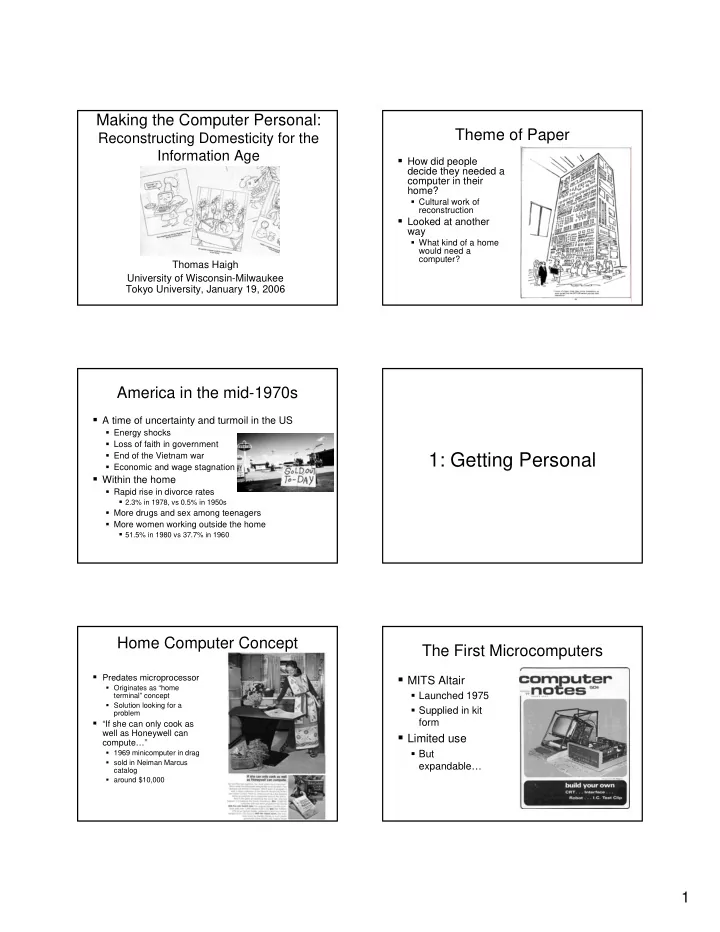
Making the Computer Personal: Theme of Paper Reconstructing Domesticity for the Information Age How did people decide they needed a computer in their home? Cultural work of reconstruction Looked at another way What kind of a


slide-1
SLIDE 1

1

Making the Computer Personal:

Reconstructing Domesticity for the Information Age

Thomas Haigh University of Wisconsin-Milwaukee Tokyo University, January 19, 2006

Theme of Paper

How did people

decide they needed a computer in their home?

Cultural work of reconstruction

Looked at another

way

What kind of a home would need a computer?

America in the mid-1970s

A time of uncertainty and turmoil in the US

Energy shocks Loss of faith in government End of the Vietnam war Economic and wage stagnation

Within the home

Rapid rise in divorce rates 2.3% in 1978, vs 0.5% in 1950s More drugs and sex among teenagers More women working outside the home 51.5% in 1980 vs 37.7% in 1960

1: Getting Personal

Home Computer Concept

Predates microprocessor

Originates as “home terminal” concept Solution looking for a problem

“If she can only cook as

well as Honeywell can compute…”

1969 minicomputer in drag sold in Neiman Marcus catalog around $10,000

The First Microcomputers

MITS Altair

Launched 1975 Supplied in kit form

Limited use

But expandable…

slide-2
SLIDE 2

2

Users and Producers Blur?

Best known user role –

hobbyist designer

Steve Wozniak, Apple II Designer

Mythology of

Geeks Garages Genius

Initial Constituency

People who

Knew how to solder Understood electronics Wanted to play with a computer

Served by Byte

magazine

88,000 circulation by spring 1977

Before & After

Selling to Enthusiasts Attempted Domestication

  • “The Noval 760… appears in its natural

setting: unfolded in a living room, office, or den. The console… folds into the desk… so that the Noval 760 blends into the décor as a desk- like woodtone piece of furniture.”

Potted Plants are Common Motif

slide-3
SLIDE 3

3

Tokenism I: The Rainbow Alliance

“People from every walk of life are adding iCOM Floppy Disks to their microcomput ers…”

Tokenism II: The Babe

“combines the 8080A CPU with a front panel featuring ultra- convenient octal keyboard and digital LED readout”

Pre-assembled Machines

Follow by around

1977

Apple II Radio Shack TRS 80 Commodore Pet

Computer Fairs

Develop very rapidly

“Computer Faire” in Bay Area is most famous But hundreds of others nationally

Boundary between visitors

and exhibitors fluid in 1970s

Booths are basic and cheap Enthusiasts on both side of the trestle table

Computer Dealers

An estimated

independent 600 stores by 1976

Plus 5,000 Radio Shacks

Functions

Sales Tech support Configuration Training Community hub Some offer own software items

Trade Groups

Trade groups

established for

Hardware producers & Distributors Microcomputer Industry

Association

Software producers Software Publishers

Association

ADAPSO Microcomputer

Software Section

National Computer Retailers Association

slide-4
SLIDE 4

4

User Groups

Distributed all over the

country

Activities include

Training sessions Organizing exhibitions and shows Creating user- contributed software libraries Publishing newsletters

Newsletters

Published by

User groups Dealers Computer manufacturers

Contents include

Hints and tips News and announcements Program listings

Some expand into

commercial magazines

Different Construction for Different Groups

The PC is cultural reconstructed to fit in different

social spaces

School Hospital Laboratory Office Home

Specialized

Software firms Hardware add-on vendors Newsletters, user groups, etc Networks within existing organizations

2: Buying and Selling the Home Computer

Home Computer Hardware

Separate species,

existed

from about 1978 to 1990

Much cheaper than

“business” PCs

Sold in large numbers Better sound and graphics Fewer peripheral options

Connect to domestic

TV

Often used with standard cassette player rather than disks

Home Computer Sales

Sold in department and discount stores By 1983

Several models under $100 Around 5 million units sold annually in US

Commodore 64 sells 30 million worldwide, 1982-early 1990s

slide-5
SLIDE 5

5

Celebrity Endorsements

Isaac Asimov

for Radio Shack

Science Fiction writer Familiar yet Futuristic

“It’s like having

the cosmos at your fingertips.”

Bill Cosby for Texas Instruments William Shatner for Commodore (show Vic System advert)

Like a Kid

Show the Alan Alda video

3: Using a Home Computer

But What Is It For?

‘It’s an interesting machine, but what do you actually use it for?’ That’s one of the most frustrating questions asked of personal computer owners. It’s also often the most difficult to answer. The Commodore 64, Getting the Most From it. (1983) “It comes with its own BASIC language that’s built in and uses plain simple English…” Alan Alda, Like a Kid, 1982.

slide-6
SLIDE 6

6

Programming

BASIC language built into

almost all home computers

turn them on, there it is Instruction manuals teach programming presented as way to get value out of purchase

The ONLY thing you can

do out of the box

Programming for Everyone

The TI Home Computer was designed to be used for extensive personal

  • programming. The built-in

BASIC language makes the TI99/4 a valuable desktop tool… a great way to teach your children about computers.

Computer Advice Books

Mostly follow format of

manual

Introduction Physical set up How to program 60% or so of total Reference tables

Program Listings

Many books consist

ONLY of programs to type in….

This one includes

Nutrition Pack Family Budget Comptroller Studying State Capitals Your Math Teacher

Byte, 1980, Pirate Adventure

Domestic Automation

Simple Programming: You write your control programs in BASIC or Assembler language.

  • Literal translation of industrial

applications.

slide-7
SLIDE 7

7

Limited Range of Applications

Same topics appear repeatedly in early

(1977-1982) programs

Type-in from magazines Printed in books Sold on cassette Used in computer advertisements

Few seem particularly compelling

Reflect shared assumptions about home and computer’s place in it

Gender Roles

Centerpiece of the nuclear family The Magic Machine

“Mum laughed, and said the magic machine can start by cooking dinner….” Byte Press, 1979 Radio Shack, 1983 “The Computer That

Said NO To Drugs”

Husband

Masculine

Tax preparation Financial calculations Checkbook balancing

slide-8
SLIDE 8

8

Wife

Feminine

Recipe databases Calorie counting Knitting Biorhythms

This book included

programs for

“Shopping” “Pantry Inventory” “Recipe” “Chore reminder”

Children

Educational

applications

Maths drill Geography quiz, etc.

Programming

4: Conclusions

The Broader Context

Late 1970s also saw popularization of

ideas of

Information technology Information society/Post Industrial Society Computer literacy Microcomputer revolution

The Third Wave

Futurist Alvin Toffler

1980, influential example of “information age” thinking

slide-9
SLIDE 9

9

Utopian best seller

Intelligent machines by early 1990s

Computer Literacy

A loaded term Assumed to

require programming skills

Creative Computing, 1977

It’s Educational!

Computers play

games but are good for you too

(Video clip:

Commodore Job Interview)

The Actual Use: Games? An Irony

The success of the home computer hinged

  • n idea of a “microcomputer society”

changed beyond all recognition. Never happened.

BUT, those involved in domesticating the

computer were trapped in a 1950s sitcom vision of the perfect suburban family already fatally undermined by REAL social change.