1. Anesthetic neurotoxicity Growing concern about the effects of - - PowerPoint PPT Presentation

1 anesthetic neurotoxicity
SMART_READER_LITE
LIVE PREVIEW

1. Anesthetic neurotoxicity Growing concern about the effects of - - PowerPoint PPT Presentation

12/4/2015 1. Anesthetic neurotoxicity Growing concern about the effects of Pediatric Ophthalmology anesthesia in the developing brain Highlights: Fads or Future? Learning disabilities, ADHD, etc. Younger age and cumulative dose


slide-1
SLIDE 1

12/4/2015 1

Pediatric Ophthalmology Highlights: Fads or Future?

Alejandra de Alba Campomanes, MD MPH Associate Professor of Ophthalmology Director of Pediatric Ophthalmology and Adult Strabismus University of California, San Francisco

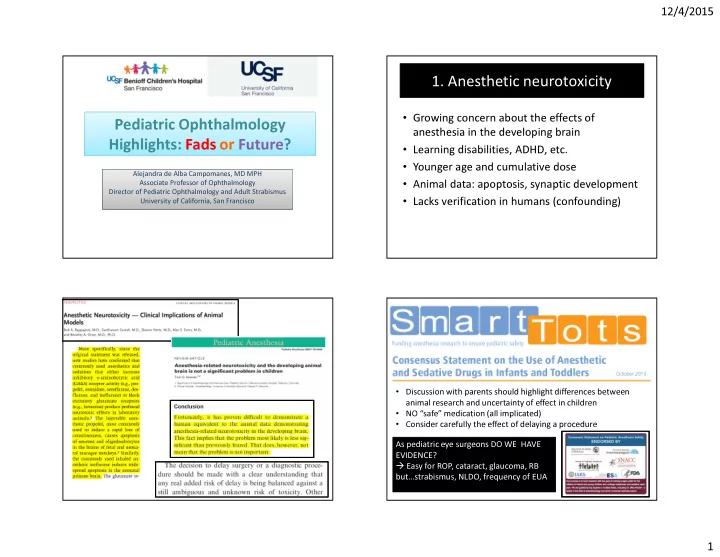
  • 1. Anesthetic neurotoxicity
  • Growing concern about the effects of

anesthesia in the developing brain

  • Learning disabilities, ADHD, etc.
  • Younger age and cumulative dose
  • Animal data: apoptosis, synaptic development
  • Lacks verification in humans (confounding)
  • Discussion with parents should highlight differences between

animal research and uncertainty of effect in children

  • NO “safe” medication (all implicated)
  • Consider carefully the effect of delaying a procedure

As pediatric eye surgeons DO WE HAVE EVIDENCE? Easy for ROP, cataract, glaucoma, RB but…strabismus, NLDO, frequency of EUA

slide-2
SLIDE 2

12/4/2015 2

Anesthetic neurotoxicity

  • …while the concern is a FAD…
  • Whether real or not, we will be hearing a lot

more about this

  • Efforts to minimize exposure among pediatric

surgeons will increase

  • “the seed of doubt has been planted”

Icare rebound tonometer

slide-3
SLIDE 3

12/4/2015 3

  • FDA approved since 2007 and endorsed by the

AAO in 2013 as accurate way of measure IOP in children <18 (normal and glaucoma)

  • DOES NOT REQUIRE TOPICAL ANESTHESIA
  • Good GAT correlation (+2-3 mmHg)
  • Solid P: +/- 1.8 mmHg SD

– flashing P-- indicates higher SD (>3.5mmHg)

6% 42% 5% 12%

  • 2. VEGF blockers for ROP
  • BEAT-ROP 2011

Late recurrence concern with IVB

JAMA Ophthal, June 2012 Bevacizumab Laser 1 year

Less myopia

slide-4
SLIDE 4

12/4/2015 4

8/06/2013

  • 9.50 +1.00 x 065

OD -7.50 +1.00 x 110 OS

Systemic absorption

T Sato, Am J Ophthal, 2011 *Lee S . IOVS 2011;52:ARVO E-abstract 3165

**All patients had received LASER

*

Which anti-VEGF?

Ranibizumab Bevacizumab

Molecular weight 48 KDa 149 KDa Intravitreal half-life 2.88 days (0.5mg) 4.32 days (1.25 mg) Serum half-life 2 hours 20 days (60 days) Decrease Serum VEGF 1-3 weeks 15% 7+ weeks 60% Cost $1,986.29 $64.62 Regulatory Not FDA approved for ROP Not FDA approved for ROP Has only RCT

slide-5
SLIDE 5

12/4/2015 5

Ranibizumab appears safer

Pre-injection Post-injection

40 days after Lucentis injection

slide-6
SLIDE 6

12/4/2015 6

IVRani vs. IVBeva

  • Chen 2015 (Retina): 72 eyes, no difference
  • Wong 2015 (Retina):83% (5/6) vs. O% reactivation
  • Baumal 2015 (OSLIR): 100% reactivation (8/8)
  • Bedda 2014: 12.5% recurrence rate
  • Jang 2010: Bilateral RD 1 month after full regression
  • Zhou 2014: 45% recurrence (10/22)
  • De Alba/Rivera (WOC 2016): 100% recurrence (7/7)

VEGF blockers for ROP

  • Despite lack of long term and safety studies
  • “the horse is out of the barn”
  • We will see (hopefully) more information

about optimal VEGF agent, combined treatments and guidelines for follow-up

  • 3. Oral levodopa for amblyopia
  • Started as treatment in 1995
  • No evidence that there is a deficiency in the

brain in children with amblyopia

  • Dopamine plays a role in retinal function and

central visual processing (Brandies et al 2008)

  • Several studies show some improvement in

vision (1.1 log) as initial treatment for amblyopia

slide-7
SLIDE 7

12/4/2015 7

  • RCT, placebo controlled, as adjunctive

treatment to patching in children 7-12 yo with VA 20/50-400

  • Strabismic or anisometropic amblyopia
  • Dose 0.76 mg/kg levo/carbidopa TID

+patching for 16 weeks

LEVODOPA/PLACEBO STOPPED

slide-8
SLIDE 8

12/4/2015 8

Dopamine for amblyopia

  • Need to expand our armamentarium for the

treatment of amblyopia

  • 4. Atropine to halt myopia progression

“the myopia epidemic”

slide-9
SLIDE 9

12/4/2015 9

  • Muscarinic antagonists

– ATROPINE, Pirenzepine

  • Progressive addition lenses (PALs)
  • Orthokeratology
  • Bifocal glasses
  • Bifocal soft contact lenses
  • Environmental interventions
  • Combinations

Interventions to retard myopic progression

Atropine

  • Night topical atropine 1%
  • Slows progression of low and moderate

myopia and axial elongation

  • Placebo eyes progressed -1.20 D (±0.69)
  • Treated eyes progressed -0.38 D (±0.92)
  • After treatment is stopped, treated eyes had a

higher rate of myopic progression

Chua et al. Ophthalmology 2006;113:2285-2291 Tong et al. Ophthalmology 2009; 116:572-579

slide-10
SLIDE 10

12/4/2015 10

Low dose Atropine

  • ATOM 1 (atropine for the treatment of myopia)
  • ATOM 2: compared 0.01% vs. 0.1% vs. 0.5%

– Dose response in progression in first 2 years – Higher dose faster effect, lower dose takes 8-24m – Higher rebound effect in higher doses, almost none in lower doses – Dilation and accommodation minimally affected by 0.01% – Decreases myopia progression by 50% (0.5 vs. 1 D/yr) – 10% do not respond – Need to slow taper

Atropine to halt myopia progression

Thank you!

dealbaa@vision.ucsf.edu

slide-11
SLIDE 11

12/4/2015 11

  • 5. Telemedicine for ROP

Telemedicine for ROP

  • Potential to expand the evaluation and management
  • ptions available for ROP surveillance.
  • Combination of factors has fueled interest in TM:

– Scarcity of qualified ophthalmologists willing to provide screening – Complex coordination of services and tracking – Inadequate reimbursement – Decentralization of neonatal care to community hospitals

  • Barriers: variability in image interpretation,

insufficient evidence, high implementation cost

Telemedicine for ROP

  • Systematic review 11 studies (total of 486

references)

  • Level I evidence that telemedicine is accurate

– Sensitivity 76*-100% (*outlier 57%) – Specificity 87*-97% (*outlier 37%)

  • Not more harmful or stressful that indirect
  • phthalmoscopy
slide-12
SLIDE 12

12/4/2015 12

Retcam Plus disease Retcam Plus disease Telemedicine for ROP

  • Useful adjunct but not replacement of ophthalmoscopy
  • “the pace of implementation of TM for ROP evaluation in

the ophthalmic community has outstripped the pace of systematic evaluation of the approach.”

  • Need to define roles, protocols, training
  • Expand on the available technology (smart phones?)