1.4 The Matrix Equation A x = b McDonald Fall 2018, MATH 2210Q 1.4 - - PDF document

1 4 the matrix equation a x b
SMART_READER_LITE
LIVE PREVIEW

1.4 The Matrix Equation A x = b McDonald Fall 2018, MATH 2210Q 1.4 - - PDF document

NOTE: These slides contain both Section 1.4 and 1.5. 1.4 The Matrix Equation A x = b McDonald Fall 2018, MATH 2210Q 1.4 &1.5 Slides 1.4 Homework : Read section and do the reading quiz. Start with practice problems, then do Hand in: 1, 3,


slide-1
SLIDE 1

NOTE: These slides contain both Section 1.4 and 1.5.

1.4 The Matrix Equation Ax = b

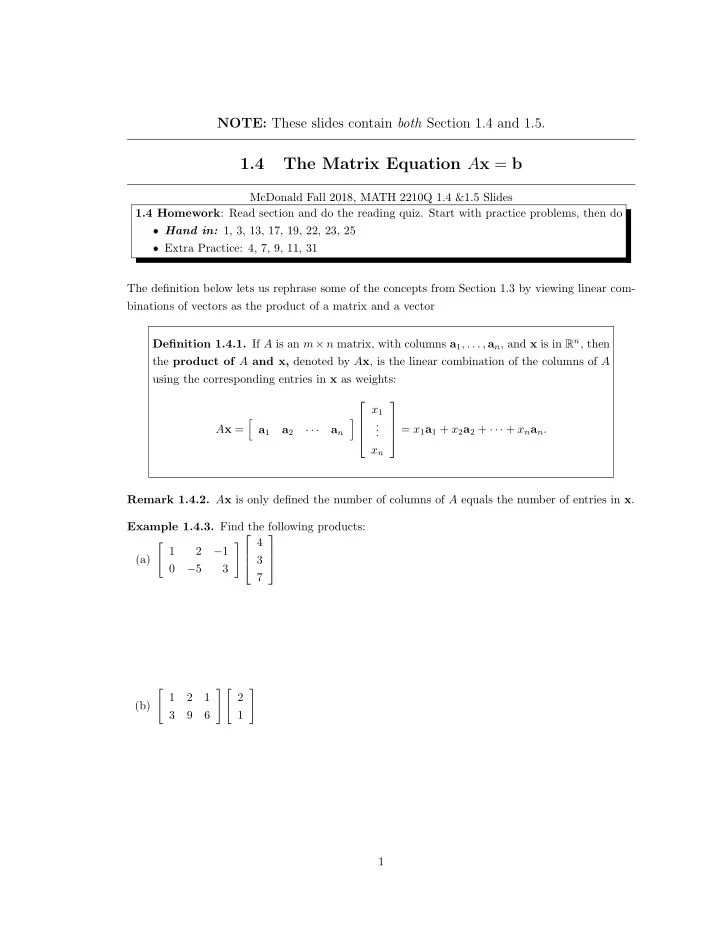
McDonald Fall 2018, MATH 2210Q 1.4 &1.5 Slides 1.4 Homework: Read section and do the reading quiz. Start with practice problems, then do ❼ Hand in: 1, 3, 13, 17, 19, 22, 23, 25 ❼ Extra Practice: 4, 7, 9, 11, 31 The definition below lets us rephrase some of the concepts from Section 1.3 by viewing linear com- binations of vectors as the product of a matrix and a vector Definition 1.4.1. If A is an m × n matrix, with columns a1, . . . , an, and x is in Rn, then the product of A and x, denoted by Ax, is the linear combination of the columns of A using the corresponding entries in x as weights: Ax =

  • a1

a2 · · · an

   x1 . . . xn     = x1a1 + x2a2 + · · · + xnan. Remark 1.4.2. Ax is only defined the number of columns of A equals the number of entries in x. Example 1.4.3. Find the following products: (a)

  • 1

2 −1 −5 3    4 3 7    (b)

  • 1

2 1 3 9 6 2 1

  • 1
slide-2
SLIDE 2

Example 1.4.4. Compute Ax, where A =    2 3 4 −1 5 −3 6 −2 8    and x =    x1 x2 x3    Procedure 1.4.5 (Row Vector Rule). If Ax is defined, then the ith entry in Ax is the sum of the products of corresponding entries from row i of A and from the vector x. Example 1.4.6. Compute (a)    2 −3 8 −5 2   

  • 4

7

  • (b)

   1 1 1       x y z    2

slide-3
SLIDE 3

Example 1.4.7. Write the system below as Ax = b for some A and b. x1 + 2x2 − x3 = 4 −5x2 + 3x3 = 1 Definition 1.4.8. The equation Ax = b is called a matrix equation. Theorem 1.4.9. If A is an m × n matrix, with columns a1, . . . , an, and b is in Rm, then Ax = b (with x in Rn) has the same solutions as the vector equation x1a1 + x2a2 + · · · + xnan = b which has the same solutions as the system of linear equations with augmented matrix

  • a1

a2 · · · an b

  • .

Corollary 1.4.10. The equation Ax = b has a solution if and only if b is a linear combination of the columns of A. Example 1.4.11. Let A =

   1 3 4 −4 2 −6 −3 −2 −7    and b =    b1 b2 b3    is Ax = b consistent for all b1, b2, b3?

3

slide-4
SLIDE 4

Theorem 1.4.12. Let A be an m × n matrix. Then the following statements are either all true, or all false. (a) For each b in Rm, the equation Ax = b has a solution. (b) Each b in Rm is a linear combination of the columns of A. (c) The columns of A span Rm. (d) A has a pivot position in every row. Example 1.4.13. If A =    2 −2 2 3 4 1 2    and b =    2 11 3   , for what x is Ax = b consistent? We end this section with some important properties of Ax, which we will use throughout the course. Theorem 1.4.14. If A is an m × n matrix, u and v are vectors in Rn, and c is a scalar: (a) A(u + v) = Au + Av; (b) A(cu) = c(Au). 4

slide-5
SLIDE 5

1.5 Solutions Sets of Linear Systems

1.5 Homework: Read section and do the reading quiz. Start with practice problems, then do ❼ Hand in: 5, 11, 15, 19, 23, 30, 32 ❼ Extra Practice: 2, 6, 18, 22, 27 In this section, we will use vector notation to give explicit and geometric descriptions of solution sets of linear systems. We begin by defining a special type of system. Definition 1.5.1. A system of linear equations is said to be homogeneous if it can be written in the form Ax = 0, where A is an m × n matrix, and 0 is the zero vector in Rm. Remark 1.5.2. The equation Ax = 0 always has at least one solution, namely x = 0, called the trivial solution. We will be interested in finding non-trivial solutions, where x = 0. Example 1.5.3. Determine if the following homogeneous system has a nontrivial solution, and describe the solution set. 3x1 + 5x2 − 4x3 = 0 −3x1 − 2x2 + 4x3 = 0 6x1 + x2 − 8x3 = 0 Proposition 1.5.4. The homogeneous equation Ax = 0 has a nontrivial solution if and

  • nly if the equation has at least one free variable.

5

slide-6
SLIDE 6

Example 1.5.5. Describe all solutions to the homogeneous system 10x1 − 3x2 − 2x3 = 0. Definition 1.5.6. The answers in 1.5.3 and 1.5.5 are parametric vector equations. Sometimes, to emphasize that the parameters vary over all real numbers, we write x = su + tv for s, t ∈ R. In both examples, we say that the solution is in parametric vector form. Example 1.5.7. Describe all solutions of 3x1 + 5x2 − 4x3 = 7 −3x1 − 2x2 + 4x3 = −1 6x1 + x2 − 8x3 = −4 6

slide-7
SLIDE 7

Definition 1.5.8. We can think of vector addition as translation. Given p and v in R2

  • r R3, the effect of adding p to v is to move v in a direction parallel to the line through p

and 0. We say that v is translated by p to v + p. If each point on a line L is translated by a vector p, the result is a line parallel to L. For t ∈ R, we call p + tv the equation of the line parallel to v through p. Example 1.5.9. Use this observation to describe the relationships between the solutions to Ax = 0 and Ax = b using the A and b from Examples 1.5.3 and 1.5.7. Theorem 1.5.10. Suppose the equation Ax = b is consistent for some given b, and let p be a solution. Then the solution set of Ax = b is the set of all vecotrs of the form w = p + vh, where vh is any solution of the homogeneous equation Ax = 0. 7

slide-8
SLIDE 8

Procedure 1.5.11. To write a solution set in parametric vector form

  • 1. Row reduce the augmented matrix to RREF
  • 2. Express each basic variable in terms of any free variables
  • 3. Write x as a vector whose entries depend on the free variables (if there are any)
  • 4. Decompose x into a linear combination of vectors using free variables as parameters

Example 1.5.12. Describe and compare the solution sets of Ax = b and Ax = 0 if A =    1 3 −5 1 4 −8 −3 −7 9    and b =    4 7 −6    . 8