SLIDE 1
1
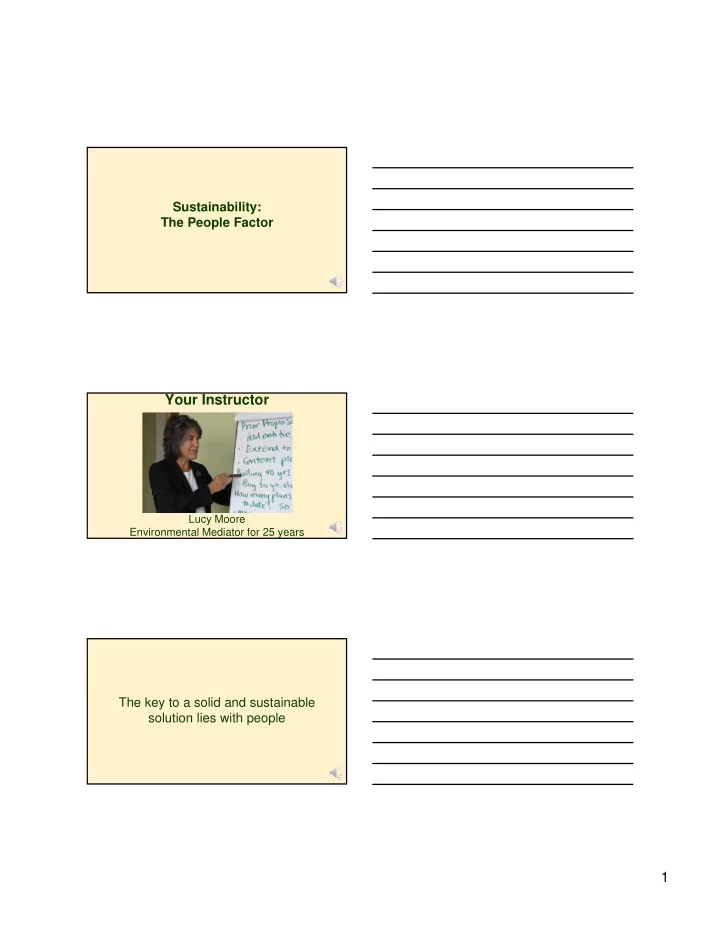
Sustainability: The People Factor
Your Instructor
Lucy Moore Environmental Mediator for 25 years
The key to a solid and sustainable solution lies with people
SLIDE 2 2
The best, most brilliant solution to a complex conflict can be the result of tons of research and fine scientific minds … but if those impacted by that solution don’t believe in it, trust it, or understand it, the solution is doomed What We’ll Cover
The nature of conflict
(cc) Betsy Weber @ Flickrcom
SLIDE 3
3
What We’ll Cover
Example conflict between a federal agency and landowners near a reservoir (reading)
What We’ll Cover
Example conflict during LEED building project
What We’ll Cover
Conclusions and questions
SLIDE 4 4
Conflict Occurs at Three Levels Level 1: The Substance
(cc) Tarik Browne @ Flickrcom
What are we fighting about?
Level Two: Process where or what is the best forum to resolve this conflict?
SLIDE 5 5
Level Three: Personal Satisfaction
is the conflict being handled so everyone feels comfortable, respected, listened to, and safe?
(cc) Jon Collier @ Flickrcom
Pay attention to all levels throughout the process; dissatisfaction with one level can contaminate the others
(cc) Frederick Dennstedt @ Flickrcom
Common Paths to Conflict Resolution
SLIDE 6
6
Litigation Research and Technology To the Streets
SLIDE 7 7
COLLABORATION
(cc) Chuck Patch @ Flickrcom
Collaboration/ Negotiation
Collaboration: a process for coming to agreement that includes key interests exchanging information and ideas safely and respectfully
The Strengths of Collaboration
Participation in the creation of a solution will create a sense
- f ownership and involvement
(cc) Kate Bunker @ Flickrcom
SLIDE 8
8
A varied group will make more diverse solutions Collaboration is a good way to do business During the process, both sides will become friendly with each other
SLIDE 9 9
Collaboration is sustainable, ensuring less conflict later
In Summary
People are the core of successful conflict resolution Without their participation and support, the solution is useless, not implementable and not sustainable THE ARMY CORPS AND THE COMMUNITY
(cc) hounddiggity @ Flickrcom
SLIDE 10 10
~ Pause the video ~
Read chapter 6 from “Common Ground on Hostile Turf: Stories from an Environmental Mediator” Download in Additional Resources
(cc) US Army Corps of Engineers @ Flickrcom
Resume the video when you are done.
What Happened?
Army Corps enters community, inspiring hostility due to past conflict
What Happened?
Locals want their land left alone Army Corps must fulfill its duty to make the reservoir safe
SLIDE 11
11
Tensions high Mediator enters to diffuse
What Happened?
Colonel must listen to mediator and community Community must be respectful and peaceful Resolution: The Corps and the community work together, arrive at a solution
SLIDE 12
12
Lessons to be Learned Bring stakeholders in as soon as possible Lessons to be Learned Focus on relations first Lessons to be Learned Seek out necessary experts
SLIDE 13 13
Lessons to be Learned Understand each other’s needs and think creatively about how to satisfy them Lessons to be Learned Stay engaged with the stakeholders throughout THE MISCONSTRUCTED BUILDING
(cc) Chris Gardner @ Getty Images
SLIDE 14
14
Example 2: Green Building Project
A non-profit organization (XYZ Limited) chose to build a green building in a new community
listened, answered questions, made adjustments Met community before proceeding How They Proceeded Chose architect with good local reputation and green building experience
SLIDE 15
15
How They Proceeded Contractor had good reputation, but little experience with green building How They Proceeded They made their priorities clear to the architect and the contractor Problems
Solar calculations wrong and acoustics bad
SLIDE 16 16
Neighbor unhappy with view
(cc) Marie In Shaw @ Flickrcom
blame falls on subcontractor and ultimately on architect
Outcomes sought acknowledgement from architect that errors were made
SLIDE 17
17
Outcomes
sought compensation,
but ultimately dropped it Outcomes neighbor moved Lessons (From the Owner)
Make sure you have experts
SLIDE 18
18
Lessons (From the Owner)
Find special experts as needed
Lessons (From the Owner)
become an expert yourself
Lessons (From the Owner)
engage neighbors early and stay engaged
SLIDE 19
19
My Observations
Early contact with the community is important
My Observations
Hire compatible people
My Observations
Good communication is important throughout
SLIDE 20
20
My Observations
Acknowledge your mistakes, value of all involved
Conclusions
Choose your team for expertise and compatibility
Conclusions
Engage stakeholders/partners early, before conflict arises, and stay engaged throughout the process
SLIDE 21
21
Conclusions
Listen and understand needs and ideas
Conclusions
Be honest and clear in what you say,develop trust if possible
Conclusions
Be clear about limitations and creative about solutions
SLIDE 22
22
Questions to Ask Yourself
Do I have the expertise for this job? Do I need to seek help to do the job right?
Questions to Ask Yourself
Is this a client/contractor I am comfortable with? Do we share the same values?
Questions to Ask Yourself
Is there a conflict brewing that I should identify and seek help to minimize?
SLIDE 23
23
Thank You!