You next 15ish minutes Why I am here What I think we are talking - - PDF document

you next 15ish minutes why i am here what i think we are
SMART_READER_LITE
LIVE PREVIEW

You next 15ish minutes Why I am here What I think we are talking - - PDF document

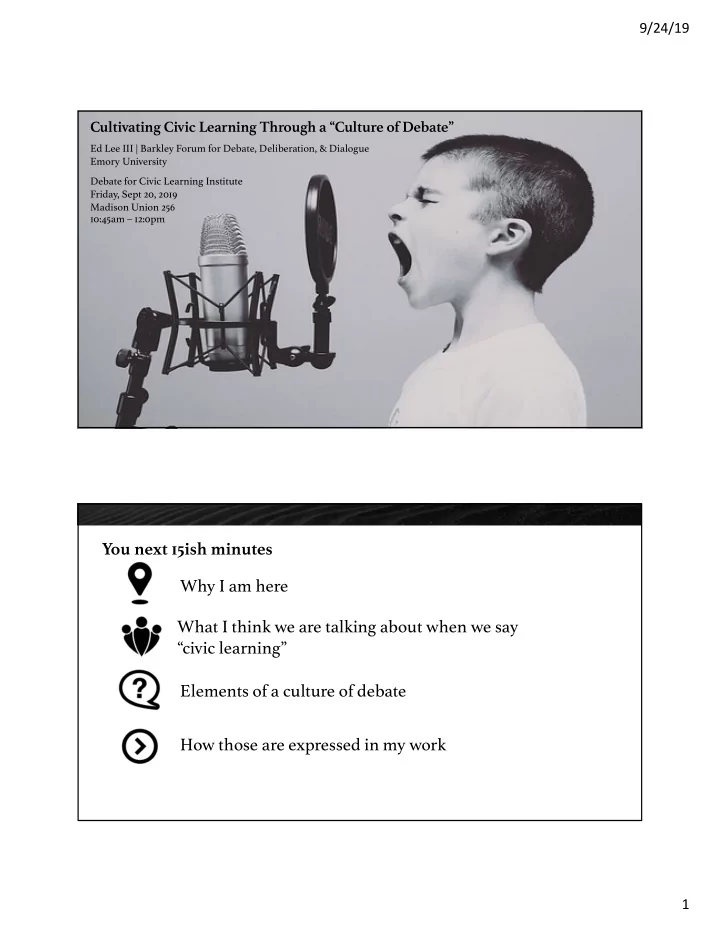
9/24/19 Cultivating Civic Learning Through a Culture of Debate Ed Lee III | Barkley Forum for Debate, Deliberation, & Dialogue Emory University Debate for Civic Learning Institute Friday, Sept 20, 2019 Madison Union 256 10:45am


slide-1
SLIDE 1

9/24/19 1 Cultivating Civic Learning Through a “Culture of Debate”

Ed Lee III | Barkley Forum for Debate, Deliberation, & Dialogue Emory University Debate for Civic Learning Institute Friday, Sept 20, 2019 Madison Union 256 10:45am – 12:0pm

You next 15ish minutes What I think we are talking about when we say “civic learning” Elements of a culture of debate How those are expressed in my work Why I am here

slide-2
SLIDE 2

9/24/19 2

Why am I here? What are we talking about when we say “civic learning”?

slide-3
SLIDE 3

9/24/19 3

If democratic citizenship involves learning to live with and alongside

  • ther people, then an appropriate

civic education must foster the capacity to understand people who may act from very different understandings, motives, and capacities.

David L Coulter & John R Wiens (2008) , Why Do We Educate Renewing the Conversation, 107th Y earbook of the National Society for the Study of Education, p. 143

  • 1. It fosters a capacity to understand difference

Citizens who cultivate their humanity need an ability to see themselves as not simply citizens

  • f some local region or group but

also, and above all, as human beings bound to all other human beings by ties of recognition and

  • concern. The world around us is

inescapably international.

Martha Nussbaum (2002), “Education for Citizenship in an Era of Global Connection, Studies in Philosophy and Education, p. 295

  • 2. It helps us to appreciate that we are citizens of the world
slide-4
SLIDE 4

9/24/19 4

I believe civic education must have a clearly political orientation… Politically oriented civic education requires young people to be able to see, be indignant about, and expose the flawed justifications for

  • inequality. This involves educating

citizens to be `difficult´ in cases where a person’s or group’s equality is not recognized.

Claudia Ruitenberg (2018), “Learning to be Difficult: Civic Education and Intransigent Indignation,” On Education: Journal for Research and Debate, doi: 10.17899/on_ed.2018.1.5

  • 3. It encourages us to make “good trouble”

What is a “culture of debate”?

slide-5
SLIDE 5

9/24/19 5

  • 1. Embrace ideological humility
  • 2. Empathy precedes critique
slide-6
SLIDE 6

9/24/19 6

  • 3. Engage in thoughtful critique of ourselves and others
  • 4. Generation of knowledge is a team sport
slide-7
SLIDE 7

9/24/19 7

Cultivating civic learning through a culture of debate at Emory Atlanta Urban Debate League (AUDL)

slide-8
SLIDE 8

9/24/19 8

Emory Conversation Project Debate, Dinner, Dialogue: A Three Course Conversation

slide-9
SLIDE 9

9/24/19 9

Rapt By Others: A Book Salon