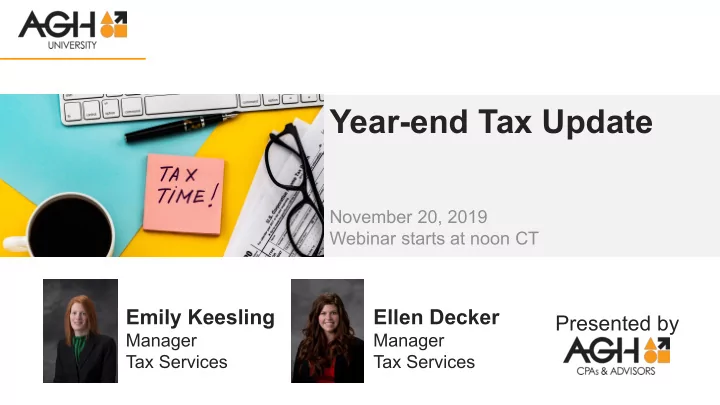
Year-end Tax Update November 20, 2019 Webinar starts at noon CT - - PowerPoint PPT Presentation

year end tax update
SMART_READER_LITE
LIVE PREVIEW

Year-end Tax Update November 20, 2019 Webinar starts at noon CT - - PowerPoint PPT Presentation

Year-end Tax Update November 20, 2019 Webinar starts at noon CT Emily Keesling Ellen Decker Presented by Manager Manager Tax Services Tax Services Administration If you need CPE credit, please participate in all polling questions


slide-1
SLIDE 1

Presented by

Year-end Tax Update

November 20, 2019 Webinar starts at noon CT

Emily Keesling

Manager Tax Services

Ellen Decker

Manager Tax Services

slide-2
SLIDE 2

Administration

If you need CPE credit, please participate in all polling questions throughout the presentation.

slide-3
SLIDE 3

Administration

A recording of today’s webinar will be emailed for your reference or to share with others.

slide-4
SLIDE 4

Administration

For best quality, call in by phone instead of using your computer speakers.

slide-5
SLIDE 5

Administration

To ask questions during the presentation, use the questions box on the right side of your screen.

slide-6
SLIDE 6

Please provide your feedback at the end of today’s presentation.

Administration

slide-7
SLIDE 7

Administration

Emily Keesling

Manager Tax Services

Emily Keesling, a certified public accountant, provides business valuation and tax planning and compliance services for individuals and

  • businesses. She works with a wide range of

industries, including manufacturing and vehicle dealerships, as well as estates and trusts.

slide-8
SLIDE 8

Administration

Ellen Decker

Manager Tax Services

Ellen Decker, a certified public accountant, has multiple years of experience working with non- profits and private sector entities with expertise in tax compliance and planning services. Ellen is a member of the American Institute of CPAs and Kansas Society of CPAs.

slide-9
SLIDE 9

Overview

  • Depreciation
  • Section 163(j) business interest expense

limitation

  • Small business accounting method changes
  • Select non-deductible expenses
  • Wayfair sales tax case
  • Qualified business income (QBI) deduction
  • Excess business loss limitation
  • Qualified opportunity zone
  • Personal tax highlights
  • Estate and gift tax update
slide-10
SLIDE 10

POLLING QUESTION #1

Please answer for continuing education credit

slide-11
SLIDE 11

Depreciation

  • 100% bonus depreciation available for

new and used assets

  • Eligible assets with tax life of 20 years or

less

  • Assets must be placed in service by

December 31, 2019

  • Tax planning opportunity: timing of

purchases and cost segregation study

slide-12
SLIDE 12

Section 179 deduction

  • $1,020,000 maximum deduction
  • Phase-out begins at asset cost of $2.55

million

  • Cannot create a taxable loss
  • Qualified improvement property is eligible
  • i.e. roofing, HVAC, security systems and

alarms

  • Tax planning opportunity: Kansas

expensing deduction for C corporations

slide-13
SLIDE 13

Depreciation

Limitations for vehicles

  • Passenger cars, light trucks, and vans

with GVW under 6,000 lbs

  • $18,100 (includes bonus depreciation)
  • SUVs with GVW over 6,000 lbs but

under 14,000 lbs

  • Section 179 deduction: $25,500
  • Passenger cars, light trucks, and vans

with GVW over 6,000 lbs

  • No limits
  • Vehicles over 14,000 lbs
  • No limits
slide-14
SLIDE 14

Business interest expense limitation

  • Section 163(j) / Form 8990
  • Required when…
  • Average annual gross receipts over $26

million for prior 3 tax years, OR

  • Tax shelter
  • Floor plan financing interest is not

subject to limitation

slide-15
SLIDE 15

Step 1: Determine total business interest expense

slide-16
SLIDE 16

Step 1: Determine total business interest expense

slide-17
SLIDE 17

Step 2: Calculate adjusted taxable income

slide-18
SLIDE 18

Step 3: 163(j) limitation calculation

Adjusted taxable income (Step Two) Multiply by: 30% Subtotal Add: business interest income Add: floor plan financing interest Total: Maximum allowable deduction If less than Step One, then excess is carried forward

slide-19
SLIDE 19

A few things to note

  • Excess business interest expense is

carried forward indefinitely

  • For partnerships:
  • Allocated to partners
  • Not carried forward by entity
  • For S corporations:
  • Carried forward by entity
slide-20
SLIDE 20

Small business opportunities

  • Small business defined: Average gross

receipts under $26 million for 3 preceding tax years

  • Opportunities…

1. Cash basis reporting 2. Elect out of 263A Uniform Capitalization Rules

  • Accounting method changes require

filing of Form 3115 – Request for Change in Accounting Method

slide-21
SLIDE 21
slide-22
SLIDE 22

Non-deductible expenses

Meals & entertainment

  • Meals:
  • 50% non-deductible
  • Entertainment:
  • 100% non-deductible
  • Recreational and social activities primarily

for benefit of employees:

  • deductible
slide-23
SLIDE 23

Non-deductible expenses

Spousal travel & gifts

  • Spousal travel:
  • Generally 100% non-deductible
  • Gifts
  • Gifts in excess of $25 to any individual are non-

deductible

  • Track cumulative cost of gifts by recipient for tax

purposes

slide-24
SLIDE 24

Non-deductible expenses

Qualified transportation fringe benefits

Categories used to determine deductibility

  • 1. Employer pays a 3rd party for employee parking spots

* Generally amount of expense paid is non-deductible

  • 2. Employer provides transit passes or commuter vans/buses for

employees * Generally amount of expense paid is non-deductible

  • 3. Employer owns or leases all or part of a parking lot/facility

*Further analysis required

slide-25
SLIDE 25

Non-deductible expenses

Qualified transportation fringe benefits

Items to consider in determining non-deductible parking expenses: 1) How many parking spaces are reserved (using a barrier or sign)?

  • # Reserved for employees
  • # Reserved for general public or nonemployees

2) How many non reserved parking spaces are used by employees? 3) How many non reserved parking spaces are open to the general public? The costs allocated to spaces reserved for employees are nondeductible. The costs allocated to spaces reserved for the general public are deductible. 50% public use exception may apply

slide-26
SLIDE 26

POLLING QUESTION #2

Please answer for continuing education credit

slide-27
SLIDE 27

State & local tax: South Dakota v. Wayfair

As of November 5, 2019 * May be invalid due to Wisconsin Circuit Court granting temporary injunction ** May be unconstitutional, KS AG released opinion

  • pposing DOR’s remote seller

policy

State Economic Nexus Threshold AL Over $250,000; effective 10/1/2018 AR Over $100,000 or 200 transactions; effective 7/1/2019 AZ Over $200,000 in 2019, $150,000 in 2020 and $100,000 in 2021; effective 10/1/2019 CA Over $100,000 or 200 transactions; effective 4/1/2019 CO Over $100,000 or 200 transactions; effective 12/1/2018 (grace period to 05/31/2019) CT Over $250,000; effective 12/1/2018 DC Over $100,000 or 200 transactions; effective 01/01/2019 GA Over $250,000 or 200 transactions; effective 07/01/2019 HI Over $100,000 or 200 transactions; effective 07/01/2018 IA Over $100,000 or 200 transactions; effective 01/01/2019 ID Over $100,000 or 200 transactions; effective 06/01/2019 IL Over $100,000 or 200 transactions; effective 10/01/2018 IN Over $100,000 or 200 transactions; effective 10/01/2018 KY Over $100,000 or 200 transactions; effective 07/01/2018 KS Over $100,000 or 200 transactions; effective 10/01/2019** LA Over $100,000 or 200 transactions; effective 01/01/2019 MA Over $100,000 and 100 transactions; effective 10/01/2019 MD Over $100,000 or 200 transactions ME Over $100,000 or 200 transactions; effective 07/01/2018 MI Over $100,000 or 200 transactions; effective 10/01/2018 MN Over $100,000; effective 10/01/2018 MS Over $250,000; effective 09/01/2018 NC Over $100,000 or 200 transactions; effective 11/01/2018 ND Over $100,000 or 200 transactions; effective 10/01/2018 NE Over $100,000 or 200 transactions; effective 03/21/2019 NJ Over $100,000 or 200 transactions; effective 11/1/2018 NM Over $100,000; effective 7/1/2019 NV Over $100,000 or 200 transactions; effective 10/1/2018 NY

Over $300,000 or 100 transactions

OH Over $100,000 or 200 transactions; effective 08/01/2019 OK Over $100,000; effective 11/01/2019 PA $100,000; effective 7/1/2019 RI Over $100,000 or 200 transactions; effective 11/01/2018 SC Over $100,000; effective 11/1/2018 SD Over $100,000 or 200 transactions TN Over $500,000; effective 10/01/2019 TX Over $500,000; effective 10/01/2019 UT Over $100,000 or 200 transactions; effective 1/01/2019 VA Over $100,000 or 200 transactions; effective 7/1/2019 VT Over $100,000 or 200 transactions; effective 7/01/2018 WA $100,000 as an alternative to notice reporting (also a $267,000 threshold B&O); effective 10/01/2018 WI Over $100,000 or 200 transactions; effective 10/01/2018* WV Over $100,000; effective 07/01/2019 WY Over $100,000 or 200 transactions; effective 2/1/2019

Pending Litigation Future Economic Nexus Economic Nexus Active Notice & Reporting Law Active

slide-28
SLIDE 28

Qualified business income deduction

Section 199A

  • Available to owners of Partnerships, S

corporations, Individuals and Trusts. Not available to C corporations.

  • Deduction may be as high as 20% of

qualified business income

  • Below-the-line deduction
  • Deducted after Adjusted Gross Income (AGI)
  • Currently not deductible on Kansas return, but

stay tuned!

slide-29
SLIDE 29

Qualified business income deduction

Section 199A

  • The following must be determined for

each trade or business activity:

  • 1. The amount of Qualified Business or

Specified Service income/loss for the tax year

  • 2. The amount of W-2 wages paid
  • 3. The amount of Unadjusted Basis

Immediately After Acquisition (UBIA)

slide-30
SLIDE 30

Qualified business income

  • Net amount of qualified items of income,

gain, deduction or loss of a qualified trade or business of the taxpayer

  • Effectively connected to trade or business in

U.S.

  • Included in taxable income
  • Excludes
  • Capital gains and losses
  • Dividends
  • Interest other than interest property allocable

to a trade or business

  • Guaranteed payments
slide-31
SLIDE 31

Qualified business income

  • Rental real estate may be considered a

qualified trade or business under Section 199A

  • Based on facts and circumstances- OR-
  • Meets safe harbor requirements outlined in

Revenue Ruling 2019-38

  • Triple Net Lease is typically not

considered QBI

  • Commercial and residential real estate

must be treated as separate activities

slide-32
SLIDE 32

Specified Service Trade or Business (SSTB)

  • Performance of services in health, law,

accounting, actuarial science, performing arts, consulting, athletics, financial services, brokerage services

  • OR any business where principal asset is

the reputation or skill of one or more employees or owners

  • Does not include Engineering and

Architecture

slide-33
SLIDE 33

Disclosure of W-2 wages & UBIA

  • W-2 Wages
  • Wages that the QTB paid to its

employees during the calendar year ending in the business’s tax year

  • The wages must be included in the W-3
  • UBIA - Unadjusted Basis

Immediately after Acquisition

  • Depreciable tangible property held by

and available for use in a QTB during the tax year and is held at the close of the tax year

slide-34
SLIDE 34

Qualified business income deduction

  • Deduction calculated at Individual or

Trust level

  • Subject to multiple limitations

depending on specific facts and circumstances

  • Maximum deduction is 20% of qualified

income

slide-35
SLIDE 35

Aggregation

Qualified business income deduction

  • Permanent election to group separate QTB’s
  • Preferred when wage and basis (UBIA) limitations may apply

In order to aggregate…

  • Both QTB’s must have same ownership group holding 50% or more
  • wnership for a majority of the tax year.
  • Must ALSO meet 2 of the 3 criteria below…
  • 1. They provide products, property or services that are the same or customarily offered

together

  • 2. They share significant centralized business elements (ex. accounting and HR)
  • 3. They are operated in coordination with or reliance upon one or more businesses in

the aggregated group

slide-36
SLIDE 36

Aggregation

Qualified business income deduction

  • SSTB’s DO NOT qualify for aggregation
  • Aggregation is allowed at both the entity and individual or trust

level

  • MUST disclose aggregation on the tax return
  • Example: Self Rental
  • Rental or licensing activity could be aggregated with the trade or

business that they rent to if qualifications are met.

slide-37
SLIDE 37

POLLING QUESTION #3

Please answer for continuing education credit

slide-38
SLIDE 38

Excess business loss limitation

  • Applies to taxpayers other than C corporations
  • Excess business loss = aggregate deductions – (aggregate

gross income + threshold)

  • Excess business loss is treated as net operating loss
slide-39
SLIDE 39

Excess business loss limitation

Example

  • Tom and Susan – married filing joint
  • Tom’s business
  • Gross income: $200,000
  • Deductions: $500,000
  • Susan’s business
  • Gross income: $200,000
  • Deductions: $500,000
  • Excess business loss of $90,000

= $1,000,000 – ($400,000 + $510,000)

slide-40
SLIDE 40

Excess business loss limitation

Example

  • Tim and Sarah – married filing joint
  • Tim’s business
  • Gross income: $200,000
  • Deductions: $500,000
  • Sarah’s wages
  • $150,000
  • Excess business loss is not applicable

= $500,000 – ($200,000 + $510,000)

slide-41
SLIDE 41

Qualified opportunity zone

  • Three potential benefits
  • Gain deferral
  • Partial forgiveness of tax on gain
  • Opportunity to exclude additional gains

generated within the qualified opportunity fund

slide-42
SLIDE 42

Individual income tax

  • Tax Bracket Changes
  • Personal Exemptions- GONE
  • Higher Standard Deduction
  • State and Local Taxes (aka SALT deduction)
  • Miscellaneous Itemized Deductions
slide-43
SLIDE 43

Dependent credits

  • $2,000 Child Tax Credit for qualifying child
  • Phase out begins at $200,000 AGI for Single filer

and $400,000 for MFJ

  • Refundable portion is $1,400
  • $500 Non-Child Dependent Credit
  • Child over age 16 but under age 19
  • Full-time student under age 24
  • Disabled child
  • Dependent relative (elderly parent)
  • Non-refundable
slide-44
SLIDE 44

Planning to itemize?

  • Timing of charitable giving
  • Bunching contributions
  • Contributing to a Donor Advised Fund
  • Over age 70 ½ …
  • Contributed Required Minimum Distributions
  • Keeps IRA distribution out of taxable income
  • Timing of 4th quarter state estimate

payment

  • Submit payment before 12/31/19 if you are

under the $10,000 SALT cap

slide-45
SLIDE 45

529 plans & qualified tuition programs

  • Can be set up on behalf of a

designated beneficiary

  • Earnings on contributions grow tax

free

  • Distributions for qualified education

expenses are tax free

  • Updated to allow $10,000 per student/per

year to be used for qualified elementary or secondary school tuition

  • Election available to spread the gifting
  • ver a 5 year period
  • Ex. $75,000 per donee= $15,000 gift per

year

slide-46
SLIDE 46

Estate & gift tax

  • Lifetime exemption for 2019 is $11.4

million for a single taxpayer and $22.8 million for a married couple

  • Increased exemption set to sunset in

2025

  • 2019 annual exclusion is $15,000
  • Recommendation: Review your

estate plan NOW

slide-47
SLIDE 47

2019 tax forms

  • Many draft forms are available for

2019

  • Form 1040 schedules will be

condensed from 6 to 3

  • Additional basis calculations and

disclosures may be required for partnership returns for tax year 2019

  • To view the draft tax forms available

visit…

  • https://apps.irs.gov/app/picklist/list/draftT

axForms.html

slide-48
SLIDE 48

POLLING QUESTION #4

Please answer for continuing education credit

slide-49
SLIDE 49

Tax planning opportunities

  • 1. Take 100% Bonus or 179 Expensing on assets PIS before year

end

  • 2. Optimize depreciation with a Cost Segregation Study
  • 3. File Form 3115: Request for Change in Accounting Method
  • 4. Aggregate Qualified Business Trades or Businesses
  • 5. Invest recognized capital gain into a Qualified Opportunity Fund
  • 6. Consider timing and bunching of itemized expenses
  • 7. Contribute to 529 or Qualified Tuition Program
  • 8. Review your estate plan
slide-50
SLIDE 50
  • Estate planning is still important
  • Tax laws will change in the future
  • Don’t let the tax tail wag the dog
  • You should be talking to your tax advisor

now

  • Things happen in the dark of night and

behind closed doors that we cannot foresee

Closing thoughts

slide-51
SLIDE 51

Thank you for attending

Emily Keesling

Manager, Tax Services Emily.Keesling@aghlc.com

316.291.4161

linkedin.com/in/emilykeesling

Check out our other webinars! AGHUniversity.com Questions NOT related to today’s content? Taylor.Wiele@aghlc.com

Ellen Decker

Manager, Tax Services Ellen.Decker@aghlc.com

316.291.4051

linkedin.com/in/deckerellen