Y VIDEO GAMES AND ADVISING STUDENTS Presented by: Stephanie - - PowerPoint PPT Presentation

y
SMART_READER_LITE
LIVE PREVIEW

Y VIDEO GAMES AND ADVISING STUDENTS Presented by: Stephanie - - PowerPoint PPT Presentation

MOTIVATION Y VIDEO GAMES AND ADVISING STUDENTS Presented by: Stephanie Chastain Choosing Your Character Current Previous Academic Advisor for the GA for Supplemental Instruction Department of Computer Science UNIV 101L Instructor


slide-1
SLIDE 1

Y

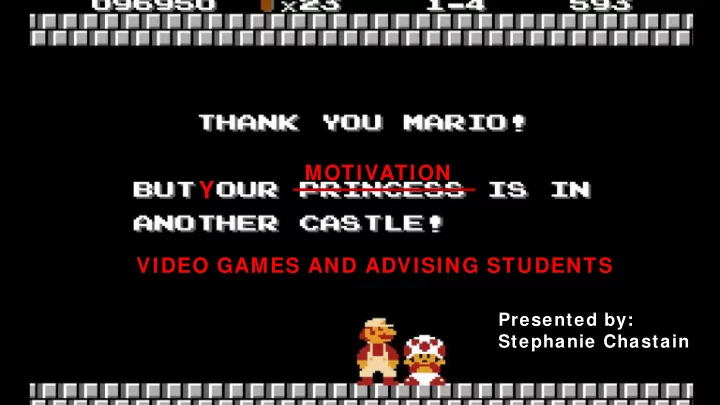
MOTIVATION VIDEO GAMES AND ADVISING STUDENTS

Presented by: Stephanie Chastain
slide-2
SLIDE 2

Choosing Your Character

Current

  • Academic Advisor for the

Department of Computer Science

  • FYS Instructor
  • Completing second master’s in

Educational Psychology

  • Part-time gamer

Previous

  • GA for Supplemental Instruction
  • UNIV 101L Instructor
  • EMU Alumnus – HESA program
  • WSU Alumnus – Psychology Honors
  • SI Leader and Peer Mentor
slide-3
SLIDE 3

Understanding Your Mission

  • Identify relevance
  • Contrast types
  • Recognize skill trees

Video Games

  • Define self-efficacy
  • Translate

conversation topics

Motivation

  • Examine

commonalities

  • Design XP bar
  • Apply techniques

College

slide-4
SLIDE 4

155 million

Americans play video games

    

4 out of 5 U.S. households own a device used to play video games 51% of U.S. households own a dedicated game console 56% of players are between the ages of one and 35 years old

Why Video Games?

slide-5
SLIDE 5

Game Types

  • Action, Shooter,
  • Adventure, RPG,
  • Simulation, Strategy,
  • Sports, Racing
  • Linear vs. Open
  • Skill trees (permanent)
slide-6
SLIDE 6
slide-7
SLIDE 7
slide-8
SLIDE 8
slide-9
SLIDE 9
slide-10
SLIDE 10

Video Game Summary

  • More than half of Americans play video games
  • RPG/Action/Adventure
  • Open World Concept vs. Linear
  • Skill/Ability Trees
  • Customizable player attributes

What motivates a player to continue when the challenge appears too great?

slide-11
SLIDE 11

Self Efficacy and Motivation

Physiological factors

  • Anxiety: normal or lack of ability?

Social persuasion

  • Encouragement from peers,

professors, advisors, family

Vicarious experience

  • Modeling: if they can do it, I can do it as well

Performance accomplishment

  • Experiencing success or mastery
slide-12
SLIDE 12

Video Games and Motivation

  • Thinking that sweaty palms and anxiety over a boss fight are normal

reactions and feelings.

  • Your best friend reassuring you that you will win this time.
  • Reviewing YouTube videos that walk players like you through difficult levels.
  • Finally defeating your opponent and completing the mission.

How can we translate these into a conversation about academic success?

slide-13
SLIDE 13

Student Success Translations

  • How do you react when you cannot win a boss fight in a video game?
  • Then ask: How can you use that thought process for your next math exam?
  • What do you do when you are not sure how to complete a mission?
  • Then ask: Is there a similar resource available to you for your English paper?

Students have the skills to succeed in their video games, why aren’t they applying the same techniques to their classes?

slide-14
SLIDE 14

Examining Differences

College Skills

  • Exams/quizzes have required skills

and knowledge for high scores

  • Abstract understanding of student

level of knowledge via grades

  • S1 Grade of A≠ S2 Grade of A

Player Skills

  • Boss fights have required items,

weapons, and abilities to win

  • Tangible understanding of player

ability via skill trees

  • Dodge Move = Dodge Move

Where is the XP bar (and equipment list) that shows a student is ready for a test?

slide-15
SLIDE 15

Designing an Experience Bar

  • Each completed action provides a set amount of XP
  • Provides students with a concrete view of what is needed to master

the skill

  • Utilizing students’ prior knowledge (and interest) of video games

and relating it to obtaining study skills

  • Motivate students to self-assess their skills and determine how to

make improvements

slide-16
SLIDE 16
slide-17
SLIDE 17

256 XP 1000 XP 744 XP to go before I’m ready for this exam! 5 more chapters and 7 more lecture slides to review...

slide-18
SLIDE 18

Topic Options

  • Motivation and Organization
  • Improving Note-taking
  • Textbook Reading Strategies
  • Exam Preparation
  • Time Management
  • Eliminating Procrastination
  • Stress Management
  • Increasing Concentration
  • Test Taking Strategies
  • Coping with Test Anxiety
slide-19
SLIDE 19

XP Bar in Practice

  • Advising appointments
  • Probation students (skill)
  • First year students (structure)
  • Academic Success Centers
  • Tutoring or SI sessions (content)
  • Success Coaching
  • First Year Seminar courses
  • FTIACs grew up with video games
slide-20
SLIDE 20

Connecting Ideas and Experiences

Video Game

  • Customize character
  • Appearance
  • Choose starter skills and abilities
  • Navigating Open World Setting
  • Side Missions
  • Develop character skills and abilities
  • Explore new areas
  • Not required, but enhance experience
  • Ultimate Goal
  • Continue the story line until the game is

won

College/University

  • Customize character
  • Seek out place in the world
  • Make choices to develop sense of self
  • Navigating Campus Setting
  • Side Missions
  • Get involved on campus
  • Join student organizations
  • Build skills for academic success
  • Ultimate Goal
  • Choose a degree that leads to a career

that matches interests and values

slide-21
SLIDE 21

Stephanie Chastain schastain@wayne.edu