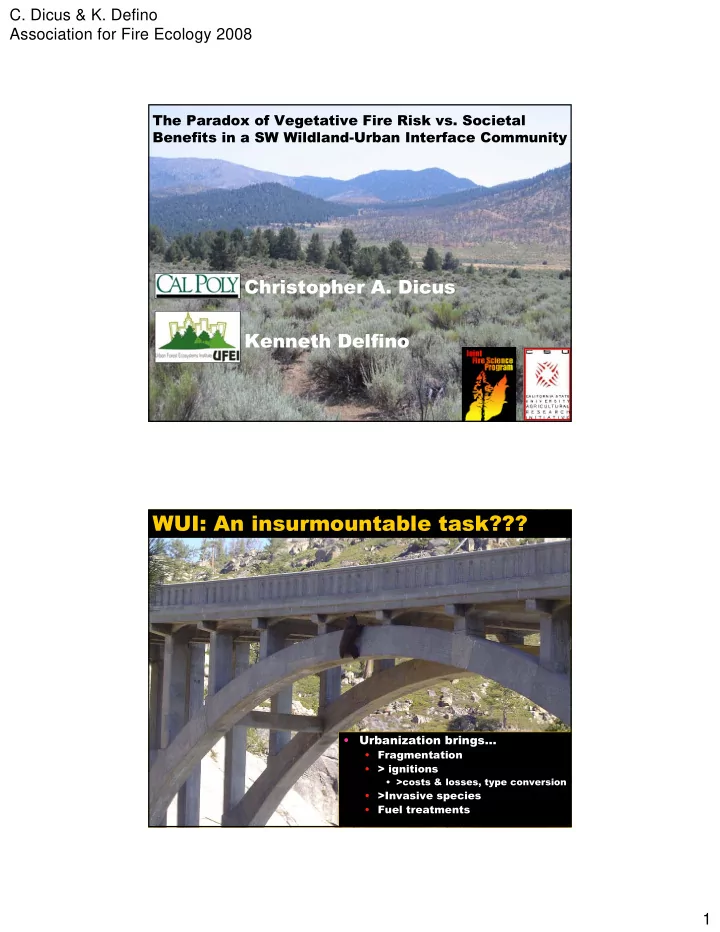
WUI: An insurmountable task??? Urbanization brings Fragmentation - - PDF document

wui an insurmountable task
SMART_READER_LITE
LIVE PREVIEW

WUI: An insurmountable task??? Urbanization brings Fragmentation - - PDF document

C. Dicus & K. Defino Association for Fire Ecology 2008 The Paradox of Vegetative Fire Risk vs. Societal Benefits in a SW Wildland-Urban Interface Community Christopher A. Dicus Kenneth Delfino WUI: An insurmountable task???


slide-1
SLIDE 1
  • C. Dicus & K. Defino

Association for Fire Ecology 2008 1

The Paradox of Vegetative Fire Risk vs. Societal Benefits in a SW Wildland-Urban Interface Community

Christopher A. Dicus Kenneth Delfino

WUI: An insurmountable task???

  • Urbanization brings…
  • Fragmentation
  • > ignitions
  • >costs & losses, type conversion
  • >Invasive species
  • Fuel treatments
slide-2
SLIDE 2
  • C. Dicus & K. Defino

Association for Fire Ecology 2008 2

Hazards vs. benefits

  • Vegetation provides benefits
  • Air pollution removal
  • Carbon sequestration
  • (Take THAT

THAT peak oil!!!)

  • Soil stabilization
  • Home cooling costs
  • Stormwater retention
  • Wildlife habitat
  • And on and on…

Pismo Beach, California

Vegetation is more than fuel!!

Previously…• FARSITE not effective at fine-

scale parcel-level analysis

  • CITYgreen not effective at…
  • anything
  • (except spending tax dollars)
  • Would I-tree work???
  • UFORE
  • (Urban Forest Effects Model)
  • Air pollution removal
  • C sequestration
  • Slew of other goodies
slide-3
SLIDE 3
  • C. Dicus & K. Defino

Association for Fire Ecology 2008 3

The objectives….

For major ecotypes in an E. Sierra, high- desert WUI community, determine …

1. Potential fire behavior 2. Societal benefits

  • Pollution removal
  • C sequestration

3. If I-tree is going to work

Study Site Study Site

  • Kennedy

Meadows

  • Eastern Sierras
  • ~6500’ between

Sierra Crest and Mojave Desert

slide-4
SLIDE 4
  • C. Dicus & K. Defino

Association for Fire Ecology 2008 4

  • Risk assessed in 2006 as

part of consulting work

Study Site Study Site

Pinyon

  • Pinyon pine
  • Pinus monophylla
  • Juniper (minor)
  • Juniperus

californica

  • Some litter,

grass, and shrubs

slide-5
SLIDE 5
  • C. Dicus & K. Defino

Association for Fire Ecology 2008 5

Sagebrush

  • Sagebrush
  • Artemisia tridentata
  • Rabbit brush
  • Ericameria nauseosus

Manter Fire (2000)

  • Both burned…
  • Until the wind stopped
slide-6
SLIDE 6
  • C. Dicus & K. Defino

Association for Fire Ecology 2008 6

Burned

  • Low annual

grasses

  • (when it rains)
  • Pinyon snags
  • Very little

regeneration

Fire Behavior

  • Fuel per SSGIC
  • Pinyon = TU1
  • Sagebrush = GS2
  • Burned = GR1
  • Weather per Manter
  • Calibrated in FARSITE

per Manter progression

  • Midflame Winds = 15

mph upslope

  • High Temp = 95oF
  • RH = 10%
slide-7
SLIDE 7
  • C. Dicus & K. Defino

Association for Fire Ecology 2008 7

Societal benefits

  • 3 plots per ecotype
  • Trees
  • Species, DBH, Ht, Crown

Base Height and width

  • Shrubs
  • Species, Ht, Width, %

Crown cover

  • Calculated benefits for

entire study area

  • Partitioned benefits via

leaf area estimates

  • Trees easy
  • Shrubs hard

.

slide-8
SLIDE 8
  • C. Dicus & K. Defino

Association for Fire Ecology 2008 8

Rate of Spread (chains/hr)

Sagebrush Sagebrush P i n y

  • n

P i n y

  • n

Burned Burned

# I Structures

Flame Length (ft)

<VALUE>

<4' 4'-8' 8'-11' 11'+

slide-9
SLIDE 9
  • C. Dicus & K. Defino

Association for Fire Ecology 2008 9

Flame Length (ft)

S a g e b r u s h S a g e b r u s h Pinyon Pinyon Burned Burned

Pollutant Removal (kg ha-1 yr-1)

0.00 2.00 4.00 6.00 8.00 10.00 12.00 K g/ha/yr PM10 CO NO2 O3 S02 Pollutant Pinyon Sagebrush Burned AAB ABC ABC ABC ABC

α= 0.05 for treatment effects

slide-10
SLIDE 10
  • C. Dicus & K. Defino

Association for Fire Ecology 2008 10

Pollutant Removal ($ ha-1 yr-1)

0.00 10.00 20.00 30.00 40.00 50.00 60.00 70.00 $/ha/yr Total PM10 CO NO2 O3 S02 Pollutant Pinyon Sagebrush Burned ABC ABC ABC AAB ABC

α= 0.05 for treatment effects

ABC

Stored C (kg/ha)

α= 0.05 for treatment effects

A

0.00 2000.00 4000.00 6000.00 8000.00 10000.00 12000.00 14000.00 16000.00 K g/ha Pinyon Sagebrush Burned Ecotype

A AB B

slide-11
SLIDE 11
  • C. Dicus & K. Defino

Association for Fire Ecology 2008 11

C sequestration

0.00 100.00 200.00 300.00 400.00 500.00 600.00 700.00 Kg/ha/yr Pinyon Burned Ecotype

A B B

So what does it mean???

  • Fire Behavior: Shrubs>Pinyon>Burned

Fire Behavior: Shrubs>Pinyon>Burned

  • Didn

Didn’ ’t consider transition to crown fire t consider transition to crown fire

  • Flames <1/2 your problem

Flames <1/2 your problem

  • Fire behavior pretty straight forward

Fire behavior pretty straight forward

  • Will also use FFE/FVS where possible

Will also use FFE/FVS where possible

  • Beware the near

Beware the near-

  • structure variability!!!

structure variability!!!

  • Benefits: Pinyon

Benefits: Pinyon greatest greatest

  • I

I-

  • Tree (UFORE) needs tweaking

Tree (UFORE) needs tweaking

  • Had to send away data for analysis

Had to send away data for analysis

  • I

I-

  • Tree good, I

Tree good, I-

  • Shrub needed

Shrub needed

− − Shrubs still the red Shrubs still the red-

  • headed stepchild

headed stepchild

slide-12
SLIDE 12
  • C. Dicus & K. Defino

Association for Fire Ecology 2008 12

  • Future work
  • Specific fuel

treatments

Chris Hamma Alex Kirkpatrick Jon Large

Holistic approach needed…

Fuels Management Land-use planning Suppression Construction Education