
SLIDE 1
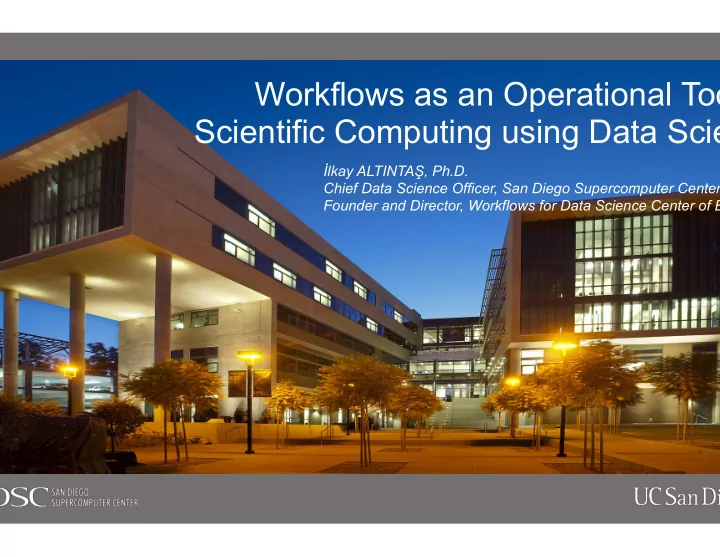
Workflows as an Operational Tool Scientific Computing using Data Scien
İlkay ALTINTAŞ, Ph.D. Chief Data Science Officer, San Diego Supercomputer Center Founder and Director, Workflows for Data Science Center of Exce
Workflows as an Operational Tool Scientific Computing using Data - - PowerPoint PPT Presentation
Workflows as an Operational Tool Scientific Computing using Data Scien lkay ALTINTA , Ph.D. Chief Data Science Officer, San Diego Supercomputer Center Founder and Director, Workflows for Data Science Center of Exce SDSC is 31 Years Young!
Workflows as an Operational Tool Scientific Computing using Data Scien
İlkay ALTINTAŞ, Ph.D. Chief Data Science Officer, San Diego Supercomputer Center Founder and Director, Workflows for Data Science Center of Exce
SDSC is 31 Years Young! Providing Cyberinfrastructure for Research and Education
Established ¡as ¡a ¡na.onal ¡ supercomputer ¡resource ¡center ¡in ¡1985 ¡ by ¡NSF ¡ A ¡world ¡leader ¡in ¡HPC, ¡data-‑intensive ¡ compu.ng, ¡and ¡scien.fic ¡data ¡ management ¡ Current ¡strategic ¡focus ¡on ¡“Big ¡Data” ¡ and ¡“HPC ¡Cloud” ¡: ¡versa.le ¡compu.ng ¡
1985 today Two discoveries in dr design from 1987 and 1
ss Walker Group
SDSC continues to focus on versatile computing and big data!
Gordon: ¡First ¡ ¡ Flash-‑based ¡Supercompute for ¡Data-‑intensive ¡Apps ¡
ail of Science
standard racks = 1944 nodes = 46,656 cores = 249 TB DRAM = 622 TB SSD Pflop/s
virtualization
SDSC Data Science Office
for Data Science Applications --
SDSC Data Science Office (DSO)
SDSC DSO is a collaborative virtual organization at SDSC for colle lasting innovation in data science research, development and educa
DSO
SDSC Expertise and Strengths
Big Data Platforms Training Industry Applications
Computing Today has Many Shapes and Size
BIG DATA COMPUTING AT SCALE Enables dynamic data-driven applications
Manufacturing Computer-Aided Drug Discovery Personalized Precision Medicine Smart Cities Smart Grid and Energy Management Disaster Resilience and Response
Requires:
dynamic coordinati and stateful resource
workforce
New era o data science
New era of data science!
Needs and Trends for Scientific Computing under the Influence o Big Data and Cloud Systems
Volume Size
Application-Specific
Value
BIG DATA
Velocity Variety Volume Scalable batch processing Stream processing Extensible data storage access and integration
Data Management and Processing in the Big Data Er has Unique Challenges!
HBase Hive Pig Giraph Storm Spark MapReduce YARN MongoDB Cassandra HDFS Flink
Lower levels: Storage and scheduling Higher levels: Expression and interactivity
These challenges come with new tools to tackle them
COORDINATION AND WORKFLOW MANAGEMENT DATA INTEGRATION AND PROCESSING DATA MANAGEMENT AND STORAGE
How do we use these new tools and combine them with existing solutions in scientific computing and data science?
Example Big Data Processing Pipelines
.slideshare.net/BigDataCloud/big-data-analytics-with-google-cloud- urce: ps://www.mapr.com/blog/distributed-stream-and-graph-processing-apache-flink Source: https://www.computer.org/csdl/mags/so/2016/02/mso2016020060.html Source: http://www.slideshare.net/ThoughtWorks/big-data-pipeline-with-scala COORDINATION AND ORKFLOW MANAGEMENT
ACQUIRE ¡ PREPARE ¡ ANALYZE ¡ REPORT ¡ ¡ ACT ¡
http://kepler-project.org
ACQUIRE ¡ PREPARE ¡ ANALYZE ¡ ACQUIRE ¡ PREPARE ¡ ANALYZE ¡
Research Challenges
How ¡to ¡easily ¡program ¡a ¡workflow ¡using ¡the ¡Big ¡Data ¡PaYerns? ¡ How ¡to ¡parallelize ¡legacy ¡tools ¡for ¡Big ¡Data? ¡ hich ¡paYern(s) ¡to ¡use ¡under ¡which ¡Big ¡Data ¡engine ¡to ¡use, ¡e.g., ¡as ¡Hadoo Flink ¡or ¡Spark? ¡ nd-‑to-‑end ¡performance ¡predic.on ¡for ¡Big ¡Data ¡applica.ons/workflows ¡(h
Knowledge ¡based: ¡Analyze ¡performance ¡using ¡profiling ¡techniques ¡and ¡dependency ¡analysis ¡ Data ¡driven: ¡Predict ¡performance ¡based ¡on ¡execu.on ¡history ¡(provenance) ¡using ¡machine ¡learning ¡ techniques ¡
n ¡demand ¡resource ¡provisioning ¡and ¡scheduling ¡for ¡Big ¡Data ¡applica.ons where ¡and ¡how ¡to ¡run) ¡
Find ¡the ¡best ¡resource ¡alloca.on ¡based ¡on ¡execu.on ¡objec.ves ¡and ¡performance ¡predic.ons ¡ Find ¡the ¡best ¡workflow ¡and ¡task ¡configura.on ¡on ¡the ¡allocated ¡resources ¡
Using Big Data Patterns in Kepler Workflow
e ¡define ¡a ¡separate ¡DDP ¡ Distributed ¡Data-‑Parallel) ¡task/actor ¡
hese ¡DDP ¡actors ¡par..on ¡input ¡ ata ¡and ¡process ¡each ¡par..on ¡ eparately ¡ ser-‑defined ¡func.ons ¡are ¡described ¡ as ¡sub-‑workflows ¡of ¡DDP ¡actors ¡ DP ¡director: ¡executes ¡DDP ¡
engines ¡
(a) Top-level Workflow (b) Sub-workflow for tRNAscan-SE (c) Sub-workflow for Visual ¡programming ¡ ¡ Parallel ¡execu=on ¡of ¡the ¡
sub-‑workflows ¡ ¡
Exis=ng ¡actors ¡can ¡easily
reused ¡for ¡new ¡tools ¡
with ¡each ¡other ¡via ¡data ¡or ¡message ¡passing ¡via ¡a ¡connec/on ¡.
RAMMCAP
QC ¡ tRNA ¡ cd-‑hit ¡ hmmer ¡ metagene ¡ blaData size CPU time Memory Parallel KB MB GB TB Minute Hour Day Month Year GB 10GB 100GB No need No Multi threading MPI Map Reduce NGS ¡
QC ¡ tRNA ¡ cd-‑hit ¡ hmmer ¡ metagene ¡ blast ¡ QC ¡ tRNA ¡ cd-‑hit ¡ hmmer ¡ metagene ¡ blast ¡ QC ¡ tRNA ¡ cd-‑hit ¡ hmmer ¡ metagene ¡ blast ¡ hmmer ¡ blast ¡ ptimization of Heterogeneous Resource Utilization using bioKepler
Na=onal ¡ ¡ Resources ¡
(Gordon) ¡ (Co (Stamp (Lonestar) ¡Cloud ¡ ¡ Resources ¡ Execution Platforms Local ¡Cluster ¡Resources ¡
dd more traditional HPC and HTC workloads to this
Dynamic data-driven coordination & resource optimization
Requires:
Ability to explore and scale on multiple platforms
Are workflows increasingly becoming the dynamic operations research tool for science
Challenge: Make workflows more aware of distributed system and application state!
Some steps to get there…
module based on all past executions of that executable o task.
predictions of individual tasks to form prediction for entire workflow.
make sure scheduling can use system level information into account in a dynamic data-driven way.
3-‑a: ¡Module ¡Predic=on: ¡Single ¡Predictor ¡ ¡ For ¡Two ¡Independent ¡SoRware ¡Tools ¡
RMSE ¡= ¡42.58 ¡sec ¡ Mean(Valida=on ¡Set) ¡= ¡1727.58 ¡¡Feature ¡Selec=on ¡and ¡Training ¡
Workflow ¡Composi=on ¡(f) ¡
Uses existing tools and computing systems! Computing is just one part
… new methods needed!
Workflows for Data Science Center of Excellence at SDSC
Goal: Methodology and tool development to build automated and operational workflow-driven solution architectures on big data and HPC platforms.
Focus ¡on ¡the ¡ ques:on, ¡ ¡ not ¡the ¡ technology! ¡
Real-‑Time ¡Hazards ¡Management wifir wifire.uc e.ucsd.edu sd.edu Data-‑Parallel ¡Bioinforma/ bio bioKeple pler.o .org ¡ ¡ Scalable ¡Automated ¡Molecular ¡Dynamics ¡and ¡Drug ¡Discovery nbc nbcr.uc .ucsd.e sd.edu du Wo WorDS.sdsc.edu
Examples: Use of Workflows as an Application Integra
Tool for “Big” Data and Computational Science
COORDINATION AND WORKFLOW MANAGEMENT DATA INTEGRATION AND PROCESSING DATA MANAGEMENT AND STORAGE COMMUNICATION AND FEEDBACK
EXPLORATION
SCALABILITY PROVENANCE
ACQUIRE ¡ PREPARE ¡ ANALYZE ¡ REPORT ¡ ¡ ACT ¡
Towards an Integrated Cyberinfrastructure for Scalable Data-Driven Monitoring, Dynamic Prediction and Resilience of Wildfires
kay ¡Al-ntas1, ¡Jessica ¡Block2, ¡Raymond ¡de ¡Callafon3, ¡Daniel ¡Crawl1, ¡Charles ¡Cowart1, ¡Amarnath ¡Gupta1, ¡Mai ¡Nguye Hans-‑Werner ¡Braun1, ¡Jurgen ¡Schulze2, ¡Michael ¡Gollner4, ¡Arnaud ¡Trouve4 ¡and ¡Larry ¡Smarr2 ¡
¡ 1San ¡Diego ¡Supercomputer ¡Center, ¡University ¡of ¡California ¡San ¡Diego, ¡U.S.A. ¡ 2Qualcomm ¡Ins=tute, ¡University ¡of ¡California ¡San ¡Diego, ¡U.S.A. ¡wifire.ucsd.edu
Big Data Fire Modeling Visualization Monitoring
WIFIRE: A Scalable Data-Driven Monitoring, Dynamic Prediction and Resilience Cyberinfrastructure for Wildfire
A Hybrid Data Processing Architecture
SPEED LAYER
BATCH LAYER
SERVING LAYER
… …
ata ¡sources ¡formally ¡described ¡ ¡ ata ¡merged ¡from ¡mul.ple ¡sources ¡into ¡a ¡single, ¡unified ¡model ¡
Measurements ¡from ¡weather ¡sta.ons ¡and ¡cameras ¡ Fire ¡perimeters, ¡e.g., ¡InciWeb ¡, ¡GeoMac, ¡SANDAG ¡ Model ¡output, ¡e.g., ¡FARSITE, ¡Firefly, ¡etc. ¡
¡unified ¡REST ¡interface ¡to ¡access ¡data ¡mul.ple ¡formats ¡
Fire Modeling Workflows in WIFIRE
ime sensors eather forecast Fire perimeter Landscape data Monitoring & fire mapping
Closing the Loop using Big Data
models ¡too ¡high ¡for ¡real-‑.me ¡ analysis ¡
adjustments ¡to ¡the ¡(input) ¡parame
simulated ¡fire ¡front ¡loca.on ¡with ¡an posteriori ¡update/measurement ¡of actual ¡fire ¡front ¡loca.on ¡ ¡
Conceptual Data Assimilation Workflow with Prediction and Update Steps using Sensor Data
Summary: Three questions about converged workflow applications! (Out of many…)
Many ¡exploratory ¡ man ¡in ¡the ¡loop ¡ mponents: ¡
¡ How ¡can ¡we ¡scale ¡the ¡ products ¡of ¡ exploratory ¡steps ¡in ¡ produc-on ¡mode? ¡
Needs ¡to ¡run ¡different ¡ parts ¡of ¡the ¡workflow ¡on ¡ changing ¡distributed ¡ planorms: ¡
¡ Is ¡workflow ¡scheduling ¡a ¡ closed ¡control ¡loop ¡ problem? ¡
Accountability ¡and repor.ng ¡needed ¡at ¡ each ¡step: ¡
¡ What ¡does ¡ provenance ¡and ¡ reproducibility ¡mea in ¡dynamic ¡ applica-ons? ¡
WorDS ¡Director: ¡ ¡Ilkay ¡Al/ntas, ¡Ph.D. Email: ¡al/ntas@sdsc.edu ¡
Questions?
Work funded by NSF, DOE, NIH, UC San Diego and industry partners.