Women and Brain Aging Disclosures Consultant: Pfizer, Noven - - PDF document

women and brain aging
SMART_READER_LITE
LIVE PREVIEW

Women and Brain Aging Disclosures Consultant: Pfizer, Noven - - PDF document

9/23/2015 Women and Brain Aging Disclosures Consultant: Pfizer, Noven Pauline M. Maki, PhD Speaking Honorarium: Abbott Professor of Psychiatry and Psychology, UIC President, North American Menopause Society Research: NIH


slide-1
SLIDE 1

9/23/2015 1

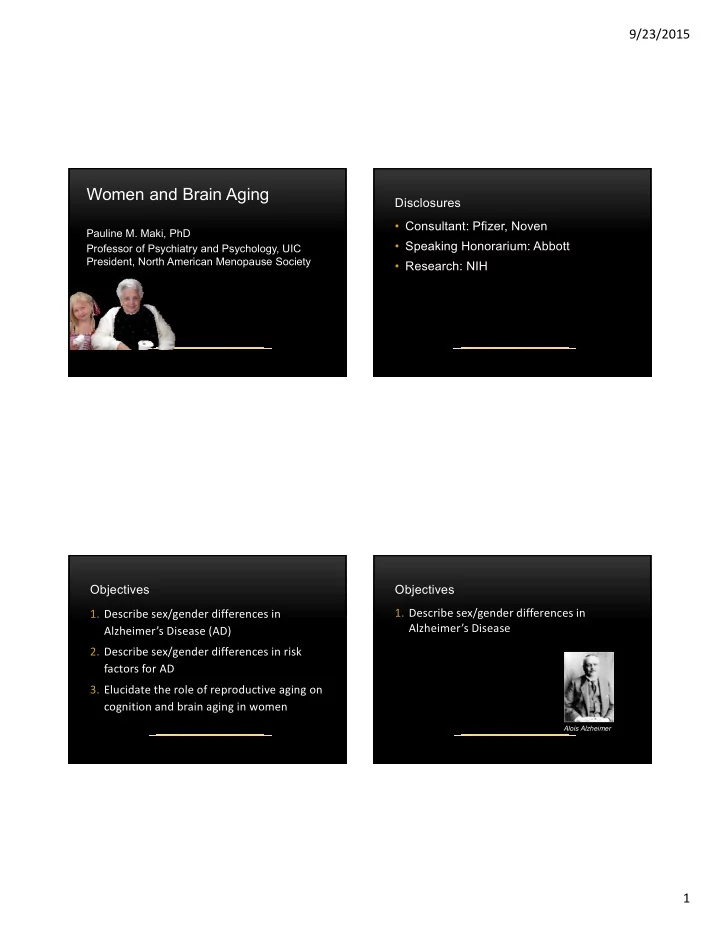
Women and Brain Aging

Pauline M. Maki, PhD Professor of Psychiatry and Psychology, UIC President, North American Menopause Society

Disclosures

  • Consultant: Pfizer, Noven
  • Speaking Honorarium: Abbott
  • Research: NIH

Objectives

  • 1. Describe sex/gender differences in

Alzheimer’s Disease (AD)

  • 2. Describe sex/gender differences in risk

factors for AD

  • 3. Elucidate the role of reproductive aging on

cognition and brain aging in women Objectives

  • 1. Describe sex/gender differences in

Alzheimer’s Disease 2.Understand how reproductive aging and hormone therapy might influence the risk for AD 3.Describe sex differences in risk factors for AD.

Alois Alzheimer

slide-2
SLIDE 2

9/23/2015 2

Prevalence of Alzheimer's Disease (AD)

  • More women than men have AD
  • Of 5 million with AD in US
  • 3.2 million are women
  • 1.8 million are men
  • ~2/3rds of AD patients in US are

women

Source: Heron, M. CDC National Vital Statistics Report; Vol 62, No 6, 2013 Source: Heron, M. CDC National Vital Statistics Report; Vol 62, No 6, 2013

Women and AD

  • At age 65, women without Alzheimer’s

have more than a 1 in 6 chance of developing AD during the remainder of their lives, compared with a 1 in 11 chance for men.

  • Women in their 60s are about twice as

likely to develop AD over the rest of their lives as they are to develop breast cancer.

Andersen K, Launer LJ, Dewey ME, et al. Gender differences in the incidence of AD and vascular dementia: The EURODEM Studies. EURODEM Incidence Research Group. Neurology. Dec 10 1999;53(9):1992-1997.

Why is the Prevalence of AD Higher in Women Than Men?

  • Major contributing factor to higher

prevalence of AD in women is that women live longer than men

  • Age is the major risk factor for AD

Heron, M. CDC National Vital Statistics Report; Vol 62, No 6, 2013; Andersen K, Launer LJ, Dewey ME, et al. Gender differences in the incidence of AD and vascular dementia: The EURODEM Studies. EURODEM Incidence Research Group.

  • Neurology. Dec 10 1999;53(9):1992-1997.

. Heron, M. CDC National Vital Statistics Report; Vol 62, No 6, 2013; Andersen K, Launer LJ, Dewey ME, et al. Gender differences in the incidence of AD and vascular dementia: The EURODEM Studies. EURODEM Incidence Research Group.

  • Neurology. Dec 10 1999;53(9):1992-1997.

.

Greater cognitive deterioration in women than men with Alzheimer's: A meta analysis

Effect Size (95% CI)

  • 1.0
  • 0.50
  • 0.25

0.25

Male Advantage

Semantic Nonsemantic Verbal Visuospatial Memory

  • 0.75

0.50 0.75

Female Advantage Cognitive Domain

Adapted from Irvine, et al. Greater cognitive deterioration in women than men with Alzheimer's disease: A meta analysis JCEN. 2012; 34 (9) 989-998.

slide-3
SLIDE 3

9/23/2015 3

Prevalence of AD Will Triple By 2050

2 4 6 8 10 12 14 2000 2010 2020 2030 2040 2050 Age 65-74 Age 75-84 Age 85+ Total

Hebert LE, Scherr PA, Bienias JL, Bennett DA, Evans DA. Alzheimer disease in the US population: prevalence estimates using the 2000 census. Archives of Neurology. 2003;60(8):1119-1122. Hebert LE, Scherr PA, Bienias JL, Bennett DA, Evans DA. Alzheimer disease in the US population: prevalence estimates using the 2000 census. Archives of Neurology. 2003;60(8):1119-1122.

Number of People with AD (in millions) Number of People with AD (in millions)

Cost of AD from 2010-2050 will exceed $20 trillion

Lewin Group for the Alzheimer’s Association: www.alz.org/trajectory Lewin Group for the Alzheimer’s Association: www.alz.org/trajectory

Cumulative Medicare costs will amount to $11.4 trillion, and cumulative Medicaid to $3.6 trillion over the same period. Objectives

  • 1. Describe sex/gender differences in

Alzheimer’s Disease (AD)

  • 2. Describe sex/gender differences in risk

factors for AD

  • 3. Elucidate the role of reproductive aging on

cognition and brain aging in women AD Can Be Prevented/Delayed

Barnes DE, Yaffe K. The projected effect of risk factor reduction on Alzheimer's disease prevalence. Lancet Neurol. 2011;10:819-828

slide-4
SLIDE 4

9/23/2015 4

Prevalence of Risk Factors for AD: Differences Between Men and Women

Compared to men, women have:

  • Higher BMI
  • Lower rates of exercise
  • Higher cholesterol levels
  • Higher rates of hypertension in older adulthood
  • Higher rates of depression
  • Higher rates of television viewing in adulthood
  • Greater risk due to the predominant genetic risk

factor (ApoE4)

Body Mass Index (BMI) > 30 doubles risk of AD 21 years later Body Mass Index (BMI) > 30 doubles risk of AD 21 years later

Kivipelto M, Ngandu T, Fratiglioni L, et al. Obesity and vascular risk factors at midlife and the risk of dementia and Alzheimer disease. Arch Neurol. Oct 2005;62(10):1556-1560. Harris CV, Bradlyn AS, Coffman J, Gunel E, Cottrell L. BMI-based body size guides for women and men: development and validation of a novel pictorial method to assess weight- related concepts. Int J Obes (Lond). Feb 2008;32(2):336-342. Anstey KJ, Cherbuin N, Budge M, Young J. Body mass index in midlife and late-life as a risk factor for dementia: a meta-analysis of prospective studies. Obes Rev. May 2011;12(5):e426-437.

APOE4 Status Matters More in Healthy Older Women Than in Men A single APOE4 allele increases the risk of clinical decline in healthy

  • lder women, but

not men.

Altmann et al. Sex modifies the APOE-related risk of developing Alzheimer diseases. Annals

  • f Neurology. 2014; 75(4):563-73.

Female Advantage in Verbal Memory

  • Women show a lifelong advantage in

verbal memory

  • Thought to be largely due to
  • rganizational effects of sex steroid

hormones on brain systems underlying memory

Kramer J, Delis D, Daniel M. Sex differences in verbal learning. Journal of Clinical Psychology. 1988;44:907-915. Kramer J, Yaffe K, Lengenfelder J, Delis D. Age and gender interactions on verbal memory performance. Journal of the International Neuropsychological Society. 2003;9(1):97-102.

slide-5
SLIDE 5

9/23/2015 5

Importance of Verbal Memory

  • Declines in verbal memory are the

earliest signs of Alzheimer’s disease (AD) and central to its diagnosis

  • New findings suggest that women

maintain verbal memory early in the course of AD and then rapidly decline

Tierney MC, Yao C, Kiss A, McDowell I. Neuropsychological tests accurately predict incident Alzheimer disease after 5 and 10 years.

  • Neurology. Jun 14 2005;64(11):1853-1859.

Linn RT, Wolf PA, Bachman DL, et al. The 'preclinical phase' of probable Alzheimer's disease. A 13-year prospective study of the Framingham cohort. Arch Neurol. May 1995;52(5):485-490.

Women Show an Advantage In Verbal Memory Despite Similar Levels of Hippocampal Atrophy

─ F ─ M

RAVLT Total Words Recalled

Hippocampal Volume Immediate Recall Delayed Recall Hippocampal Volume

─ F ─ M

Females: β=, p= Males: β=, p= Males: β=, p= Females: β=, p=

Women perform better than men Once atrophy reaches a threshold, women rapidly decline P = .001 P = .001

Objectives

  • 1. Describe sex/gender differences in

Alzheimer’s Disease (AD)

  • 2. Describe sex/gender differences in risk

factors for AD

  • 3. Elucidate the role of reproductive aging on

cognition and brain aging in women

Memory Performance Depends on Menopausal Status: Worsens during Transition

n = 403 followed for 14 years Epperson CN, Sammel MD, Freeman EW. Menopause effects on verbal memory: findings from a longitudinal community cohort. J Clin Endocrinol Metab. Sep 2013;98(9):3829-3838.

Penn Ovarian Aging Study

slide-6
SLIDE 6

9/23/2015 6

Memory and Other Cognitive Functions Vary with Menopausal Stage

n = 117 Weber, M., Rubin, L.H., Maki, P.M. Cognition in the perimenopause: The effect of transition stage. Menopause. 2013;20(5):511-517

Relationship between Cognitive Changes and Menopausal Symptoms

Megamonalisa.com

  • Biolog Skin

Conductance Monitor

  • Objective hot flash

defined as a 2 mmho increase in skin conductance across a 30 second period

  • Button press used for

subjective recognition

  • f hot flash

Measuring Physiologic VMS Objectively with Ambulatory Monitors

Women under-report VMS

Maki PM, Drogos LL, Rubin LH, et al. Objective hot flashes are negatively related to verbal memory performance in midlife women. Menopause. 2008;15(5):848-856.

slide-7
SLIDE 7

9/23/2015 7

Placebo effect is not evident when VMS are measured objectively

5 10 15 20 25 Placebo Red Clover Black Cohosh Prempro Baseline 1-year 5 10 15 20 25 Placebo Red Clover Black Cohosh Prempro Baseline 1-year

Subjective Objective

Maki PM, et al. Menopause. 2009;16(6):1167-77. See also: Carpenter JS, et al. Oncologist. 2007;12(1):124-135. Walega DR et al. Menopause. 2014.

Objective VMS are associated with worse verbal memory

6 5 4 3 2 1

  • 1
  • 2
  • 3
  • 4
  • 5
  • 6

Total Number of Objective Hot Flashes during Sleeping Hours 6 5 4 3 2 1

  • 1
  • 2
  • 3
  • 4
  • 5
  • 6

Delayed Paragraph Recall (score adjusted for other significant predictors)

6 5 4 3 2 1

  • 1
  • 2
  • 3
  • 4
  • 5
  • 6

Total Number of Objective Hot Flashes during Sleeping Hours 6 5 4 3 2 1

  • 1
  • 2
  • 3
  • 4
  • 5
  • 6

Delayed Paragraph Recall (score adjusted for other significant predictors)

29 midlife women (mean age = 53 y) with moderate to severe hot flashes Number of hours of sleep independently predicted worse memory

Maki PM, Drogos LL, Rubin LH, et al. Objective hot flashes are negatively related to verbal memory performance in midlife women. Menopause. 2008;15(5):848-856.

Decreases in objective VMS relate to improvements in verbal memory

r=0.51, p<0.05 See Rubin, et al P-90.

Physiologic VMS are associated with adverse brain outcomes

Thurston RC, Aizenstein HJ, Derby CA, Sejdić E, & Maki PM. Menopausal hot flashes and white matter hyperintensities.

  • Menopause. 2015.

More white matter hyperintensities Hyperconnectivity in brain at rest, especially in hippocampus

Thurston RC, Maki PM, Derby CA, Sejdić E, & Aizenstein, HJ (2015). Menopausal hot flashes and the default mode

  • network. Fertility and Sterility.
slide-8
SLIDE 8

9/23/2015 8

Early use of HT and AD Risk

  • Three prospective studies have examined

timing of initiation of HT in relation to risk of AD

  • Each of the three provides support for the

timing hypothesis

  • Unfortunately, a randomized clinical trial to

test that hypothesis is not feasible

Henderson VW, Benke KS, Green RC, Cupples LA, Farrer LA. Postmenopausal hormone therapy and Alzheimer's disease risk: interaction with age. J Neurol Neurosurg Psychiatry. Jan 2005;76(1):103-105. Shao H, Breitner JC, Whitmer RA, et al. Hormone therapy and Alzheimer disease dementia: New findings from the Cache County

  • Study. Neurology. Oct 30 2012;79(18):1846-1852.

Whitmer RA, Quesenberry CP, Zhou J, Yaffe K. Timing of hormone therapy and dementia: the critical window theory revisited. Ann Neurol. Jan 2011;69(1):163-169.

Early use of HT has neutral effect on cognitive functions

Keeps (Kronos Early Estrogen Prevention Study) 1

  • 5-yr cyclic micro P (200 mg,12 d/month) + transdermal E2 (50 g/wk) or CEE (0.45

mg) in 720 women (42-58 yrs) < 36 m of FMP

  • Neutral cognitive effects after 48 m; some mood benefit with CEE on depression and

anxiety

WHIMSY (WHI Memory Study of Younger Women)2

  • CEE alone or with MPA in women (50 to 54 y) upon enrollment; n =1326
  • Published: neutral cognitive effects when tested on average 7.2 years after the trials

ended

  • “CEE-based therapies produced no overall sustained benefit or risk to cognitive

function when administered to postmenopausal women aged 50–55 years”

ELITE (Early Versus Late Intervention Trial with Estradiol)

  • Oral E2 1 mg/d + vaginal P gel for 10 days per month in 643 younger (< 6 y since

FMP) and older (> 10 y since FMP)

  • Neutral effects

1 Gleason et al., 2015; Plos Med; Jun 2l; 12(6) ; 2 Espeland et al. 2014; JAMA Intern Med. 2013 August 12; 173(15) 3.

Take-home Messages

  • Women have a higher prevalence of AD and of many risk

factors for AD

  • Modifying risk factors such as obesity can lower the public

health burden of AD

  • Verbal memory is key to diagnosing AD, and women might

“mask” AD in the early stages because they have an advantage in verbal memory

  • Verbal memory declines during the menopause; might rebound
  • New evidence suggests that VMS are linked to memory

declines and structural and functional brain abnormalities

  • Early use of HT might lower risk of AD; use of HT early in

women has neutral cognitive effects; effects in symptomatic women are not known