Wireless Network Monitoring Using Coordinated Sampling Chris - - PDF document

wireless network monitoring using coordinated sampling
SMART_READER_LITE
LIVE PREVIEW

Wireless Network Monitoring Using Coordinated Sampling Chris - - PDF document

Wireless Network Monitoring Using Coordinated Sampling Chris McDonald (The University of Western Australia) Udayan Deshpande and David Kotz (Dartmouth College) Effective monitoring of wireless network traffic, using commodity hardware, is a


slide-1
SLIDE 1

Wireless Network Monitoring Using Coordinated Sampling

Chris McDonald (The University of Western Australia) Udayan Deshpande and David Kotz (Dartmouth College)

1

Effective monitoring of wireless network traffic, using commodity hardware, is a challenging task due to the limitations of the hardware. IEEE 802.11 networks support multiple channels, and a wireless interface can monitor

  • nly a single channel at one time. Thus, capturing all frames passing an

interface on all channels is an impossible task, and we need strategies to capture the most representative sample. The competing goals of effective wireless monitoring are to capture as many frames as possible, while minimizing the number of those frames that are captured redundantly by more than one monitoring station. Both goals may be addressed with a sampling strategy that directs neighbouring monitoring stations to different channels during any period.

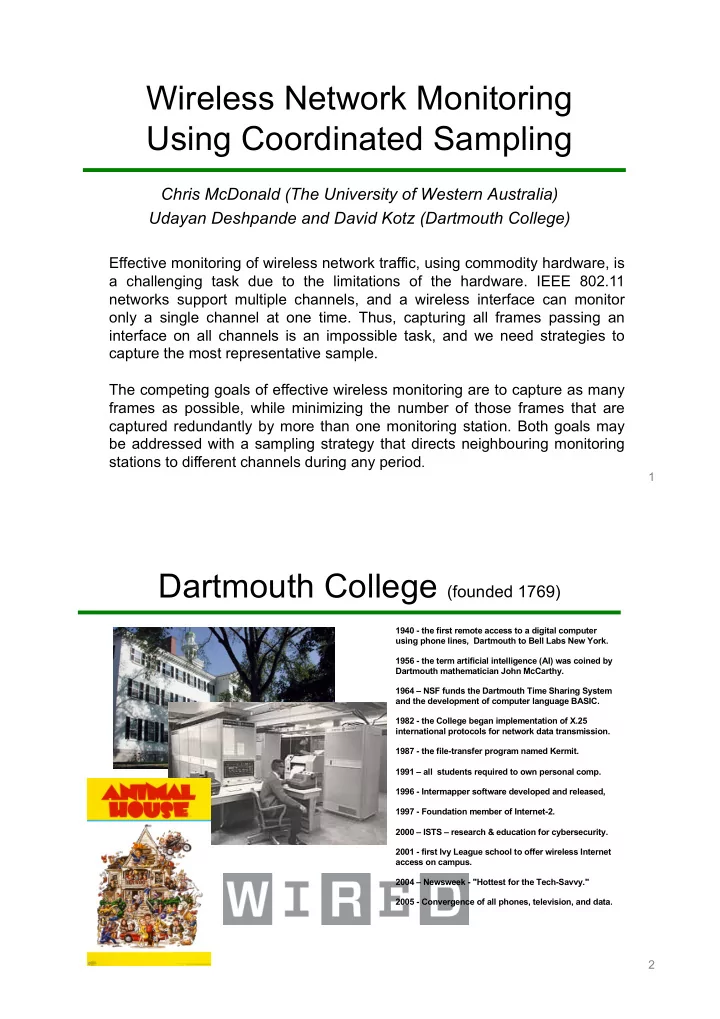
Dartmouth College (founded 1769)

2

1940 - the first remote access to a digital computer using phone lines, Dartmouth to Bell Labs New York. 1956 - the term artificial intelligence (AI) was coined by Dartmouth mathematician John McCarthy. 1964 – NSF funds the Dartmouth Time Sharing System and the development of computer language BASIC. 1982 - the College began implementation of X.25 international protocols for network data transmission. 1987 - the file-transfer program named Kermit. 1991 – all students required to own personal comp. 1996 - Intermapper software developed and released, 1997 - Foundation member of Internet-2. 2000 – ISTS – research & education for cybersecurity. 2001 - first Ivy League school to offer wireless Internet access on campus. 2004 – Newsweek - "Hottest for the Tech-Savvy." 2005 - Convergence of all phones, television, and data.

slide-2
SLIDE 2

In New Hampshire, this is a tree

3 4

The MAP team

Dartmouth College – ISTS (Institute for Security Technology Studies)

– David Kotz, Professor and PI – Chris McDonald, adjunct Professor from Western Australia – Bennet Vance, programmer – Michael Locasto, postdoc – Udayan Deshpande, Keren Tan, graduate students

University of Massachusetts Lowell

– Guanling Chen, Professor and Co-PI – Bo Yan, graduate student

Aruba Networks

– Joshua Wright, Wi-Fi security expert

ISTS

Supported by award NBCH2050002 from HSARPA, DHS Science and Technology Directorate

slide-3
SLIDE 3

5

  • Wireless LANs becoming the dominant transport

– Mission-critical, voice/video over wireless

  • VoWLAN $15B/yr by 2012 (Juniper07)

– Fast moving area; new device and packet technologies

  • 802.11i, 802.11n, 802.11e, 802.16

– presenting many new vulnerabilities

  • Growing set of simple but effective attacks

– Denial of Service (DoS) attacks, Reduction of Quality (RoQ) attacks, consuming excessive bandwidth, disrupting VoIP and video protocols

  • 160 entries in WVE.org database (as of April ‘08)
  • Challenge

– Capture all “over the air” 802.11 frames and analyze them [NSA guidelines for 802.11 wireless IDS, November 2005] – There are no wireless IDS systems capable of doing that today, particularly at the scale of a business, campus, town, or city.

Wi-Fi security needed

6

Attack – DeAuth/DisAssoc Flood

Victim AP

Authentication Request Association Request Authentication Response Association Response Data Frames/ACKs (TCP/UDP video stream) DeAuth / DisAssoc Notification Time

Attacker

DeAuth / DisAssoc Notifications Live video stream

  • ver IEEE 802.11g

Flood of DeAuth/Disassoc Frames using the forged MAC address of AP

Streaming Media Server

  • This attack belongs to

– spoofing attacks – Denial-of-Service (DoS) attacks.

  • Impact on video quality

– is different on UDP and TCP based video

  • MAP can detect this

attack by observing – abnormally high rate

  • f DeAuth/DisAssoc

frames – sequence number gaps (anomalies).

slide-4
SLIDE 4

7

Attack – NAV Flood using ACK Frames

DoS Attacker Victim

Live video stream

  • ver IEEE 802.11g

Flood of “ACK” Frames with large duration value.

“I have more frames to send, everybody be quiet.”

Access Point + Streaming Media Server

NAV - Network Allocation Vector: a register in each station, of the time periods it should not send frames. This attack sends flood of “ACK” frames with large duration value.

  • reserves the wireless medium without using it.

ACK Frame - a type of 802.11 control frames, its duration field is used to reserve the wireless medium.

8 Access Point RoQ Attacker Victim Streaming Media Server

Ethernet

Other Normal Station(s)

The Internet RoQ Attacker Normal Stations

A subtle attack targets the 802.11 DCF (Distributed Coordination Function), and is difficult to detect. MAP detects this attack by looking at the rate of BEACON frames sent by the AP.

Attack – RoQ (Reduction of Quality)

slide-5
SLIDE 5

Wi-Fi network management

  • “Help desk” support

– Student reports trouble with connections – Need after-the-fact analysis of the network conditions in that location at that time.

  • Locating areas of poor coverage

– Proactively discover coverage problems – Examine PHY-layer and MAC-layer behaviour of clients in the region

9 10 Aruba Switch Merger, Analysis server Sniffer AP AP Sniffer

MAP Architecture

slide-6
SLIDE 6

11

In a typical 24hr in-term period: (Normal-proportional) 317 million captured frames 161 million merged frames 98 distinct APs (BSSIDs) 696 distinct STAs 37.8 GB pre-merger trace 23.4 GB post-merger trace

  • approx. 1 GB stats

MAP testbed

12

  • Goals for deployment of the Air

Monitors (AMs)

– Coverage of wireless network – Must be aesthetically unobtrusive – Power over ethernet required – Goals sometimes conflict – Undergone a detailed security audit

Sniffer nodes: Aruba AP70s

Dartmouth Internet Security Testbed – http://www.cs.dartmouth.edu/~dist

slide-7
SLIDE 7

13

Tool: MAPmaker

  • Global start/stop of sniffers, merger, etc.
  • Independent concurrent instances
  • Automates encryption and anonymization
  • Systematic experimental record

– Stores data in designated directory tree – Saves configuration snapshot, logs

14

Secure collection of traffic

  • Encrypt UDP-based traffic crossing the

untrusted wired Ethernet between the AMs and server.

– captured AMEX wireless frames, – commands and statistics

  • We support

– the NLSv2 stream cipher, – the AES Rijndael block cipher. – Additional algorithms may easily be added.

slide-8
SLIDE 8

Density dilemma

  • Sparse sniffers leave gaps

– Traffic in gaps will be lost

  • Dense sniffers give overlapping coverage

– Traffic may be heard redundantly – Improves overall capture (but requires merging)

vs.

Merging Wi-Fi frames

A B

C

E

F

A

B

D

E

F

MERGER’S SNIFFER QUEUES MERGER OUTPUT

F F E E C D B B A A

Traffic generation Wi-Fi sniffer Wi-Fi sniffer

slide-9
SLIDE 9

Synchronization challenge

  • Sniffer timestamps not reliable
  • NTP synchronization inadequate

– Resolution too coarse – Unpredictable discontinuities

  • NIC timers accurate but jumpy
  • Remedy: merger corrects timestamps

– Uses common beacons as guideposts – Corrections propagate to unify all sniffers

Frame sampling challenges

  • IEEE 802.11 networks support multiple

channels, but a wireless interface can monitor only a single channel at once.

  • Changing channels takes (randomly) 5-

70msec, during which frames cannot be captured.

slide-10
SLIDE 10

Frame sampling strategies

  • Goal: capture a representative sample.
  • A simple taxonomy of sampling strategies:

– Random channel sampling – Equal time on each channel – Proportional time on each channel – Coordinate the activities of each AM so as to maximize the likelihood of hearing desired traffic

  • Minimize redundant or unnecessary effort
  • Maximize number of unique frames captured

Channel sampling strategies

  • Per-sniffer (local) strategies

– Equal channel sampling – Proportional channel sampling

1 2 5 3 4 6 7 8 9 10 11 1 2 5 3 4 6 7 8 1 2 5 3 4 6 7 8 Equal Proportional 1 2 5 3 4 6 7 8 9 10 11 First cycle Subsequent cycle

slide-11
SLIDE 11

Problems with simplistic sampling

Our hypothesis is that scheduling the channels on AMs, such that the coverage includes minimal overlap, should result in even greater unique frame capture.

Poor channel overlap Good channel overlap

Coordinated sampling

  • Using the merger's stream of unique

frame information, the controller builds a neighbour graph recording which sniffers recently saw the same frames.

  • The controller employs simulated

annealing to shuffle sniffer sampling schedules to reduce the overlap.

slide-12
SLIDE 12

Unique frame capture

"There are people who will commit unspeakable acts for another ten percent” – John Mashey, founder of MIPS. ICON 2007: "Coordinated Sampling to Improve the Efficiency of Wireless Network Monitoring"

Redundant frame capture

78% of frames captured using coordinated sampling are unique, compared with only 58% of those using proportional sampling

slide-13
SLIDE 13

Refocusing on traffic types

“Refocusing” allows the analysis engine – or sysadmin – to ask the measurement system to focus more effort on a particular kind of traffic. To refocus, we define a predicate, e.g.,

"src == 00:16:cb:b7:18:82"

And run the sniffer policy:

set cyclelen 3000ms run -c 1-5 -p npredicate

This policy will capture traffic on channels 1 to 5 in proportion to the number of frames matching the predicate.

Merger

AMEX frames

Sniffer Sniffer

AMEX frames

Controller

Statistics in, Schedule out

Analysis

Refocus request

Refocusing results

Improved focus without losing baseline capture

Matching frames Non-matching frames

PAM 2008: "Refocusing in 802.11 Wireless Measurement"

slide-14
SLIDE 14

30

Spoofing detection using RSSI (Received Signal Strength Indication)

  • Spoofing is the foundation of

many 802.11 MAC layer attacks

  • RSSI can be used to identify

“senders”

– The RSSI patterns are statistically identifiable – RSSI is difficult to forge – Works with a single sniffer, and even better with multiple sniffers.

Attacker Wireless Station Victim Air Monitor Air Monitor Air Monitor Air Monitor

The Victim The Attacker

31

Multi-Modal RSS patterns

The above plot suggests the received RSS comes from two active and stable sources, due to “Antenna Diversity” and multi-path propagation.

An example of multi-modal RSS distribution from one wireless sender

slide-15
SLIDE 15

32

Multi-Modal RSS pattern profiling

Sender AM

An example to show how a Gaussian Mixture Model (GMM) profiles multi-modal RSS patterns well

34

Detection results

By matching the RSS pattern to pre-obtained profiles, any mis-matches will be reported as “spoofing”. The best-performing algorithm is global detection based

  • n the frame-by-frame merging from multiple AMs.

Our algorithms out-perform other leading techniques. Future work: mobile stations.

INFOCOM 2008: "Detecting 802.11 MAC Layer Spoofing Using Received Signal Strength"

slide-16
SLIDE 16

36

Effectiveness of detection

At each location marked “*”, we deployed

  • Group 1: 6 AMs, local proportional;
  • Group 2: 6 AMs, coordinated proportional;
  • Group 3: 6 AMs, coordinated + refocusing;

and

  • A controler AM, marked “C”, no sampling;
  • An attacker injects DeAuth/DisAssoc Frames

  • nto channel 7 (idlest) and 11 (busiest)

– at various injecting rate 0.5 ~ 50 Fps

Victim Attacker

Refocusing is an effective strategy to improve detection accuracy.

37 37

Layer-3 rogue AP detection

  • Existing commercial solutions cannot detect protected layer-3 rogue APs

– Network Computing survey, June 2006 – Layer-3 APs = off-the-shelf wireless routers

  • New approach based on

– Wired “verifier” listens on packet streams or transport layer netflow records exported by routers/switches – Verifier sends forged test packets – Wireless sniffer picks up these special test packets – 100% accurate in lab environment – Works for all 802.11a/b/g APs – Works even if the packets are encrypted by AP

BROADNETS 2007: "Detecting protected layer-3 rogue APs"

slide-17
SLIDE 17

38

Active fingerprinting

  • Inject non-standard or malformed frames to target device

– FromDS and ToDS bits are expected to be cleared in Probe/ Authentication Request Requests – Probe/Authentication Requests are not supposed to be fragmented – Responses to Probe Requests with other Frame Control bits set (in particular, More Fragments, Power Management, More Data, and Order bits) differed between APs.

  • Classify devices based on response behaviours

WiSec 2008: "Active Behavioral Fingerprinting of Wireless Devices"

39

Voice over WLAN Diagnosis

  • Emerging VoWLAN applications

– Projected to be a $15B market by 2012 (Juniper Research 2007) – Sensitive to QoS and vulnerable to various DoS/RoQ attacks

  • Automated diagnosis when QoS degrades

– Link MAP MAC-layer IDS output with application-level measurements – Both malicious attacks and benign faults may degrade QoS – Need automatic fault classification and localization – Very few existing solutions address this problem

  • VeriWave (offline method, no IDS functionalities), AirMagnet (client-only, limited)
  • Our new approach

– Cross-layer correlation of both wired and wireless network measurements

  • Isolate problems of AP, wireless channel, DHCP, DNS, SIP, authentication, etc.

– Two-stage analysis

  • Lightweight state-machine analyzer finds anomalous traffic events
  • High-level model-based event correlation engine for auto diagnosis

– Works directly on APs or as an appliance attached to WLAN switches

  • Status

– Building prototype

slide-18
SLIDE 18

40 Aruba Switch Merger, Analysis server Sniffer AP AP Sniffer

Multi-Source Aggregation

Wired Monitor

  • Higher layers, such as VoIP
  • Wireless authentication protocols
  • Correlate traditional IDS (Snort)
  • Other components (DHCP, DNS, etc.)
  • Other sources (syslog, SNMP, etc.)

45

Performance of sniffing

Our AMs (Aruba AP70) 266M-MIPS32 CPU 32MB DRAM 2xAtheros 5212 NIC (a/b/g) 2x100MB Ethernet NIC OpenWRT Madwifi Driver Dingo and AMEX libraries

AMs drop frames Resource-constrained devices. Running complicated analysis software on AMs – unrealistic.

slide-19
SLIDE 19

46

Scaling the MAP architecture

Although our merger should scale well, not to a whole campus! Need concept of ‘Merging regions’. Merging regions may overlap. We depend on a centralized alert server to remove duplicated alerts. The overlapped region can be minimized by careful selection of merging regions and AM deployment. We’d like to know the maximum region a merger can cover.

47

What’s the bottleneck?

50% CPU Load

The bandwidth is not the bottleneck. We believe it should be the CPU load for merging frames.

slide-20
SLIDE 20

48

Capacity at scale

Sudikoff 19 AP’s, 1,600 m2 Baker & Berry Library 69 AP’s, 22,000 m2

Google Earth view

  • f Dartmouth Campus

Desired AM density (m2/AM) 80 160 320 AP:AM ratio 1:1 2:1 4:1 Projected max coverage at 50% CPU load Max AMs 117 95 80 Max area covered (m2) 9,360 15,200 25,600

Frame captured by AM under various AM deployment density. R denotes the rate of redundancy.

202

49 49

Dartmouth campus testbed soon to be 240 sniffers

Computer Science Dorm Student Center Chemistry Engineering school Business school Library complex

slide-21
SLIDE 21

50

  • Detailed view of wireless traffic

– sniffers capture MAC-layer headers

  • not available at wired monitors

– merger produces a more complete packet stream

  • each sniffer has limited range (view)
  • each sniffer may lose frames
  • Flexible controller architecture

– Different channel sniffing strategies – Dynamic and manual refocusing capability

  • Near real-time traffic analysis
  • Many spin-off security and monitoring projects

MAP benefits and summary