
SLIDE 1
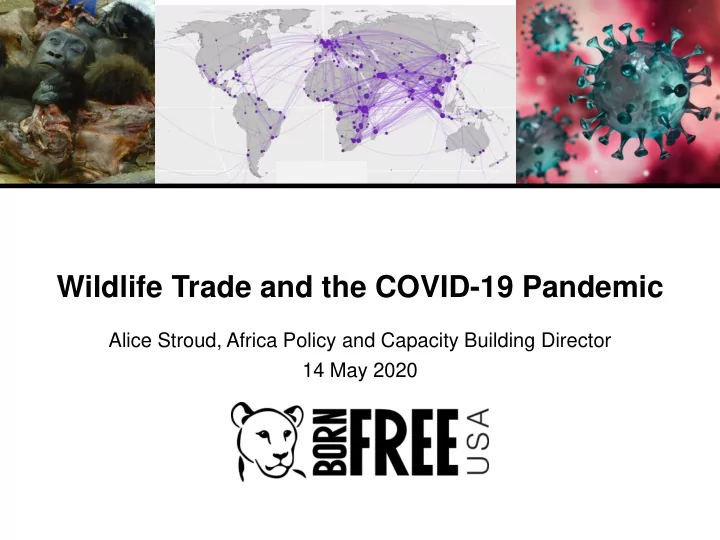
Wildlife Trade and the COVID-19 Pandemic
Alice Stroud, Africa Policy and Capacity Building Director 14 May 2020
Wildlife Trade and the COVID-19 Pandemic Alice Stroud, Africa Policy - - PowerPoint PPT Presentation
Wildlife Trade and the COVID-19 Pandemic Alice Stroud, Africa Policy and Capacity Building Director 14 May 2020 Outline Links between zoonotic diseases and biodiversity threats Impact of wildlife trade Born Free USA response the
Alice Stroud, Africa Policy and Capacity Building Director 14 May 2020
The spread
diseases is exacerbated by threats to biodiversity Response to Covid-19 must integrate a response to threats affecting biodiversity
60% of emerging infectious diseases are zoonotic and 70% of these are thought to
Source: 2019 Report of the Plenary of the Intergovernmental Science-Policy Platform on Biodiversity and Ecosystem Services on the work of its seventh session
Data produced through a search algorithm that mined the IUCN’s and CITES’s databases for trade records of land animals. Source: “Global Wildlife Trade across the Tree of Life,” by Brett R. Scheffers et al., in Science, Vol. 366; October 4, 2019.
Traded species are more likely to be endangered than non-traded ones – wildlife trade has the ability to decimate affected species in just a few years
Illicit exploitation of natural resources (poaching, illegal logging, etc.) Processing of animals and plants into products, their transportation, offer for sale, sale, possession Concealment and laundering of the financial benefits made out of these crimes Violations of the Convention on International Trade in Endangered Species of Wild Fauna and Flora (CITES)
International Consortium on Combating Wildlife Crime
All African countries are Party to CITES except for South Sudan and Western Sahara
Species most commonly trafficked in West Africa
claws, bones)
Source: Run Away to Extinction, Wildlife Trafficking in the Air Transport, ROUTES 2019
Trafficking routes by air for wildlife products between 2009 and 2017. Source: In Plane Sight: Wildlife Trafficking in the Air Transport Sector - C4ADS & ROUTES, 2018
are more susceptible to infections
proximity in unhygienic conditions
Source country Transit country Destination country
unregulated or poorly regulated
products, traditional medicine
site
thousands of live animals
70 Democrats and Republicans from both chambers of Congress calling
permanently ban live wildlife markets
Photo: Asia times
Security implications
wildlife trade Links to Organized Crime: According to a series of U.N. studies on the
illicit traffic of wildlife, wildlife experts claim that Chinese, Japanese, Italian, and Russian organized crime syndicates are “heavily involved in illegal wildlife trade.” Elephant ivory, rhino horns, tiger products, whale meat, sturgeon and caviar targeted among many others.
Links to Drug Trafficking: Key illicit drug production and distribution
countries coincide with major source states for endangered wildlife; illicit wildlife has been found to be smuggled along the same routes as narcotics as a subsidiary trade for drug traffickers; wildlife, both legal and illegal, are also used as the means to conceal illegal drugs.
Links to Terrorism: According to U.N. reports and Interpol officials, some
insurgent groups and possibly terrorist groups are reportedly engaged in illegal poaching for profit in several areas of Asia and Africa. It is possible that terrorist groups or other criminal entities in regions of high biodiversity are taking advantage
Source: Wyler and Sheikh, CRC Report for US Congress, International Illegal Trade in Wildlife: Threats and US Policy, 3 March 2008
Methods used for traffic in live animals and wildlife products
Use of secret compartments of luggage, shipping containers, or clothing Mis-declaration on customs forms and trade permits :
Fraudulently identifying look-alike non-protected species Under reporting the declared number of items shipped Changing the declared value of items Declaring wild species as captive-bred species
Use of forged or stolen trade permits to give the false impression that the contents are being legitimately traded Use of common delivery services (postal services, Fedex, DHL, etc). Also diplomatic luggage which is not subject to scrutiny Use of the Internet, where traders are reportedly using chat rooms and auction websites, such as eBay, to engage in illicit wildlife sales
Source: Wyler and Sheikh, CRC Report for US Congress, International Illegal Trade in Wildlife: Threats and US Policy, 3 March 2008
Country Support: Wildlife Crime Threat Assessments
EXPANDED COLLABORATION (beyond CITES) with new and existing partners
List of priority enforcement needs and recommendations
Information on how illegal wildlife trade works
Understanding its impact as a compounding threat
endangered species and ecosystems
Coast, Mauritania, Senegal and Togo
CITES Identification Guides (paper):
vernacular in English and in French
products that are trafficked
controls, the impact of wildlife crime
identification for coastal countries
CITES Secretariat, subregionally and nationally
A CITES enforcement poster and a leaflet + a series of 8 targeted species enforcement posters (pangolins, elephants, primates, timber, reptiles, marine species, birds, big cats)
decrease in enforcement funds, opportunism)
in February-March 2020 (traffic in vultures parts)
Guinea border on 30 March 2020
biodiversity loss
protected areas
wildlife exploitation and trade
livelihoods
law enforcement coordination
implementing laws
markets
communities
public/NGO engagement
BFUSA CALLING FOR CHANGE OF SCALE IN WORLD INVESTMENT RESPONSE
Alice Stroud, Africa Policy and Capacity Building Director, Born Free USA alice@bornfreeusa.org
For donations: www.bornfreeusa.org/covid19