WHO definition of Health Health is a state of complete physical, - - PDF document

who definition of health
SMART_READER_LITE
LIVE PREVIEW

WHO definition of Health Health is a state of complete physical, - - PDF document

Regional Migration: Challenges and opportunities' Dr.Apostolos Veizis Director of the Medical Support Unit apostolos.veizis@athens.msf.org WHO definition of Health Health is a state of complete physical, mental and Public health is


slide-1
SLIDE 1

1

Dr.Apostolos Veizis Director of the Medical Support Unit apostolos.veizis@athens.msf.org

Regional Migration: ‘Challenges and opportunities'

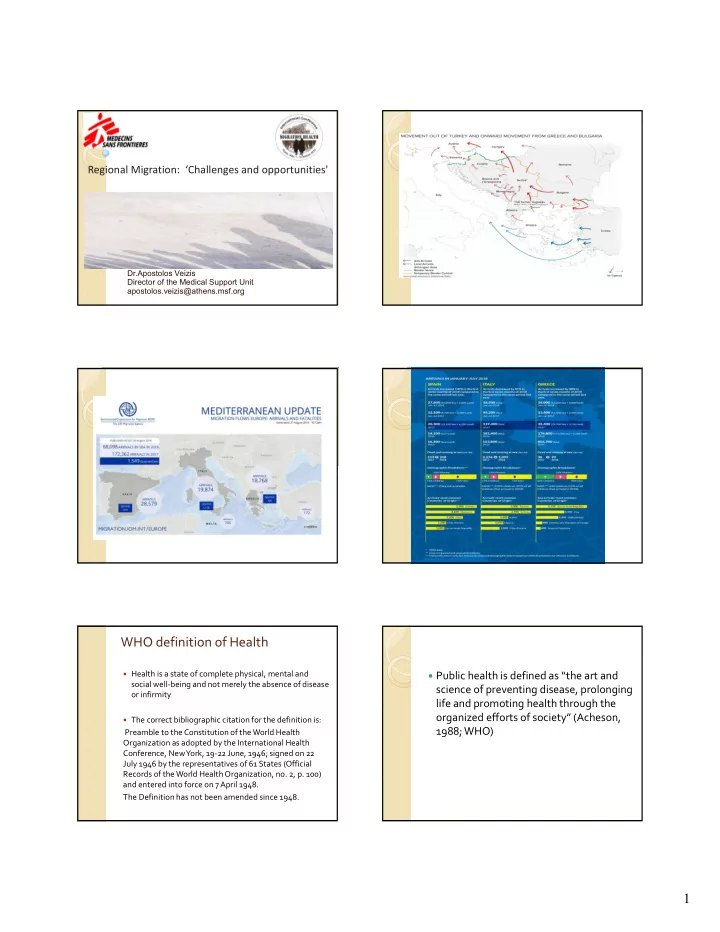
 Health is a state of complete physical, mental and

social well‐being and not merely the absence of disease

  • r infirmity

 The correct bibliographic citation for the definition is:

Preamble to the Constitution of the World Health Organization as adopted by the International Health Conference, New York, 19‐22 June, 1946; signed on 22 July 1946 by the representatives of 61 States (Official Records of the World Health Organization, no. 2, p. 100) and entered into force on 7 April 1948. The Definition has not been amended since 1948.

WHO definition of Health

 Public health is defined as “the art and

science of preventing disease, prolonging life and promoting health through the

  • rganized efforts of society” (Acheson,

1988; WHO)

slide-2
SLIDE 2

2

Life, health and human dignity at risk

Mixed migration routes to the EU : orchestrated humanitarian crisis

 When one is closed

another one opens…

 More and more

refugee profiles

 More and more

women and children

 Violence and loss of

human dignity

 People pushed‐back

and stranded

 People dying on the

way

Dignity, safety, and respect for the basic rights that all people have are enshrined in international humanitarian, human rights and refugee law... The needs… Restrictive policies Consequences

  • Detention as deterrence
  • Poor reception conditions

(as deterrence?)

  • Externalization of border

controls/containment

  • Closure of borders
  • Active forced/voluntary

return policy

  • Push‐backs
  • Readmission agreements

 Lack/discrimination in access

to health care

 Violence and violations of

human rights

 Torture and ill‐treatment  Interruption of chronic

treatment

 MH disorders  Correlation between sub‐

standard living conditions & diseases

 Labor exploitation and human

trafficking

slide-3
SLIDE 3

3

Migration to EU:5 persistent challenges and fundamental right concerns

1.Strict border management 2.Inadequate living conditions in reception

centres

3.Restrictive asylum procedures 4.Leaving unaccompanied children vulnerable 5.Immigration detention

ECDC field visit report, 2011

“The main problem is the increased risk for communicable diseases in the detention centers, mainly linked to severe overcrowding, lack of hygiene, lack of basic supplies (e.g. blankets, shoes, soap, etc.), lack of the possibility for outdoor activities and the long duration of detention. The conditions in the centers are below the internationally accepted minimum standards in all visited detention

  • centers. It is well documented that overcrowding

increases the risk for communicable diseases spread, such as tuberculosis, diarrhea, upper respiratory infections, etc” European Center for Disease Control, 2011.

‘Games Of Violence – Unaccompanied Children And Young People Repeatedly Abused By EU Member State Border Authorities’ The report is based on information of young men or

boys aged between 15 and 25 injured while attempting to cross towards the Schengen Zone treated by MSF in its primary and mental health care clinic in Belgrade in the period from January to June 2017.

69% (86) of MSF’s patients under 18 reported of

direct violence, the majority had visible physical injuries.

 76% named state authorities as perpetrators, of

which majority (92%) were EU border forces.

The young patients reported about mistreatment in

camps, detention centres, at police stations in Bulgaria, Croatia or Hungary.

slide-4
SLIDE 4

4 Challenges

 Multiple actors: Coordination ‐

collaboration

 Cultural mediation:

  • Many languages
  • Not enough

 Patients on the move /stranded

  • Quality care
  • Follow‐up – continuity of care

@MSF/Anna Surinyach @MSF/Jodi Hilton

Increased vulnerability

Multiple traumatic life‐events

Physical & Mental health needs – chronic diseases

Transit population: difficult to follow‐up – continuity of care

@MSF/Alessandro Penso @MSF/Achilleas Zavallis @MSF @MSF/Florian Lems

This report shows that providing regular preventive care, as opposed to providing only emergency care, is cost‐ saving for healthcare systems. Even when using a simple model to estimate costs, the implications are clear: treating a condition only when it becomes an emergency not only endangers the health of a patient, but also results in a greater economic burden to healthcare systems The hypertension model was also applied to other time

  • periods. When the costs were calculated for a period of five

years and then over a lifetime, the cost‐savings of providing regular access to care over emergency treatment increased. Over a period of five years, the cost‐savings increased between 12 % and 13 %. The cost‐savings over a lifetime were even higher, about 16 %

slide-5
SLIDE 5

5

  • EU Charter of Fundamental Rights

Human dignity is inviolable. It must be respected and protected

Recommendations

At transit and destination countries in EUROPE:

 Authorities need to assume their humanitarian and legal

responsibility & take action:

  • Safety – living conditions – early vulnerability screening
  • Free, easy access to healthcare (physical/MH care)
  • Preventive (screening, perinatal, vaccinations)
  • Curative (acute/chronic)
  • Cultural mediation

 Innovative ways for continuity of care & follow‐up

@MSF

New areas and locations:

Research priorities

 Analysis of the data of the medical

structures/NGOs/actors on arrival

 Analysis of the data of the medical

structures/NGOs/actors in transit

 Analysis of the data of the medical

structures/NGOs/actors final destination

 Why no medical services/resources provided proactively

by the authorities VS police/military resources

slide-6
SLIDE 6

6