Where does our water come from? Geohydrology presentation for Chaos - - PowerPoint PPT Presentation

where does our water come from
SMART_READER_LITE
LIVE PREVIEW

Where does our water come from? Geohydrology presentation for Chaos - - PowerPoint PPT Presentation

Where does our water come from? Geohydrology presentation for Chaos Cafe, Jan 26, 2020 by Dick Thomas Page 1 Madrid Water Coop: Madrids water comes from groundwater: an 800 foot deep well was drilled through the upper mesa verde formation


slide-1
SLIDE 1

Where does our water come from?

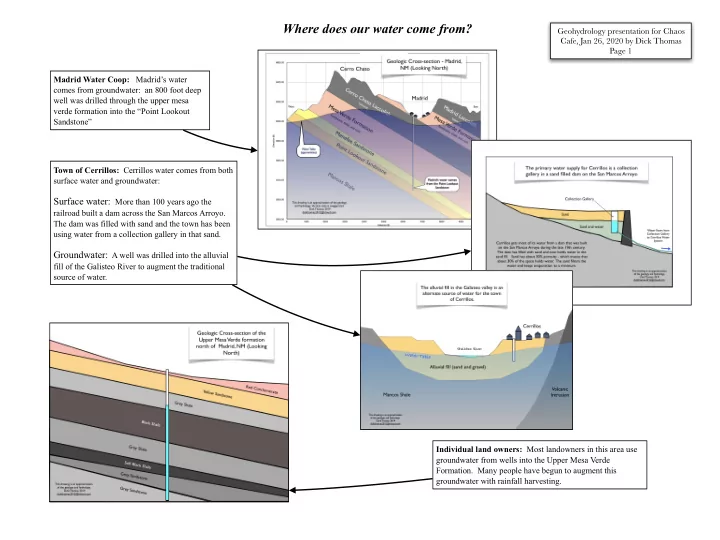
Madrid Water Coop: Madrid’s water comes from groundwater: an 800 foot deep well was drilled through the upper mesa verde formation into the “Point Lookout Sandstone” Town of Cerrillos: Cerrillos water comes from both surface water and groundwater:

Surface water: More than 100 years ago the

railroad built a dam across the San Marcos Arroyo. The dam was filled with sand and the town has been using water from a collection gallery in that sand.

Groundwater: A well was drilled into the alluvial

fill of the Galisteo River to augment the traditional source of water. Individual land owners: Most landowners in this area use groundwater from wells into the Upper Mesa Verde

  • Formation. Many people have begun to augment this

groundwater with rainfall harvesting. Geohydrology presentation for Chaos Cafe, Jan 26, 2020 by Dick Thomas Page 1

slide-2
SLIDE 2

Groundwater

Origins and nature of groundwater Groundwater everywhere has originated as rain that falls on the land and has moved down through the layers of rock until it lies beneath every part of the earth. Water settles into the pore spaces of rock layers which are known as aquifers. Rocks that have large pore spaces (such as sandstone) make good aquifers. Clay and shale hold a lot of water, but because they have very small pore spaces they are poor aquifers. Hard rocks such as granite or basalt have no pore spaces, but they can hold water in fracture zones Old Water: In this area most of that water came from precipitation during the last ice age. In our current climate there is a small amount of recharge resulting from present day precipitation, but water is recharging at rate a that is far less than the rate that we are using it. We are mining the water. Groundwater Mining = Unsustainable Use: In this area and in most all arid regions of the world, groundwater is being mined and its use is unsustainable. Water tables are dropping each year as we mine the water. It will be hundreds to thousands of years before this water is recharged. Rocks and Aquifers in the Madrid - Cerrillos area The type of rock that a well is finished in is critical to how the well provides

  • water. In the Madrid - Cerrillos area wells must intersect a sandstone layer to be

able to get sufficient water for domestic use. In the Madrid area, however, there are a several wells that are finished in fractured zones of one of the laccolith layers (similar to basalt). These wells can provide very good water quality, but may be the first to go dry as the water table drops. Wells that are finished in clay or shale can get water, but only if they are pumped very slowly.

Water Path

Sandstone: Sandstone is very porous and is a good aquifer. Water can easily move through it. Clay and Shale: Clay and shale are fairly porous, but it is difficult for water to move through it. It is not a good aquifer. Basalt or Granite: These hard rocks are generally not porous, except in fracture zones where it can be a fairly good aquifer. Geohydrology presentation for Chaos Cafe, Jan 26, 2020 by Dick Thomas Page 2
slide-3
SLIDE 3

Madrid Cerro Chato

West East

Mancos Shale Point Lookout Sandstone Menefee Sandstone Mesa Verde Formation Cerro Chato Laccolith Madrid Laccolith Mesa Verde Formation

Sandstone, shale, and coal Sandstone, shale, and coal Volcanic Volcanic

This drawing is an approximation of the geology and hydrology. Vertical scale is exaggerated. Dick Thomas 2019 dickthomas2012@icloud.com

Geologic Cross-section - Madrid, NM (Looking North)

Madrid’s water comes from the Point Lookout Sandstone

Water Table (approximate) Geohydrology presentation for Chaos Cafe, Jan 26, 2020 by Dick Thomas Page 3

slide-4
SLIDE 4

Sand Sand and water Collection Gallery

Water flows from Collection Gallery to Cerrillos Water System

Cerrillos gets most of its water from a dam that was built

  • n the San Marcos Arroyo during the late 19th century.

The dam has filled with sand and now holds water in the sand fill. Sand has about 30% porosity - which means that about 30% of the space holds water. The sand filters the water and keeps evaporation to a minimum.

The primary water supply for Cerrillos is a collection gallery in a sand filled dam on the San Marcos Arroyo

This drawing is an approximation

  • f the geology and hydrology.

Dick Thomas 2019 dickthomas2012@icloud.com Geohydrology presentation for Chaos Cafe, Jan 26, 2020 by Dick Thomas Page 4

slide-5
SLIDE 5

Cerrillos Water Table Mancos Shale Alluvial fill (sand and gravel) Volcanic Intrusion

Galisteo River

The alluvial fill in the Galisteo valley is an alternate source of water for the town

  • f Cerrillos.

This drawing is an approximation

  • f the geology and hydrology.

Dick Thomas 2019 dickthomas2012@icloud.com Geohydrology presentation for Chaos Cafe, Jan 26, 2020 by Dick Thomas Page 5

slide-6
SLIDE 6

Red Conglomerate Yellow Sandstone Grey Sandstone Grey Sandstone Grey Shale Grey Shale Black Shale Soft Black Shale

Geologic Cross-section of the Upper Mesa Verde formation north of Madrid, NM (Looking North)

This drawing is an approximation

  • f the geology and hydrology.

Dick Thomas 2019 dickthomas2012@icloud.com Geohydrology presentation for Chaos Cafe, Jan 26, 2020 by Dick Thomas Page 6

slide-7
SLIDE 7

S a n d s t

  • n

e S h a l e a n d C l a y S a n d s t

  • n

e S a n d s t

  • n

e S a n d s t

  • n

e S a n d s t

  • n

e S h a l e a n d C l a y S h a l e a n d C l a y S h a l e a n d C l a y

This well produces a good flow of water because it intersects the porous sandstone. This well is considered to be a dry well because it is finished only in the clay / shale layer. It is not dry, but produces water only very slowly

This drawing represents the Galisteo formation in the area along Highway 14 - east of Cerrillos - known as the “garden of the gods”. Water Table

This drawing is an approximation

  • f the geology and hydrology.

Dick Thomas 2019 dickthomas2012@icloud.com Geohydrology presentation for Chaos Cafe, Jan 26, 2020 by Dick Thomas Page 7