Where Are We? How to model systems CISC422/853: Formal Methods - - PowerPoint PPT Presentation

where are we
SMART_READER_LITE
LIVE PREVIEW

Where Are We? How to model systems CISC422/853: Formal Methods - - PowerPoint PPT Presentation

Where Are We? How to model systems CISC422/853: Formal Methods Theoretically : FSAs in Software Engineering: Practically : BIR, PROMELA How to express properties Computer-Aided Verification Assertions, invariants


slide-1
SLIDE 1

Topic 10: Software Model Checking Tool Overview

Juergen Dingel March, 2009

CISC422/853: Formal Methods

in Software Engineering: Computer-Aided Verification

CISC422/853, Winter 2009 Software Model Checking Tool Overview 2

Where Are We?

How to model systems

  • Theoretically: FSAs
  • Practically: BIR, PROMELA

How to express properties

  • Assertions, invariants
  • Theoretically:

° FSA, Buechi Automata, temporal logic, LTL

  • Practically:

° BIR, Never Claims, LTL

How to check properties of systems

  • Basic DFS, BFS, nested DFS
  • Optimizations: slicing, compression, bit-state hashing, POR

Some practical experience

  • Intuition about strengths and weaknesses of MC

CISC422/853, Winter 2009 Software Model Checking Tool Overview 3

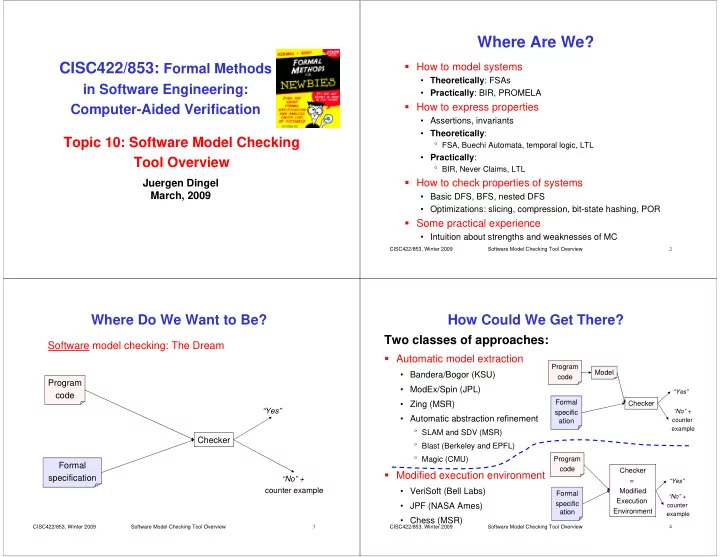
Where Do We Want to Be?

Software model checking: The Dream

Program code Formal specification Checker

“Yes” “No” + counter example

CISC422/853, Winter 2009 Software Model Checking Tool Overview 4

How Could We Get There?

Two classes of approaches:

Automatic model extraction

  • Bandera/Bogor (KSU)
  • ModEx/Spin (JPL)
  • Zing (MSR)
  • Automatic abstraction refinement

° SLAM and SDV (MSR) ° Blast (Berkeley and EPFL) ° Magic (CMU)

Modified execution environment

  • VeriSoft (Bell Labs)
  • JPF (NASA Ames)
  • Chess (MSR)

Program code Formal specific ation Checker

“Yes” “No” + counter example

Model Program code Formal specific ation Checker = Modified Execution Environment

“Yes” “No” + counter example

slide-2
SLIDE 2

CISC422/853, Winter 2009 Software Model Checking Tool Overview 5

Bandera/Bogor

SW MC framework for Java developed at KSU Since Bandera 1.0 (alpha):

  • All of Java
  • Use Bogor (instead of Spin, SMV, …)

Bogor Optimizer

  • slicing
  • data abstraction

Java Front end Jimple BIR constructor

Current research:

  • How to deal with native code, libraries, distributed code?
  • Distributed model checking

BIR

CISC422/853, Winter 2009 Software Model Checking Tool Overview 6

Bandera/Bogor (Cont’d)

bandera.projects.cis.ksu.edu

  • Code, papers, FAQ, Forum

CISC422/853, Winter 2009 Software Model Checking Tool Overview 7

ModEx (FeaVer) / Spin

SW MC for distributed systems written in C Developed by G. Holzmann at Bell Labs (now JPL) since 1998 Use user-defined look-up tables to translate C into PROMELA cm.bell-labs.com/cm/cs/what/modex/

  • Code
  • User guide
  • Examples
  • Papers

CISC422/853, Winter 2009 Software Model Checking Tool Overview 8

Automatic Abstraction Refinement (AAR)

Problem: How to find appropriate abstraction? Answer: Use counter example to iteratively compute abstraction:

(0) start with most aggressive overabstraction P0 of P (1) if Pi satisfies property, then done (2) if Pi doesn’t satisfy property (w/ counter example cex), then

° check if cex feasible in P (i.e., if cex is not a “false negative”) ° if yes, then done (P does not satisfy property, output cex) ° if no, then

quse cex to refine Pi into program Pi+1 that cannot exhibit cex qset i to i+1 and goto 1.

slide-3
SLIDE 3

CISC422/853, Winter 2009 Software Model Checking Tool Overview 9

Automatic Abstraction Refinement (Cont’d)

Used by

  • SLAM/SDV (MSR)
  • Blast (Berkeley and EPFL)
  • Magic (CMU)

Pros:

  • Appropriate abstraction computed automatically

Cons:

  • So far, only been applied to sequential programs

CISC422/853, Winter 2009 Software Model Checking Tool Overview 10

SLAM, Blast and Magic

Analyze C programs Predicate abstraction for abstraction refinement SLAM/SDV (MSR)

  • research.microsoft.com/slam

° Papers

  • http://www.microsoft.com/whdc/devtools/tools/SDV.mspx

Blast (Berkeley and EPFL)

  • www-cad.eecs.berkeley.edu/~rupak/blast/

° Code (in Eclipse), user manual, papers

Magic (CMU)

  • www-2.cs.cmu.edu/~chaki/magic

° Code, user manual, papers

CISC422/853, Winter 2009 Software Model Checking Tool Overview 11

Problems With SW MC Through Translation

  • 1. Need translation in both directions

code ⇒ model ⇓ counter example ⇐ counter example (in code terms) (in model terms)

  • 2. Correctness of analysis hinges on correctness of

translation

  • 3. Some MC languages (e.g., SMV, Spin) not well suited

to represent modern, OO code

  • In Bandera, Java was initially translated into PROMELA
  • Bogor was developed to solve this problem

CISC422/853, Winter 2009 Software Model Checking Tool Overview 12

SW MC Through Modified Execution Environment

What if run-time environment of your language knew about

  • non-determinism
  • exhaustive exploration
  • formal specifications
  • optimizations?

You’d get

  • VeriSoft (C/C++)
  • JPF2 (Java)
  • Chess (MSR)

Program code Formal specific ation Checker = Modified Execution Environment

“Yes” “No” + counter example

slide-4
SLIDE 4

CISC422/853, Winter 2009 Software Model Checking Tool Overview 13

VeriSoft

SW MC for concurrent C/C++ programs Developed by Patrice Godefroid at Bell Labs in 1996 Analysis:

  • Directly on (only slightly modified) source code

⇒ no translation necessary

  • Uses VeriSoft scheduler which replaces standard C scheduler

CISC422/853, Winter 2009 Software Model Checking Tool Overview 14

VeriSoft (Cont’d)

Processes communicate through communication objects

  • Semaphores, channels, or shared memory

Visible action:

  • Read or write access to communication object

VeriSoft exhaustively enumerates all possible sequences

  • f visible actions a concurrent program can perform up to

a user-defined depth Supports:

  • Checks for

° Deadlocks, livelocks, divergences, and assertion violations

  • Support for non-deterministic choice: VS_toss(n)

° Simplifies implementation of test harnesses

CISC422/853, Winter 2009 Software Model Checking Tool Overview 15

VeriSoft (Cont’d)

Analysis uses

  • State-less DFS: no seen set

⇒ less memory, but looping possible ⇒ DFS bounded by user-defined depth parameter

Optimizations:

  • Partial order reduction
  • Search space pruning: abort(b)
  • Abstraction through: placement of visible actions

GUI allows:

  • display of computation tree up to depth
  • inspection of variable values at every node in tree
  • display of violating states
  • guided execution

Wow! Wow! assume(b) in Bogor assume(b) in Bogor

CISC422/853, Winter 2009 Software Model Checking Tool Overview 16

VeriSoft: AC Example

AC_Controller Temperature Sensor AC Door Sensor

“Is the AC always on, when

  • door is closed and
  • room is hot?”
slide-5
SLIDE 5

CISC422/853, Winter 2009 Software Model Checking Tool Overview 17

VeriSoft: AC Example (Cont’d)

AC_Controller Temperature Sensor AC “Is the AC always on, when

  • door is closed and
  • room is hot?”

Door Sensor

void AC_Controller() { char *message; int is_room_hot=0; // initially, room is not hot int is_door_closed=1; // and door is closed int ac=0; // so, ac is off while (1) { message=(char *)rcv_from_queue(to_me,QSZ); if (strcmp(message,"room_is_hot") == 0) is_room_hot=1; if (strcmp(message,"room_is_cool") == 0) is_room_hot=0; if (strcmp(message,"open_door") == 0) { is_door_closed=0; ac=0; } // turn ac off if ((strcmp(message,"close_door") == 0)) { is_door_closed=1; if (is_room_hot) ac=1; // turn ac on }; }; } void AC_Controller() { char *message; int is_room_hot=0; // initially, room is not hot int is_door_closed=1; // and door is closed int ac=0; // so, ac is off while (1) { message=(char *)rcv_from_queue(to_me,QSZ); if (strcmp(message,"room_is_hot") == 0) is_room_hot=1; if (strcmp(message,"room_is_cool") == 0) is_room_hot=0; if (strcmp(message,"open_door") == 0) { is_door_closed=0; ac=0; } // turn ac off if ((strcmp(message,"close_door") == 0)) { is_door_closed=1; if (is_room_hot) ac=1; // turn ac on }; }; }

CISC422/853, Winter 2009 Software Model Checking Tool Overview 18

void AC_Controller() { char *message; int is_room_hot=0; // initially, room is not hot int is_door_closed=1; // and door is closed int ac=0; // so, ac is off while (1) { message=(char *)rcv_from_queue(to_me,QSZ); if (strcmp(message,"room_is_hot") == 0) is_room_hot=1; if (strcmp(message,"room_is_cool") == 0) is_room_hot=0; if (strcmp(message,"open_door") == 0) { is_door_closed=0; ac=0; } // turn ac off if ((strcmp(message,"close_door") == 0)) { is_door_closed=1; if (is_room_hot) ac=1; // turn ac on }; if (is_room_hot && is_door_closed) VS_assert(ac); }; } void AC_Controller() { char *message; int is_room_hot=0; // initially, room is not hot int is_door_closed=1; // and door is closed int ac=0; // so, ac is off while (1) { message=(char *)rcv_from_queue(to_me,QSZ); if (strcmp(message,"room_is_hot") == 0) is_room_hot=1; if (strcmp(message,"room_is_cool") == 0) is_room_hot=0; if (strcmp(message,"open_door") == 0) { is_door_closed=0; ac=0; } // turn ac off if ((strcmp(message,"close_door") == 0)) { is_door_closed=1; if (is_room_hot) ac=1; // turn ac on }; if (is_room_hot && is_door_closed) VS_assert(ac); }; }

VS_assert(b): checks whether b is true at particular location along all possible execution paths VS_assert(b): checks whether b is true at particular location along all possible execution paths But how to model the environment (i.e., the sensors)?

VeriSoft: AC Example (Cont’d)

CISC422/853, Winter 2009 Software Model Checking Tool Overview 19

void Environment() { char *msg; msg=(char *)malloc(100); while (1) { switch(VS_toss(3)) { case 0: sprintf(msg, "room_is_cool"); break; case 1: sprintf(msg, "room_is_hot"); break; case 2: sprintf(msg, "open_door"); break; case 3: sprintf(msg, "close_door"); break; }; send_to_queue(from_me, QSZ, msg); }; } void Environment() { char *msg; msg=(char *)malloc(100); while (1) { switch(VS_toss(3)) { case 0: sprintf(msg, "room_is_cool"); break; case 1: sprintf(msg, "room_is_hot"); break; case 2: sprintf(msg, "open_door"); break; case 3: sprintf(msg, "close_door"); break; }; send_to_queue(from_me, QSZ, msg); }; } void AC_Controller() { char *msg; int is_room_hot=0; // initially, room is not hot int is_door_closed=1; // and door is closed int ac=0; // so, ac is off while (1) { msg=(char *)rcv_from_queue(to_me,QSZ); if (strcmp(msg, "room_is_hot") == 0) is_room_hot=1; if (strcmp(msg, "room_is_cool") == 0) is_room_hot=0; if (strcmp(msg, "open_door") == 0) { is_door_closed=0; ac=0; } // turn ac off if ((strcmp(msg, "close_door") == 0)) { is_door_closed=1; if (is_room_hot) ac=1; // turn ac on }; if (is_room_hot && is_door_closed) VS_assert(ac); }; } void AC_Controller() { char *msg; int is_room_hot=0; // initially, room is not hot int is_door_closed=1; // and door is closed int ac=0; // so, ac is off while (1) { msg=(char *)rcv_from_queue(to_me,QSZ); if (strcmp(msg, "room_is_hot") == 0) is_room_hot=1; if (strcmp(msg, "room_is_cool") == 0) is_room_hot=0; if (strcmp(msg, "open_door") == 0) { is_door_closed=0; ac=0; } // turn ac off if ((strcmp(msg, "close_door") == 0)) { is_door_closed=1; if (is_room_hot) ac=1; // turn ac on }; if (is_room_hot && is_door_closed) VS_assert(ac); }; }

VS_toss(n): returns value between 0 and n non-deterministically VS_toss(n): returns value between 0 and n non-deterministically

CISC422/853, Winter 2009 Software Model Checking Tool Overview 20
slide-6
SLIDE 6

CISC422/853, Winter 2009 Software Model Checking Tool Overview 21

VeriSoft (Cont’d)

Limitations:

  • No support for

° liveness or temporal properties ° input/output from GUIs, files, network

  • Some manual instrumentation necessary
  • No automatic abstraction techniques, e.g.,

° data or predicate abstraction

CISC422/853, Winter 2009 Software Model Checking Tool Overview 22

VeriSoft Demo

CISC422/853, Winter 2009 Software Model Checking Tool Overview 23

Java Path Finder (JPF)

Model checker for Java byte code Developed at NASA Ames Analysis:

  • directly on Java byte code

⇒ no translation necessary

  • uses JPF JVM

CISC422/853, Winter 2009 Software Model Checking Tool Overview 24

JPF (Cont’d)

Optimizations

  • Abstraction through:

° predicate abstraction

  • Pruning of search space:

° ignoreIf(b)

  • Heuristic search: Based on (combinations of)

° property

qdeadlock: maximize # of blocked processes qassertion: minimize distance from assertion

° structure of program

qcontext switches increase heuristic value qnon-determinism decreases heuristic value

° user info

qinteresting(b): if b, then state receives high heuristic value qboring(b): if b, then state receives low heuristic value

assume(b) in Bogor assume(b) in Bogor inter- esting inter- esting

slide-7
SLIDE 7

CISC422/853, Winter 2009 Software Model Checking Tool Overview 25

JPF (Cont’d)

Supports:

  • Checking for deadlocks, assertion violations, LTL properties
  • Non-determinism

° randomInt(), randomBool(), randomObject()

  • DFS, BFS

Limitations: No support for

  • Native code
  • Input/output through GUIs, files, network

Same as Bandera! Same as Bandera!

CISC422/853, Winter 2009 Software Model Checking Tool Overview 26

JPF (Cont’d)

http://javapathfinder.sourceforge.net

  • Code
  • User manual
  • Papers

CISC422/853, Winter 2009 Software Model Checking Tool Overview 27

Course Summary

Concurrency

  • is very tricky
  • interleavings/schedules, race conditions, deadlocks
  • testing concurrent code is difficult

Many different ways to formally describe

  • system behaviour M

° Theoretically: FSAs, Buechi Automata ° Practically: BIR, Promela

  • system requirements ϕ

° Safety

qAssertions, invariants, FSAs, regular expressions, LTL, CTL

° Liveness

qProgress labels, Buechi Automata, Never Claims, LTL, CTL

° Specification patterns

CISC422/853, Winter 2009 Software Model Checking Tool Overview 28

Course Summary (Cont’d)

How to use state space exploration to check M²ϕ

  • DFS, BFS, depth-bounded DFS/BFS, nested DFS
  • For CTL: recursive labeling algorithm (fixed point iteration)

State space explosion

  • LTL and CTL model checking linear in size of state space, but
  • Size of state space exponential in number of processes
  • Fairness

Optimization techniques

  • False negatives, false positives
  • Depth-bounded search, data abstraction, slicing (data flow analysis,

abstract syntax trees, control flow graphs, parser generators, fixed point iteration), state and collapse compression, bitstate hashing, partial order reduction, statement merging

slide-8
SLIDE 8

CISC422/853, Winter 2009 Software Model Checking Tool Overview 29

Course Summary (Cont’d)

Two approaches to implementing software model checkers

  • Based on translation (Bandera/Bogor, FeaVer/Spin)
  • Based on modified execution environment (VeriSoft, JPF)

Model checkers: Bogor, Spin

CISC422/853, Winter 2009 Software Model Checking Tool Overview 30

Project Presentations

  • 1. Model checking for security (Harley)
  • 2. Protocol conformance checking (Yann)
  • 3. LTL-to-Buechi Automaton translation (Ruben)
  • 4. Model checking for UML state machines (Karolina)
  • 5. Model checking for web applications (Xianrong)

To take place on Wed, April 8 from 1:30-5pm in Goodwin 521 All are welcome

CISC422/853, Winter 2009 Software Model Checking Tool Overview 31

For the Final

  • Monday, April 13, 2009 at 9am in Dupuis Hal 215
  • 1 data sheet (8.5x11’’, no flaps, no tricks)
  • Take a look at CTL and CTL model checking parts of

past 422 finals

  • Make sure you know
  • 1. Concurrency: non-determinism, shared variable concurrency,

the problem w/ testing

  • 2. Expressing behaviour: (i)FSMs, (a)synchronous composition,

Buechi automata (BA)

  • 3. Basics of Spin & Promela, Bogor & BIR
  • 1. E.g., how to obtain FSM from BIR or Promela program
  • 4. Expressing properties: assertions, invariants, computation

trees, LTL, CTL, FSMs, BAs, never claims, progress labels, safety, liveness, specification patterns

CISC422/853, Winter 2009 Software Model Checking Tool Overview 32

For the Final (Cont’d)

  • 5. Analysis

° Random, user-guided simulation ° LTL MC: D/BFS for safety properties (possibly depth-bounded), nested DFS for liveness ° CTL MC: labeling algorithm ° fairness

  • 6. Optimization: slicing, data abstraction, collapse compression,

bitstate hashing, partial order reduction, statement merging

  • I’m available to answer questions
  • Good luck
slide-9
SLIDE 9

CISC422/853, Winter 2009 Software Model Checking Tool Overview 33

That’s all, folks!