What do graphs have that trees dont? After this lesson, you should - - PowerPoint PPT Presentation

what do graphs have that trees don t
SMART_READER_LITE
LIVE PREVIEW

What do graphs have that trees dont? After this lesson, you should - - PowerPoint PPT Presentation

Review Re A E C F B D What do graphs have that trees dont? After this lesson, you should be able to define the major terminology relating to graphs implement a graph in code, using various conventions https ://


slide-1
SLIDE 1

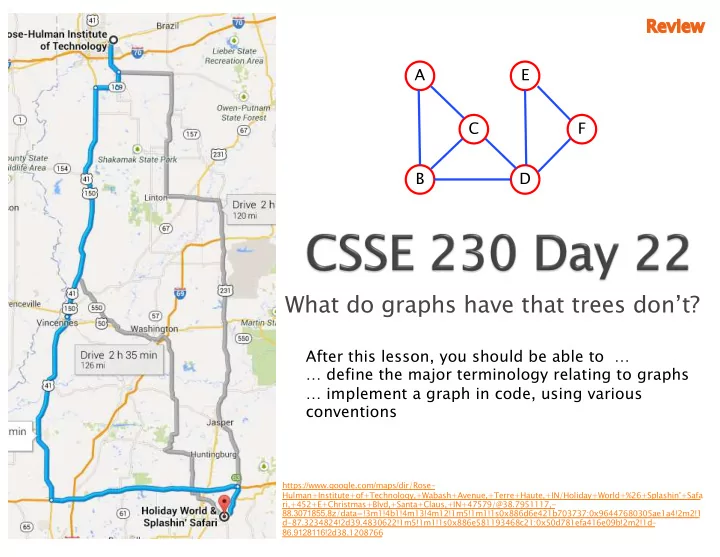
What do graphs have that trees don’t?

https://www.google.com/maps/dir/Rose- Hulman+Institute+of+Technology,+Wabash+Avenue,+Terre+Haute,+IN/Holiday+World+%26+Splashin'+Safa ri,+452+E+Christmas+Blvd,+Santa+Claus,+IN+47579/@38.7951117,- 88.3071855,8z/data=!3m1!4b1!4m13!4m12!1m5!1m1!1s0x886d6e421b703737:0x96447680305ae1a4!2m2!1 d-87.3234824!2d39.4830622!1m5!1m1!1s0x886e581193468c21:0x50d781efa416e09b!2m2!1d- 86.9128116!2d38.1208766

After this lesson, you should be able to … … define the major terminology relating to graphs … implement a graph in code, using various conventions E A D B F C

Re Review

slide-2
SLIDE 2

Terminology Representations Algorithms

slide-3
SLIDE 3

I received this unsolicited email from former student, Sang Choi, in June 2020: "It’s literally one day into my summer vacation and I’ I’m al alread ady using 230 content in my work. My research internship started yesterday, and my research project heavily involves implementing formal methods for the verification of

  • programs. I’ve been assigned to read a lot of papers on this

stuff, and I’ve noticed that fo form rmal meth thods are re gra raph-ba based. There’s states and transitions, which are vertices and edges in graphs. The paper I’m currently reading also goes into depth about how an increase of states in the model of a device might create a greater time complexity of O(N^2) but the author found out it was an O(N) increase after some testing .... When he runs these tests, he also talks about how many vertices he’s visited, and how many minutes it took him to run the test. This just shows ho how important nt data st structures es are e to computer er sc scien ence."

slide-4
SLIDE 4

A graph G = (V,E) is composed of: V: set of vertices (singular: vertex) E: set of edges An edge is a pair of vertices. Can be unordered: e = {u,v} (undirected graph)

  • rdered: e = (u,v)

(directed graph/digraph) Undirected V = {A,B,C,D,E,F} E = {{A,B},{A,C},{B,C},{B,D}, {C,D},{D,E},{D,F},{E,F}} Directed V = {a,b,c,d,e,f} E = {(a,b),(a,c),(b,d),(c,d), (d,c),(d,e),(d,f),(f,c)}

E A D B F C b a d c e f

slide-5
SLIDE 5

} Size? Edges or vertices? } Usually take size to be n = |V| (# of vertices) } But the runtime of graph algorithms often

depend on the number of edges, |E|

} Relationships between |V| and |E|?

slide-6
SLIDE 6

Fact: (Why?)

  • If {u,v} is an edge, then u and v are neighbors

(also: u is adjacent to v)

  • degree of v = number of neighbors of v

E A D B F C

slide-7
SLIDE 7
  • If (u,v) is an edge, then v is a successor of u and

u is a predecessor of v

  • Out-degree of v = number of successors of v
  • In-degree of v = number of predecessors of v

b a d c e f

slide-8
SLIDE 8
  • A path is a list of unique vertices joined by edges.
  • For example, [a, c, d] is a path from a to d.
  • A subgraph is connected if every pair of vertices

in the subgraph has a path between them.

E A D B F C

Not a connected graph. Su Subgr graph Con Connected? {A,B,C,D} Yes {E,F} Yes {C,D,E} No {A,B,C,D,E,F} No

slide-9
SLIDE 9

(Connected) component: a maximal connected subgraph. For example, this graph has 3 connected components:

slide-10
SLIDE 10

Tree: connected acyclic graph (no cycles)

  • Example. Which component is a tree?

Question: for a tree, what is the relationship between m = #edges and n = #vertices?

m = n – 1

slide-11
SLIDE 11
  • A directed path is a list of unique vertices joined

by directed edges.

  • For example, [a, c, d, f] is a directed path from

a to f. We say f is reachable from a.

  • A subgraph is strongly connected if for every pair

(u,v) of its vertices, v is reachable from u and u is reachable from v.

b a d c e f

1

slide-12
SLIDE 12

2

  • Strongly-connected component: maximal

strongly connected subgraph

St Strongl gly co connect cted co components {a} {b} {c,d,f} {e}

b a d c e f

slide-13
SLIDE 13

} Each vertex associated with a name (key) } Examples:

  • City name
  • IP address
  • People in a social network

} An edge (undirected/directed) represents a link

between keys

} Graphs are flexible: edges/nodes can have

weights, capacities, or other attributes

slide-14
SLIDE 14

} Adjacency matrix

  • Each key is associated with an index from 0, …, (n-1)

– Map from keys to ints?

  • Edges denoted by 2D array (#V x #V) of 0’s and 1’s

} Adjacency list

  • Collection of vertices

– Map from keys to Vertex objects?

  • Each Vertex stores a List of adjacent vertices

3-5

E A D B F C } Edge list

  • A collection of vertices and a

collection of edges

slide-15
SLIDE 15

E A D B F C

Adjacency matrix Adjacency list

1 2 3 4 5

1 1

1

1 1 1

2

1 1 1

3

1 1 1 1

4

1 1

5

1 1

Aà0 Bà1 Cà2 Dà3 Eà4 Fà5

} Running time of degree(v)? } Running time of deleteEdge(u,v)? } Space efficiency?

[B,C] A B C D E F [A,C,D] [A,B,D] [B,C,E,F] [D,F] [D,E] 3-5

slide-16
SLIDE 16
slide-17
SLIDE 17

} Milestone 1: Implement

AdjacencyListGraph<T> and AdjacencyMatrixGraph<T>

  • both extend the given ADT, Graph<T>.

} Milestone 2: Write methods

  • stronglyConnectedComponent(v)
  • shortestPath(from, to)

and use them to go WikiSurfing!

6-8

slide-18
SLIDE 18

b a d c e f

6 4 1 3 2 5

slide-19
SLIDE 19

To discuss algorithms, take MA/CSSE473 or MA477

slide-20
SLIDE 20

} What’s the cost of the shortest path from A to

each of the other nodes in the graph?

For For much mor

  • re

e on

  • n gr

graph phs, s, take e MA/CSSE 473 or

  • r MA 477
slide-21
SLIDE 21

} Spanning tree: a connected acyclic subgraph that

includes all of the graph’s vertices

} Minimum spanning tree of a weighted, connected

graph: a spanning tree of minimum total weight Example:

c d b a

4 2 3 6 7

c d b a

2 3 6

MST:

slide-22
SLIDE 22

} n cities, weights are travel distance } Must visit all cities (starting & ending at same

place) with shortest possible distance

  • Exhaustive search: how many routes?
  • (n–1)!/2 Î Θ((n–1)!)
slide-23
SLIDE 23

} Online source for all things TSP:

  • http://www.math.uwaterloo.ca/tsp/