
SLIDE 1
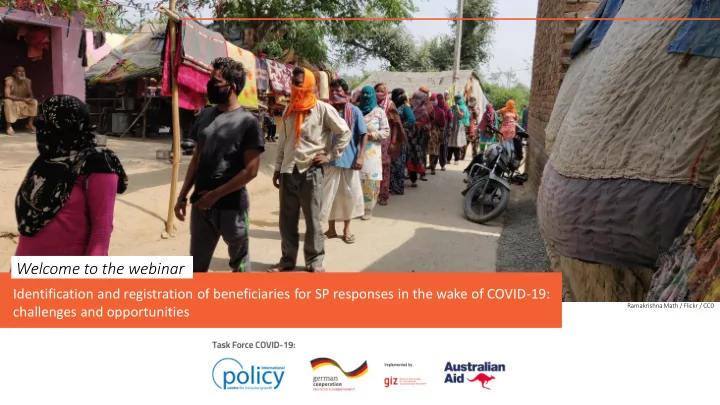
Identification and registration of beneficiaries for SP responses in the wake of COVID-19: challenges and opportunities
Welcome to the webinar
Ramakrishna Math / Flickr / CC0
Welcome to the webinar Identification and registration of - - PowerPoint PPT Presentation
Welcome to the webinar Identification and registration of beneficiaries for SP responses in the wake of COVID-19: Ramakrishna Math / Flickr / CC0 challenges and opportunities Social protection responses to #C #COVID19 This joint effort is
Identification and registration of beneficiaries for SP responses in the wake of COVID-19: challenges and opportunities
Welcome to the webinar
Ramakrishna Math / Flickr / CC0
This joint effort is inspired by colleagues and
ssemina nate e and d disc scus uss the most recen ent conten ent on social protec ection n resp spons nses s to COVID VID-19 19. The initiative has three major components:
1. A weekly special edition of a dedicated ne newsl sletter, featuring a compilation of relevant information from all over the world on social protection initiatives dealing with COVID-19; 2. Weekly webin inars to foster discussions and exchanges; 3. An on
line com
ty to systematise the information gathered
Photo by Gelani Banks on Unsplash
#SPcovid19 #COVID19 #SPresponses
socialprotection.org presents:
Panel ellists: Valentina Barca, Independent Consultant Richard Chirchir, Development Pathways Moderator
Nikos Nikolidakis, GIZ
Identification and registration of beneficiaries for SP responses in the wake of COVID-19: challenges and opportunities
Moderator
Nikos Nikolidakis
GIZ
Identification and registration of beneficiaries for SP responses in the wake of COVID-19: challenges and opportunities
Nikos Nikolidakis is the Team Leader for GIZ’s Programme “Global Alliances for Social Protection” in Bonn/Germany coordinating the programme’s activities on facilitation of learning and exchange on Social Protection. He is also Head of Project for the “External Monitoring for the Vision Zero Fund (VZF)” supporting the ILO implementing a Multi- Donor Trust Fund on preventing work-related deaths, injuries and diseases in global supply chains. Before coming to Bonn, he spent three years in Vietnam working as CIM Integrated Expert in the research department of the Ministry of Labour, Invalids and Social Affairs where he worked on all pillars of social protection including social assistance, social insurance, active labour market support and social services. His further professional experience includes, amongst others, work on social impact analysis and Information and Communication Technologies for Development (ICT4D).
Panellist
Valentina Barca
Independent Consultant
@ValentinaBarca_
Identification and registration of beneficiaries for SP responses in the wake of COVID-19: challenges and opportunities
Valentina Barca is an independent consultant with a focus on how delivery systems (e.g. design and implementation aspects) can facilitate the responsiveness, inclusiveness and effectiveness of social protection systems. In recent years she has worked extensively on integrated information systems, digital identity, shock responsiveness, voice and accountability mechanisms, and rigorous user-focused M&E systems. Her work applied to the field of social protection and included research, policy design, implementation and capacity building work in Asia, Africa and Latin America, across over 15 countries.
Identification and registration of beneficiaries for SP responses in the wake of COVID-19: challenges and opportunities
Richard Chirchir is the Senior management information specialist at Development Pathways and an experienced Management Information Systems (MIS) expert with more than 18 years of professional experience in more than 20 low and middle-income
technology solutions for social protection. In particular, he has spent a considerable amount of his professional experience specializing in designing, developing and implementing Management Information Systems (MIS) for cash transfer and social protection programmes internationally.
Panellist
Richard Chirchir
Development Pathways
@kchirchir
#SPorgWebinar #SPcovid19 #COVID19 #SPresponses
type them in the chat bar
Also, interact with us on Twitter (@SP_Gateway): Identification and registration of beneficiaries for SP responses in the wake of COVID-19: challenges and opportunities
challenges and opportunities
02.06.2020 Valentina Barca, based on inputs from the SPACE team
2
Inputs and comments from many, including Hebbar M., Beazley R.. And the whole SPACE team
Forthcoming GIZ paper,
registration
Source: TRANSFORM (forthcoming SRSP Module) building on ILO USP, UNICEF 2019, O’Brien et al (2018), SPaN (2019), BMZ 2018
WhAt has been happening?
Source: Gentilini et al (2020)
Adequacy Coverage
Both
Enhancing system resilience
Building on existing systems, where possible
Policy Programme (design) Administration
How to quickly register, enrol… and pay?
Source: Seyfert et al (2019) – see also SPACE Delivery Systems Matrix
TOUCHPOINTS ALONG THE DELIVERY CHAIN Integration of existing databases e.g. Civil Registry, ID, Tax, etc. DATA INTEGRATION One-off at routine deadlines (e.g. every 2-3 years, very often delayed). CENSUS SURVEY REGISTRATION Always available, in person via local welfare/programme offices or Municipal/local offices, or online PERIODIC ‘ACTIVE’ OUTREACH Temporary ‘rotating desks’, adequately staffed, travelling to different communities over time CONTINUOUS ON-DEMAND REGISTRATION, IN PERSON OR ONLINE Source: Barca and Hebbar (2020) – GIZ – see also Lindert et al (forthcoming)
Permanent local
Online or hotline (digital ‘window’)
WhAt existing systems?
TOUCHPOINTS ALONG THE DELIVERY CHAIN Integration of existing databases e.g. Civil Registry, ID, Tax, etc. DATA INTEGRATION One-off at routine deadlines (e.g. every 2-3 years, very often delayed) – NOT the topic of this paper. CENSUS SURVEY REGISTRATION Always available, in person via local welfare/programme offices or Municipal/local offices, or online PERIODIC ‘ACTIVE’ OUTREACH Temporary ‘rotating desks’, adequately staffed, travelling to different communities over time CONTINUOUS ON-DEMAND REGISTRATION, IN PERSON OR ONLINE Source: Barca and Hebbar (2020) - GIZ
Permanent local
Online or hotline (digital ‘window’)
And for an emergency? Not necessarily leveraged in full..
& systems
+ ‘Usual suspects’, vulnerable + Informal workers & missing middle + Better off
…All COMPLEMENTARY approaches!
DATA INTEGRATION. EXPANDING TO:
…for emergency expansion/payments via new or existing programme Past beneficiaries from beneficiary registries Those on waiting lists (previous quotas) Those who were eligible but had previously been rejected as beneficiaries Further expanding to a broader caseload using data on potential beneficiaries from Social Registries (registered but not eligible for routine programmes) ‘Easy’ and fast Potential coverage
Social Assistance
Where?
Being considered in Zambia Iraq, Sri Lanka, Zambia Being considered in North Macedonia Pakistan, Brazil, Cape Verde, Peru, Colombia, Ecuador, Jordan, Malaysia, Indonesia…
Source: SPACE, building on Barca and Hebbar (2020), Gentilini et al (2020), IPC
Social registry …deep dive
Source: Barca and Beazley (2019) - DFAT
In 2019 we had stressed there were hardly any examples of countries leveraging data on potential beneficiaries to expand to new caseloads in the aftermath of a shock – and for “good reasons” → See full Infographic!
Source: adapted from Barca and Beazley (2019) – DFAT, and forthcoming blog post on SP.org
Social registry …deep dive
Source: Gentilini et al (2020) May 15 edition
DATA INTEGRATION. Using:
…reach ‘everyone’ …reach some categories of individuals ‘Easy’ & fast Potential coverage …Target OUT ID/CRVS data to… Other gvmt data to register or complement
Tax data, disability, land, health insurance, census, etc
Government… non SP Depends
and how
Where?
Singapore, Hong Kong, Japan Bolivia, Namibia… USA (tax) Morocco (H.I.), Ecuador (census)
Source: SPACE, building on Barca and Hebbar (2020), Gentilini et al (2020), IPC
DATA INTEGRATION. EXPANDING using:
Humanitarian data Financial inclusion programmes, mobile money providers, others including private sector ‘Easy’ & fast Potential coverage Local council/cooperative registration mechanisms and/or chambers of commerce and or informal worker organisations, farmer registries..
Other
Where?
Covid not yet India, Uganda…
…also capacity, tools!
Cape Verde, Sierra Leone..
Source: SPACE, building on Barca and Hebbar (2020), Gentilini et al (2020), IPC
On-demand emergency registration via Digital ‘windows’ and helplines
Digital window or helpline. Triggering or complementing registration and enrolment ‘Easy’ & fast Potential coverage
Source: SPACE, building on Barca and Hebbar (2020), IPC
Where?
Thailand, Peru, Colombia, Namibia, Malaysia, South Africa, Morocco etc
Permanent local
On-demand emergency registration via Digital ‘windows’ and helplines
Source: SPACE, building on Barca and Hebbar (2020), IPC
579,000 applications in one week (SMS)
deemed eligible 22 million applications in two weeks… but target was 9 million
Some of the traditional barriers to access for on-demand systems are overcome! Information, simplicity, no stigma
On-demand emergency registration via Digital ‘windows’ and helplines
EASY? Depends..
risk fraud or enhance ‘targeting’ i.e. not ‘ALONE’
Source: SPACE, building on Barca and Hebbar (2020)
On-demand emergency registration via PERMANENT CAPACITY
Permanent local offices/capacity a) Deconcentrated/Local Welfare Offices or Programme offices b) Municipal/ Local Government Offices with potential for some outreach activities too ‘Easy’ & fast Potential coverage Where?
Those where capacity in place… e.g. see Sri Lanka Depends
C and D. Ongoing one-off active outreach
Census Survey or targeted active outreach ‘Easy’ & fast Potential coverage Where?
Those where capacity in place…
quite high risks Depends
23
prepared the better (SP and beyond – e.g. ID)
No matter what:
✓ SIMPLE is BEST: Simplified forms, eligibility criteria and documentation requirements, authentication/ identification processes ✓ ACCOUNTABILITY to AFFECTED POPULATIONS ▪ Handholding + last mile support + grievance ▪ Safety/reduced risk of contagion ▪ Responsible use of data at all stages of the chain
COVID related
Shock Responsive Social Protection
Tax & rev. databases Social reg. & others On demand registration
SP Non- Beneficiaries
Menu of options for leveraging social protection in response to Covid-19: building on what is already in place…
The first 147,000 grants were reportedly paid within 1 week of announcement, using SMS notification + paid via mobile phones and ‘digital wallets’ organised by various banks
date data
demand registration/enrolment to enable payments
transfers
mechanism needs to be designed
F O R M A L S E C T O R
One-off Emergency Income Grant of R750, paid to people aged 18-59 who had lost informal livelihoods or were already unemployed – by targeting out formal sector, current bens, etc with no means
announcement via SMS to a toll-free number + ID card = 579,000 applicants in
…
approach: online registration.
documentation and criteria
I N F O R M A L S E C T O R +
OUTREACH, REGISTRATION, ENROLMENT PAYMENTS
What did NAMIBIA do to swiftly expand to new caseloads (including from the INFORMAL SECTOR)?
Source: https://www.news.uct.ac.za/article/-2020-05-04-covid-19-grant-we-can-learn-from-namibia
Tax & rev. databases Social reg. & others On demand registration
SP Non- Beneficiaries
Menu of options for leveraging social protection in response to Covid-19: building on what is already in place…
a) For those with Bank Account, money transferred directly to the account. For the
ID as authentication and safety measures in place. b) SMS enabling access to State Bank mobile banking and choice of withdrawal option via One Time Password
date data
filling and enrolment' to enable payments
transfers
mechanism needs to be designed
F O R M A L S E C T O R
…
approaches: online registration, using
documentation and criteria
I N F O R M A L S E C T O R +
OUTREACH, REGISTRATION, ENROLMENT PAYMENTS
What did PERU do to swiftly expand to new caseloads, including from the INFORMAL SECTOR?
Source: Socialprotection.org COVID webinars, adapted by Barca and Beazley
a) New programme called ‘Bono Yo Me Quedo en Casa’, targeting 2.7 million individuals (8.4% pop) identified through the country’s SISFOH Social Registry data (which covered
platform created to further review eligibility and collect missing data. Linkage with other government databases too. b) New programme ‘Bono Independiente’ targeting 780,000 hhs (13% pop) only via new
Tax & rev. databases Social reg. & others On demand registration
SP Non- Beneficiaries
Menu of options for leveraging social protection in response to Covid-19: building on what is already in place…
…local offices
date data
filling and enrolment' to enable payments
transfers
mechanism needs to be designed
F O R M A L S E C T O R
…
approaches: SMS registration, using
documentation and criteria
I N F O R M A L S E C T O R +
OUTREACH, REGISTRATION, ENROLMENT PAYMENTS
What did Pakistan do to swiftly expand to new caseloads, icluding from the INFORMAL SECTOR?
Source: Socialprotection.org COVID webinars, adapted by Barca and Beazley
Two expansion approaches, one raising eligibility cut-off on NSER Social Registry (that has 85% coverage and is being updated) to reach 3 million HHs; the other via on extraordinary on-demand SMS and website enabled enrollment campaign to reach 2.5 million HHs …(together 17% coverage population)
Outline…
Key technology principles for COVID-19 SP identification and registration mechanisms?
Development Pathways 39
1. Interoperability and open standards:
registration software e.g. ODK, Survey Solutions, CSPRO, KOBO etc
should be capable of linking to existing SP information systems
and confidentiality:
the application processes and tools
for the secure and confidential sharing of information
is handled in a sensitive manner and
need to use basis and ensure that providers
and requestors carry liability
3. Collaboration:
insights and strategies with key stakeholders
have established COVID-19 emergency response teams at the national and sub-national levels
supported social protection intervention must be rolled out in coordination with
led emergency responses
technologies instead
solutions for COVID- 19 into policies, daily practices and user workflow
system and context to ensure that technology solutions are fit for purpose and fit for context
What are the main technology options?: SIMPLIFY SP PROCESSES AND INFORMATION VARIABLES
COVID-19. The more data variables complicates registration…
Essential information parameters such as ID numbers, names, addresses and mobile numbers (if needed for delivery) should be collected instead
monitoring information such as assets, household composition and socio-economic details
What are the main technology options?: LEVERAGE EXISTING REGISTRIES AND INFORMATION SYSTEMS
and payment platforms
Cashless payment delivery – for example, through mobile money accounts – should be encouraged to avoid risks of crowding, and the spreading of the virus through the handling of cash
What are the main technology options?: RE-USE ADMIN REGISTRIES AND SELF-REGISTRATION TECHNOLOGIES
mechanisms to reach out to additional beneficiaries
Register here
Electronic single windows for social protection and other digital self-registration mechanisms, which are based on web, mobile or USSD (see Box 1) technologies can be utilised to quickly register new beneficiaries who can then be paid using appropriate electronic payment modalities
What are the main technology options?: BUILD NEW TECHNOLOGY SOLUTIONS E.G. USSD APPLICATIONS
is a choice technology in context with high phone and network coverage…
SP RESPONSE
Depending on the nature of the COVID- 19 social protection interventions, new information systems
platforms for social protection may need to be developed to supplement existing
What are the main technology options?: RE-USE EXISTING DATA HOSTING PLATFORMS
SP RESPONSE
Physical data centres are resource-heavy and time-consuming to set up, as they require hardware infrastructure to be replaced every five years; reliable electricity or backup generators; physical security measures and trained staff to administer the centre. So, re-using existing data hosting platforms is reasonable in COVID-19 climate!
What are the main technology options?: STRENGTHEN DIGITAL LITERACY TO REDUCE FRAUD
digital literacy and provide feedback systems
E-digital tools both for registration and the delivery of the COVID-19 social protection interventions should be accompanied by public information
the digital literacy programmes, applicants and beneficiaries of benefits may be open to fraud or scams
What are the challenges?
In the context where registries and information systems do not exist, the main challenge is ensuring that there is a fair balance between setting up a system that can support simple process and ensuring there is adequate data that can spport broader SP system in the country.
Many SP systems were not created for crisis. Irrespective of the technology platform adopted, the crisis creates pressure in many ways: (i) need to rapidly register needy applicants (ii) need to avoid spreading the virus.
data politics:
Unwillingness to share data and cooperate to achieve common objectives because
comes with information
COVID-19 presents unprecedented challenge to SP
building capacity in establishing or adopting technology platforms that can provide rapid support to the needy
build new information systems. Whereas such capacity could be easily built or outsourced during ‘normal’ times, COVID-19 has created abnormal times with allot of restrictions.
infrastructure:
Telecommunication links are often unreliable in many rural areas, a factor that hampers the capacity to fully operate an online information system.
Inclusive social protection: Making the case
This presentation is extracted from the following blog: https://www.developmentpathways.co.uk/blog/7-ways-technology- can-help-the-social-protection-response/
Identification and registration of beneficiaries for SP responses in the wake of COVID-19: challenges and opportunities
Make sure to answer our webinar survey, available after the session!