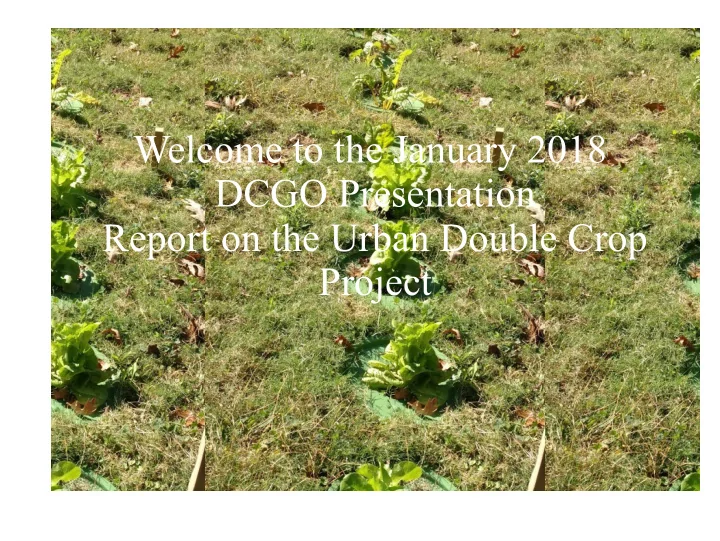
Welcome to the January 2018 DCGO Presentation Report on the Urban - - PowerPoint PPT Presentation
Welcome to the January 2018 DCGO Presentation Report on the Urban Double Crop Project Agenda Reason for the Project Project Sponsor Project Goals Specialized Tools Tested Method of Implentation Results to Date The
Agenda
- Reason for the Project
- Project Sponsor
- Project Goals
- Specialized Tools Tested
- Method of Implentation
- Results to Date
- The Next Step
Why do It
- Warm season grasses like Bermuda go dormant in
cool weather
- At the same time cool season crops like Swiss chard
and broccoli are planted.
- Researchers want to know if home owners could
make use of an area they planted in warm season grass to grow cool season crops and have a good lawn the following spring.
- They also wanted to test two new tools for the home
gardner.
Who Ran the Project
- The project was conceived and conducted by the
UGA research station in Griffin
- Dr Ellen Bauske Program Coordinator UGA Center
for Urban Agriculture/Plant Pathology headed the project with assistance from the turff management group in Griffin.
- Sheri Dorn the Coordinator for the Master Gardener
Program at the UGA facillated the master gardners' role in the project
Object of the Project
- Grow and harvest butter crunch lettuce, bright light
Swiss chard and lieutenant broccoli in a Bermuda lawn area.
- Compare the harvest to the harvest of the same
crops grown at the same time in a traditional bed in the same location.
- Restore the lawn for the following spring.
- Determine how useful lawn pots and a water drill
are in home lawn gardening.
Tools Tested
- Lawn Pots
– Helped a little on weed
controll
– Good for lawn
maintenance
– Made planting and
weeding somewhat difficult because of the four inch diameter
- Water drill
– Not rugged construction
Implemention Plan
- Three treatments of 12 plants each were planted
– 4 butterhead lettuce, 4 swiss chard and 4 broccoli – Control in established garden – Lawn Pot – Lawn Hole
- Plants would be supplied by UGA for all three treatments
- Fertilizer and potting soil supplied for both lawn treatments
- Fertilizing and watering instructions were given for lawn
treatments, garden treatment was maintained as would normally be done.
Planting
- Plants were shipped from Griffin
– Arrived 15 September – Planted 21 September after a brief hardening off
- Raised bed plants were planted by the regular
method
- Both lawn treatments were planted in 4 inch holes
created with the water drill
- Lawn pots were installed in the lawn pot treatment
- In both lawn treatments planting soil supplied by
UDA was added and the plants were fertilized with fertilizer suppled by UGA
Problems Encountered
- Poor condition of plants when received
– Shipped by UPS – Bonnie plants in 4 inch pots – Had not been hardened off
- Warm weather and soil temperature for first few
weeks
- Poor soil in area of lawn treatments
- Insects early in the project
– Treated with organic insect control methods
Maintenance
- Raised beds watered by irrigation system
- Lawn treatments watered by hand one half inch per
week minium including rain fall
- Lawn treatments were fertilized at planting and after
six weeks, 2 tablespoons per plant.
- Weeding as necessary
– Weeding the lawn pot treatment difficult because of the
4 inch insert my hadn did not fit easily inside this was included in report on lawn pot performance.
- Lawn treatments sprayed with organic garlic based
insect repellant
- Raised bed treatment was sprayed with an organic
commercial insect repellant
Harvest
- Produce was weighed as harvested and weight of
harvest by treatment and species was recorded and reported.
- Most of the harvest was donated to St. Patrick's food
bank
– When the harvest was very small it was not donated
- First harvest was October 12 Swiss chard and lettuce
from the raised bed
- Last Harvest was December 15th Swiss chard and
broccoli from the lawn pots and lawn hole treatments
Week End date RB Let RB SC RB Broc LH Let LH SC LH Broc LP Let LP SC LP Broc Total No 3 10/14 158.5 88.5 247 No 4 10/21 No 5 10/28 45 55 100 No 6 11/4 27 39 20 86 No 7 11/11 21 8 37 21 87 No 8 11/18 12 12 15 39 No 9 11/25 40 19 38 2 99 No 10 12/2 30 112 No 11 12/9 No 12 12/16 4 42 8 45 97 Total 203.5 158.5 112 76 70 42 127 58 45 755
Weight in grams
Monitoring and Reporting
- Weekly reports made on website set up by project
head for reports
– Number of plants living of each species by treatment – Grams harvested of each species by treatment – Comments on each species by treatment including
photos
– General comments including photos
Reporting Continued
- Data was inputed to this website by Janet Hanser
– Special thanks to Janet for this and for doing the raised
bed poprtion of the experiment
- Each location was assigned a code name to maintain
confidentiatily.
– Only entering site could see their data – Locations are not known to participants
Now What
- Monitor area where vegtables were planted for the
recovery of the Bermuda grass
- Monthly reports including will be made on the
progress of the Bermuda grass recovery
- Project will be complete when the recovery is