SLIDE 1
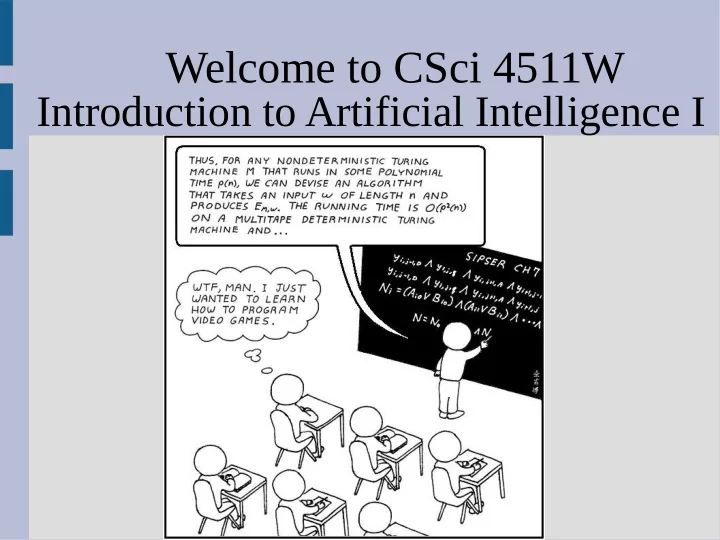
Welcome to CSci 4511W
Introduction to Artificial Intelligence I
SLIDE 2
James Parker Shepherd Laboratories 391
Instructor (me)
Primary contact: jparker@cs.umn.edu
SLIDE 3
Teaching Assistants
Myat Mo, Ojas Bhavani Narayanann, Robert Giaquinto, Shreyasi Pal, Yan Luo
SLIDE 4
Artificial Intelligence A Modern Approach, Russel and Norvig, 3rd edition
Textbook
SLIDE 5
Class website
Syllabus, schedule, other goodies Canvas page will have grades and homework submission www.cs.umn.edu/academics/classes Or google “umn.edu csci class”
SLIDE 6
www.cs.umn.edu
SLIDE 7
Don't like my slides? (tough)
http://aima.eecs.berkeley.edu/slides-pdf/
SLIDE 8 Prerequisites
- 1. Competent programmer and
understand big-O
- 2. Understanding of data structures
(graphs and trees)
- 3. Basic knowledge of formal logic
(truth tables, boolean ops)
SLIDE 9
30% Homework (-15% per day late) 20% Writing assignments (-15% pdf) 15% Project 10% Midterm (Tuesday Oct. 8) 10% Midterm 2 (Tuesday Nov. 12) 15% Final (Sec 001: 12/17 @ 4pm Sec 002: 12/19 @ 8am) 3% Extra credit in-class activies
Syllabus
SLIDE 10 All exams are open book/notes (most people think they are hard) You can use an electronic device if you want on exams, but no:
- phones
- internet
- running code (ish)
Syllabus
SLIDE 11
Homework and written assignments are individual assessments (unless explicitly stated otherwise) Please ensure the work you turn in is your own
Syllabus
SLIDE 12
Grading scale: 93% A 90% A- 87% B+ 83% B 80% B-
Syllabus
77% C+ 73% C 70% C- 67% D+ 60% D Below F
SLIDE 13
Week 1-4, Ch 1-4 - Intro & Search Week 5-6, Ch 5, 17.5 - Game playing Week 7-11, Ch 6-9 - Logic Week 12-14, Ch 10, 12 - Planning Week 15 - Special topics There will be one assignment (or exam) every week (first assignment due Sep. 17)
Schedule
SLIDE 14 The writing assignments will use Latex (down with docx!) The first few will be reviews of related topics and the last couple will tie into the project These can be resubmitted within two weeks
- f being returned for another regrade (once)
Writing assignments
SLIDE 15 The project will be a large part of the class and should be about 10-12 pages and include:
- Title, authors, abstract
- Introduction & problem description (1-2 pg)
- Literature review (2-3 pages)
- Description of your approach (2-3 pages)
- Analysis of results (1-2 pages)
- Conclusion and summary
- Bibliography
Project
SLIDE 16
You may work on the project with partner, but we will expect higher quality of work If you form a group, you must also submit a the specific contributions of each member The project should reflect about 50 hours of work per person (including reading, programing and writing)
Project
SLIDE 17 You pick the project, but must use knowledge representation (something interesting) Some ideas:
- AI for a game (3D tic-tac-toe, board games...)
- Spam filter (naive Bayes probability)
- Use A* to plan paths around Minneapolis
- Agent behavior in a system (evacuation or
disaster resuce)
- Planning (snail-mail delivery, TSP)
Project
SLIDE 18
Mario?
https://www.youtube.com/watch?v=qv6UVOQ0F44
Project
SLIDE 19
Syllabus
Any questions?
SLIDE 20
AI
What is intelligence?
SLIDE 21 AI
What is intelligence?
What is rational?
SLIDE 22 AI
What is intelligence?
What is rational?
- Acts on knowledge to achieve “best
- utcome”
SLIDE 23
Turing Test
For a long time, the Turing Test was a supposed indication of intelligence A person would question two entities and have to determine which one is the computer and human This is not very popular anymore
SLIDE 24 Turing Test
To pass the Turing Test, a computer needs the following:
- Natural language processing (as the
test is written and not verbal)
- Knowledge representation (storage)
- Reasoning (logical conclusions)
- Machine Learning (extrapolation)
SLIDE 25
Turing Test
https://www.youtube.com/watch?v=WFR3lOm_xhE
SLIDE 26 Agent/robot
The formal definition of a robot is not very useful either For our purpose, a robot/agent:
- Perceives the environment
- Adapts to changes
- Pursues a goal
SLIDE 27
Agent/robot
Is this a robot? .... How about this?
SLIDE 28
Agent/robot
Thus a rational agent acts to achieve the best outcome or goal (or best in expectation with uncertainty) A limitedly rational agent makes the best choice with limited computation (also called online algorithms)
SLIDE 29 Agent/robot
Often times, fully exploring all the
- ptions is too costly (takes forever)
Chess: 1047 states (tree about 10123) Go: 10171 states (tree about 10360) At 1 million states per second... Chess: 10109 years Go: 10346 years
SLIDE 30
AI
Simple computers have been built for hundreds of years For artificial intelligence to mature, it needed to borrow from other fields: Math - logic and proofs Statistics - probability Economics - utility
SLIDE 31
AI
Self driving cars Speech recognition Game playing Logistics Spam filter
SLIDE 32
AI - Chess
Spring 1997 - Deep(er) Blue (CMU / IBM)
SLIDE 33
AI - Go
Spring 2016 - AlphaGo (Google) December 2017- AlphaZero
SLIDE 34 AI - Dota2
August 2017 - OpenAI (Elon Musk)
https://www.youtube.com/watch?v=l92J1UvHf6M&feature=youtu.be
SLIDE 35
AlphaStar – Jan. 2019
https://www.youtube.com/watch?v=cUTMhmVh1qs