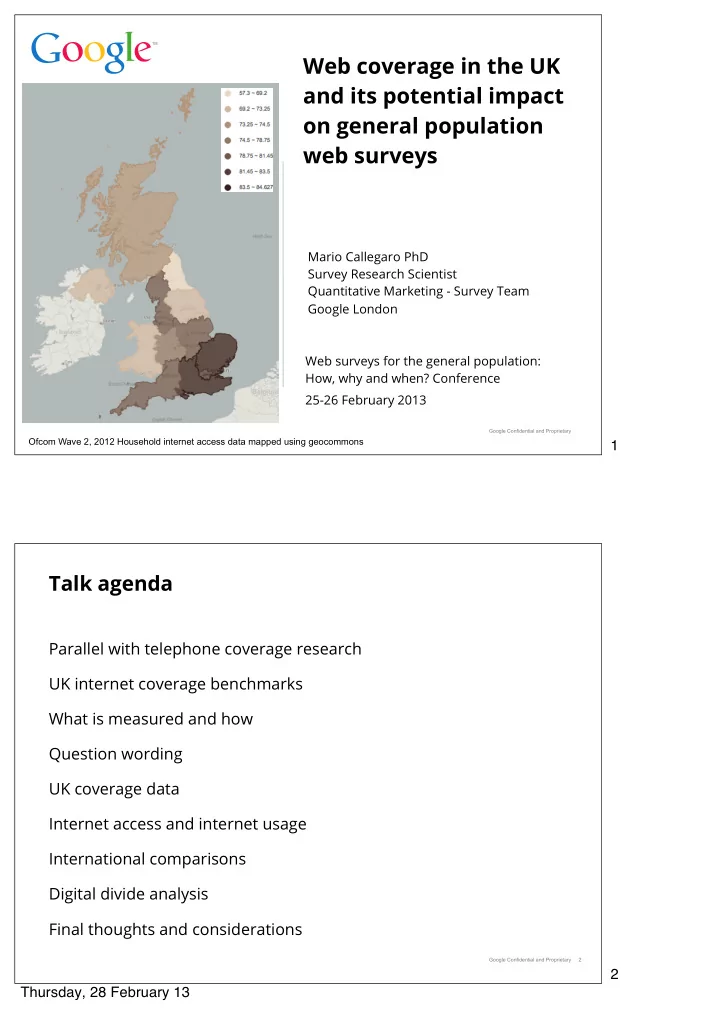
Web coverage in the UK and its potential impact on general - - PDF document

web coverage in the uk and its potential impact on
SMART_READER_LITE
LIVE PREVIEW

Web coverage in the UK and its potential impact on general - - PDF document

Web coverage in the UK and its potential impact on general population web surveys Mario Callegaro PhD Survey Research Scientist Quantitative Marketing - Survey Team Google London Web surveys for the general population: How, why and when?


slide-1
SLIDE 1

Google Confidential and Proprietary

Web coverage in the UK and its potential impact

  • n general population

web surveys

Mario Callegaro PhD Survey Research Scientist Quantitative Marketing - Survey Team Google London Web surveys for the general population: How, why and when? Conference 25-26 February 2013

Ofcom Wave 2, 2012 Household internet access data mapped using geocommons

Google Confidential and Proprietary

Talk agenda

Parallel with telephone coverage research UK internet coverage benchmarks What is measured and how Question wording UK coverage data Internet access and internet usage International comparisons Digital divide analysis Final thoughts and considerations

2

1 2 Thursday, 28 February 13

slide-2
SLIDE 2

Google Confidential and Proprietary

Web surveys of the general population: learnings from telephone survey methodology

If history teaches us anything, telephone surveys took off in the late 1960s when the telephone penetration approached 90% in the U.S. and in many european countries (Tucker & Lepkowsky, 2008, p.4)

3

Coverage was an issue debated at the First International conference

  • n Telephone Survey

Methodology held in 1987, and at the Second conference held in 2006

Trevin and Lee (1988) wrote their chapter about international comparisons of telephone coverage by asking statisticians around the world to provide data about telephone coverage of their own country

Google Confidential and Proprietary

Telephone coverage methodological debate during the years

  • 1. Access
  • Landline household access
  • Mobile phone access
  • 2. Changes in technology
  • Multiple phone lines
  • Faxes, answering machines, Caller-ID
  • Mobile phones
  • 3. Changes in sociopolitical climate
  • Mobility of the respondent
  • Attitudes towards privacy and confidentiality
  • Legislations such as Do not call initiatives

4

3 4 Thursday, 28 February 13

slide-3
SLIDE 3

Google Confidential and Proprietary

Why do survey researchers need Internet coverage benchmarks

Assess magnitude of coverage error Assist in weighting survey data if the non internet population is not surveyed but the target population includes it Make considerations and cost estimates for mixed mode surveys of the general population

5 Google Confidential and Proprietary

Ideal characteristics of Internet penetration benchmarks

  • Survey design not subject to potential coverage error associated

with the variable of interest (Internet penetration)

  • Face-to-face
  • Telephone
  • Mail
  • Collected frequently (at least once a year)
  • Large sample size
  • Released timely
  • Publicly available
  • Released with a report or official tables (not dataset only)
  • Anonymized microdataset availability (not tables or report only)

6

5 6 Thursday, 28 February 13

slide-4
SLIDE 4

Google Confidential and Proprietary

Benchmarks of Internet penetration in the UK

Official statistics sources

  • Office of National Statistics (ONS), Labour Force Survey
  • Office of National Statistics (ONS), Opinion and Lifestyle Survey
  • Office of Communication (Ofcom) technology tracker
  • Eurobarometer E-communication survey (annual)
  • Eurostat Information and Communication Technology (ICT) survey

(annual) Commercial sources

  • Broadcaster Audience Research Board (Barb) Establishment survey

(monthly)

  • AcXiom Research Opinion Poll (ROP)
  • Google Consumer Barometer enumeration study (Started in 2012)

7 Google Confidential and Proprietary

Measurement of Internet penetration, social agenda

Internet access rates are monitored by many agencies, funding large scale surveys to obtain regular estimates For example, the European Union Digital Agenda (EDA) target is to increase regular internet usage up to 75% of the population by 2015 Official statistics questionnaires ask about reasons why the household is not online and also how the household is connected (broadband versus dial-up) Another major reason for measuring internet access is to assess pockets of digital divide by specific groups such as elderly, disabled and other low income groups

8

7 8 Thursday, 28 February 13

slide-5
SLIDE 5

Google Confidential and Proprietary

Measurement of Internet penetration, UK social agenda

Guardian article on October 17, 2012 by Jessica Fuhi, “How the digital divide is being tackled”: “Digital exclusion is a social care issue, whether it's ordering prescriptions, applying for benefits or simply talking to others. So what is being done to help more people get online?” link Non-for-profit initiatives such as GoOn UK reporting ONS data: 21% Not users= 10.8 Million link to site

9 Google Confidential and Proprietary

Benchmarks: question wording

In the following slides we are looking at the exact question wording

  • f the following surveys:
  • ONS Labour Force Survey
  • ONS Opinion and Lifestyle Survey
  • Ofcom technology tracker
  • Eurobarometer E-communication survey
  • Eurostat ICT survey

10

9 10 Thursday, 28 February 13

slide-6
SLIDE 6

Google Confidential and Proprietary

ONS Labour Force Survey question

INTUSE When did you last use the internet, was it? Within the last 3 months? Between 3 months and a year ago? More than 1 year ago? or Never used it? Don’t Know <proxy only>

11 Google Confidential and Proprietary

ONS Labour Force Survey dataset

12

Data collection frequency Quarterly Data release delay Approximately one quarter late Sampling methodology Stratified by geography Lowest interviewed age 16 Data availability Economic and Social Data Service Free for university/nonprofit or £600 commercial. Sample size Approximately 99,900

11 12 Thursday, 28 February 13

slide-7
SLIDE 7

Google Confidential and Proprietary

ONS Opinions and Lifestyle Survey key questions

  • A1. Do you or anyone in your household have access to the

Internet at home, regardless of whether it is used? (by any device) Yes No Don't know

  • C2. On average how often did you use the Internet in the last 3

months? Every day or almost every day At least once a week (but not every day) At least once a month (but not every week) Less than once a month

13 Google Confidential and Proprietary

ONS Opinion and Lifestyle dataset

14

Data collection frequency Yearly Data release delay Approximately six months later Sampling methodology Address based sample PPS Lowest interviewed age 16 Data availability Economic and Social Data Service Free for univ /nonprofit or £600 comm. Sample size Approximately 1,100 - 1,800 depends on the month

13 14 Thursday, 28 February 13

slide-8
SLIDE 8

Google Confidential and Proprietary

Ofcom Technology Tracker key questions

QE2 Do you or does anyone in your household have access to the internet/ Worldwide Web at HOME (via any device, e.g. PC, mobile phone etc)? Yes have access and use at home Yes have access but do not use at home Do not have access at home Don't know QE3 (IN6). SHOWCARD Do you ever access the internet anywhere

  • ther than in your home at all? IF YES: Where is that? (MULTI

CODE) ...

15 Google Confidential and Proprietary

Ofcom Technology Tracker

16

Data collection frequency Triannual Data release delay Few months later Sampling methodology Stratified by geography + quota Lowest interviewed age 16 Data availability Not readily available, need to file a Freedom of Information Request (FOI) Sample size Approximately 2,750

15 16 Thursday, 28 February 13

slide-9
SLIDE 9

Google Confidential and Proprietary

Eurobarometer E-communication survey question

D46 SHOWCARD Which of the following goods do you have? ... An internet connection at home ...

17 Google Confidential and Proprietary

Eurostat survey on ICT usage in households and by individuals key questions

A2 Do you or anyone in your household have access to the Internet at home? (by any device) Yes No Don't know C1 When did you last use the Internet? (filter question) (via any device, desktop, portable or handheld, including mobile or smart phones) Within the last 3 months Between 3 months and a year ago More than 1 year ago Never used it

18

17 18 Thursday, 28 February 13

slide-10
SLIDE 10

Google Confidential and Proprietary

Coverage issues and literacy levels

  • Because surveys often focus on subgroups, coverage of the social,

demographic and economic subdomains is important for designing and analyzing the results from internet surveys of the general population

  • Internet literacy and literacy in general is a key assumption for self

administered surveys such as web surveys

  • According to the BSI report in the UK there is 7.1% of the population

below level Entry level 2 or lower

– Entry Level 1 is the national school curriculum equivalent for attainment at age 5-7. Adults below Entry Level 1 may not be able to write short messages to family or select floor numbers – Entry Level 2 is the national school curriculum equivalent for attainment at age 7-9. Adults with below Entry Level 2 may not be able to describe a child’s symptoms to a doctor or use a cash point to withdraw cash

19 Google Confidential and Proprietary

Telephone Status vs. Internet Status

20

Phone status

  • No phone of any kind
  • Landline only
  • Both Landline and Mobile
  • Mobile mostly
  • Mobile only

Internet status

  • No internet from anywhere
  • Internet from home only
  • Internet from home and
  • utside home
  • Internet outside home only
  • Smartphone
  • Work + wifi

19 20 Thursday, 28 February 13

slide-11
SLIDE 11

Google Confidential and Proprietary

UK Household internet access growth over time

21

20 40 60 80 100

1998 1999 2000 2001 2002 2003 2004 2005 2006 2007 2008 2009 2010 2011 2012

Source: ONS 2012 report

Google Confidential and Proprietary

UK internet penetration, household level

22

20 40 60 80 100

74 80 79

Ofcom Q4 2012 ONS Mid 2012 Eurobarometer Dec 2011

21 22 Thursday, 28 February 13

slide-12
SLIDE 12

Google Confidential and Proprietary

UK internet penetration, person level (16+)

23

20 40 60 80 100

85 82

Ofcom Q4 2012 ONS LFS Q3 2012

Google Confidential and Proprietary

International comparisons, Internet from home 2012

24

Austria Belgium France Germany Italy Netherlands Spain Switzerland* United Kingdom United States*

20 40 60 80 100

72 83 76 68 94 63 85 80 78 79

Source: Eurostat Statistics in Focus 50/2012 report + CPS data (July 2011) for US and Office Fédéral de la Statistique for Switzerland (2012)

23 24 Thursday, 28 February 13

slide-13
SLIDE 13

Google Confidential and Proprietary

UK: Who is online from home age by gender

25

20 40 60 80 100 16-24 25-44 45-54 55-65 65+

Male Female

Source: Ofcom July 2012

Google Confidential and Proprietary

UK: Who is online from anywhere age by gender

26

20 40 60 80 100 16-24 25-44 45-54 55-65 65+

Male Female

Source: Ofcom July 2012

25 26 Thursday, 28 February 13

slide-14
SLIDE 14

Google Confidential and Proprietary

Level of connectivity

  • Internet both inside and outside home, multiple devices
  • Internet both inside and outside home, not multiple devices
  • Internet at home only, multiple devices
  • Internet at home only, single device
  • Internet only from outside home
  • No Internet at home neither access from outside home

27

High Connectivity No Connectivity

Source: File (2013)

Google Confidential and Proprietary

Level of internet usage activity

  • Every day
  • Several times a week
  • At least once a week
  • At least once a month
  • Less than once a month
  • Never

28

High Activity No Activity

27 28 Thursday, 28 February 13

slide-15
SLIDE 15

Google Confidential and Proprietary

UK combination of access and frequency of use (%)

29

Every day & many times a week Once a week and at least

  • nce a month

Never or extremely rare Home use only Home & Outside home Outside only No access from anywhere

24.2 3.6 2.2 47.0 1.4 0.1 2.0 2.1 1.0 19.7

Ofcom July 2012 dataset

Google Confidential and Proprietary

UK Internet access other than home

[Do you ever access the internet anywhere other than in your home at all?]

30

Workplace School/University Library Internet cafe Someone else’s home Smartphone Wifi laptop/tablet

20 40 60 80 100

4.7 22.5 8.9 1.8 5.0 7.3 26.6

Source: Ofcom July 2012

29 30 Thursday, 28 February 13

slide-16
SLIDE 16

Google Confidential and Proprietary

UK Digital divide analysis using Ofcom Q2 2012 technology tracker

Dependent variable: Having Internet access from home and use it Predictors:

  • Gender (1 = Male)
  • Cage: Age centered (Age - mean of age)
  • Race (1 = White)
  • Urbanicity (1 = Urban)
  • Regions (England, Scotland, Wales, Northern England)
  • Social Grade (A&B, C1, C2, D&E)
  • Interaction between Cage and Social Grade

Income not used due to high missing rate (29.1%)

31 Google Confidential and Proprietary

A note on social grade

“Social Grade is the ‘common currency’ social classification used by the advertising industry and employed in market research This is NOT the government NC_SEC classification The classification assigns every household to a grade, usually based upon the occupation and employment status of the Chief Income Earner...” (Market Research Society) A. Higher managerial, administrative and professional B. Intermediate managerial, administrative and professional C. Supervisory, clerical and junior managerial, administrative and professional C. Skilled manual worker D. Semi-skilled and unskilled manual workers E. State pensioners, casual and lowest grade workers, unemployed with state benefits only

32

1 2

31 32 Thursday, 28 February 13

slide-17
SLIDE 17

Google Confidential and Proprietary

Odds ratios of being online from home UK

Ofcom July 2012 dataset logistic regression

33

0.98% 0.99% 0.99% 2.73% 5.05% 1.38% 1.84% 2.10% 0.88% 1.25% 0.95% 1.19% !1# 6# Cage%by%SG%C2%vs%D&E% Cage%by%SG%C1%vs%D&E%% Cage%by%SG%A&B%vs%D&E% Social%Grade%C2%vs%D&E% Social%Grade%C1%vs%D&E% Social%Grade%A&B%vs%D&E% Wales%vs%Norther%Ireland% Scotland%vs%Norther%Ireland% England%vs%Norther%Ireland% Urban%vs%Rural% White%vs%non%white% Age%centered%(cage)%% Male%vs%Female%

Hosmer and Lemeshow test X 2 = 50.154, df=8, p<.000 Nagelkerke R Square: .412 Classification success rate 81.9% N=2,893 Missing cases: 38

  • -/-- 17.75
  • ->

1

Google Confidential and Proprietary

Odds ratios of being online from home U.S.

CPS July 2011 dataset logistic regression (File, 2013)

34

2.28$ 1.16$ 1.05$ 1.31$ 0.51$ 0.87$ 0.37$ 1.21$ 1.07$ 0.57$ 0.22$ 1.09$ !1# 6# 25K-$49,000$vs$<$$25K$ 50K-$99,000$vs$<$$25K$ Over$$100K$vs$<$$25K$ Northest$vs$South$ Midwest$vs$South$ Region$West$vs$South$ AA$not$Hisp$vs$White$NH$$$$$$$$$$$ Other$not$Hisp$vs$White$NH$$$$$$$$ Hisp$vs$White$NH$$$$$$$$$$$$$$$$$$$$$$$$ 18-34$vs$3-17$$$$$$$$$$$$$ 35-44$vs$3-17$$$$$$$$$$$$$$ 45-64$vs$3-17$$$$$$$$$$$$$$ 65+$vs$3-17$$$$$$$$$$$$$$$$$ Male$vs$Female$

N= 293,414

  • -/-- 15.35
  • ->

1

  • -/-- 7.66
  • ->

33 34 Thursday, 28 February 13

slide-18
SLIDE 18

Google Confidential and Proprietary

Digital divide analysis summary

By using logistic regression type analysis we can net out what really makes a difference in internet access For example in the UK it does not appear that there is a gender gap when controlling for age, rage, urbanicity, social class, and region This is not the case for the US, where there is still a gender gap although of low magnitude

35 Google Confidential and Proprietary

Internet coverage methodological debate (or what we should debate)

  • 1. Access
  • Type of access: home vs. outside home
  • Smartphone access
  • Frequency of usage
  • Internet / reading literacy
  • 2. Changes in technology
  • Multiple devices: laptop/desktop/ smartphone & tablets
  • 3. Changes in sociopolitical climate
  • Mobility of the respondent
  • Attitudes towards privacy and confidentiality
  • Legislations

36

35 36 Thursday, 28 February 13

slide-19
SLIDE 19

Google Confidential and Proprietary

Considerations for web surveys of the General Population

The good news: In the UK internet access is steadily increasing and it can quickly reach a level of almost universal coverage as in the Netherlands, for example The less so good news: Internet access is becoming more and more mobile (e.g Smartphone) and more and more devices are available to answer a survey Making web surveys device agnostic and eliminating device effect is the next challenge of survey methodologists

37

37 Thursday, 28 February 13

slide-20
SLIDE 20

Web coverage in the UK and its potential impact on general population web surveys

Mario Callegaro PhD Survey Research Scientist Quantitative Marketing - Survey Team Google London Web surveys for the general population: How, why and when? Conference 25-26 February 2013, London

References

Department for Business, Innovation and Skills (BIS). (2011, December). 2011 Skills for life survey. Headline findings. BIS research paper number 57. Retrieved from http://www.bis.gov.uk/assets/BISCore/further-education- skills/docs/0-9/11-1367-2011-skills-for-life-survey-findings.pdf European Commission. (2012). Eurobarometer Special surveys: Special Eurobarometer 381. European Commission. Retrieved from http://ec.europa.eu/public_opinion/archives/ebs/ebs_381_en.pdf File, T. (2012, September 19). Digital Divides: A connectivity continuum for the United States. Data from the 2011 Current Population Survey. Retrieved from http://paa2013.princeton.edu/papers/130743

  • Ofcom. (2012). Ofcom technology tracker Wave 2, 2012. Ofcom. Retrieved from

http://stakeholders.ofcom.org.uk/binaries/research/statistics/2012Sept/d ata-tables-wave-2.pdf

  • Ofcom. (2013). Ofcom technology tracker Wave 3, 2012. Ofcom. Retrieved from

http://stakeholders.ofcom.org.uk/binaries/research/statistics/2013jan/wa ve3.pdf Office for National Statistics. (2012, August 24). Internet access - Households and individuals, 2012. Retrieved from http://www.ons.gov.uk/ons/dcp171778_275775.pdf

slide-21
SLIDE 21

Office for National Statistics. (2013, February 28). Internet access - Households and individuals, 2012 part 2. Retrieved from http://www.ons.gov.uk/ons/dcp171778_301822.pdf Seybert, H. (2012, December 13). Internet use in households and by individual in

  • 2012. Eurostat Statistics in Focus 50/2012. Eurostat. Retrieved from

http://epp.eurostat.ec.europa.eu/cache/ITY_OFFPUB/KS-SF-12-050/EN/KS- SF-12-050-EN.PDF Trewin, D., & Lee, G. (1998). International comparison of telephone coverage. In

  • R. M. Groves, P. P. Biemer, L. E. Lyberg, J. T. Massey, W. L. Nicholls II, & J.

Waksberg (Eds.), Telephone survey methodology (pp. 25–50). New York: Wiley. Tucker, C., & Lepkowski, J. M. (2008). Telephone survey methodology: Adapting to

  • change. In J. M. Lepkowski, C. Tucker, M. J. Brick, E. De Leeuw, L. Japec, P. J.

Lavrakas, … R. L. Sangster (Eds.), Advances in telephone survey methodology (pp. 3–26). Hoboken NJ: Wiley.