= w ( T ) w ( u , v ) . Carola Wenk ( u , v ) T - - PowerPoint PPT Presentation

w t w u v carola wenk u v t slides courtesy of charles
SMART_READER_LITE
LIVE PREVIEW

= w ( T ) w ( u , v ) . Carola Wenk ( u , v ) T - - PowerPoint PPT Presentation

Minimum spanning trees CS 3343 -- Spring 2009 Input: A connected, undirected graph G = ( V , E ) with weight function w : E R . For simplicity, assume that all edge weights are distinct. (CLRS covers the general case.) Output: A spanning


slide-1
SLIDE 1

1

CS 3343 Analysis of Algorithms 1 4/9/09

CS 3343 -- Spring 2009

Minimum Spanning Trees

Carola Wenk Slides courtesy of Charles Leiserson with changes and additions by Carola Wenk

CS 3343 Analysis of Algorithms 2 4/9/09

Minimum spanning trees

Input: A connected, undirected graph G = (V, E) with weight function w : E → R.

  • For simplicity, assume that all edge weights are
  • distinct. (CLRS covers the general case.)

=

T v u

v u w T w

) , (

) , ( ) ( . Output: A spanning tree T — a tree that connects all vertices — of minimum weight:

CS 3343 Analysis of Algorithms 3 4/9/09

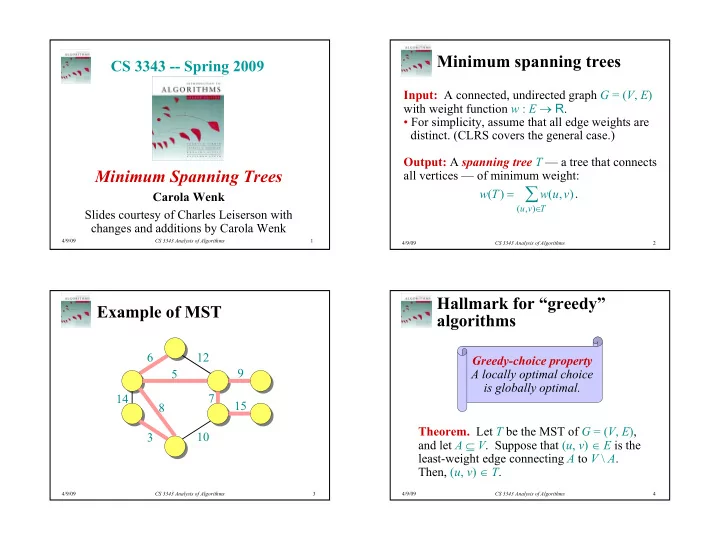
Example of MST

6 12 5 14 3 8 10 15 9 7

CS 3343 Analysis of Algorithms 4 4/9/09

Hallmark for “greedy” algorithms

Greedy-choice property A locally optimal choice is globally optimal.

  • Theorem. Let T be the MST of G = (V, E),

and let A ⊆ V. Suppose that (u, v) ∈ E is the least-weight edge connecting A to V \ A. Then, (u, v) ∈ T.

slide-2
SLIDE 2

2

CS 3343 Analysis of Algorithms 5 4/9/09

Proof of theorem

  • Proof. Suppose (u, v) ∉ T. Cut and paste.

∈ A ∈ V \ A T: u v

(u, v) = least-weight edge connecting A to V \ A

CS 3343 Analysis of Algorithms 6 4/9/09

Proof of theorem

  • Proof. Suppose (u, v) ∉ T. Cut and paste.

∈ A ∈ V \ A T: u Consider the unique simple path from u to v in T.

(u, v) = least-weight edge connecting A to V \ A

v

CS 3343 Analysis of Algorithms 7 4/9/09

Proof of theorem

  • Proof. Suppose (u, v) ∉ T. Cut and paste.

∈ A ∈ V \ A T: u

(u, v) = least-weight edge connecting A to V \ A

v Consider the unique simple path from u to v in T. Swap (u, v) with the first edge on this path that connects a vertex in A to a vertex in V \ A.

CS 3343 Analysis of Algorithms 8 4/9/09

Proof of theorem

  • Proof. Suppose (u, v) ∉ T. Cut and paste.

∈ A ∈ V \ A T′: u

(u, v) = least-weight edge connecting A to V \ A

v Consider the unique simple path from u to v in T. Swap (u, v) with the first edge on this path that connects a vertex in A to a vertex in V \ A. A lighter-weight spanning tree than T results.

slide-3
SLIDE 3

3

CS 3343 Analysis of Algorithms 9 4/9/09

Prim’s algorithm

IDEA: Maintain V \ A as a priority queue Q. Key each vertex in Q with the weight of the least- weight edge connecting it to a vertex in A.

Q ← V key[v] ← ∞ for all v ∈ V key[s] ← 0 for some arbitrary s ∈ V while Q ≠ ∅ do u ← EXTRACT-MIN(Q) for each v ∈ Adj[u] do if v ∈ Q and w(u, v) < key[v] then key[v] ← w(u, v)

⊳ DECREASE-KEY

π[v] ← u

At the end, {(v, π[v])} forms the MST.

CS 3343 Analysis of Algorithms 10 4/9/09

Example of Prim’s algorithm

∈ A ∈ V \ A ∞ ∞ ∞ ∞ ∞ ∞ ∞ ∞ ∞ ∞ ∞ ∞ ∞ ∞ 6 12 5 14 3 8 10 15 9 7

u ← EXTRACT-MIN(Q) for each v ∈ Adj[u] do if v ∈ Q and w(u, v) < key[v] then key[v] ← w(u, v)⊳ DECREASE-KEY π[v] ← u

CS 3343 Analysis of Algorithms 11 4/9/09

Example of Prim’s algorithm

∈ A ∈ V \ A ∞ ∞ ∞ ∞ ∞ ∞ ∞ ∞ ∞ ∞ ∞ ∞ ∞ ∞ 6 12 5 14 3 8 10 15 9 7

u ← EXTRACT-MIN(Q) for each v ∈ Adj[u] do if v ∈ Q and w(u, v) < key[v] then key[v] ← w(u, v)⊳ DECREASE-KEY π[v] ← u

CS 3343 Analysis of Algorithms 12 4/9/09

Example of Prim’s algorithm

∈ A ∈ V \ A ∞ ∞ ∞ ∞ 7 7 ∞ ∞ 10 10 ∞ ∞ 15 15 6 12 5 14 3 8 10 15 9 7

u ← EXTRACT-MIN(Q) for each v ∈ Adj[u] do if v ∈ Q and w(u, v) < key[v] then key[v] ← w(u, v)⊳ DECREASE-KEY π[v] ← u

slide-4
SLIDE 4

4

CS 3343 Analysis of Algorithms 13 4/9/09

Example of Prim’s algorithm

∈ A ∈ V \ A ∞ ∞ ∞ ∞ 7 7 ∞ ∞ 10 10 ∞ ∞ 15 15 6 12 5 14 3 8 10 15 9 7

u ← EXTRACT-MIN(Q) for each v ∈ Adj[u] do if v ∈ Q and w(u, v) < key[v] then key[v] ← w(u, v)⊳ DECREASE-KEY π[v] ← u

CS 3343 Analysis of Algorithms 14 4/9/09

Example of Prim’s algorithm

∈ A ∈ V \ A 12 12 5 5 7 7 ∞ ∞ 10 10 9 9 15 15 6 12 5 14 3 8 10 15 9 7

u ← EXTRACT-MIN(Q) for each v ∈ Adj[u] do if v ∈ Q and w(u, v) < key[v] then key[v] ← w(u, v)⊳ DECREASE-KEY π[v] ← u

CS 3343 Analysis of Algorithms 15 4/9/09

Example of Prim’s algorithm

∈ A ∈ V \ A 12 12 5 5 7 7 ∞ ∞ 10 10 9 9 15 15 6 12 5 14 3 8 10 15 9 7

u ← EXTRACT-MIN(Q) for each v ∈ Adj[u] do if v ∈ Q and w(u, v) < key[v] then key[v] ← w(u, v)⊳ DECREASE-KEY π[v] ← u

CS 3343 Analysis of Algorithms 16 4/9/09

Example of Prim’s algorithm

∈ A ∈ V \ A 6 6 5 5 7 7 14 14 8 8 9 9 15 15 6 12 5 14 3 8 10 15 9 7

u ← EXTRACT-MIN(Q) for each v ∈ Adj[u] do if v ∈ Q and w(u, v) < key[v] then key[v] ← w(u, v)⊳ DECREASE-KEY π[v] ← u

slide-5
SLIDE 5

5

CS 3343 Analysis of Algorithms 17 4/9/09

Example of Prim’s algorithm

∈ A ∈ V \ A 6 6 5 5 7 7 14 14 8 8 9 9 15 15 6 12 5 14 3 8 10 15 9 7

u ← EXTRACT-MIN(Q) for each v ∈ Adj[u] do if v ∈ Q and w(u, v) < key[v] then key[v] ← w(u, v)⊳ DECREASE-KEY π[v] ← u

CS 3343 Analysis of Algorithms 18 4/9/09

Example of Prim’s algorithm

∈ A ∈ V \ A 6 6 5 5 7 7 14 14 8 8 9 9 15 15 6 12 5 14 3 8 10 15 9 7

u ← EXTRACT-MIN(Q) for each v ∈ Adj[u] do if v ∈ Q and w(u, v) < key[v] then key[v] ← w(u, v)⊳ DECREASE-KEY π[v] ← u

CS 3343 Analysis of Algorithms 19 4/9/09

Example of Prim’s algorithm

∈ A ∈ V \ A 6 6 5 5 7 7 3 3 8 8 9 9 15 15 6 12 5 14 3 8 10 15 9 7

u ← EXTRACT-MIN(Q) for each v ∈ Adj[u] do if v ∈ Q and w(u, v) < key[v] then key[v] ← w(u, v)⊳ DECREASE-KEY π[v] ← u

CS 3343 Analysis of Algorithms 20 4/9/09

Example of Prim’s algorithm

∈ A ∈ V \ A 6 6 5 5 7 7 3 3 8 8 9 9 15 15 6 12 5 14 3 8 10 15 9 7

u ← EXTRACT-MIN(Q) for each v ∈ Adj[u] do if v ∈ Q and w(u, v) < key[v] then key[v] ← w(u, v)⊳ DECREASE-KEY π[v] ← u

slide-6
SLIDE 6

6

CS 3343 Analysis of Algorithms 21 4/9/09

Example of Prim’s algorithm

∈ A ∈ V \ A 6 6 5 5 7 7 3 3 8 8 9 9 15 15 6 12 5 14 3 8 10 15 9 7

u ← EXTRACT-MIN(Q) for each v ∈ Adj[u] do if v ∈ Q and w(u, v) < key[v] then key[v] ← w(u, v)⊳ DECREASE-KEY π[v] ← u

CS 3343 Analysis of Algorithms 22 4/9/09

Example of Prim’s algorithm

∈ A ∈ V \ A 6 6 5 5 7 7 3 3 8 8 9 9 15 15 6 12 5 14 3 8 10 15 9 7

u ← EXTRACT-MIN(Q) for each v ∈ Adj[u] do if v ∈ Q and w(u, v) < key[v] then key[v] ← w(u, v)⊳ DECREASE-KEY π[v] ← u

CS 3343 Analysis of Algorithms 23 4/9/09

Handshaking Lemma ⇒ Θ(|E|) implicit DECREASE-KEY’s. Q ← V key[v] ← ∞ for all v ∈ V key[s] ← 0 for some arbitrary s ∈ V while Q ≠ ∅ do u ← EXTRACT-MIN(Q) for each v ∈ Adj[u] do if v ∈ Q and w(u, v) < key[v] then key[v] ← w(u, v) π[v] ← u

Analysis of Prim

degree(u) times |V| times Θ(|V|) total

Time = Θ(|V|)·TEXTRACT-MIN + Θ(|E|)·TDECREASE-KEY

CS 3343 Analysis of Algorithms 24 4/9/09

Analysis of Prim (continued)

Time = Θ(|V|)·TEXTRACT-MIN + Θ(|E|)·TDECREASE-KEY Q TEXTRACT-MIN TDECREASE-KEY Total array O(|V|) O(1) O(|V|2) binary heap O(log |V|) O(log |V|) O(|E| log |V|) Fibonacci heap O(log |V|) amortized O(1) amortized O(|E| + |V| log |V|) worst case

slide-7
SLIDE 7

7

CS 3343 Analysis of Algorithms 25 4/9/09

Kruskal’s algorithm

IDEA (again greedy):

Repeatedly pick edge with smallest weight as long as it does not form a cycle.

  • The algorithm creates a set of trees (a forest)
  • During the algorithm the added edges merge the

trees together, such that in the end only one tree remains

  • The correctness of this greedy strategy is not obvious

and needs to be proven. (Proof skipped here.)

CS 3343 Analysis of Algorithms 26 4/9/09

Example of Kruskal’s algorithm

a a b b c c e e f f h h d d g g 6 12 5 14 3 8 10 15 9 7

MST edges

Every node is a single tree. S={ {a},{b},{c},{d},{e} {f},{g},{h} }

a set repr.

CS 3343 Analysis of Algorithms 27 4/9/09

Example of Kruskal’s algorithm

a a b b c c e e f f h h d d g g 6 12 5 14 3 8 10 15 9 7

MST edges

Edge 3 merged two singleton trees. S={ {a},{b},{c},{d},{f} {g}, {e, h} }

a set repr.

CS 3343 Analysis of Algorithms 28 4/9/09

Example of Kruskal’s algorithm

a a b b c c e e f f h h d d g g 6 12 5 14 3 8 10 15 9 7

MST edges

S={ {a},{d},{f}, {g} {e, h}, {b, c} }

a set repr.

slide-8
SLIDE 8

8

CS 3343 Analysis of Algorithms 29 4/9/09

Example of Kruskal’s algorithm

a a b b c c e e f f h h d d g g 6 12 5 14 3 8 10 15 9 7

MST edges

S={ {d},{f}, {g} {e, h}, {a, b, c} }

a set repr.

CS 3343 Analysis of Algorithms 30 4/9/09

Example of Kruskal’s algorithm

a a b b c c e e f f h h d d g g 6 12 5 14 3 8 10 15 9 7

MST edges

S={ {d}, {g} {e, h}, {a, b, c, f} }

a set repr.

CS 3343 Analysis of Algorithms 31 4/9/09

Example of Kruskal’s algorithm

a a b b c c e e f f h h d d g g 6 12 5 14 3 8 10 15 9 7

MST edges

S={ {d}, {g} {e, h, a, b, c, f} } Edge 8 merged the two bigger trees.

a set repr.

CS 3343 Analysis of Algorithms 32 4/9/09

Example of Kruskal’s algorithm

a a b b c c e e f f h h d d g g 6 12 5 14 3 8 10 15 9 7

MST edges

S={ {g} {e, h, a, b, c, f, d} }

a set repr.

slide-9
SLIDE 9

9

CS 3343 Analysis of Algorithms 33 4/9/09

Example of Kruskal’s algorithm

a a b b c c e e f f h h d d g g 6 12 5 14 3 8 10 15 9 7

MST edges

Skip edge 10 as it would cause a cycle. S={ {g} {e, h, a, b, c, f, d} }

a set repr.

CS 3343 Analysis of Algorithms 34 4/9/09

Example of Kruskal’s algorithm

a a b b c c e e f f h h d d g g 6 12 5 14 3 8 10 15 9 7

MST edges

Skip edge 12 as it would cause a cycle. S={ {g} {e, h, a, b, c, f, d} }

a set repr.

CS 3343 Analysis of Algorithms 35 4/9/09

Example of Kruskal’s algorithm

a a b b c c e e f f h h d d g g 6 12 5 14 3 8 10 15 9 7

MST edges

Skip edge 14 as it would cause a cycle. S={ {g} {e, h, a, b, c, f, d} }

a set repr.

CS 3343 Analysis of Algorithms 36 4/9/09

Example of Kruskal’s algorithm

a a b b c c e e f f h h d d g g 6 12 5 14 3 8 10 15 9 7

MST edges

S={{e, h, a, b, c, f, d, g} }

a set repr.

slide-10
SLIDE 10

10

CS 3343 Analysis of Algorithms 37 4/9/09

Disjoint-set data structure (Union-Find)

  • Maintains a dynamic collection of pairwise-disjoint

sets S = {S1, S2, …, Sr}.

  • Each set Si has one element distinguished as the

representative element.

  • Supports operations:
  • MAKE-SET(x): adds new set {x} to S
  • UNION(x, y): replaces sets Sx, Sy with Sx ∪ Sy
  • FIND-SET(x): returns the representative of the

set Sx containing element x

  • 1 < α(n) < log*(n) < log(log(n)) < log(n)

O(1) O(α(n)) O(α(n))

CS 3343 Analysis of Algorithms 38 4/9/09

Kruskal’s algorithm

IDEA: Repeatedly pick edge with smallest weight as long as it does not form a cycle.

S ← ∅ ⊳ S will contain all MST edges for each v ∈V do MAKE-SET(v) Sort edges of E in non-decreasing order according to w For each (u,v) ∈ E taken in this order do if FIND-SET(u) ≠ FIND-SET(v) ⊳ u,v in different trees S ← S ∪ {(u,v)}

UNION(u,v) ⊳ Edge (u,v) connects the two trees

O(|V|) O(|E|log|E|) O(α(|V|)) O(|E|)

Runtime: O(|V|+|E|log|E|+|E|α(|V|)) = O(|E| log |E|)

CS 3343 Analysis of Algorithms 39 4/9/09

MST algorithms

  • Prim’s algorithm:
  • Maintains one tree
  • Runs in time O(|E| log |V|), with binary heaps.
  • Kruskal’s algorithm:
  • Maintains a forest and uses the disjoint-set

data structure

  • Runs in time O(|E| log |E|)
  • Best to date: Randomized algorithm by Karger,

Klein, Tarjan [1993]. Runs in expected time O(|V| + |E|)