Views Views In some cases, it is not desirable for all users to see - - PowerPoint PPT Presentation

views views
SMART_READER_LITE
LIVE PREVIEW

Views Views In some cases, it is not desirable for all users to see - - PowerPoint PPT Presentation

Views Views In some cases, it is not desirable for all users to see the entire logical model (i.e, all the actual relations stored in the database.) Consider a person who needs to know a customers loan number but has no need to see the


slide-1
SLIDE 1

UCSD CSE132B Slide 38/76

Views Views

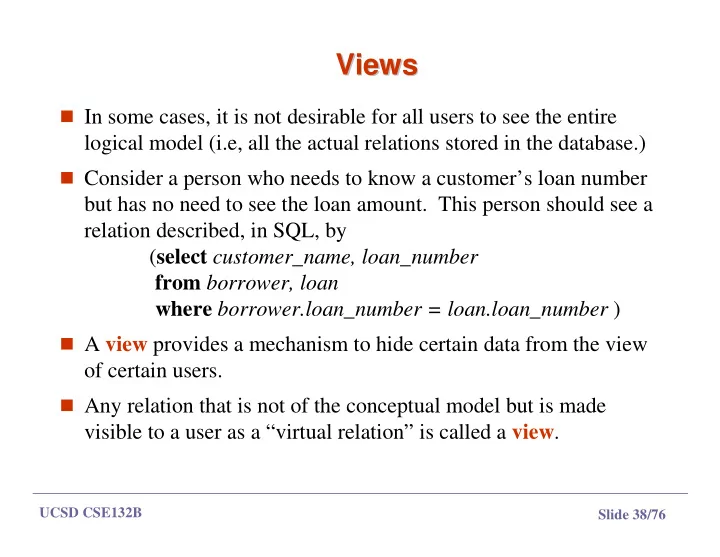
In some cases, it is not desirable for all users to see the entire

logical model (i.e, all the actual relations stored in the database.)

Consider a person who needs to know a customer’s loan number

but has no need to see the loan amount. This person should see a relation described, in SQL, by (select customer_name, loan_number from borrower, loan where borrower.loan_number = loan.loan_number )

A view provides a mechanism to hide certain data from the view

  • f certain users.

Any relation that is not of the conceptual model but is made

visible to a user as a “virtual relation” is called a view.

slide-2
SLIDE 2

UCSD CSE132B Slide 39/76

View Definition View Definition

A view is defined using the create view statement which has

the form create view v as < query expression > where <query expression> is any legal SQL expression. The view name is represented by v.

Once a view is defined, the view name can be used to refer to

the virtual relation that the view generates.

View definition is not the same as creating a new relation by

evaluating the query expression

Rather, a view definition causes the saving of an expression;

the expression is substituted into queries using the view.

slide-3
SLIDE 3

UCSD CSE132B Slide 40/76

Views in SQL Views in SQL

A view is a “virtual” table that is derived from

  • ther tables

Allows for limited update operations (since the

table may not physically be stored)

Allows full query operations A convenience for expressing certain operations

slide-4
SLIDE 4

UCSD CSE132B Slide 41/76

Specification of Views Specification of Views

SQL command: CREATE VIEW

a table (view) name a possible list of attribute names (for example,

when arithmetic operations are specified or when we want the names to be different from the attributes in the base relations)

a query to specify the table contents

slide-5
SLIDE 5

UCSD CSE132B Slide 42/76

Example Queries Example Queries

A view consisting of branches and their customers

Find all customers of the Perryridge branch

create view all_customer as (select branch_name, customer_name from depositor, account where depositor.account_number = account.account_number ) union (select branch_name, customer_name from borrower, loan where borrower.loan_number = loan.loan_number ) select customer_name from all_customer where branch_name = ‘Perryridge’

slide-6
SLIDE 6

UCSD CSE132B Slide 43/76

Views Defined Using Other Views Views Defined Using Other Views

One view may be used in the expression defining

another view

A view relation v1 is said to depend directly on a

view relation v2 if v2 is used in the expression defining v1

A view relation v1 is said to depend on view

relation v2 if either v1 depends directly to v2 or

there is a path of dependencies from v1 to v2

A view relation v is said to be recursive if it

depends on itself.

slide-7
SLIDE 7

UCSD CSE132B Slide 44/76

SQL Views: Another Example SQL Views: Another Example

Specify a different WORKS_ON table

CREATE TABLE WORKS_ON_NEW AS SELECT FNAME, LNAME, PNAME, HOURS FROM EMPLOYEE, PROJECT, WORKS_ON WHERE SSN=ESSN AND PNO=PNUMBER GROUP BY PNAME;

slide-8
SLIDE 8

UCSD CSE132B Slide 45/76

Using a Virtual Table Using a Virtual Table

We can specify SQL queries on a newly create view:

SELECT FNAME, LNAME FROM WORKS_ON_NEW WHERE PNAME=‘Seena’;

When no longer needed, a view can be dropped:

DROP WORKS_ON_NEW;

slide-9
SLIDE 9

UCSD CSE132B Slide 46/76

Efficient View Implementation Efficient View Implementation

Query modification: present the view query in

terms of a query on the underlying base tables

disadvantage: inefficient for views defined via

complex queries (especially if additional queries are to be applied to the view within a short time period)

slide-10
SLIDE 10

UCSD CSE132B Slide 47/76

Efficient View Implementation Efficient View Implementation

View materialization: involves physically creating

and keeping a temporary table

assumption: other queries on the view will follow concerns: maintaining correspondence between

the base table and the view when the base table is updated

strategy: incremental update

slide-11
SLIDE 11

UCSD CSE132B Slide 48/76

Update of a View Update of a View

Create a view of all loan data in the loan relation, hiding the

amount attribute create view branch_loan as select branch_name, loan_number from loan

Add a new tuple to branch_loan

insert into branch_loan values (‘Perryridge’, ‘L-307’) This insertion must be represented by the insertion of the tuple (‘L-307’, ‘Perryridge’, null ) into the loan relation

slide-12
SLIDE 12

UCSD CSE132B Slide 49/76

View Update View Update

Update on a single view without aggregate

  • perations: update may map to an update on the

underlying base table

Views involving joins: an update may map to an

update on the underlying base relations

not always possible

slide-13
SLIDE 13

UCSD CSE132B Slide 50/76

Updates Through Views Updates Through Views (Cont.)

(Cont.)

Some updates through views are impossible to translate into

updates on the database relations

create view v as

select branch_name from account insert into v values (‘L-99’, ‘ Downtown’, ‘23’)

Others cannot be translated uniquely

insert into all_customer values (‘ Perryridge’, ‘John’)

Have to choose loan or account, and

create a new loan/account number!

Most SQL implementations allow updates only on simple views

(without aggregates) defined on a single relation

slide-14
SLIDE 14

UCSD CSE132B Slide 51/76

Un Un-

  • updatable Views

updatable Views

Views defined using groups and aggregate

functions are not updateable

Views defined on multiple tables using joins are

generally not updateable

WITH CHECK OPTION: must be added to the

definition of a view if the view is to be updated

to allow check for updatability and to plan for

an execution strategy