Velocity Regimes for Sphere Penetration of Granular Materials M. - - PowerPoint PPT Presentation

velocity regimes for sphere penetration of granular
SMART_READER_LITE
LIVE PREVIEW

Velocity Regimes for Sphere Penetration of Granular Materials M. - - PowerPoint PPT Presentation

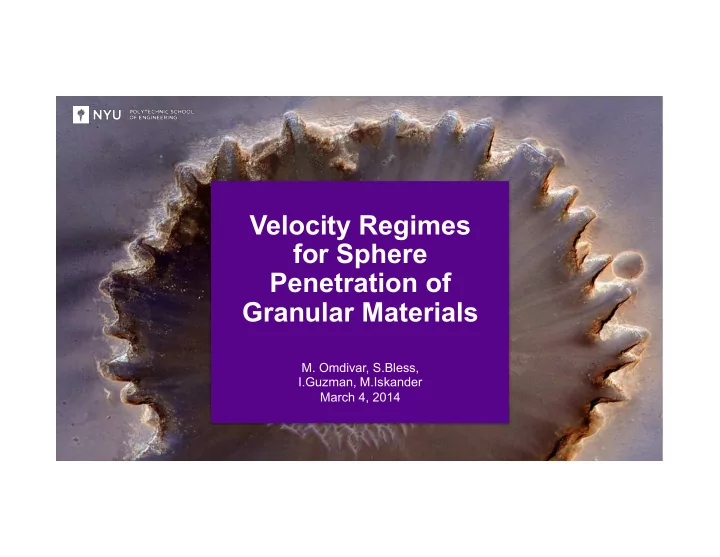
Velocity Regimes for Sphere Penetration of Granular Materials M. Omdivar, S.Bless, I.Guzman, M.Iskander March 4, 2014 Experiments Experiments were conducted to measure deceleration during penetration of granular materials. There were two

slide-1
SLIDE 1

Velocity Regimes for Sphere Penetration of Granular Materials

  • M. Omdivar, S.Bless,

I.Guzman, M.Iskander March 4, 2014

slide-2
SLIDE 2

Experiments

Experiments were conducted to measure deceleration during penetration of granular materials. There were two materials: ground fused quartz

  • r silica sand. Three types of saturation: dry,
  • il (for quartz) and water (for sand). For most

materials, there were two different relative densities. Projectiles were either spheres (10 or 12 mm)

  • r hemispherical-nose rods (10 mm)

Velocities were up to 300 m/s, achieved with compressed gas guns.

slide-3
SLIDE 3

A PDV was used to measure V(t)

  • This is a doppler device, based on

heterodyning with a laser source. Its features include a very large DoF and dynamic range.

  • Spherical projectiles, 14 mm.
  • Projectiles could be observed through cavity
  • From V(t) integrate to get V(x) or

differentiate to get dV/dt.

Measurements of V(t)

3

slide-4
SLIDE 4

DOP experiments measured p(V).

  • Spherical projectiles: made from Al, steel, or

WC.

  • Penetration measured by recovery.
  • Data: penetration (x) vs V.
  • Estimate: ΔV/Δt ≅ <V> (ΔV/Δx) .

.

Measurements of x(V)

4

Phenomenology shown by DOP experiment conducted near a window.

slide-5
SLIDE 5

High speed camera used to measure x(t) during penetration.

  • Hemispherical or conical nosed rod the a

sting on the back.

  • X(t) data double differentiated to give dV/dt.

. .

Measurements of x(t)

5

slide-6
SLIDE 6

The PDV results can be used to directly compare penetration resistance of different materials.

  • Steeper curves mean greater penetration

resistance.

  • Resistance increases with density.
  • Resistance decreases with saturation.
  • Resistance is higher for sand than for quartz
  • For saturated materials, signal was lost at

about 50 m/s.

Comparing materials

6

slide-7
SLIDE 7

For sand there are apparently three velocity regimes.

  • Deceleration is very high during embedment

and shock formation.

  • Deceleration inversely proportional to V for

V>Vc ≈100 m/s.

  • Below Vc deceleration proportionality

increases, but then becomes nearly constant. .

Calculation of acceleration

7

Acceleration for loose dry sand.

slide-8
SLIDE 8

For each experiment, penetration resistance is computed.

  • Force on projectile, F = M dV/dt
  • Average penetration resistance over

hemisphere = F/A

  • This is also the stress that the projectile

exerts on the sand.

  • Max values are 70 – 110 MPa.

.

Penetration resistance

8

Dense quartz Loose sand Dense sand

slide-9
SLIDE 9

An practical implication of these results is that for sand penetration, there is little advantage to shooting >100 m/s.

  • This is borne out by various studies of

penetration of spheres and rods as a function of velocity.

  • The reason is that the force resisting

penetration increases approx as V2.

  • Most penetration takes place at low velocity.

9

Implications for penetration depth

DOP data for spheres Decelera- tion of W rods in sand (Bless et al)

slide-10
SLIDE 10
  • Based on MdV/dt = ½ρCAV2.
  • Variability shows deviation from

simple inertial resistance. .

  • Thus the usual assumption that at

high velocities resistance is due to inertia or dynamic friction is not correct.

  • The “drag coefficient” has local

maximum at V0.

. .

Instantaneous Drag Coefficient

10

Loose and dense sand penetrated by spheres.

slide-11
SLIDE 11

For sand penetrated by a conical nose rod: High C at low velocities arises because deceleration becomes nearly constant, meaning resistance is due to friction, not inertia (and C ≈1/V2).

  • .

.

11

Instantaneous Drag Coefficient

V(t) C(V)

slide-12
SLIDE 12

This is the velocity beyond which there is large scale comminution of the sand.

.

12

Interpretation of critical velocity

Kovtov hypothesis: for V>Vc, sand becomes stronger as pores are crushed out. It becomes possible to form a false nose that makes penetration easier.

.

slide-13
SLIDE 13

Depends on material

Sand is harder than quartz. Dry materials are harder than wet materials. Resistance increases with density. *

Depends on velocity wrt a critical value Critical velocity has highest drag coefficient. Behavior for V>Vc Resistance increases almost as V2, e.g. inefficient penetration. Behavior for V<Vc

C increases with velocity.

Behavior as V goes to zero. Resistance becomes frictional.

Summary wrt Penetration Resistance

13