Vehicular Cyber-Physical Systems (Or, Improving Your Commute) - - PDF document

vehicular cyber physical systems or improving your commute
SMART_READER_LITE
LIVE PREVIEW

Vehicular Cyber-Physical Systems (Or, Improving Your Commute) - - PDF document

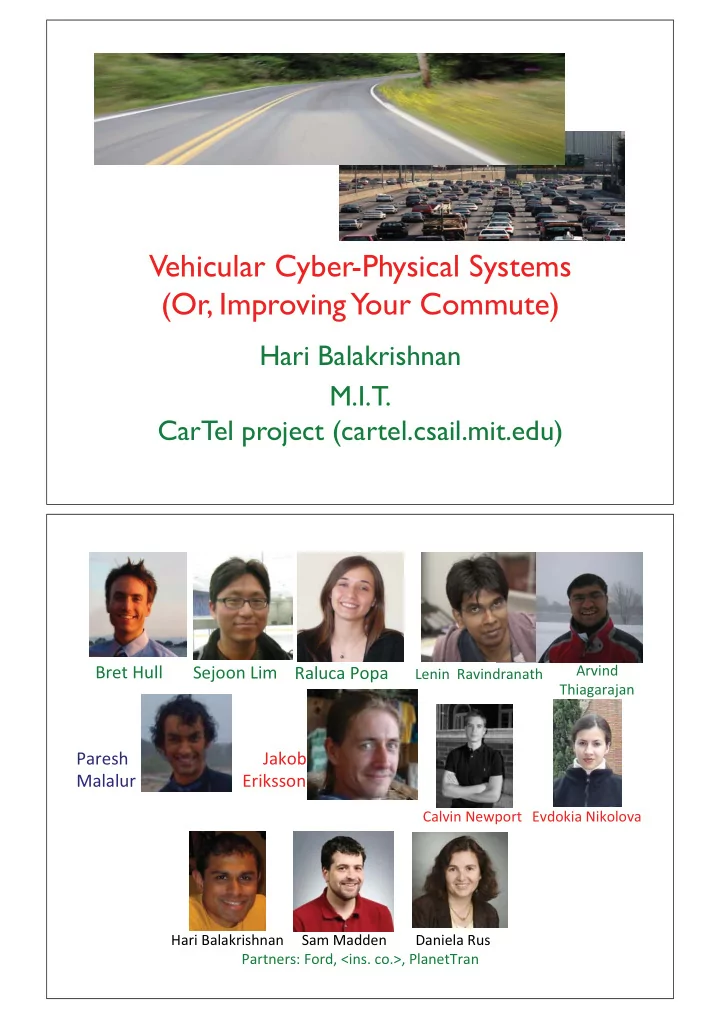
Vehicular Cyber-Physical Systems (Or, Improving Your Commute) Hari Balakrishnan M.I.T. CarTel project (cartel.csail.mit.edu)


slide-1
SLIDE 1

Vehicular Cyber-Physical Systems (Or, Improving Your Commute)

  • Hari Balakrishnan
  • M.I.T.

CarTel project (cartel.csail.mit.edu)

slide-2
SLIDE 2

The Challenge

  • Road transportation presents an array of hard

problems worldwide

  • Accidents & hazards, congestion (routing &

tolling), emissions & pollution, degrading infrastructure, telematics

Traffic Problems

  • 1982 2005

Morning Commute

3 12 3 12 3 12 3 12

Evening Commute 1982 2005

Rush Hour

Highway congestion costs $128 billion annually Avg commuter travels 100 minutes a day 33% commuters stuck in very heavy traffic at least once/week

US BTS

  • ghway congestion costs $128 billion annually

B

h ti t $128 billi ll

80% of world’s population is in places where automobile growth is occurring at >20% per year

slide-3
SLIDE 3

Phones as Probes

  • Gather <time, position, otherdata>

samples from phone

  • Map sequence of positions to a

trajectory

  • Estimate delays & other data for

individual road segments

  • Use in prediction, combining

historic and current information

Camera Microphone Accelerometer GPS Compass Gyro WiFi Cellular radio

Phones as Probes: Challenges

  • Accuracy

Errors & outages

Energy

GPS is an energy hog: 400 mW for continuous monitoring Effective radiative power

  • nly 2*10-11 W/m2

(Cf. cellular radio: 10 mW/m2 – 117 dB difference!)

Location privacy

  • 20

40 60 80 100 200 400 600 800 1000 1200 1400 1600 1800 Remaining Battery Life (percentage) Time Elapsed (minutes) Battery Drain Curve GPS every 1s GPS every 120s

Android G1

  • A. Thiagarajan, L. Sivalingam, K. LaCurts, S. Toledo, J. Eriksson, S. Madden, HB, Sensys, 2009
slide-4
SLIDE 4

Idea: Trade-off Accuracy for Longer Battery Life

  • GPS has outages and errors

in urban canyons Cellular all the time, WiFi some of the time, and GPS infrequently Augment with accel & compass for turn hints

Input: Radio Fingerprint Sequence

  • d8:30:62:5f:be:da | RSSI -94

00:0f:b5:3d:43:20 | RSSI -58 00:18:0a:30:00:a3 | RSSI -51

. . . . . . . . . . . . . . Base station / Access point | Signal strength

slide-5
SLIDE 5
  • State-of-the-art:

localize each RF fingerprint to best static location [PlaceLab]

  • Ok for point

localization – poor for tracks

Current RF Localization Produces Poor Trajectories

  • Maximum-likelihood trajectory estimate
  • Operates directly with fingerprints using

a 2-stage hidden Markov model (“soft decision decoding”)

  • 75% as accurate as 1 Hz GPS
  • Energy comparable to GPS every 240

seconds (on Android G1)

CTrack: Accurate Trajectory Mapping with Cellular Signals

  • A. Thiagarajan, L. Sivalingam, HB, S. Madden, NSDI 2011
slide-6
SLIDE 6

HMM fingerprints to grid sequence HMM smooth grid to map Raw points (placelab) Smooth + interpolate grid sequence

Delays are Inherently Probabilistic

  • Speed (Delay/Length)

Time of day

P . Malalur, A. Thiagarajan, HB, S. Madden, Traffic Prediction from Historical Observations, 2011

slide-7
SLIDE 7

13

Traffic-Aware Stochastic Routing

  • You need to reach the airport by 6 pm.

You leave at 4.45 pm. What route should you take? – Want max probability route – Or, for a given probability of arrival, minimize time for arrival with at least that probability

  • Goal: Credible routes & accurate estimates
  • Practical solution for single-user planning
  • Challenges: fast online re-routing, multi-user routing,

multi-mode routing

Stochastic Routing Isn’t Easy

  • Optimal substructure property doesn’t hold
  • A

B C time PDFs of path delays AB deadline Mean 5 St.dev. 3 Mean 7 St.dev. 1 4

slide-8
SLIDE 8

Stochastic Routing Isn’t Easy

  • Optimal substructure property doesn’t hold
  • Non-convex objective

A B C 4 time PDFs of path delays AC deadline Mean 5 St.dev. 3 Mean 7 St.dev. 1

Insight 1: min Prob(late) for Gaussian is equivalent to:

  • Insight 2:

Visualize on mean-variance plane

  • Insight 3: Solution is on

bottom-left quadrant boundary

mean var

Mean-Variance of Paths

minimize path mean – t

{paths} √path var. (path mean – t)² path var. t (deadline) p √ th (p ) th

Evdokia Nikolova, Strategic Algorithms (stochastic shortestpaths via quasi-convex maximization)

Key Insights

slide-9
SLIDE 9

Practice: Pruned Parametric Optimization

Undiscovered path Discovered path

Mean d Variance

  • Set edge weight = me + * ve
  • Search overby running deterministic shortest paths

with above weights

  • Prune search space efficiently: O(N2 polylog N) avg time
  • ~2-10 shortest path computations (~1-3 seconds)

Lim, HB, Madden, Rus, Stochastic Motion Planning and Applications to Traffic, IJRR 2010

  • s

Example: 4 pm MIT to Alewife

slide-10
SLIDE 10

iCarTel iPhone App

  • Conclusion
  • Transportation is a grand challenge problem
  • Vehicular cyber-physical systems combining

mobile sensing, wireless networking, and mobile/cloud computing can help

  • Many interesting problems

– whose solutions have to be embedded in a complex social and physical context

  • cartel.csail.mit.edu