
SLIDE 1
24/11/2014 1
Bioeconomy: A view from the stakeholders
(JRC-IES, 21st November 2014) Calliope Panoutsou
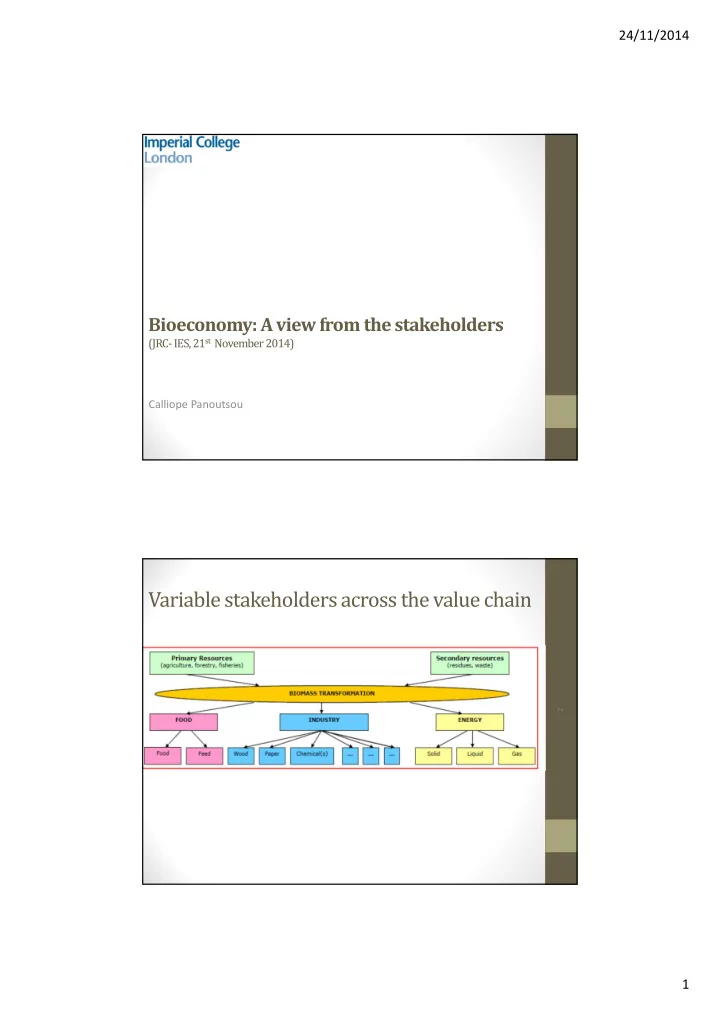
Variable stakeholders across the value chain
2
Variable stakeholders across the value chain 2 1 24/11/2014 - - PDF document
24/11/2014 Bioeconomy: A view from the stakeholders (JRC-IES, 21 st November 2014) Calliope Panoutsou Variable stakeholders across the value chain 2 1 24/11/2014 Complex interactions lead to misleading messages : diverse feedstock, regional
(JRC-IES, 21st November 2014) Calliope Panoutsou
2
understand and what are the appropriate metrics to evaluate and monitor progress?
shaping the sustainable biomass supply and building new value chains?
bioeconomy to the economy, society and environment?
what policy mechanisms/ instruments?
and supply –push bioeconomy?
Policy. Sustainability
.
Demand Supply
Educate Understand Validate Conclude Review
Primary and secondary resources Energy, fuels Biobased materials Biodiversity, Land and water use GHG balances Climate Change, Renewables Agriculture, Trade Environment, Enterprise Innovation
Work with each group
processors, waste handlers, advanced bio-material manufacturers, researchers, educationalists, policy-makers, bio-energy providers, NGOs and civil society.
industry and stakeholder
finite resource that serves as the raw material for a range of different uses.
together at various levels in a coherent manner if it is to achieve its full potential.
courageous in taking risks and accepting failures as learning experiences.
where consumers are increasingly focusing on health, well-being and sustainable food
importance to the long-term security of its 500 million people. This concerns not just food security, but the adaptations required to balance an economic use of biological resources with all aspects of conservation of the environment.
and low-tech skills in a range of bio-refining and bio-processing technologies. This in turn has implications for educational curricula – from primary education to third and fourth level – which will need to be re-engineered to meet the demands of the bio and green economies of the future.
and planned over much wider dimensions of space and time, addressing its global impact and looking beyond short-term budgetary cycles. In particular, policies and actions to minimise climate change require urgent and consistent priority in the decades ahead.
industry, academia and end-users.
different bioeconomy sectors.
and local level.
chain steps and scales of decision making/ implementation (EU, national, regional, local)
set of clear messages that each stakeholder group can relate to or will be interested to hear (tackle the issues of ‘stakeholder fatigue’ and ‘lack of real time response’ to misleading messages).