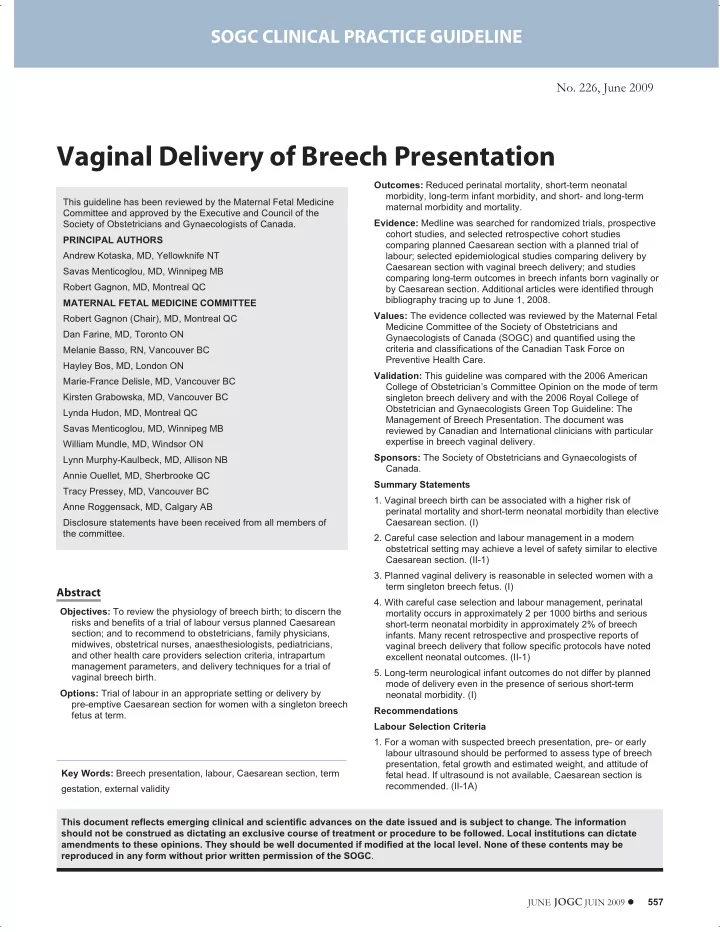
Vaginal Delivery of Breech Presentation Outcomes: Reduced perinatal - - PDF document

vaginal delivery of breech presentation
SMART_READER_LITE
LIVE PREVIEW

Vaginal Delivery of Breech Presentation Outcomes: Reduced perinatal - - PDF document

SOGC CLINICAL PRACTICE GUIDELINE SOGC CLINICAL PRACTICE GUIDELINE No. 226, June 2009 Vaginal Delivery of Breech Presentation Outcomes: Reduced perinatal mortality, short-term neonatal morbidity, long-term infant morbidity, and short- and


slide-1
SLIDE 1

SOGC CLINICAL PRACTICE GUIDELINE

Vaginal Delivery of Breech Presentation

Abstract

Objectives: To review the physiology of breech birth; to discern the risks and benefits of a trial of labour versus planned Caesarean section; and to recommend to obstetricians, family physicians, midwives, obstetrical nurses, anaesthesiologists, pediatricians, and other health care providers selection criteria, intrapartum management parameters, and delivery techniques for a trial of vaginal breech birth. Options: Trial of labour in an appropriate setting or delivery by pre-emptive Caesarean section for women with a singleton breech fetus at term. Outcomes: Reduced perinatal mortality, short-term neonatal morbidity, long-term infant morbidity, and short- and long-term maternal morbidity and mortality. Evidence: Medline was searched for randomized trials, prospective cohort studies, and selected retrospective cohort studies comparing planned Caesarean section with a planned trial of labour; selected epidemiological studies comparing delivery by Caesarean section with vaginal breech delivery; and studies comparing long-term outcomes in breech infants born vaginally or by Caesarean section. Additional articles were identified through bibliography tracing up to June 1, 2008. Values: The evidence collected was reviewed by the Maternal Fetal Medicine Committee of the Society of Obstetricians and Gynaecologists of Canada (SOGC) and quantified using the criteria and classifications of the Canadian Task Force on Preventive Health Care. Validation: This guideline was compared with the 2006 American College of Obstetrician’s Committee Opinion on the mode of term singleton breech delivery and with the 2006 Royal College of Obstetrician and Gynaecologists Green Top Guideline: The Management of Breech Presentation. The document was reviewed by Canadian and International clinicians with particular expertise in breech vaginal delivery. Sponsors: The Society of Obstetricians and Gynaecologists of Canada. Summary Statements

  • 1. Vaginal breech birth can be associated with a higher risk of

perinatal mortality and short-term neonatal morbidity than elective Caesarean section. (I)

  • 2. Careful case selection and labour management in a modern
  • bstetrical setting may achieve a level of safety similar to elective

Caesarean section. (II-1)

  • 3. Planned vaginal delivery is reasonable in selected women with a

term singleton breech fetus. (I)

  • 4. With careful case selection and labour management, perinatal

mortality occurs in approximately 2 per 1000 births and serious short-term neonatal morbidity in approximately 2% of breech

  • infants. Many recent retrospective and prospective reports of

vaginal breech delivery that follow specific protocols have noted excellent neonatal outcomes. (II-1)

  • 5. Long-term neurological infant outcomes do not differ by planned

mode of delivery even in the presence of serious short-term neonatal morbidity. (I) Recommendations Labour Selection Criteria

  • 1. For a woman with suspected breech presentation, pre- or early

labour ultrasound should be performed to assess type of breech presentation, fetal growth and estimated weight, and attitude of fetal head. If ultrasound is not available, Caesarean section is

  • recommended. (II-1A)

JUNE JOGC JUIN 2009 557

SOGC CLINICAL PRACTICE GUIDELINE

This guideline has been reviewed by the Maternal Fetal Medicine Committee and approved by the Executive and Council of the Society of Obstetricians and Gynaecologists of Canada. PRINCIPAL AUTHORS Andrew Kotaska, MD, Yellowknife NT Savas Menticoglou, MD, Winnipeg MB Robert Gagnon, MD, Montreal QC MATERNAL FETAL MEDICINE COMMITTEE Robert Gagnon (Chair), MD, Montreal QC Dan Farine, MD, Toronto ON Melanie Basso, RN, Vancouver BC Hayley Bos, MD, London ON Marie-France Delisle, MD, Vancouver BC Kirsten Grabowska, MD, Vancouver BC Lynda Hudon, MD, Montreal QC Savas Menticoglou, MD, Winnipeg MB William Mundle, MD, Windsor ON Lynn Murphy-Kaulbeck, MD, Allison NB Annie Ouellet, MD, Sherbrooke QC Tracy Pressey, MD, Vancouver BC Anne Roggensack, MD, Calgary AB Disclosure statements have been received from all members of the committee. Key Words: Breech presentation, labour, Caesarean section, term gestation, external validity

  • No. 226, June 2009

This document reflects emerging clinical and scientific advances on the date issued and is subject to change. The information should not be construed as dictating an exclusive course of treatment or procedure to be followed. Local institutions can dictate amendments to these opinions. They should be well documented if modified at the local level. None of these contents may be reproduced in any form without prior written permission of the SOGC.

slide-2
SLIDE 2
  • 2. Contraindications to labour include
  • a. Cord presentation (II-3A)
  • b. Fetal growth restriction or macrosomia (I-A)
  • c. Any presentation other than a frank or complete breech with a

flexed or neutral head attitude (III-B)

  • d. Clinically inadequate maternal pelvis (III-B)
  • e. Fetal anomaly incompatible with vaginal delivery (III-B)
  • 3. Vaginal breech delivery can be offered when the estimated fetal

weight is between 2500 g and 4000 g. (II-2B) Labour Management

  • 4. Clinical pelvic examination should be performed to rule out

pathological pelvic contraction. Radiologic pelvimetry is not necessary for a safe trial of labour; good progress in labour is the best indicator of adequate fetal-pelvic proportions. (III-B)

  • 5. Continuous electronic fetal heart monitoring is preferable in the

first stage and mandatory in the second stage of labour. (I-A) When membranes rupture, immediate vaginal examination is recommended to rule out prolapsed cord. (III-B)

  • 6. In the absence of adequate progress in labour, Caesarean section

is advised. (II-1A)

  • 7. Induction of labour is not recommended for breech presentation.

(II-3B) Oxytocin augmentation is acceptable in the presence of uterine dystocia. (II-1A)

  • 8. A passive second stage without active pushing may last up to

90 minutes, allowing the breech to descend well into the pelvis. Once active pushing commences, if delivery is not imminent after 60 minutes, Caesarean section is recommended. (I-A)

  • 9. The active second stage of labour should take place in or near an
  • perating room with equipment and personnel available to perform

a timely Caesarean section if necessary. (III-A)

  • 10. A health care professional skilled in neonatal resuscitation should

be in attendance at the time of delivery. (III-A) Delivery Technique

  • 11. The health care provider for a planned vaginal breech delivery

needs to possess the requisite skills and experience. (II-1A)

  • 12. An experienced obstetrician-gynaecologist comfortable in the

performance of vaginal breech delivery should be present at the delivery to supervise other health care providers, including a

  • trainee. (I-A)
  • 13. The requirements for emergency Caesarean section, including

availability of the hospital operating room team and the approximate 30-minute timeline to commence a laparotomy, must be in accordance with the recommendations of the SOGC Policy Statement, “Attendance at Labour and Delivery” (CPG No. 89; update in press, 2009). (III-A)

  • 14. The health care provider should have rehearsed a plan of action

and should be prepared to act promptly in the rare circumstance of a trapped after-coming head or irreducible nuchal arms: symphysiotomy or emergency abdominal rescue can be life

  • saving. (III-B)
  • 15. Total breech extraction is inappropriate for term singleton breech
  • delivery. (II-2A)
  • 16. Effective maternal pushing efforts are essential to safe delivery

and should be encouraged. (II-1A)

  • 17. At the time of delivery of the after-coming head, an assistant

should be present to apply suprapubic pressure to favour flexion and engagement of the fetal head. (II-3B)

  • 18. Spontaneous or assisted breech delivery is acceptable. Fetal

traction should be avoided, and fetal manipulation must be applied

  • nly after spontaneous delivery to the level of the umbilicus. (III-A)

SOGC CLINICAL PRACTICE GUIDELINE 558 JUNE JOGC JUIN 2009

Key to evidence statements and grading of recommendations, using the ranking of the Canadian Task Force on Preventive Health Care

Quality of Evidence Assessment* Classification of Recommendations† I: Evidence obtained from at least one properly randomized controlled trial II-1: Evidence from well-designed controlled trials without randomization II-2: Evidence from well-designed cohort (prospective or retrospective) or case-control studies, preferably from more than one centre or research group II-3: Evidence obtained from comparisons between times or places with or without the intervention. Dramatic results in uncontrolled experiments (such as the results of treatment with penicillin in the 1940s) could also be included in this category III: Opinions of respected authorities, based on clinical experience, descriptive studies, or reports of expert committees A. There is good evidence to recommend the clinical preventive action B. There is fair evidence to recommend the clinical preventive action

  • C. The existing evidence is conflicting and does not allow to

make a recommendation for or against use of the clinical preventive action; however, other factors may influence decision-making

  • D. There is fair evidence to recommend against the clinical

preventive action E. There is good evidence to recommend against the clinical preventive action L. There is insufficient evidence (in quantity or quality) to make a recommendation; however, other factors may influence decision-making

The quality of evidence reported in these guidelines has been adapted from The Evaluation of Evidence criteria described in the Canadian Task Force

  • n Preventive Health Care.62

†Recommendations included in these guidelines have been adapted from the Classification of Recommendations criteria described in the The Canadian Task Force on Preventive Health Care.62

ABBREVIATIONS

ACOG American College of Obstetricians and Gynecologists CS Caesarean section CEFM continuous electronic fetal monitoring RCOG Royal College of Obstetricians and Gynaecologists TBT Term Breech Trial TOL trial of labour

slide-3
SLIDE 3
  • 19. Nuchal arms may be reduced by the Løvset or Bickenbach
  • manoeuvres. (III-B)
  • 20. The fetal head may deliver spontaneously, with the assistance of

suprapubic pressure, by Mauriceau-Smellie-Veit manoeuvre, or with the assistance of Piper forceps. (III-B) Setting and Consent

  • 21. In the absence of a contraindication to vaginal delivery, a woman

with a breech presentation should be informed of the risks and benefits of a trial of labour and elective Caesarean section, and informed consent should be obtained. A woman’s choice of delivery mode should be respected. (III-A)

  • 22. The consent discussion and chosen plan should be well

documented and communicated to labour-room staff. (III-B)

  • 23. Hospitals offering a trial of labour should have a written protocol

for eligibility and intrapartum management. (III-B)

  • 24. Women with a contraindication to a trial of labour should be

advised to have a Caesarean section. Women choosing to labour despite this recommendation have a right to do so and should not be abandoned. They should be provided the best possible in-hospital care. (III-A)

  • 25. The Society of Obstetricians and Gynaecologists of Canada

(SOGC), in collaboration with the Association of Professors of Obstetrics and Gynaecology (APOG), The College of Family Physicians of Canada (CFPC), and The Canadian Association of Midwives (CAM) should revise the training requirements at the undergraduate and postgraduate levels. SOGC will continue to promote training of current health care providers through the MOREOB, ALARM (Advances in Labour and Risk Management), and other courses. (III-A)

  • 26. Theoretical and hands-on breech birth training simulation should

be part of basic obstetrical skills training programs such as ALARM, ALSO (Advanced Life Support Training in Obstetrics), and MOREOB to prepare health care providers for unexpected vaginal breech births. (III-B) J Obstet Gynaecol Can 2009;31(6):557–566

BACKGROUND

C

  • mpared with a fetus with cephalic presentation, a

breech fetus faces increased risk during labour and delivery of asphyxia from cord compression and of trau- matic injury during delivery of the shoulders and head. Pre-emptive Caesarean section avoids most of this risk. Prior to 1940, despite breech perinatal mortality rates of 5%, CS involved too much maternal risk to be used rou- tinely to lower fetal risk.1 Improved safety with antibiotics, blood transfusion, and Kerr’s lower segment incision prompted consideration of routine CS for breech presenta- tion.2 Concurrently, improvements in vaginal breech deliv- ery technique markedly lowered the risk of a trial of labour in experienced hands, and breech perinatal mortality con- tinued to fall, despite stabilization of the CS rate.1,3–8 The debate surrounding the optimal mode of delivery for the breech fetus focuses on a single clinical question: what is the magnitude of risk to the fetus of a TOL and how should we balance it against the increased immediate and future risk of CS to the mother and her future children?

TERM BREECH TRIAL

Published in 2000, the Term Breech Trial was a large, multicentre randomized controlled trial designed to deter- mine the safest mode of delivery for a term breech fetus.9 In countries with a low perinatal mortality rate, the trial showed no difference in perinatal mortality between a planned CS and a TOL but a striking difference in “serious” short-term neonatal morbidity: 0.4% versus 5.1%. No dif- ference in maternal mortality or serious morbidity was mea- sured, leading most experts to recommend planned CS for breech presentation at term.10,11 An abrupt shift in clinical practice ensued, and term breech CS rates increased around the world. The pool of expertise in vaginal breech birth has shrunk rapidly since, and many obstetrician-gynaecologists now graduate with little or no experience with vaginal breech delivery. In many regions of the world, women with a breech fetus no longer have the option of a medically attended vaginal breech birth.12,13 The TBT is the largest randomized clinical trial ever under- taken on term breech mode of delivery, and it has provided a wealth of information about breech birth. Despite its strengths, however, a number of weaknesses have been identified since its publication.14–20 Based on the informa- tion available at the time, its findings may have been misin- terpreted and may have led to premature changes in clinical

  • practice. A comprehensive analysis is beyond the scope of

this guideline; however, an examination of the TBT’s major limitations is critical to estimating the true risk of labour to a breech fetus. They can be grouped as follows: (1) inadequate case selection and intrapartum manage- ment; (2) maternity units with markedly different skill lev- els grouped together; and (3) short-term morbidity used as a surrogate marker for long-term neurological impairment.

TBT: Case Selection and Labour Management

Pre- or early labour ultrasound was not required, which may have allowed fetuses with growth restriction due to placen- tal insufficiency to go undetected. At least seven of the trial’s 16 perinatal deaths were in growth-restricted fetuses.9,16,19,21 To what extent undetected fetal macrosomia and deflexed head position contributed to morbidity and mortality is unknown. Continuous electronic fetal monitor- ing was also not required, and only one third of fetuses received it. The trial protocol allowed labour progress to be as slow as 0.5 cm/hr in the first stage and up to 3.5 hours for the second stage.21 Although they are acceptable for cephalic fetuses, few experienced practitioners consider these limits acceptable for a breech fetus, and the 5% of fetuses born after an active second stage longer than 60 minutes encountered increased morbidity and mortal- ity.22 Therefore it can be learned from the TBT that the fol- lowing strategies may increase the safety of term breech

Vaginal Delivery of Breech Presentation JUNE JOGC JUIN 2009 559

slide-4
SLIDE 4

deliveries: ultrasound estimation of fetal weight to detect abnormal fetal growth, fetal head attitude, and type of breech presentation, and close attention to progress in the second stage of labour. Although a practitioner experienced in vaginal breech birth was expected at every delivery, a licensed obstetrician was not present at 13% of births in the planned vaginal birth group versus 2% in the planned Caesarean section group, and there was a high degree of crossover in the trial: 10% of women randomized to planned CS delivered vaginally. Three percent of fetuses were cephalic at delivery, high- lighting the need for routine ultrasound for suspected breech in labour or prior to elective CS.

TBT: Surrogate Short-term Outcome

Short-term morbidity in vaginally born breech fetuses is

  • ften increased because of the cord compression that com-

monly occurs during the second stage and fetal expulsion. In countries like Canada with low perinatal mortality, the absolute difference in serious short-term morbidity between the arms of the TBT was 5%. However, one half of the sample was followed beyond two years, at which time there was no difference in the combined perinatal death and abnormal neurological outcome: 3.1% in the planned CS group, and 2.8% in the TOL group.23 Of the 18 infants with serious neonatal morbidity that were followed, 17 were neu- rologically normal at two years of age. The remaining infant died of congenital subglottic stenosis, considered unlikely to be related to mode of delivery. This demonstrates the systematic failure, also shown by other studies, of short-term morbidity to predict long-term outcome in breech infants.24–28 At two years of age, the only significant difference in infant outcome was fewer “medical problems in the past several months” in the TOL group (15% vs. 21%; P = 0.02). The neonatal immune system is activated during labour, and associations between labour and reduced incidence of pediatric allergic and auto-immune disease may be causal.29–32 With the limitations in the TBT, women had a 97% chance

  • f having a neurologically normal two-year old, regardless
  • f planned mode of birth. Those randomized to a trial of

labour had a 6% absolute lower chance (or 30% relative risk reduction) of having a two-year-old child with unspecified medical problems, suggesting some lasting benefit of labour to the newborn immune system.

PREMODA STUDY

Numerous retrospective series comparing a TOL with planned CS have been published.26,27,33–37 Many were large enough to demonstrate acceptable safety of breech birth in individual units; however, data were collected retrospectively and were not necessarily generalizable beyond those experienced units. In 2006, in response to the TBT, Goffinet et al. published the PREMODA study: a multicentre descriptive study four times larger than the TBT.38 Prospective data were collected from 8105 women in 174 centres in France and Belgium, using the same short-term combined outcome of perinatal mortality or serious neonatal morbidity as the TBT. Contemporary prac- tice in France and Belgium involves a cautious, consistent level of care, which was not altered by the investigators. The PREMODA study was descriptive, and the percentage

  • f women attempting vaginal birth varied between centres

(47.8–89.0%). Overall, CS was planned in 69% and a TOL undertaken in 31%, consistent with non-randomization. Of 2526 women having a TOL, 1796 (71%) delivered vaginally for an overall vaginal birth rate of 22.5%. Pre- or early labour ultrasound and CEFM in labour were universal. Contrary to standard practice in many countries, including Canada, radiologic pelvimetry was employed in 82%. Fail- ure to progress for more than two hours in the first stage of labour occurred in 3.8% of labours, and an active second stage longer than 60 minutes occurred in only 0.2% of

  • cases. Only 0.6% of women planning CS eventually deliv-

ered vaginally, and all fetuses were breech at delivery. Although not strictly comparable, the PREMODA out- comes contrast with those of the TBT. There was no differ- ence in perinatal mortality (0.08% vs. 0.15%) or serious neonatal morbidity (1.6% vs. 1.45%) between a TOL and planned CS. The only difference in outcome was a 0.16% incidence of five-minute Apgar score < 4 in the TOL group versus 0.02% in the planned CS group. Eight times larger than the low-perinatal-mortality subset of the TBT, the PREMODA study provides a robust estimate of the risk of a cautious breech TOL in a modern, well-supported

  • bstetrical unit.

EPIDEMIOLOGY

Epidemiological comparisons of breech infants born vagi- nally or by CS are typically hampered by their large and ret- rospective design: the ultimate mode of delivery does not take into account the planned mode of delivery or quality of care provided. One study in particular bears mentioning,

  • however. From a large, well-maintained national database,

Reitberg et al. studied the change in obstetrical breech prac- tice in the Netherlands before and after publication of the TBT.39 They detected an abrupt drop immediately after publication in overall vaginal breech birth rate from 50% to 20%, accompanied by a drop in perinatal mortality from 0.35% to 0.18% and in fetal trauma from 0.29% to 0.08%. Although perinatal mortality had previously continued to decline in the Netherlands despite a stabilization of the CS

SOGC CLINICAL PRACTICE GUIDELINE 560 JUNE JOGC JUIN 2009

slide-5
SLIDE 5

rate, the clear further decrease with the sudden increase in CS rate strongly implies causality.8 The magnitude of the drop was small, requiring altered management in some 600 women with a breech fetus and some 175 additional CS to prevent one perinatal death; however, the results imply that increased caution resulted in a lower vaginal breech birth rate and improved safety. The improved outcome was largely due to the increase in planned CS, but the outcome was also better after emergency CS and vaginal delivery, suggesting that in carefully selected pregnant women, vaginal breech delivery may be a safe option. In contrast to the TBT, the new practice has resulted in a small increase in CS-related maternal morbidity and mortality, sparking debate about the balance between maternal and fetal risk.40–44

Summary Statements

  • 1. Vaginal breech birth can be associated with a higher

risk of perinatal mortality and short-term neonatal morbidity than elective Caesarean section. (I)

  • 2. Careful case selection and labour management in a

modern obstetrical setting may achieve a level of safety similar to elective Caesarean section. (II-1)

  • 3. Planned vaginal delivery is reasonable in selected

women with a term singleton breech fetus. (I)

  • 4. With careful case selection and labour management,

perinatal mortality occurs in approximately 2 per 1000 births and serious short-term neonatal morbidity in approximately 2% of breech infants. Many recent retrospective and prospective reports of vaginal breech delivery that follow specific protocols have noted excellent neonatal outcomes. (II-1)

  • 5. Long-term neurological infant outcomes do not differ

by planned mode of delivery even in the presence of serious short-term neonatal morbidity. (I) Recommendations Vaginal breech birth is a complex phenomenon. Selection criteria, intrapartum management parameters, and delivery techniques are difficult to isolate and study, and there is lit- tle rigorous evidence to support or refute them individually. The criteria outlined here are based upon the physiology of breech birth, the results of the TBT and cohort studies with demonstrated safety, and the opinions of experts in breech

  • birth. Clinical judgement and the experience of the obstetri-

cal team are essential components of safe breech birth. Besides an obstetrician-gynaecologist, the health care pro- viders involved in the team may also include a family practi- tioner or midwife. The recommendations were developed using the guidelines developed by the Canadian Task Force on Preventive Health Care (Table). Labour Selection Criteria

  • 1. For a woman with suspected breech presentation, pre- or

early labour ultrasound should be performed to assess type of breech presentation, fetal growth and estimated weight, and attitude of fetal head. If ultrasound is not available, Caesarean section is recommended. (II-1A)

  • 2. Contraindications to labour include
  • a. Cord presentation (II-3A)
  • b. Fetal growth restriction or macrosomia (I-A)
  • c. Any presentation other than a frank or complete

breech with a flexed or neutral head attitude (III-B)

  • d. Clinically inadequate maternal pelvis (III-B)
  • e. Fetal anomaly incompatible with vaginal delivery (III-B)
  • 3. Vaginal breech delivery can be offered when the esti-

mated fetal weight is between 2500 g and 4000 g. (II-2B) When a woman is admitted for a planned vaginal breech birth, having been followed by a family practitioner or a midwife, a consultation with an obstetrician-gynaecologist should be obtained. Pre- or early-labour ultrasound assessment is essential to determine type of breech presentation, assess fetal growth, and detect the rare extended fetal neck at increased risk of entrapment.45,46 To be eligible for a TOL, estimated fetal weight should be between 2500 g and 4000 g. The lower margin is intended to exclude growth-restricted fetuses, the upper margin to avoid fetal-pelvic disproportion. Clinical pelvic examination should be performed to rule out patho- logical pelvic contraction. Although used in 82% of labours in the PREMODA study, radiological pelvimetry remains controversial, and many centres have demonstrated safety without it.26,34,35,37 The best indication of adequate fetal- pelvic proportions is good progress in labour. A breech fetus has a higher chance of cord presentation. Persistent cord presentation is an indication for CS to pre- vent cord prolapse.47 A breech fetus also has a higher risk of cord prolapse in labour than a cephalic fetus. This risk var- ies from less than 1% for frank breech to perhaps 10% for footling breech presentation.48 For a woman to be eligible for a TOL, her fetus must be in a frank or complete breech

  • presentation. A footling breech, defined as having at least
  • ne extended fetal hip, is a contraindication to labour, and a

CS should be performed unless delivery is imminent. A fetus with feet presenting but flexed hips and knees is a complete breech, therefore eligible for a TOL. Labour Management

  • 4. Clinical pelvic examination should be performed to rule
  • ut

pathological pelvic contraction. Radiologic pelvimetry is not necessary for a safe trial of labour; good

Vaginal Delivery of Breech Presentation JUNE JOGC JUIN 2009 561

slide-6
SLIDE 6

progress in labour is the best indicator of adequate fetal-pelvic proportions. (III-B)

  • 5. Continuous electronic fetal heart monitoring is prefera-

ble in the first stage and mandatory in the second stage of

  • labour. (I-A) When membranes rupture, immediate vagi-

nal examination is recommended to rule out prolapsed

  • cord. (III-B)
  • 6. In the absence of adequate progress in labour, Caesarean

section is advised. (II-1A)

  • 7. Induction of labour is not recommended for breech pre-
  • sentation. (II-3B) Oxytocin augmentation is acceptable

in the presence of uterine dystocia. (II-1A)

  • 8. A passive second stage without active pushing may last

up to 90 minutes, allowing the breech to descend well into the pelvis. Once active pushing commences, if deliv- ery is not imminent after 60 minutes, Caesarean section is recommended. (I-A)

  • 9. The active second stage of labour should take place in or

near an operating room with equipment and personnel available to perform a timely Caesarean section if

  • necessary. (III-A)
  • 10. A health care professional skilled in neonatal resuscitation

should be in attendance at the time of delivery. (III-A) During breech labour, CEFM is recommended because of the increased risk of cord prolapse. Detection of cord pro- lapse in hospital with timely access to CS is usually associ- ated with good fetal outcome.27,49 Prior to deep engagement in labour, membranes should be ruptured artificially only with a clear indication and careful monitoring. When mem- branes rupture, immediate vaginal examination is indicated to rule out prolapsed cord. If membranes rupture at home, a woman with a known breech presentation should be advised to present immediately to hospital for assessment. During the second stage of labour, descent of the breech and entry of the umbilical insertion into the pelvis are com- monly associated with an increased incidence of cord com- pression and variable decelerations. CEFM is universally required in the second stage. A fetal scalp ECG electrode may be inserted into the buttock for CEFM, and one small study supports the validity of capillary blood gas samples drawn from the fetal buttocks to assess fetal well-being.50 Progress in labour is an important factor in breech labour

  • management. In the absence of data to the contrary, the

TBT protocol allowed a minimum of 0.5 cm/hr progress in the first stage and up to 3.5 hours for the second stage. The trial did not analyze results according to labour progress in the first stage, but post hoc analysis showed increased perinatal morbidity in the 5% of women with an active sec-

  • nd stage > 60 minutes.21 Comparatively, only 0.2% of

labouring women in the PREMODA study had an active second stage > 60 minutes. There was failure to progress for two hours or more in the first stage in only 3.8% of labours, and dilation from 5 to 10 cm took more than 7 hours in only 1.4%. It would seem prudent to expect cervi- cal dilation from 5 to 10 cm to take a maximum of 7 hours. The use of oxytocin during breech labour is controversial. Oxytocin augmentation was used in 74% of labours in PREMODA, and 9% of women were induced. Although small series have also supported its safety, induction of labour with a breech fetus is not recommended.51 Decreased uterine contractions (uterine dystocia) due to epidural analgesia may be appropriately treated with

  • xytocin augmentation; however, in spontaneous labour

without epidural analgesia, oxytocin augmentation is not recommended.22,38,52 Failure to progress for two hours despite adequate uterine contractions is an indication for

  • CS. Of note, the revised ACOG committee opinion indi-

cated that some of the recently published studies describing good perinatal outcome did not offer oxytocin induction or augmentation as part of their protocol.11 Assessing full dilatation in breech presentation is more dif- ficult than in cephalic presentation because the fully dilated cervix does not disappear behind the cephalic crown. Instead, the cervix remains palpable as the fetal trunk descends through it. An experienced clinician should make the assessment of full dilatation, as its timing is critical to evaluating labour progress. Cord compression during descent in the second stage is common and of unpredict- able severity: active pushing should take place in or near an

  • perating room with equipment and personnel available to

perform an immediate CS if necessary. An experienced

  • bstetrician-gynaecologist with the requisite skills should

be available for a planned vaginal birth, although it is recog- nized that complications at birth may occur even under the best possible circumstances. The second stage of labour can be divided into a passive phase, prior to active pushing, and an active pushing phase. The passive phase was > 60 minutes in 18% of labouring women in PREMODA. Active pushing lasted for > 60 minutes in only 0.2%. A prudent limit for the overall duration of the second stage, therefore, would be 2.5 hours. If delivery is not imminent after 60 minutes of active push- ing, CS is indicated, even if the buttocks are on the peri-

  • neum. Breech infants often have lower Apgar scores at

birth; a health care professional skilled in neonatal resuscita- tion should be in attendance at the time of delivery. Delivery Technique

  • 11. The health care provider for a planned vaginal breech

delivery needs to possess the requisite skills and experience (II-1A)

SOGC CLINICAL PRACTICE GUIDELINE 562 JUNE JOGC JUIN 2009

slide-7
SLIDE 7
  • 12. An experienced obstetrician-gynaecologist comfortable

in the performance of vaginal breech delivery should be present at the delivery to supervise other health care pro- viders, including a trainee. (I-A)

  • 13. The requirements for emergency Caesarean section,

including availability of the hospital operating room team and the approximate 30-minute timeline to commence a laparotomy, must be in accordance with the recommen- dations of the SOGC Policy Statement, “Attendance at Labour and Delivery” (CPG No. 89; update in press, 2009). (III-A)

  • 14. The health care provider should have rehearsed a plan
  • f action and should be prepared to act promptly in the

rare circumstance of a trapped after-coming head or irre- ducible nuchal arms: symphysiotomy or emergency abdominal rescue can be life saving. (III-B)

  • 15. Total breech extraction is inappropriate for term single-

ton breech delivery. (II-2A)

  • 16. Effective maternal pushing efforts are essential to safe

delivery and should be encouraged. (II-1A)

  • 17. At the time of delivery of the after-coming head, an

assistant should be present to apply suprapubic pressure to favour flexion and engagement of the fetal head. (II-3B )

  • 18. Spontaneous or assisted breech delivery is acceptable.

Fetal traction should be avoided, and fetal manipula- tion must be applied only after spontaneous delivery to the level of the umbilicus. (III-A)

  • 19. Nuchal arms may be reduced by the Løvset or

Bickenbach manoeuvres. (III-B)

  • 20. The fetal head may deliver spontaneously, with the

assistance of suprapubic pressure, by Mauriceau- Smellie-Veit manoeuvre, or with the assistance of Piper

  • forceps. (III-B)

In 1938, Bracht published a study that had a great impact on perinatal mortality. The prevalent method of delivery at the time was partial or complete breech extraction under mater- nal sedation. By encouraging maternal effort in the second stage without sedation, abandoning traction efforts from below, and using fundal pressure to prevent a prolonged expulsion phase, Bracht reduced perinatal mortality from a baseline of 3.2% to 0%.3 As a breech fetus transits the pelvis, normal fetal tone and uterine compression keep its head and arms flexed. Fetal manipulation prior to entrance of the elbows and chin into the pelvic inlet can induce extension of fetal limbs and head (Moro reflex) resulting in trapped after-coming fetal parts. Spontaneous birth helps minimize this risk, and many breech infants deliver spontaneously in a timely fashion with maternal expulsive efforts alone. Whether used routinely or only if spontaneous birth is not forthcoming, fetal manoeuvres should be employed only after spontane-

  • us delivery to the umbilicus, and traction should be

minimized.53 After the breech crowns, fetal expulsion is invariably accompanied by cord compression and fetal bradycardia. The normally grown fetus enters this phase well oxygenated without acidemia. It may tolerate a number of minutes of delay with extrinsic cord compression, resulting in a respira- tory acidosis, easily reversed once ventilation is established. A growth-restricted fetus, however, has a high likelihood of metabolic acidemia in labour due to pre-existing compro- mise in placental function, which reduces its tolerance to cord compression during expulsion. Therefore, fetal growth restriction is a contraindication to labour. Significant cord compression beyond several minutes will eventually lead to severe acidosis even in a normal fetus, and prevention and treatment of expulsive delay are critical components of delivery technique. Mechanisms that maxi- mize power from above may be associated with lower risk

  • f trapped after-coming fetal parts than manoeuvres that

involve fetal traction.1,3–6 Maternal cooperation is essential, and heavy sedation or dense epidural analgesia should be avoided to maximize expulsive efforts.52 Methods of increasing power from above once the buttocks have crowned include maximizing maternal pushing efforts, upright posture, and suprapubic pressure.5,6 None have been well studied independently. Maximizing maternal pushing is considered safe, and the use of an assistant to apply suprapubic pressure after crowning to maintain flexion of the fetal head and facilitate its engagement may be helpful (Bracht manoeuvre).1,3 After spontaneous delivery to the fetal umbilicus, expulsive delay despite power from above, with or without nuchal arms may require manoeuvres involving fetal manipulation. The Løvset and Bickenbach manoeuvres are the best described.7,54 Only the bony fetal pelvis and legs should be grasped to avoid damage to the fetal adrenal glands, which are disproportionately large. Traction on the fetus should be minimized to avoid trapped after-coming fetal parts. Total breech extraction is inappropriate for term singleton breech delivery in a modern hospital with ready access to

  • CS. The fetal head may deliver spontaneously, by

Mauriceau-Smellie-Veit manoeuvre, with the assistance of suprapubic pressure (Bracht manoeuvre), or with the assis- tance of Piper’s forceps. Symphysiotomy performed under local anaesthesia or abdominal rescue can be a life-saving procedure in the event of a trapped fetal head.55–57 Setting and Consent

  • 21. In the absence of a contraindication to vaginal delivery,

a woman with a breech presentation should be informed

Vaginal Delivery of Breech Presentation JUNE JOGC JUIN 2009 563

slide-8
SLIDE 8
  • f the risks and benefits of a trial of labour and elective

Caesarean section, and informed consent should be

  • btained. A woman’s choice of delivery mode should be
  • respected. (III-A)
  • 22. The consent discussion and chosen plan should be well

documentedandcommunicatedtolabour-roomstaff.(III-B)

  • 23. Hospitals offering a trial of labour should have a written

protocol for eligibility and intrapartum management. (III-B)

  • 24. Women with a contraindication to a trial of labour

should be advised to have a Caesarean section. Women choosing to labour despite this recommendation have a right to do so and should not be abandoned. They should be provided the best possible in-hospital care. (III-A)

  • 25. The Society of Obstetricians and Gynaecologists of

Canada (SOGC), in collaboration with the Association

  • f Professors of Obstetrics and Gynaecology (APOG),

The College of Family Physicians of Canada (CFPC), and The Canadian Association of Midwives (CAM) should revise the training requirements at the undergrad- uate and postgraduate levels. SOGC will continue to promote training of current health care providers through the MOREOB, ALARM (Advances in Labour and Risk Management), and other courses. (III-A)

  • 26. Theoretical and hands-on breech birth training simula-

tion should be part of basic obstetrical skills training pro- grams such as ALARM, ALSO (Advanced Life Support Training in Obstetrics), and MOREOB to prepare health care providers for unexpected vaginal breech births. (III-B) In light of recent publications that further clarify the lack of long-term newborn risk of vaginal breech delivery and the many cohort reports noting excellent neonatal outcomes in settings with specific protocols, it is acceptable for hospitals to offer vaginal breech delivery. Hospitals offering vaginal breech birth should have a written protocol for eligibility and intrapartum management, including notification of the most responsible health care provider upon admission in labour. Faced with a parturient requesting a TOL, the health care provider must evaluate his or her own system of breech selection, intrapartum management, delivery technique, and clinical experience. Women should be informed that the risk of short-term neonatal morbidity maybe higher for a planned vaginal delivery than for a planned CS but that long-term infant neurological outcome is not different. In the low-perinatal-mortality-country arm of the TBT and the PREMODA study, perinatal mortality was not different between the planned vaginal delivery and planned CS

  • groups. When vaginal breech delivery is planned, the con-

sent discussion regarding risks and benefits of mode of delivery and plans for delivery should be well documented in the chart and available in the birthing centre.

THE POTENTIAL RISK OF COERCION

The 2001 ACOG and RCOG breech guidelines left little room for parturient autonomy.10,11 Since their publication, it has been routine practice in many jurisdictions for

  • bstetrician-gynaecologists to refuse women a breech TOL

in hospital. On occasion, women so denied have given birth unattended at home, and perinatal deaths have resulted.58 Also, the volume of midwife-attended breech home births appears to have increased. Even with the quality of care lim- itations of the TBT, the long-term outcome was equivalent in the planned vaginal birth and planned CS groups, and parturient autonomy takes precedence over practitioner concerns about small levels of fetal risk. Women should be informed of the safety of a TOL in a setting with experienced care providers. Women who have a contraindication to labour or who are considered poor candidates for a TOL should be advised to deliver by CS. However, it is the patient’s right to decline any recommended medical procedure or treatment. If a woman chooses to labour despite this recommendation, she should be cared for in hospital. In-hospital breech birth in a modern obstetrical setting is almost certainly safer than home birth, and a woman must not be abandoned if she does not take medical advice.59

SYSTEM FACTORS

In 2006, the Royal College of Obstetricians and Gynaecolo- gists and the American College of Obstetrics and Gynecol-

  • gy replaced their restrictive 2001 breech guidelines with

new versions supportive of selected vaginal breech birth.60,61 The 2006 RCOG Green Top Guideline on breech birth outlines the obstetrical community’s responsibility to the individual parturient: “If a unit is unable to offer the choice of a planned vaginal breech birth, women who wish to choose this option should be referred to a unit where this

  • ption is available.”

Many newly qualified obstetrician-gynaecologists do not have the experience necessary to supervise a breech TOL, and mentoring by more senior colleagues will be necessary if they are to attain these skills. As precipitous breech births will occur in all settings, theoretical and hands-on breech birth training using models should be part of basic obstetri- cal and midwifery training and of training programs such as ALARM, ALSO, and MOREOB.

REFERENCES

  • 1. Plentl A, Stone R. The Bracht Maneuver. Obstet Gynecol Surv

1953;8(3):313–25. SOGC CLINICAL PRACTICE GUIDELINE 564 JUNE JOGC JUIN 2009

slide-9
SLIDE 9
  • 2. Kubli F, Rüttgers H, Meyer-Menk M. Die fetale Acidosegefährdung bei

vaginaler Geburt aus Beckenendlage [article in German]. Z Geburtsh Perinat 1975;179:1–16.

  • 3. Bracht E. Zur Behandlung der Steisslage [article in German]. Zentralbl

Gynakol 1938;62:1735.

  • 4. Bellew LN, Allison HM, Greenville SC. Experience with the Bracht Method
  • f delivery of the breech. Am J Obstet Gynecol 1958;76(4):754–60.
  • 5. Thiessen P. Spontangeburt, Herausleiten und Manualhilfe bei der Geburt in

Beckenendlage [article in German]. Zentralbl Gynakol 1952;74(50):1969–76.

  • 6. Thiessen P. Die eigene Geburtsleitung bei Beckenendlage und ihr

Gegensatz zur Schul- oder Lehrauffassung [article in German]. Geburtsh Frauenheilk 1964;24:661–82.

  • 7. Løvset J. Shoulder delivery by breech presentation. J Obset Gynaecol Brit

Emp 1937;44:696–704.

  • 8. Albrechtsen S, Ramussen S, Irgens LM. Secular trends in peri- and neonatal

mortality in breech presentation; Norway 1967–1994. Acta Obstet Gynecol Scand 2000;79:508–12.

  • 9. Hannah ME, Hannah WJ, Hewson SA, Hodnett ED, Saigal S, Willan AR.

Planned caesarean section versus planned vaginal birth for breech presentation at term: a randomized multicentre trial. Lancet 2000;356:1375–83.

  • 10. Royal College of Obstetricians and Gynaecologists. RCOG Green Top

Guidelines: The Management of Breech Presentation, Guideline no. 20. London: RCOG, 2001.

  • 11. American College of Obstetricians and Gynecologists. ACOG Committee

Opinion No. 265, Mode of Term Singleton Breech Delivery. Obstet Gynecol 2001;98:1189–90.

  • 12. Phipps H, Roberts CL, Nassar N, Raynes-Greenow CH, Peat B, Hutton
  • EK. The management of breech pregnancies in Australia and New Zealand.

Aus NZ J Obstet Gynaecol 2003;43:294–7.

  • 13. Hogle KL, Kilburn L, Hewson S, Gafni A, Wall R, Hannah ME. Impact of

the international term breech trial on clinical practice and concerns: a survey

  • f centre collaborators. J Obstet Gynaecol Can 2003;25:14–6.
  • 14. Goffinet F, Blondel B, Bréart G. À propos du débat sur le siege. J Gynecol

Obstet Biol Reprod 2001;30:187–90.

  • 15. Hauth JC, Cunningham FG. Vaginal breech delivery is still justified. Obstet

Gynecol 2002;99:1115–6.

  • 16. Van Roosmalen J, Rosendaal F. There is still room for disagreement about

vaginal delivery of breech infants at term. BJOG 2002;109:967–9.

  • 17. Kotaska A. Inappropriate use of randomized trials to evaluate complex

phenomena: case study of vaginal breech delivery. BMJ 2004;329:1039–42.

  • 18. Keirse MJ. Evidence-based childbirth only for breech babies? Birth

2002;29(1):55–9.

  • 19. Menticoglou SM. Why vaginal breech delivery should still be offered.

J Obstet Gynaecol Can 2006;28:380–5.

  • 20. Glezerman M. Five years to the term breech trial: the rise and fall of a

randomized controlled trial. Am J Obstet Gynecol 2006;194:20–5.

  • 21. University of Toronto Maternal, Infant and Reproductive Health Research
  • Unit. Term breech trial study protocol. 1996:8.
  • 22. Su M, McLeod L, Ross S, Willan A, Hannah WJ, Hutton E, et al. Factors

associated with adverse perinatal outcome in the Term Breech Trial. Am J Obstet Gynecol 2003;189:740–5.

  • 23. Whyte H, Hannah ME, Saigal S, Hannah W, Hewson S, Amankwah K, et al.

Outcomes of children at 2 years after planned cesarean birth versus planned vaginal birth for breech presentation at term: The International Randomized Term Breech Trial. Am J Obstet Gynecol 2004;191:864–71.

  • 24. Danelian PJ, Wang J, Hall MH. Long term outcome by method of delivery
  • f fetuses in breech presentation at term: population based follow-up. BMJ

1996;312:1451–3.

  • 25. Pradhan P, Mohajer M, Deshpande S. Outcome of term breech births:

10-year experience at a district general hospital. BJOG 2005;112:218–22.

  • 26. Giuliani A, Scholl WMJ, Basver A, Tamussino KF. Mode of delivery and
  • utcome of 699 term singleton breech deliveries at a single center. Am J

Obstet Gynecol 2002;187:1694–8.

  • 27. Hellsten C, Lindqvist PG, Olofsson P. Vaginal breech delivery: is it still an
  • ption? Eur J Obstet Gynecol Reprod Biol 2003;111:122–8.
  • 28. Munstedt K, von Georgi R, Reucher S, Zygmunt M, Lang U. Term breech

and long-term morbidity—cesarean section versus vaginal breech delivery. Eur J Obstet Gynecol Repro Biol 2001;96:864–71.

  • 29. Thilaganathan B, Meher-Homji N, Nicolaides KH. Labor: an

immunologically beneficial process for the neonate. Am J Obstet Gynecol 1994 Nov;171(5):1271–2.

  • 30. Malamitsi-Puchner A, Protonotariou E, Boutsikou T, Makrakis E,

Sarandakou A, Creatsas G. The influence of the mode of delivery on circulating cytokine concentrations in the perinatal period. Early Hum Dev 2005;81:387–92.

  • 31. Negele K, Heinrich J, Borte M, von Berg A, Schaaf B, Lehmann I, et al.

Mode of delivery and development of atopic disease during the first 2 years

  • f life. Pediatr Allergy Immunol 2004;15:48–54.
  • 32. Laubereau B, Filipiak-Pittroff B, von Berg A, Grübl A, Reinhardt D,

Wichmann HE, et al. Caesarean section and gastrointestinal symptoms, atopic dermatitis, and sensitisation during the first year of life. Arch Dis Child 2004;89:993–7.

  • 33. Kayem G, Goffinet F, Clement D, Hessabi M, Cabrol D. Breech

presentation at term: morbidity and mortality according to the type of delivery at Port Royal Maternity hospital from 1993 through 1999. Eur J Obstet Gynecol Reprod Biol 2002;102:137–42.

  • 34. Alarab M, Regan C, O’Connell MP, Keane DP, O’Herlihy C, Foley ME.

Singleton vaginal delivery at term: still a safe option. Obstet Gynecol 2004;103:407–12.

  • 35. Irion O, Almagbaly PH, Morabia A. Planned vaginal delivery versus elective

caesarean section: a study of 705 singleton term breech presentations. Brit J Obstet Gynaecol 1998;105:710–7.

  • 36. Albrechtsen S, Rasmussen S, Reigstad H, Markestad T, Irgens LM, Dalaker
  • K. Evaluation of a protocol for selecting fetuses in breech presentation for

vaginal delivery or cesarean section. Am J Obstet Gynecol 1997;177:586–92.

  • 37. Krause M, Lenz A, Feige A. Vaginale Beckenendlagengeburt—

Entscheidungskriterien und Einfluss auf die kindliche Morbiditaet [article in German]. Hebamme 1999;12:22–9.

  • 38. Goffinet F, Carayol M, Foidart JM, Alexander S, Uzan S, Subtil D, et al.;

PREMODA Study Group. Is planned vaginal delivery for breech presentation at term still an option? Results of an observational prospective survey in France and Belgium. Am J Obstet Gynecol 2006;194:1002–11.

  • 39. Rietberg CC, Elferink-Stinkens PM, Visser GH. The effect of the Term

Breech Trial on medical intervention behaviour and neonatal outcome in The Netherlands: an analysis of 35,453 term breech infants. BJOG 2005;112:205–9.

  • 40. Schutte JM, Steegers AP, Satema JG, Schuitemaker NW, Van Roosmalen J.

Maternal deaths after elective cesarean section for breech presentation in the Netherlands. Acta Obstet Gynecol 2007;86:240–3.

  • 41. Verhoeven ATM, de Leeuw JP, Bruinse HW. Breech presentation at term:

elective cesarean section is the wrong choice as a standard treatment because of too high risks for the mother and her future children [article in Dutch]. Ned Tijdschr Geneeskd 2005;149:2207–11.

  • 42. Burke G. The end of vaginal breech delivery. BJOG 2006;113:969–72.
  • 43. Porter R. Breech delivery: the dilemma. BJOG 2006;113:973–4.
  • 44. de Leeuw JP, Verhoeven ATM, Schutte JM, Zwart J, van Roosmalen J.

The end of vaginal breech delivery (letter). BJOG 2007;114:373–4. Vaginal Delivery of Breech Presentation JUNE JOGC JUIN 2009 565

slide-10
SLIDE 10
  • 45. Svenningsen NW, Westgren M, Ingemarsson I. Modern strategy for the

term breech delivery—A study with 4-year follow-up of the infants. J Perinat Med 1985;13:117–26.

  • 46. Westgren M, Grundsell H, Ingemarsson I, Mühlow A, Svenningsen NW.

Hyperextension of the fetal head in breech presentation. A study with long-term follow-up. Brit J Obstet Gynaecol 1981;88:101–4.

  • 47. Kinugasa M, Sato T, Tamura M, Suzuki H, Miyazaki Y, Imanaka M.

Antepartum detection of cord presentation by transvaginal ultrasonography for term breech presentation: potential prediction and prevention of cord

  • prolapse. J Obstet Gynaecol Res 2007;33(5):612–8.
  • 48. Cunningham FG, Leveno KJ, Bloom SL, Hauth JC, Gilstrap L, Wenstrom
  • KD. Williams Obstetrics. 22nd ed. McGraw-Hill; 2005.
  • 49. Murphy DJ, MacKenzie IZ. The mortality and morbidity associated with

umbilical cord prolapse. Br J Obstet Gynaecol 1995;102:826–30.

  • 50. Brady K, Duff P, Read JA, Harlass FE. Reliability of fetal buttock sampling

in assessing the acid-base balance of the breech fetus. Obstet Gynecol 1989;74:886–8.

  • 51. Rojansky N, Tsafrir A, Ophir E, Ezra Y. Induction of labour in breech
  • presentation. Int J Gynaecol Obstet 2001;74(2):151–6.
  • 52. Chadha YC, Mahmood TA, Dick MJ, Smith NC, Campbell DM, Templeton
  • A. Breech delivery and epidural analgesia. Brit J Obstet Gynaecol

1992;99:96–100.

  • 53. Jotkowitz MW, Picton FCR. An appraisal of an anatomically and

physiologically correct method of breech delivery: the Bracht Maneuver. Aust NZ J Obstet Gynaecol 1970;10:151–9.

  • 54. Krause M, Feige A. Techniques for Vaginal Breech Delivery [article in

German]. Geburtsh Frauenheilk 2008;68:R25–48.

  • 55. Menticoglou SM. Symphysiotomy for the trapped aftercoming parts of the

breech: a review of the literature and plea for its use. Aust NZ J Obstet Gynaecol 1990;30:1–9.

  • 56. Pust RE, Hirschler RA, Lennox CE. Emergency symphysiotomy for the

trapped head in breech delivery: indications, limitations, and method. Trop Doct 1992;22:71–5.

  • 57. Sandberg EC. The Zavanelli maneuver: 12 years of recorded experience.

Obstet Gynecol 1999;93(2):312–7.

  • 58. Office of the Chief Coroner of British Columbia. Judgement of Enquiry

into Death 2005.

  • 59. Kotaska A. Combatting coercion: breech birth, parturient choice, and the

evolution of evidence-based maternity care. Birth 32;2:176–80.

  • 60. Royal College of Obstetricians and Gynaecologists. RCOG Green Top

Guidelines: The management of breech presentation. Guideline no. 20b. London: RCOG, December 2006.

  • 61. American College of Obstetricians and Gynecologists. ACOG Committee

Opinion No. 340, Mode of term singleton breech delivery. Obstet Gynecol 2006;108:235–7.

  • 62. Woolf SH, Battista RN, Angerson GM, Logan AG, Eel W. Canadian Task

Force on Preventive Health Care. New grades for recommendations from the Canadian Task Force on Preventive Health Care. CMAJ 2003;169(3):207–8. SOGC CLINICAL PRACTICE GUIDELINE 566 JUNE JOGC JUIN 2009