USING HCBS HCBS Quality Measures QUALITY Historically have - - PowerPoint PPT Presentation

using hcbs
SMART_READER_LITE
LIVE PREVIEW

USING HCBS HCBS Quality Measures QUALITY Historically have - - PowerPoint PPT Presentation

3/2/2017 USING HCBS HCBS Quality Measures QUALITY Historically have emphasized acute and traditional health care outcomes; MEASURES TO Growing emphasis on LTSS and HCBS SUPPORT quality as states shift towards Managed Long Term


slide-1
SLIDE 1

3/2/2017 1

USING HCBS QUALITY MEASURES TO SUPPORT COMMUNITY LIVING

Ari Ne’eman E-mail: ari@mysupport.com MySupport.com Phone: 202.596.1056

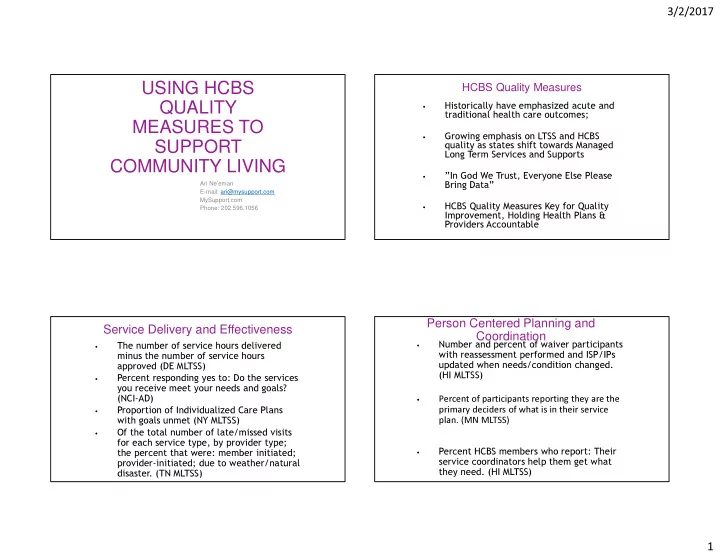
HCBS Quality Measures

  • Historically have emphasized acute and

traditional health care outcomes;

  • Growing emphasis on LTSS and HCBS

quality as states shift towards Managed Long Term Services and Supports

  • ”In God We Trust, Everyone Else Please

Bring Data”

  • HCBS Quality Measures Key for Quality

Improvement, Holding Health Plans & Providers Accountable

Service Delivery and Effectiveness

  • The number of service hours delivered

minus the number of service hours approved (DE MLTSS)

  • Percent responding yes to: Do the services

you receive meet your needs and goals? (NCI-AD)

  • Proportion of Individualized Care Plans

with goals unmet (NY MLTSS)

  • Of the total number of late/missed visits

for each service type, by provider type; the percent that were: member initiated; provider-initiated; due to weather/natural

  • disaster. (TN MLTSS)

Person Centered Planning and Coordination

  • Number and percent of waiver participants

with reassessment performed and ISP/IPs updated when needs/condition changed. (HI MLTSS)

  • Percent of participants reporting they are the

primary deciders of what is in their service

  • plan. (MN MLTSS)
  • Percent HCBS members who report: Their

service coordinators help them get what they need. (HI MLTSS)

slide-2
SLIDE 2

3/2/2017 2 Choice and Control

  • Percent responding yes to: Can you see

your friends when you want to? (NCI-ACS)

  • Percent of HCBS members who report:

making choices about everyday lives, including: housing, roommates, daily routines, case manager, support staff or providers, and social activities. (HI MLTSS)

  • Percent of MLTSS members opting to use

self-direction. (NJ, SC MLTSS, others)

Self-Directing PWD Across the US

Source: National Resource Center on Participant Directed Services

Self-Direction Across the US

Source: National Resource Center on Participant Directed Services

Community Inclusion

  • Proportion of individuals in sheltered

workshops who transition to integrated community based employment. (NY MLTSS)

  • Percent HCBS members who report: They

have adequate transportation when they want to go somewhere. (HI MLTSS)

  • Proportion of individuals who have an

integrated job in the community. (NY MLTSS)

slide-3
SLIDE 3

3/2/2017 3 Caregiver Support

  • Percent responding no to: During the past

12 months, has your overall health suffered because of your caregiving responsibilities? (GSS-CRR)

  • Percent responding yes to: Before [person]

left the hospital or was discharged, did you receive clear instructions about any medical/nursing tasks you would need to perform for [person]? (CGUS)

  • Percent responding yes to: In the last year,

have you used any service that took care

  • f [person] so that you could take some

time away from helping? (NSOC)

Workforce

  • Percent of members reporting that the

people who help with personal care always treat them with courtesy and respect. (WI MLTSS)

  • Proportion of direct support professionals

that meet competencies. (NY MLTSS)

  • Percent responding no to: Is it difficult for

you to find attendant providers for your care? (EAZI)

  • Percent responding yes to: My worker is

sensitive and responsive to customs and traditions of my culture or background. (MAHCSS)

Human and Legal Rights

  • Percent of critical incidents reported to

the state within 30 days, including corrective actions taken. (MLTSS Multiple States)

  • Critical Incident reporting: per 1000

enrollees total and by population (HCBS and Institutional). (DE MLTSS)

  • Percent of member records reviewed in

which HCBS were denied, reduced, suspended, or terminated as evidenced in the Plan of Care and consequently, the member was informed of and afforded the right to request a Fair Hearing. (TN MLTSS)

Human and Legal Rights

  • Percent responding yes to: At the service

planning meeting, did you know what was being talked about? (NCI-ACS)

  • Percent responding yes to: Are you able to

be alone at home with visitors if you want to? (NCI-ACS)

  • Percent responding yes to: Is the person

provided with the support needed to exercise his or her rights? (POMs)

slide-4
SLIDE 4

3/2/2017 4 Equity

  • Percent of recipients using each service,

compared by eligibility group. (MN MLTSS)

  • Community health service utilization data

for Enrollees, including number of units and units per 1,000 enrollees, by age group and gender (MA MLTSS)

  • Percent of authorized units paid over time

by eligibility group. (MN MLTSS)

  • Percent responding “true” to: I am treated
  • equally. (PART-E)

Holistic Health and Functioning

  • Percent reporting that they feel lonely,

sad, or depressed “not often,” “almost never,” or “never.” (NCI-AD)

  • Participants in the Demonstration who

remained stable or improved in ADL functioning between previous assessment and most recent assessment. (NY , AZ MLTSS & others)

  • Percent of HCBS members who were re-

admitted to the hospital within 30 days of last hospitalization (NJ, NY MLTSS)

Systems Performance and Accountability

  • Percent of individuals who are receiving

HCBS versus institutional services. (DE MLTSS, others)

  • Percent of HCBS members transitioning

from the community to the NF for a stay

  • f greater than 180 days (NJ MLTSS)
  • Members transitioned into the community

are transitioned into a home and setting of their choice that is fully accessible on day

  • f transition (RI MLTSS)
  • Overall average cost per recipient of long-

term care services by eligibility group, lead agency, and demographic group. (MN MLTSS)

Consumer Leadership in System Development

  • Documentation in the form of stakeholder

meeting agendas and meeting minutes that demonstrate the MCO response to significant concerns raised by stakeholder group participants. (MN MLTSS)

  • Often reflected in initial MLTSS application

process with CMS, insufficiently tracked on an ongoing basis.

slide-5
SLIDE 5

3/2/2017 5

Clear Quality Measures Spark Innovation

CONFIDENTIAL Hi! I’m Ari. Thank you for taking a look at my profile and considering me as a candidate to be your support worker. Over past 10 years, I have worked with seniors and individuals with disabilities to ensure that they have every

  • pportunity possible to lead an active and fulfilling life. I believe that my

clients are the experts in their own experience, and I recognize that disability is a natural part of life. I work to treat my clients with the same kind of dignity and respect that I would expect if/when I receive support worker services

  • myself. I am very friendly, fluent in Spanish, and love animals! I am happy to

provide references from previous clients. 1 8

WORKER PROFILE

MY PROFILE MY VALUES MY AVAILABILITY

Workers can describe themselves and everything they are capable of through a comprehensive profile

Philadelphia, PA 19101

O T SL P

CONFIDENTIAL 1 9 CONFIDENTIAL

We help match people seeking support and workers through questions that determine what’s important to them

Doing what the person they are supporting tells them Making sure the person they are supporting is safe Helping the person they are supporting to be all they can be

Workers Similar to Jason

MATCH QUESTIONS

CONFIDENTIAL 2

Filter and search using location proximity, availability times, gender, age, language, last login time and many other advanced filters

19101

POWERFUL SEARCH

8.9 miles, Philadelphia, PA 19101 0.9 miles, Philadelphia, PA 19101 0.9 miles, Philadelphia, PA 19101
slide-6
SLIDE 6

3/2/2017 6

CONFIDENTIAL 2 1

Analytics Dashboard

View client and worker activity on a robust and powerful analytics dashboard that allows any graph or table to be exported into Excel

MySupport

  • Vendorized by the Golden Gate Regional

Center

  • Has approximately 300 people with

disabilities and 600+ worker users in the Greater Bay Area

  • Currently active in California and Iowa
  • Preparing for Launch in Maryland, Virginia,

Delaware and New York

What’s Next in HCBS Quality Measurement?

  • General Quality Improvement
  • Managed Long Term Services and Supports
  • Pay for Performance Reimbursement

Models Emerging in Employment and Residential Services

  • Provider-Level Risk Models (i.e: PACE for

under 50s)

Questions?