using GPUs Presenter Dr.Hammad Omer Assistant Professor Group - - PowerPoint PPT Presentation

using gpus
SMART_READER_LITE
LIVE PREVIEW

using GPUs Presenter Dr.Hammad Omer Assistant Professor Group - - PowerPoint PPT Presentation

2019 Accelerating Magnetic Resonance Imaging (MRI) using GPUs Presenter Dr.Hammad Omer Assistant Professor Group Lead: Medical Image Processing Research Group (MIPRG) (www.miprg.com) COMSATS University Islamabad (Pakistan) Thursday, March


slide-1
SLIDE 1

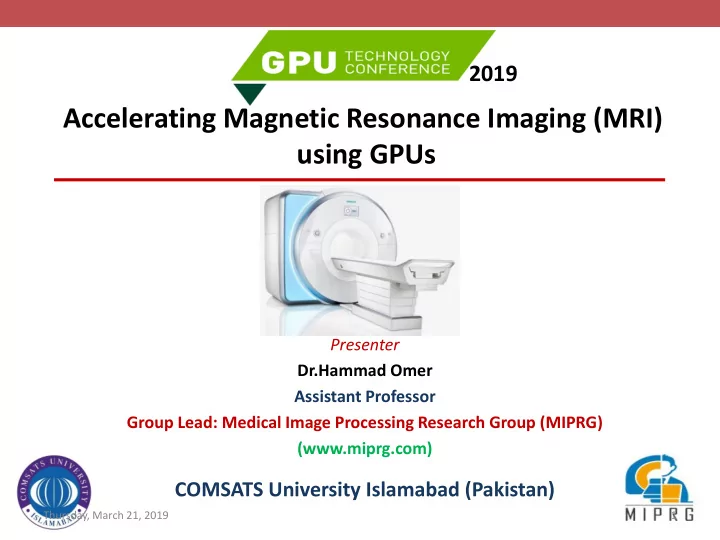
Accelerating Magnetic Resonance Imaging (MRI) using GPUs

Presenter Dr.Hammad Omer Assistant Professor Group Lead: Medical Image Processing Research Group (MIPRG) (www.miprg.com)

COMSATS University Islamabad (Pakistan)

2019

Thursday, March 21, 2019 1

slide-2
SLIDE 2

Thursday, March 21, 2019

Outline

►Overview of Magnetic Resonance Imaging (MRI)

►GPU based Advance MR Image Reconstruction

  • GPU based GRAPPA Reconstruction using CUDA
  • GPU based SENSE Reconstruction using CUDA
  • GPU based Gridding using CUDA

►Magnetic Resonance Finger Printing (MRF)

  • GPU based MRF using CUDA

►Acknowledgements

2

slide-3
SLIDE 3

Thursday, March 21, 2019

What is MRI ?

Outline

► MIPRG at Glance

► Overview ► What is MRI?

► MRI Hardware ► How MRI works? ► MR Image Formation ► Limitations in conventional MRI ► Parallel MRI ► Magnetic Resonance Finger printing ► Acknowledgements

  • Safe and painless diagnostic procedure
  • Excellent soft tissue contrast
  • No need to change the position of the

patient

  • Non-invasive
  • Diagnoses & monitors treatments such as
  • Heart problems
  • Blockage or enlargement of blood

vessels

  • Lungs
  • Diseases of the liver such as cirrhosis
  • Tumors and other cancer related

abnormalities

Human head (sagittal axis) Human head (Coronal axis)

3

slide-4
SLIDE 4

Thursday, March 21, 2019

Outline

MRI Hardware

  • Magnets
  • Permanent Magnets
  • Resistive Magnets
  • Super Conducting Magnets
  • RF Coils
  • Surface coils
  • Body coils
  • Head coils
  • Gradient Coils
  • Induce non-linear change

in the magnetic field

MAGNETOM Skyra 3T (Siemens)

► MIPRG at Glance

► Overview

► What is MRI?

► MRI Hardware

► How MRI works? ► MR Image Formation ► Limitations in conventional MRI ► Parallel MRI ► Magnetic Resonance Finger printing ► Acknowledgements 4

slide-5
SLIDE 5

Thursday, March 21, 2019

Outline

How MRI works

RF - TX RF-RX Magnetic Filed NMR Signal Fourier Transform Image

► MIPRG at Glance

► Overview

► What is MRI? ► MRI Hardware

► How MRI works?

► MR Image Formation ► Limitations in conventional MRI ► Parallel MRI ► Magnetic Resonance Finger printing ► Acknowledgements 5

slide-6
SLIDE 6

Thursday, March 21, 2019

Outline

k-Space Basic Gradient-Echo Pulse Sequence

  • 𝒍𝒚

+𝒍𝐲 +𝒍𝒛

  • 𝒍𝐳

MR Image Formation

  • MRI Pulse Sequence and Data Acquisition

𝒍𝒛 = Phase encoding Direction 𝒍𝒚 = Frequency encoding Direction

► MIPRG at Glance

► Overview

► What is MRI? ► MRI Hardware ► How MRI works?

► MR Image Formation

► Limitations in conventional MRI ► Parallel MRI ► Magnetic Resonance Finger printing ► Acknowledgements 6

slide-7
SLIDE 7
  • 𝒍𝒚

+𝒍𝐲 +𝒍𝒛

  • 𝒍𝐳

Outline

k-Space Basic Gradient-Echo Pulse Sequence Thursday, March 21, 2019

MR Image Formation

  • MRI Pulse Sequence and Data Acquisition

𝒍𝒛 = Phase encoding Direction 𝒍𝒚 = Frequency encoding Direction

► MIPRG at Glance

► Overview

► What is MRI? ► MRI Hardware ► How MRI works?

► MR Image Formation

► Limitations in conventional MRI ► Parallel MRI ► Magnetic Resonance Finger printing ► Acknowledgements 7

slide-8
SLIDE 8

Thursday, March 21, 2019

Outline

k-Space Basic Gradient-Echo Pulse Sequence

  • 𝒍𝒚

+𝒍𝐲 +𝒍𝒛

  • 𝒍𝐳

MR Image Formation

  • MRI Pulse Sequence and Data Acquisition

𝒍𝒛 = Phase encoding Direction 𝒍𝒚 = Frequency encoding Direction

► MIPRG at Glance

► Overview

► What is MRI? ► MRI Hardware ► How MRI works?

► MR Image Formation

► Limitations in conventional MRI ► Parallel MRI ► Magnetic Resonance Finger printing ► Acknowledgements 8

slide-9
SLIDE 9

Thursday, March 21, 2019

Outline

k-Space Basic Gradient-Echo Pulse Sequence

  • 𝒍𝒚

+𝒍𝐲 +𝒍𝒛

  • 𝒍𝐳

MR Image Formation

  • MRI Pulse Sequence and Data Acquisition

𝒍𝒛 = Phase encoding Direction 𝒍𝒚 = Frequency encoding Direction

► MIPRG at Glance

► Overview

► What is MRI? ► MRI Hardware ► How MRI works?

► MR Image Formation

► Limitations in conventional MRI ► Parallel MRI ► Magnetic Resonance Finger printing ► Acknowledgements 9

slide-10
SLIDE 10

Thursday, March 21, 2019

Outline

k-Space Basic Gradient-Echo Pulse Sequence

  • 𝒍𝒚

+𝒍𝐲 +𝒍𝒛

  • 𝒍𝐳

MR Image Formation

  • MRI Pulse Sequence and Data Acquisition

𝒍𝒛 = Phase encoding Direction 𝒍𝒚 = Frequency encoding Direction

► MIPRG at Glance

► Overview

► What is MRI? ► MRI Hardware ► How MRI works?

► MR Image Formation

► Limitations in conventional MRI ► Parallel MRI ► Magnetic Resonance Finger printing ► Acknowledgements 10

slide-11
SLIDE 11
  • 𝒍𝒚

+𝒍𝐲 +𝒍𝒛

  • 𝒍𝐳

Outline

k-Space Basic Gradient-Echo Pulse Sequence Thursday, March 21, 2019

MR Image Formation

  • MRI Pulse Sequence and Data Acquisition

𝒍𝒛 = Phase encoding Direction 𝒍𝒚 = Frequency encoding Direction

► MIPRG at Glance

► Overview

► What is MRI? ► MRI Hardware ► How MRI works?

► MR Image Formation

► Limitations in conventional MRI ► Parallel MRI ► Magnetic Resonance Finger printing ► Acknowledgements 11

slide-12
SLIDE 12

Thursday, March 21, 2019

Outline

k-Space Basic Gradient-Echo Pulse Sequence

  • 𝒍𝒚

+𝒍𝐲 +𝒍𝒛

  • 𝒍𝐳

MR Image Formation

  • MRI Pulse Sequence and Data Acquisition

𝒍𝒛 = Phase encoding Direction 𝒍𝒚 = Frequency encoding Direction

► MIPRG at Glance

► Overview

► What is MRI? ► MRI Hardware ► How MRI works?

► MR Image Formation

► Limitations in conventional MRI ► Parallel MRI ► Magnetic Resonance Finger printing ► Acknowledgements 12

slide-13
SLIDE 13

Thursday, March 21, 2019

Outline

k-Space Basic Gradient-Echo Pulse Sequence

  • 𝒍𝒚

+𝒍𝐲 +𝒍𝒛

  • 𝒍𝐳

MR Image Formation

  • MRI Pulse Sequence and Data Acquisition

𝒍𝒛 = Phase encoding Direction 𝒍𝒚 = Frequency encoding Direction

► MIPRG at Glance

► Overview

► What is MRI? ► MRI Hardware ► How MRI works?

► MR Image Formation

► Limitations in conventional MRI ► Parallel MRI ► Magnetic Resonance Finger printing ► Acknowledgements 13

slide-14
SLIDE 14

Thursday, March 21, 2019

Outline

MR Image Formation

  • MRI Pulse Sequence and Data Acquisition

k-Space Basic Gradient-Echo Pulse Sequence

  • 𝒍𝒚

+𝒍𝐲 +𝒍𝒛

  • 𝒍𝐳

𝒍𝒛 = Phase encoding Direction 𝒍𝒚 = Frequency encoding Direction

► MIPRG at Glance

► Overview

► What is MRI? ► MRI Hardware ► How MRI works?

► MR Image Formation

► Limitations in conventional MRI ► Parallel MRI ► Magnetic Resonance Finger printing ► Acknowledgements 14

slide-15
SLIDE 15

Thursday, March 21, 2019

Outline

MR Image Formation

  • MR Pulse Sequence and Data Acquisition

The Total acquisition time (𝑈

𝐵) (fully sampled k-space)

𝑼𝑩 = 𝑼𝑺 × 𝑶𝒛 Where, 𝑼𝑺 = Time required to collect a single line of k-space 𝑶𝒛 = Total number of PE lines that must be acquired

FFT ► MIPRG at Glance

► Overview

► What is MRI? ► MRI Hardware ► How MRI works?

► MR Image Formation

► Limitations in conventional MRI ► Parallel MRI ► Magnetic Resonance Finger printing ► Acknowledgements 15

slide-16
SLIDE 16

Thursday, March 21, 2019

Outline

MR Image Formation

  • Image Resolution and Contrast

∆𝑙𝑦 ∆𝑙𝑧 ∆𝑧 ∆𝑦 Fourier Transform

► MIPRG at Glance

► Overview

► What is MRI? ► MRI Hardware ► How MRI works?

► MR Image Formation

► Limitations in conventional MRI ► Parallel MRI ► Magnetic Resonance Finger printing ► Acknowledgements 16

slide-17
SLIDE 17

Friday, March 15, 2019 9

Outline

MR Image Formation

  • k-space sampling trajectories

Thursday, March 21, 2019 ► MIPRG at Glance

► Overview

► What is MRI? ► MRI Hardware ► How MRI works?

► MR Image Formation

► Limitations in conventional MRI ► Parallel MRI ► Magnetic Resonance Finger printing ► Acknowledgements 17

slide-18
SLIDE 18

Thursday, March 21, 2019

Outline

Limitations in Conventional MRI

  • Major Limitations
  • Scan duration of conventional MRI (30 to 40 mins)
  • Too expensive (typically £350-£500 per hour)
  • Long Breath hold (abdominal imaging)
  • Moving structures (e.g. heart)
  • Contrast changes( Flowing blood )

► MIPRG at Glance

► Overview

► What is MRI? ► MRI Hardware ► How MRI works? ► MR Image Formation

► Limitations in conventional MRI

► Parallel MRI ► Magnetic Resonance Finger printing ► Acknowledgements 18

slide-19
SLIDE 19

Thursday, March 21, 2019

Outline

Parallel MRI

  • Multichannel receiver coils
  • Reduce acquisition time
  • Advanced pMRI Techniques

(GRAPPA, SENSE etc.)

  • Key properties of pMRI techniques

1. Acceleration factors 2. Reconstruction accuracy 3. Reconstruction time

Parallel Imaging using multi-channel receiver coils Example of 4-channe receiver coil ► MPIRG at Glance ► Overview

► Parallel MRI

► Magnetic Resonance Finger printing ► Acknowledgements 19

slide-20
SLIDE 20

Thursday, March 21, 2019

Outline

Parallel MRI

Image based reconstruction k-space based reconstruction

► MPIRG at Glance ► Overview

► Parallel MRI

► Magnetic Resonance Finger printing ► Acknowledgements 20

slide-21
SLIDE 21

Thursday, March 21, 2019

Outline

Parallel MRI

Parallel MRI Cartesian pMRI non-Cartesian pMRI e.g. SENSE e.g. GRAPPA e.g. CG-SENSE e.g. Non-Cartesian GRAPPA Image based k-space based Image based k-space based

► MPIRG at Glance ► Overview

► Parallel MRI

► Magnetic Resonance Finger printing ► Acknowledgements 21

slide-22
SLIDE 22

Thursday, March 21, 2019

GRAPPA Reconstruction Method

Outline

► MPIRG at Glance ► Overview

► Parallel MRI ► GRAPPA

► GPU based GRAPPA ► SENSE ► GPU based SENSE ► Non-Cartesian pMRI methods ► GPU based Gridding ► Magnetic Resonance Finger printing ► Acknowledgements 22

slide-23
SLIDE 23

Thursday, March 21, 2019

Outline

  • k-space based pMRI
  • Inspired by VD-Auto-

SMASH technique

  • Siemen‘s Health Care
  • Abdominal and lung

imaging

  • Calibration Phase
  • Synthesis Phase

GRAPPA reconstruction process **M. A. Griswold, et al., "Generalized autocalibrating partially parallel acquisitions (GRAPPA),“ Magnetic Resonance in Medicine, vol. 47, pp. 1202-1210, 2002.

GRAPPA Reconstruction

► MPIRG at Glance ► Overview

► Parallel MRI ► GRAPPA

► GPU based GRAPPA ► SENSE ► GPU based SENSE ► Non-Cartesian pMRI methods ► GPU based Gridding ► Magnetic Resonance Finger printing ► Acknowledgements 23

slide-24
SLIDE 24

2 points along 𝑙𝑧 3 points along 𝑙𝑦 5 x 4 Kernel for 𝐵𝑔 = 3 Source Target 3 x 2 Kernel for 𝐵𝑔 = 2 4 points along 𝑙𝑧 5 points along 𝑙𝑦

Thursday, March 21, 2019

Outline

  • Calibrations Phase (GRAPPA)

GRAPPA Reconstruction

► MPIRG at Glance ► Overview

► Parallel MRI ► GRAPPA

► GPU based GRAPPA ► SENSE ► GPU based SENSE ► Non-Cartesian pMRI methods ► GPU based Gridding ► Magnetic Resonance Finger printing ► Acknowledgements 24

slide-25
SLIDE 25

Thursday, March 21, 2019

Outline

ACS 𝒖𝐧 𝒚𝒎 = 𝑻𝐧×𝒐 × 𝒙𝐨×𝒎

GRAPPA Reconstruction

  • Calibrations Phase (𝑶𝑫 =1 )

► MPIRG at Glance ► Overview

► Parallel MRI ► GRAPPA

► GPU based GRAPPA ► SENSE ► GPU based SENSE ► Non-Cartesian pMRI methods ► GPU based Gridding ► Magnetic Resonance Finger printing ► Acknowledgements 25

slide-26
SLIDE 26

Thursday, March 21, 2019

Outline

GRAPPA Reconstruction

  • Calibrations Phase (𝑶𝑫 =1 )

ACS 𝒖𝐧 𝒚𝒎 = 𝑻𝐧×𝒐 × 𝒙𝐨×𝒎

► MPIRG at Glance ► Overview

► Parallel MRI ► GRAPPA

► GPU based GRAPPA ► SENSE ► GPU based SENSE ► Non-Cartesian pMRI methods ► GPU based Gridding ► Magnetic Resonance Finger printing ► Acknowledgements 26

slide-27
SLIDE 27

Outline

ACS

GRAPPA Reconstruction

  • Calibrations Phase (𝑶𝑫 =1 )

𝒖𝐧 𝒚𝒎 = 𝑻𝐧×𝒐 × 𝒙𝐨×𝒎

► MPIRG at Glance ► Overview

► Parallel MRI ► GRAPPA

► GPU based GRAPPA ► SENSE ► GPU based SENSE ► Non-Cartesian pMRI methods ► GPU based Gridding ► Magnetic Resonance Finger printing ► Acknowledgements

Thursday, March 21, 2019

27

slide-28
SLIDE 28

Outline

ACS

GRAPPA Reconstruction

  • Calibrations Phase (𝑶𝑫 =1 )

𝒖𝐧 𝒚𝒎 = 𝑻𝐧×𝒐 × 𝒙𝐨×𝒎

► MPIRG at Glance ► Overview

► Parallel MRI ► GRAPPA

► GPU based GRAPPA ► SENSE ► GPU based SENSE ► Non-Cartesian pMRI methods ► GPU based Gridding ► Magnetic Resonance Finger printing ► Acknowledgements

Thursday, March 21, 2019

28

slide-29
SLIDE 29

Outline

ACS

GRAPPA Reconstruction

  • Calibrations Phase (𝑶𝑫 =1 )

𝒖𝐧 𝒚𝒎 = 𝑻𝐧×𝒐 × 𝒙𝐨×𝒎

► MPIRG at Glance ► Overview

► Parallel MRI ► GRAPPA

► GPU based GRAPPA ► SENSE ► GPU based SENSE ► Non-Cartesian pMRI methods ► GPU based Gridding ► Magnetic Resonance Finger printing ► Acknowledgements

Thursday, March 21, 2019

29

slide-30
SLIDE 30

Outline

GRAPPA Reconstruction

  • Calibrations Phase (𝑶𝑫 =1 )

ACS 𝒖𝐧 𝒚𝒎 = 𝑻𝐧×𝒐 × 𝒙𝐨×𝒎 𝒏 > 𝒐 𝒙𝒐×𝒎 = 𝑻𝐧×𝒐

𝑰𝑻𝐧×𝒐 −𝟐 𝑻𝐧×𝒐 𝑰𝒖𝐧 𝒚𝒎

𝒙𝒊𝒇𝒔𝒇, 𝒏 = 𝑶𝒒𝑶𝑮, 𝒐 = 𝒆𝒚𝒆𝒛𝑶𝒅 and 𝒎 = 𝑶𝑫 𝒃𝒈 − 𝟐

GRAPPA calibration equation GRAPPA weight Sets

► MPIRG at Glance ► Overview

► Parallel MRI ► GRAPPA

► GPU based GRAPPA ► SENSE ► GPU based SENSE ► Non-Cartesian pMRI methods ► GPU based Gridding ► Magnetic Resonance Finger printing ► Acknowledgements

Thursday, March 21, 2019

30

slide-31
SLIDE 31

Outline

GRAPPA Reconstruction

  • Synthesis Phase (𝑶𝑫 =1 )

𝒖𝐧 𝒚𝒎 = 𝑻𝐧×𝒐 × 𝒙𝐨×𝒎

► MPIRG at Glance ► Overview

► Parallel MRI ► GRAPPA

► GPU based GRAPPA ► SENSE ► GPU based SENSE ► Non-Cartesian pMRI methods ► GPU based Gridding ► Magnetic Resonance Finger printing ► Acknowledgements

Thursday, March 21, 2019

31

slide-32
SLIDE 32

Outline

GRAPPA Reconstruction

  • Synthesis Phase (𝑶𝑫 =1 )

𝒖𝐧 𝒚𝒎 = 𝑻𝐧×𝒐 × 𝒙𝐨×𝒎

► MPIRG at Glance ► Overview

► Parallel MRI ► GRAPPA

► GPU based GRAPPA ► SENSE ► GPU based SENSE ► Non-Cartesian pMRI methods ► GPU based Gridding ► Magnetic Resonance Finger printing ► Acknowledgements

Thursday, March 21, 2019

32

slide-33
SLIDE 33

Outline

GRAPPA Reconstruction

  • Synthesis Phase (𝑶𝑫 =1 )

𝒖𝐧 𝒚𝒎 = 𝑻𝐧×𝒐 × 𝒙𝐨×𝒎

► MPIRG at Glance ► Overview

► Parallel MRI ► GRAPPA

► GPU based GRAPPA ► SENSE ► GPU based SENSE ► Non-Cartesian pMRI methods ► GPU based Gridding ► Magnetic Resonance Finger printing ► Acknowledgements

Thursday, March 21, 2019

33

slide-34
SLIDE 34

Outline

GRAPPA Reconstruction

  • Synthesis Phase (𝑶𝑫 =1 )

𝒖𝐧 𝒚𝒎 = 𝑻𝐧×𝒐 × 𝒙𝐨×𝒎

► MPIRG at Glance ► Overview

► Parallel MRI ► GRAPPA

► GPU based GRAPPA ► SENSE ► GPU based SENSE ► Non-Cartesian pMRI methods ► GPU based Gridding ► Magnetic Resonance Finger printing ► Acknowledgements

Thursday, March 21, 2019

34

slide-35
SLIDE 35

Outline

GRAPPA Reconstruction

  • Synthesis Phase (𝑶𝑫 =1 )

𝒖𝐧 𝒚𝒎 = 𝑻𝐧×𝒐 × 𝒙𝐨×𝒎

► MPIRG at Glance ► Overview

► Parallel MRI ► GRAPPA

► GPU based GRAPPA ► SENSE ► GPU based SENSE ► Non-Cartesian pMRI methods ► GPU based Gridding ► Magnetic Resonance Finger printing ► Acknowledgements

Thursday, March 21, 2019

35

slide-36
SLIDE 36

Outline

GRAPPA Reconstruction

Practical gains in the performance of parallel imaging using GRAPPA are offset by the long image reconstruction time

  • Major Challenge
  • Keys Issues

i. Multiple sequential GRAPPA kernel fittings on the auto-calibration signals (ACS lines) ii. Estimation of GRAPPA weight sets Wnxl by finding least squares solution to a large over-determined system of linear equations ŵ = min

w

Sw − t

2

iii. Iterative sequential convolutional kernel fittings

► MPIRG at Glance ► Overview

► Parallel MRI ► GRAPPA

► GPU based GRAPPA ► SENSE ► GPU based SENSE ► Non-Cartesian pMRI methods ► GPU based Gridding ► Magnetic Resonance Finger printing ► Acknowledgements

Thursday, March 21, 2019

36

slide-37
SLIDE 37

Outline

GRAPPA Reconstruction

To meet the rising demands of fast image processing in real-time clinical applications

  • Objective
  • Keys features

Thursday, March 21, 2019

i. Parmeterizable (ACS lines,𝐵𝑔 , Kernel sizes) ii. Parallel fittings of GRAPPA kernel on ACS lines iii. Parallel estimations of the reconstruction coefficients; iv. Parallel interpolations in the under-sampled k-space

  • f receiver coils.

► MPIRG at Glance ► Overview

► Parallel MRI ► GRAPPA

► GPU based GRAPPA ► SENSE ► GPU based SENSE ► Non-Cartesian pMRI methods ► GPU based Gridding ► Magnetic Resonance Finger printing ► Acknowledgements 37

slide-38
SLIDE 38

Thursday, March 21, 2019

Outline

GPU based GRAPPA Reconstruction using CUDA

Proposed Architecture

► MPIRG at Glance ► Overview

► Parallel MRI

► GRAPPA

► GPU based GRAPPA

► SENSE ► GPU based SENSE ► Non-Cartesian pMRI methods ► GPU based Gridding ► Magnetic Resonance Finger printing ► Acknowledgements **‘Iterative Schemes to Solve Low-Dimensional Calibration Equations in Parallel MR Image Reconstruction with GRAPPA’ (Inam, Omair, Omer, H et al), BioMed research international, vol 2017 38

slide-39
SLIDE 39

Thursday, March 21, 2019

Outline

GPU based GRAPPA Reconstruction using CUDA

Optimized CUDA kernels

  • kernel_SRC_EXT
  • kernel_TARG_EXT
  • kernel_TRANS_MUL
  • kernel_MAT_INV
  • kernel_GET_SRC
  • kernel_CONV
  • Performs concurrent GRAPPA kernel fittings on

the ACS lines to collect the calibration data points in the source 𝑻𝐧×𝒐 and target 𝑼𝐧×𝒎 matrices

  • Estimation of GRAPPA weight sets (𝐗)

𝑿𝐨×𝒎 = 𝑻𝐧×𝒐

′𝑻𝐧×𝒐 −𝟐𝑻𝐧×𝒐 ′ × 𝑼𝐧×𝒎

  • Complex matrix Inversion
  • Parallelized Gauss Jordan algorithm
  • Complex matrix-matrix multiplications
  • Tile partitioning
  • Performs parallel kernel fittings to extract a new

set of source matrices 𝑻𝒐𝒇𝒙

  • Performs parallel convolutions for interpolation
  • f the under-sampled k-space data in each

receiver coil.

► MPIRG at Glance ► Overview

► Parallel MRI

► GRAPPA

► GPU based GRAPPA

► SENSE ► GPU based SENSE ► Non-Cartesian pMRI methods ► GPU based Gridding ► Magnetic Resonance Finger printing ► Acknowledgements 39

slide-40
SLIDE 40

GPU based GRAPPA Reconstruction using CUDA

METHODOLOGIES

In-vivo 8-channel human head dataset acquired on 1.5T scanner, St Mary’s Hospital London.

Outline

Thursday, March 21, 2019

► MPIRG at Glance ► Overview

► Parallel MRI

► GRAPPA

► GPU based GRAPPA

► SENSE ► GPU based SENSE ► Non-Cartesian pMRI methods ► GPU based Gridding ► Magnetic Resonance Finger printing ► Acknowledgements 40

slide-41
SLIDE 41

GPU based GRAPPA Reconstruction using CUDA

RESULTS

GRAPPA reconstruction time for 8-channel 1.5T in-vivo human head data using kernel size [2x3] and no of ACS lines=32

Outline

Thursday, March 21, 2019

GPU-enabled-GRAPPA (Proposed Method) CPU-based GRAPPA Speed up Processing time 𝒒 (𝒏𝒕) Memory Latency 𝒏 (𝒏𝒕) 𝝊𝒉𝒒𝒗 = 𝒒 + 𝒏 (𝒏𝒕) 𝝊𝒅𝒒𝒗 (𝒏𝒕) 𝝊𝒅𝒒𝒗 𝝊𝒉𝒒𝒗 Calibration 900 5 905 7955 9x Synthesis 100 20 120 1154 10x Total 1000 25 1025 9109 9x ► MPIRG at Glance ► Overview

► Parallel MRI

► GRAPPA

► GPU based GRAPPA

► SENSE ► GPU based SENSE ► Non-Cartesian pMRI methods ► GPU based Gridding ► Magnetic Resonance Finger printing ► Acknowledgements 41

slide-42
SLIDE 42

GPU based GRAPPA Reconstruction using CUDA

RESULTS

GRAPPA reconstruction time for 8-channel 1.5T in-vivo human head data using kernel size [4x7] and no of ACS lines=48

Outline

Thursday, March 21, 2019

GPU-enabled-GRAPPA (Proposed Method) CPU-based GRAPPA Speed up Processing time 𝒒 (𝒏𝒕) Memory Latency 𝒏 (𝒏𝒕) 𝝊𝒉𝒒𝒗 = 𝒒 + 𝒏 (𝒏𝒕) 𝝊𝒅𝒒𝒗 (𝒏𝒕) 𝝊𝒅𝒒𝒗 𝝊𝒉𝒒𝒗 Calibration 4756 34 4790 74922 16x Synthesis 160 50 210 2581 12x Total 4916 84 5000 77503 15x ► MPIRG at Glance ► Overview

► Parallel MRI

► GRAPPA

► GPU based GRAPPA

► SENSE ► GPU based SENSE ► Non-Cartesian pMRI methods ► GPU based Gridding ► Magnetic Resonance Finger printing ► Acknowledgements 42

slide-43
SLIDE 43

GPU based GRAPPA Reconstruction using CUDA

RESULTS

Outline

Thursday, March 21, 2019 GRAPPA reconstruction results (CPU vs GPU) of 8-channel 1.5T in-vivo human head using kernel size [2x3] and no of ACS lines=32. (Left) Image reconstructed using CPU-based-GRAPPA; (Right) Image reconstructed using GPU-enabled- GRAPPA

► MPIRG at Glance ► Overview

► Parallel MRI

► GRAPPA

► GPU based GRAPPA

► SENSE ► GPU based SENSE ► Non-Cartesian pMRI methods ► GPU based Gridding ► Magnetic Resonance Finger printing ► Acknowledgements 43

slide-44
SLIDE 44

GPU based GRAPPA Reconstruction using CUDA

CONCLUSION

Outline

Thursday, March 21, 2019

  • Proposed frame work is scalable to different GRAPPA parameter

settings

  • Significantly reduces the latency of the calibration and synthesis

phases, thereby resulting up to 15x speedup (8-channel 1.5T human head dataset)

  • Proposed method is a suitable choice to accelerate the GRAPPA

reconstruction process as the thread creation and memory transfer overheads are negligible (i.e. a memory latency is 0.017%

  • f the total reconstruction time)
  • Future: Cardiac MRI (32 channel receiver coil)

► MPIRG at Glance ► Overview

► Parallel MRI

► GRAPPA

► GPU based GRAPPA

► SENSE ► GPU based SENSE ► Non-Cartesian pMRI methods ► GPU based Gridding ► Magnetic Resonance Finger printing ► Acknowledgements 44

slide-45
SLIDE 45

Thursday, March 21, 2019

SENSE Reconstruction Method

Outline

► MPIRG at Glance ► Overview

► Parallel MRI

► GRAPPA ► GPU based GRAPPA

► SENSE

► GPU based SENSE ► Non-Cartesian pMRI methods ► GPU based Gridding ► Magnetic Resonance Finger printing ► Acknowledgements 45

slide-46
SLIDE 46

Thursday, March 21, 2019

Outline

  • Performs reconstruction in Image Space
  • Siemens (mSENSE)
  • GE (ASSET)
  • Philips (SENSE)
  • Hitachi (RAPID - "Rapid Acquisition through Parallel

Imaging Design")

  • Canon (SPEEDER)
  • Involves 4 steps

1. Sensitivity Maps Estimation 2. Acquired Partia k-Space 3. Reconstruct partial FOV images from each coil 4. Combined partial FOV images by matrix inversion

**Preussmann KP, Weiger M, Scheidegger MB, Boesiger P. 1999. SENSE: sensitivity

encoding for fast `MRI. Magn Reson Med 42:952–962

SENSE Reconstruction

► MPIRG at Glance ► Overview

► Parallel MRI

► GRAPPA ► GPU based GRAPPA

► SENSE

► GPU based SENSE ► Non-Cartesian pMRI methods ► GPU based Gridding ► Magnetic Resonance Finger printing ► Acknowledgements 46

slide-47
SLIDE 47

Thursday, March 21, 2019

Outline

  • Combining aliased images

SENSE Reconstruction

Coil Sensitivities

=

Accelerated Image (AF = 2) Four receiver Coils 𝑮𝑷𝑾𝑺𝒇𝒆 𝐽1 Fully Sampled Image 𝑮𝑷𝑾𝑮𝒗𝒎𝒎 𝝇1 𝝇1

×

𝑫1𝟐 𝑫1𝟑 𝐽2 𝐽3 𝐽4

𝑱

𝑫2𝟐 𝑫22 𝑫3𝟐 𝑫32 𝑫4𝟐 𝑫42

Ĉ 𝝇

𝑱𝟐 = 𝑫𝟐𝟐𝝇𝟐 + ∁𝟐𝟑𝝇𝟑 𝑱𝟑 = 𝑫𝟑𝟑𝝇𝟐 + ∁𝟑𝟑𝝇𝟑 𝑱𝟒 = 𝑫𝟒𝟐𝝇𝟐 + ∁𝟒𝟑𝝇𝟑 𝑱𝟓 = 𝑫𝟓𝟐𝝇𝟐 + ∁𝟓𝟑𝝇𝟑 ► MPIRG at Glance ► Overview

► Parallel MRI

► GRAPPA ► GPU based GRAPPA

► SENSE

► GPU based SENSE ► Non-Cartesian pMRI methods ► GPU based Gridding ► Magnetic Resonance Finger printing ► Acknowledgements 47

slide-48
SLIDE 48

Thursday, March 21, 2019

Outline

  • Inversion

SENSE Reconstruction

𝑱𝟐 = 𝑫𝟐𝟐𝝇𝟐 + ∁𝟐𝟑𝝇𝟑 𝑱𝟑 = 𝑫𝟑𝟑𝝇𝟐 + ∁𝟑𝟑𝝇𝟑 𝑱𝟒 = 𝑫𝟒𝟐𝝇𝟐 + ∁𝟒𝟑𝝇𝟑 𝑱𝟓 = 𝑫𝟓𝟐𝝇𝟐 + ∁𝟓𝟑𝝇𝟑 𝑱𝟐 𝑱𝟑 𝑱𝟒 𝑱𝟓 = 𝑫𝟐𝟐 𝑫𝟐𝟑 𝑫𝟑𝟐 𝑫𝟑𝟑 𝑫𝟒𝟐 𝑫𝟒𝟑 𝑫𝟓𝟐 𝑫𝟓𝟑 × 𝝇𝟐 𝝇𝟑 Encoding Matrix Aliased Image Matrix Unknown Image Matrix to be reconstructed Inverse of Rectangular Matrix

𝑱 = Ĉ × 𝝇 𝝇 = Ĉ-1 × 𝑱

  • Due to size of encoding matrix, direct inversion is computational expensive
  • Ĉ = 131072 × 65536 for Image size = 256 × 256 having AF =2 with 4

receiver coils

  • Encoding matrix is divided into smaller sub matrices
  • Inverse of each sub-matrix is sequentially computed
  • Generally those submatrices are rectangular matrices
  • Matrix decomposition methods are required to take inverse of rectangular

matrix instead of simple inverse techniques

► MPIRG at Glance ► Overview

► Parallel MRI

► GRAPPA ► GPU based GRAPPA

► SENSE

► GPU based SENSE ► Non-Cartesian pMRI methods ► GPU based Gridding ► Magnetic Resonance Finger printing ► Acknowledgements 48

slide-49
SLIDE 49

Thursday, March 21, 2019

Outline

SENSE Reconstruction

Inversion of the rectangular encoding matrix is the most computationally expensive task in SENSE algorithm

  • Major Challenge
  • Keys Issues

A fast (with optimal computational complexity) and stable algorithm is required to perform the inversion of the encoding matrix in SENSE reconstruction

► MPIRG at Glance ► Overview

► Parallel MRI

► GRAPPA ► GPU based GRAPPA

► SENSE

► GPU based SENSE ► Non-Cartesian pMRI methods ► GPU based Gridding ► Magnetic Resonance Finger printing ► Acknowledgements 49

slide-50
SLIDE 50

Outline

SENSE Reconstruction

To meet the rising demands of fast image processing in real-time clinical applications

  • Objective
  • Keys features

Thursday, March 21, 2019

i. Parametrizable (image sizes, Af) ii. Parallel matrix inversions using QR-decomposition

► MPIRG at Glance ► Overview

► Parallel MRI

► GRAPPA ► GPU based GRAPPA

► SENSE

► GPU based SENSE ► Non-Cartesian pMRI methods ► GPU based Gridding ► Magnetic Resonance Finger printing ► Acknowledgements 50

slide-51
SLIDE 51

Thursday, March 21, 2019

Outline

GPU based SENSE using CUDA

Proposed Architecture

► MPIRG at Glance ► Overview

► Parallel MRI

► GRAPPA ► GPU based GRAPPA ► SENSE

► GPU based SENSE

► Non-Cartesian pMRI methods ► GPU based Gridding ► Magnetic Resonance Finger printing ► Acknowledgements ** ‘QR-decomposition based SENSE reconstruction using parallel architecture’ (Ullah, Irfan, Omer, H et al), In Computers in biology and medicine, Elsevier, volume 95, 2018. 51

slide-52
SLIDE 52

Thursday, March 21, 2019

Outline

► MPIRG at Glance ► Overview

► Parallel MRI

► GRAPPA ► GPU based GRAPPA ► SENSE

► GPU based SENSE

► Non-Cartesian pMRI methods ► GPU based Gridding ► Magnetic Resonance Finger printing ► Acknowledgements

GPU based SENSE Reconstruction using CUDA

Proposed Architecture

52

slide-53
SLIDE 53

Thursday, March 21, 2019

Outline

► MPIRG at Glance ► Overview

► Parallel MRI

► GRAPPA ► GPU based GRAPPA ► SENSE

► GPU based SENSE

► Non-Cartesian pMRI methods ► GPU based Gridding ► Magnetic Resonance Finger printing ► Acknowledgements

GPU based SENSE Reconstruction using CUDA

Proposed Architecture

53

slide-54
SLIDE 54
  • In-vivo
  • St. Mary’s Hospital London, UK
  • University Hospitals of Cleveland, Case Western Reserve University (CWRU),

USA

Outline

Thursday, March 21, 2019

Data Receiver coils Scanner AFs Image size Slice thickness Phantom dataset 8 1.5 T GE scanner 2,3,4 256 x 256 3mm Human head dataset 8 1.5 T GE scanner 2,3,4 256 x 256 3mm Human head dataset 12 3T. Siemens Skyra scanner 2,4,6 448 x 224 5mm Cardiac dataset (11 frames) 30 3T. Siemens Skyra scanner 5,8,12 512 x 252 8mm ► MPIRG at Glance ► Overview

► Parallel MRI

► GRAPPA ► GPU based GRAPPA ► SENSE

► GPU based SENSE

► Non-Cartesian pMRI methods ► GPU based Gridding ► Magnetic Resonance Finger printing ► Acknowledgements

GPU based SENSE Reconstruction using CUDA

Proposed Architecture

54

slide-55
SLIDE 55

Reconstructed Images of Phantom, receiver coil = 8, Af = 2 and 4

Outline

Thursday, March 21, 2019

(a) (b) (c) AF = 2 AF= 4 Difference image between the reconstructed image and the reference image at AF = 4 (d) CPU Reconstructed Images (e) GPU Reconstructed images Reference Image ► MPIRG at Glance ► Overview

► Parallel MRI

► GRAPPA ► GPU based GRAPPA ► SENSE

► GPU based SENSE

► Non-Cartesian pMRI methods ► GPU based Gridding ► Magnetic Resonance Finger printing ► Acknowledgements

GPU based SENSE Reconstruction using CUDA

Proposed Architecture

55

slide-56
SLIDE 56

Visual Result for in Vivo human head dataset, Receiver coils = 12, AF = 2,4 and 6

Outline

Thursday, March 21, 2019

► MPIRG at Glance ► Overview

► Parallel MRI

► GRAPPA ► GPU based GRAPPA ► SENSE

► GPU based SENSE

► Non-Cartesian pMRI methods ► GPU based Gridding ► Magnetic Resonance Finger printing ► Acknowledgements

GPU based SENSE Reconstruction using CUDA

Proposed Architecture

56

slide-57
SLIDE 57

Outline

Thursday, March 21, 2019 Visual Result for 30 channel Cardiac Dataset, AF = 5, 11 Frames

► MPIRG at Glance ► Overview

► Parallel MRI

► GRAPPA ► GPU based GRAPPA ► SENSE

► GPU based SENSE

► Non-Cartesian pMRI methods ► GPU based Gridding ► Magnetic Resonance Finger printing ► Acknowledgements

GPU based SENSE Reconstruction using CUDA

Proposed Architecture

57

slide-58
SLIDE 58

GPU based GRAPPA Reconstruction using CUDA

RESULTS

Outline

Thursday, March 21, 2019

Dataset Type and Dimension AF Reconstruction Time GPU (ms) Total Time GPU (ms) Artifact Power Data Latency Time GPU processing time Memory Allocation 𝑬𝑼𝐃→𝑯 𝑬𝑼𝐇→𝑫 Phantom Dataset 256X256 2 0.12 1.517 0.8 4.76 7.2 𝟐. 𝟓𝟏𝟖𝟕 × 𝟐𝟏−𝟔 3 0.13 1.55 0.8 9.523 12 𝟖. 𝟕𝟘𝟔𝟗 × 𝟐𝟏−𝟔 4 0.126 1.49 0.8 15.685 18.1 𝟑. 𝟗𝟐𝟓𝟕 × 𝟐𝟏−𝟓 In-Vivo Human Head Dataset 256X256 (8 coils) 2 0.12 1.517 0.8 5.023 7.46 𝟑. 𝟐𝟐𝟒𝟑 × 𝟐𝟏−𝟔 3 0.13 1.55 0.8 9.7 12.18 𝟔. 𝟒𝟗𝟐 × 𝟐𝟏−𝟔 4 0.14 1.49 0.8 15.96 18.39 𝟐. 𝟔𝟐𝟕 × 𝟐𝟏−𝟓 In-Vivo Human Head Dataset 448X224 (12 coils) 2 0.16 7.5 1.2 8.73 17.59 𝟘. 𝟏𝟖𝟒𝟐 × 𝟐𝟏−𝟓 4 0.18 7.4 1.2 21.38 30.16 𝟑. 𝟐 × 𝟐𝟏−𝟒 6 0.20 7.49 1.2 52.2 61.09 𝟒. 𝟓𝟐 × 𝟐𝟏−𝟑 Cardiac Dataset 512X252 (30 coils) 11 frames 5 0.24 20.2 1.7 92.41 114.55 𝟒. 𝟗 × 𝟐𝟏−𝟒 8 0.24 20.4 1.7 205.39 227.73 𝟒. 𝟑𝟔 × 𝟐𝟏−𝟑 12 0.27 20.6 1.7 441.26 463.83 𝟐. 𝟕𝟑𝟒 × 𝟐𝟏−𝟐 ► MPIRG at Glance ► Overview

► Parallel MRI

► GRAPPA ► GPU based GRAPPA ► SENSE

► GPU based SENSE

► Non-Cartesian pMRI methods ► GPU based Gridding ► Magnetic Resonance Finger printing ► Acknowledgements 58

slide-59
SLIDE 59

Outline

Thursday, March 21, 2019

246 207 190 80 75 68 7.46 12.18 18.39

50 100 150 200 250

2 3 4

Time (ms) Acceleration Factor Human Head Data 256x256 (8 coils)

S Core 8 Core GPU 938 1430 1953 232 363 535 17.59 30.16 61.09

200 400 600 800 1000 1200 1400 1600 1800 2000

2 4 6

Time (ms) Acceleration Factor Human Head Data 448x224 (12 coils)

S Core 8 Core GPU 5290 7765 11062 1420 2032 2837 114.55 227.73 463.83

2000 4000 6000 8000 10000 12000

5 8 12

Time (ms) Acceleration Factor

Cardiac Data 512x252 (30 coils and 11 frames) S Core 8 Core GPU

► MPIRG at Glance ► Overview

► Parallel MRI

► GRAPPA ► GPU based GRAPPA ► SENSE

► GPU based SENSE

► Non-Cartesian pMRI methods ► GPU based Gridding ► Magnetic Resonance Finger printing ► Acknowledgements

GPU based SENSE Reconstruction using CUDA

RESULTS

59

slide-60
SLIDE 60

Outline

Thursday, March 21, 2019

► MPIRG at Glance ► Overview

► Parallel MRI

► GRAPPA ► GPU based GRAPPA ► SENSE

► GPU based SENSE

► Non-Cartesian pMRI methods ► GPU based Gridding ► Magnetic Resonance Finger printing ► Acknowledgements

GPU based SENSE Reconstruction using CUDA

CONCLUSION

  • QR-decomposition is proposed for the rectangular encoding matrix

inversion in SENSE reconstruction.

  • The inherent parallelism of the proposed method is exploited by

implementing it on a parallel platform(GPU) to further reduce the reconstruction time

  • The proposed method is fully parametrizable

60

slide-61
SLIDE 61

Thursday, March 21, 2019

Non-Cartesian Parallel Imaging

Outline

► MPIRG at Glance ► Overview

► Parallel MRI

► GRAPPA ► GPU based GRAPPA ► SENSE ► GPU based SENSE

► Non-Cartesian pMRI methods

► GPU based Gridding ► Magnetic Resonance Finger printing ► Acknowledgements 61

slide-62
SLIDE 62

Outline

Thursday, March 21, 2019

  • Gridding
  • NUFFT
  • GROG
  • SC-GROG

Non-Cartesian Parallel MRI

  • Reconstruction Methods
  • Radial GRAPPA
  • Spiral GRAPPA
  • Pseudo Cartesian GRAPPA
  • CG-SENSE

Scanner Data k-space trajectory

  • Radial
  • Spiral
  • Rosette
  • PROPELLER

GRIDDING Reconstruction Frame Work FFT Reconstruction Method ► MPIRG at Glance ► Overview

► Parallel MRI

► GRAPPA ► GPU based GRAPPA ► SENSE ► GPU based SENSE

► Non-Cartesian pMRI methods

► GPU based Gridding ► Magnetic Resonance Finger printing ► Acknowledgements 62

slide-63
SLIDE 63

Outline

Thursday, March 21, 2019

Non-Cartesian Parallel MRI

  • Self Calibration GRAPPA Operator Gridding
  • Extended version of GROG
  • Uses the properties of GRAPPA operator
  • Shifts each non-Cartesian sample in a k-space by smaller

intervals (δx and δy) in kx and ky directions

  • Does not require additional data acquisition
  • Works in two stages:

1) Self-Calibration 2) Gridding

s kx + δx, ky + δy = Gx

δx ∙ Gy δy ∙ s kx, ky

GROG weights are applied to shift non-Cartesian data points in a k-space by smaller intervals in 𝐥𝐲 and 𝐥𝐳 directions.

► MPIRG at Glance ► Overview

► Parallel MRI

► GRAPPA ► GPU based GRAPPA ► SENSE ► GPU based SENSE

► Non-Cartesian pMRI methods

► GPU based Gridding ► Magnetic Resonance Finger printing ► Acknowledgements **‘Self‐calibrating GRAPPA operator gridding for radial and spiral trajectories’ N Seiberlich, F Breuer, M Blaimer, P Jakob, M Griswold, Magnetic Resonance in Medicine, Vol 59, 2008 63

slide-64
SLIDE 64

Outline

Thursday, March 21, 2019

Non-Cartesian Parallel MRI

  • Self Calibration GRAPPA Operator

Gridding

  • Conventional SC-GROG

Step 1 : Calculate all the possible combinations of 2D gridding weight sets for smaller shifts (Gx

δx, Gy δy)

Step 2: Sequential Mapping s kx + δx, ky + δy = Gxy(δx, δy) ∙ s kx, ky, kz Step 3: Sequential Averaging

► MPIRG at Glance ► Overview

► Parallel MRI

► GRAPPA ► GPU based GRAPPA ► SENSE ► GPU based SENSE

► Non-Cartesian pMRI methods

► GPU based Gridding ► Magnetic Resonance Finger printing ► Acknowledgements 64

slide-65
SLIDE 65

Thursday, March 21, 2019

Outline

Accelerating non-Cartesian parallel Imaging using GPU based SC-GROG

  • Objective
  • Keys Features

i. Parametrizable (Radial projections, coils and image size) ii. Implementation of LUTs to update and store 2D gridding weight sets in parallel iii. Parallel access to LUTs for concurrent shifting of the non- Cartesian samples to their nearest Cartesian grid locations (to avoid race condition) iv. The total number of points shifted at the same Cartesian location are averaged in parallel

GPU based SC-GROG using CUDA

► MPIRG at Glance ► Overview

► Parallel MRI

► GRAPPA ► GPU based GRAPPA ► SENSE ► GPU based SENSE ► Non-Cartesian pMRI methods

► GPU based Gridding

► Magnetic Resonance Finger printing ► Acknowledgements 65

slide-66
SLIDE 66

Thursday, March 21, 2019

Outline

PROPOSED ARCHITECTURE

  • Self-Calibration

(CPU)

  • Gridding (GPU)

1) kernel_ws 2) kernel_map 3) kernel_avg

  • Employs look-up-

tables (LUTs) to avoid race conditions

GPU based SC-GROG using CUDA

► MPIRG at Glance ► Overview

► Parallel MRI

► GRAPPA ► GPU based GRAPPA ► SENSE ► GPU based SENSE ► Non-Cartesian pMRI methods

► GPU based Gridding

► Magnetic Resonance Finger printing ► Acknowledgements 66 **‘GPU-accelerated self-calibrating GRAPPA operator gridding for rapid reconstruction

  • f

non-cartesian MRI data’ (Inam, Omair, Omer, H et al), Applied Magnetic Resonance, Springer, volume 48, 2017

slide-67
SLIDE 67

Thursday, March 21, 2019

Outline

MEHODOLOGIES

GPU based SC-GROG using CUDA

  • Radial Data sets (In-vivo)
  • St. Mary’s Hospital London, UK
  • University Hospitals of Cleveland, Case Western Reserve University

(CWRU), USA

  • Phantom
  • Standard Shepp-Logan phantom (simulated 24-channel, with 64 to 400

projections, 256 readout points

  • Simulation Platforms
  • CPU: Intel(R) Core(TM) i5-3210M @ 2.50GHz, 2501MHz, Memory 4GB
  • NVIDIA GeForce GTX 780 (876 MHz, 2880 shared cores, 3GB Memory)

Data Channels Scanner Projections Read out points Cardiac data sets 30 3T (GE) 144 256 Human head data 12 3T (Siemens Skyra) 256 256 ► MPIRG at Glance ► Overview

► Parallel MRI

► GRAPPA ► GPU based GRAPPA ► SENSE ► GPU based SENSE ► Non-Cartesian pMRI methods

► GPU based Gridding

► Magnetic Resonance Finger printing ► Acknowledgements 67

slide-68
SLIDE 68

Thursday, March 21, 2019

Outline

METHODOLOGIES

GPU based SC-GROG using CUDA

Simulated Shepp-Logan phantom with different no of radial projections ranging from 64 to 400

Self-Calibration and Gridding process as % of total computation time

► MPIRG at Glance ► Overview

► Parallel MRI

► GRAPPA ► GPU based GRAPPA ► SENSE ► GPU based SENSE ► Non-Cartesian pMRI methods

► GPU based Gridding

► Magnetic Resonance Finger printing ► Acknowledgements 68

slide-69
SLIDE 69

Thursday, March 21, 2019

Outline

RESULTS

GPU based SC-GROG using CUDA

Performance comparison between GPU-based gridding and CPU-based gridding

► MPIRG at Glance ► Overview

► Parallel MRI

► GRAPPA ► GPU based GRAPPA ► SENSE ► GPU based SENSE ► Non-Cartesian pMRI methods

► GPU based Gridding

► Magnetic Resonance Finger printing ► Acknowledgements 69

slide-70
SLIDE 70

Thursday, March 21, 2019

Outline

RESULTS

GPU based SC-GROG using CUDA

Overall speedup gain in the total computation time of SC-GROG

► MPIRG at Glance ► Overview

► Parallel MRI

► GRAPPA ► GPU based GRAPPA ► SENSE ► GPU based SENSE ► Non-Cartesian pMRI methods

► GPU based Gridding

► Magnetic Resonance Finger printing ► Acknowledgements 70

slide-71
SLIDE 71

Thursday, March 21, 2019

Outline

RESULTS

GPU based SC-GROG using CUDA

Comparison between the GPU-based SC-GROG and CPU-based SC-GROG reconstruction results

► MPIRG at Glance ► Overview

► Parallel MRI

► GRAPPA ► GPU based GRAPPA ► SENSE ► GPU based SENSE ► Non-Cartesian pMRI methods

► GPU based Gridding

► Magnetic Resonance Finger printing ► Acknowledgements 71

slide-72
SLIDE 72

Thursday, March 21, 2019

Outline

RESULTS

GPU based SC-GROG using CUDA

Comparison of the center line profiles of the reconstructed images between the GPU- based SC-GROG and CPU-based SC-GROG

► MPIRG at Glance ► Overview

► Parallel MRI

► GRAPPA ► GPU based GRAPPA ► SENSE ► GPU based SENSE ► Non-Cartesian pMRI methods

► GPU based Gridding

► Magnetic Resonance Finger printing ► Acknowledgements 72

slide-73
SLIDE 73

Thursday, March 21, 2019

Outline

RESULTS

GPU based SC-GROG using CUDA

Speedup gains in the gridding operation Overall speedup in SC-GROG

► MPIRG at Glance ► Overview

► Parallel MRI

► GRAPPA ► GPU based GRAPPA ► SENSE ► GPU based SENSE ► Non-Cartesian pMRI methods

► GPU based Gridding

► Magnetic Resonance Finger printing ► Acknowledgements 73

slide-74
SLIDE 74

Thursday, March 21, 2019

Outline

RESULTS

GPU based SC-GROG using CUDA

12-channel human head data set with 256 projections and base matrix 256x256

► MPIRG at Glance ► Overview

► Parallel MRI

► GRAPPA ► GPU based GRAPPA ► SENSE ► GPU based SENSE ► Non-Cartesian pMRI methods

► GPU based Gridding

► Magnetic Resonance Finger printing ► Acknowledgements 74

slide-75
SLIDE 75

Thursday, March 21, 2019

Outline

RESULTS

GPU based SC-GROG using CUDA

Speedup gains in the gridding operation Overall speedup in SC-GROG

► MPIRG at Glance ► Overview

► Parallel MRI

► GRAPPA ► GPU based GRAPPA ► SENSE ► GPU based SENSE ► Non-Cartesian pMRI methods

► GPU based Gridding

► Magnetic Resonance Finger printing ► Acknowledgements 75

slide-76
SLIDE 76

Thursday, March 21, 2019

Outline

RESULTS

GPU based SC-GROG using CUDA

30-channel cardiac data with 144 projections, 25 frames and base matrix 128x128

► MPIRG at Glance ► Overview

► Parallel MRI

► GRAPPA ► GPU based GRAPPA ► SENSE ► GPU based SENSE ► Non-Cartesian pMRI methods

► GPU based Gridding

► Magnetic Resonance Finger printing ► Acknowledgements 76

slide-77
SLIDE 77

Outline

Thursday, March 21, 2019

  • Proposed frame work is scalable to different gridding parameters

and can be used with many non-Cartesian parallel MRI methods e.g. CG-SENSE, radial GRAPPA, Pseudo Cartesian GRAPPA etc.

  • Parameterizable
  • Employs look-up-table (LUT) based kernels of CUDA to accelerate

SC-GROG gridding operations

  • Avoids race condition
  • GPU-based SC-GROG can accelerate the data gridding process by

factors ranging from 12 to 30

  • Reduces the overall computation time of SC-GROG by factors

ranging from 6 to 7 without compromising the quality of the reconstructed images

GPU based SC-GROG using CUDA

CONCLUSION

► MPIRG at Glance ► Overview

► Parallel MRI

► GRAPPA ► GPU based GRAPPA ► SENSE ► GPU based SENSE ► Non-Cartesian pMRI methods

► GPU based Gridding

► Magnetic Resonance Finger printing ► Acknowledgements 77

slide-78
SLIDE 78

Thursday, March 21, 2019

Magnetic Resonance Fingerprinting

Outline

► MPIRG at Glance ► Overview ► Parallel MRI

► Magnetic Resonance Finger printing

► Acknowledgements 78 **‘Magnetic resonance fingerprinting’ D Ma, V Gulani, N Seiberlich, K Liu, JL Sunshine, JL Duerk, MA Griswold Nature 495 (7440), 187

slide-79
SLIDE 79

Thursday, March 21, 2019

Outline

Magnetic Resonance Fingerprinting (MRF)

Randomized Acquisition Pattern Recognition Information

► MPIRG at Glance ► Overview ► Parallel MRI

► Magnetic Resonance Finger printing

► Acknowledgements 79

slide-80
SLIDE 80

Thursday, March 21, 2019

Outline

Magnetic Resonance Fingerprinting (MRF)

Name Cell# Address DOB

► MPIRG at Glance ► Overview ► Parallel MRI

► Magnetic Resonance Finger printing

► Acknowledgements 80

slide-81
SLIDE 81

Thursday, March 21, 2019

Outline

Magnetic Resonance Fingerprinting (MRF)

  • MRF is a novel approach that consists of:
  • Data

Acquisition, Post Processing and Visualization

  • Revolutionizing MR Imaging
  • Provides quantitative maps
  • Local changes in T1 and T2 have been measured in

diseases (Table )

Neurological Psychological Genetic Alzheimer’s Parkinson’s Multiple sclerosis Epilepsy Autism Schizophrenia Cancer Table Diseases known to have caused local changes in T1 and T2 relaxation times

► MPIRG at Glance ► Overview ► Parallel MRI

► Magnetic Resonance Finger printing

► Acknowledgements 81

slide-82
SLIDE 82

Thursday, March 21, 2019

Outline

The execution of MRF algorithms requires a considerable amount of computation time. Therefore, main limitation

  • f

MRF in clinical realization is the computation complexity.

  • Major Challenge
  • Keys Issues

MRF quantitatively examines many magnetic resonance tissue parameters simultaneously by sequentially processing the data majorly due to the limitation of the data processing hardware(limited number

  • f

computational cores in CPU)

Magnetic Resonance Fingerprinting (MRF)

► MPIRG at Glance ► Overview ► Parallel MRI

► Magnetic Resonance Finger printing

► Acknowledgements 82

slide-83
SLIDE 83

Outline

  • Objective
  • Keys features

Thursday, March 21, 2019

i. Parametrizable (MRF dictionary size) ii. MRF algorithm is accelerated without any functional modifications in the native MRF algorithm iii. MRF algorithm is accelerated without reducing data to be processed in the native MRF algorithm

Magnetic Resonance Fingerprinting (MRF)

► MPIRG at Glance ► Overview ► Parallel MRI

► Magnetic Resonance Finger printing

► Acknowledgements

To reduce the computation complexity of MRF algorithms that is an important step toward the clinically realization

  • f the MRF technology

83 **Magnetic Resonance Fingerprinting (MRF) implementation on Graphical Processing Unit (GPU) for exploiting inherent parallelism (I. Ullah, Seiberlich, M. Griswold, H. Omer et al), 33rd Annual Scientific Meeting of ESMRMB 2016, 2016, Vienna, Austria, 2016

slide-84
SLIDE 84

Thursday, March 21, 2019

Outline

MRF Magnetic Resonance Fingerprinting (MRF) ON CPU

MRF Pattern Matching Algorithm MRF Dictionary Algorithm ► MPIRG at Glance ► Overview ► Parallel MRI

► Magnetic Resonance Finger printing

► Acknowledgements 84

slide-85
SLIDE 85

Thursday, March 21, 2019

Outline

GPU based MRF Magnetic Resonance Fingerprinting (MRF) using CUDA

PROPOSED PARALLEL FRAME WORK FOR DICTIONARY ALGORITHM

► MPIRG at Glance ► Overview ► Parallel MRI

► Magnetic Resonance Finger printing ► GPU based MRF

► Acknowledgements 85

slide-86
SLIDE 86

Thursday, March 21, 2019

Outline

GPU based MRF Magnetic Resonance Fingerprinting (MRF) using CUDA

PROPOSED PARALLEL FRAME WORK FOR PATTERN MATCHING

► MPIRG at Glance ► Overview ► Parallel MRI

► Magnetic Resonance Finger printing ► GPU based MRF

► Acknowledgements 86

slide-87
SLIDE 87
  • In-vivo
  • Variable density spiral sampling Brain dataset from Case Western Reserve

University, USA

  • CPU
  • Intel Core i7 – 4510U @ 2.16 GHz with 8Gb RAM
  • NIVIDIA GPUs
  • Tesla k40C, GTX 780, GTX 560, GT 630m

Outline

Thursday, March 21, 2019 Data Coils Scanner Image size Human head dataset 32 1.5T Espree, Siemen Healthcare Scanner 192x192

GPU based MRF Magnetic Resonance Fingerprinting (MRF) using CUDA

RESULTS

► MPIRG at Glance ► Overview ► Parallel MRI

► Magnetic Resonance Finger printing ► GPU based MRF

► Acknowledgements 87

slide-88
SLIDE 88

GPU based MRF Magnetic Resonance Fingerprinting (MRF) using CUDA

RESULTS

Outline

Thursday, March 21, 2019 MRF Dictionary NVIDIA GT 630m NVIDIA GTX 560 NVIDIA GTX 780 NVIDIA Tesla k40c Computational Time(seconds) 602.25 491.53 226 210 MRF Pattern Matching Algorithm NVIDIA GT 630m NVIDIA GTX 560 NVIDIA GTX 780 NVIDIA Tesla k40c Computational Time(seconds) 715.115 164.656 54.186 50 MRF Algorithm 4th Gen Core-i7 NVIDIA Tesla k40C Speed-up using parallel framework for MRF MATLAB C++ Data Processing time w.r.t MATLAB w.r.t C++ Computation Time 348 mins 90 mins 4.5 mins 69.6 x 18x

► MPIRG at Glance ► Overview ► Parallel MRI

► Magnetic Resonance Finger printing ► GPU based MRF

► Acknowledgements 88

slide-89
SLIDE 89

GPU based MRF Magnetic Resonance Fingerprinting (MRF) using CUDA

Outline

Thursday, March 21, 2019

► MPIRG at Glance ► Overview ► Parallel MRI

► Magnetic Resonance Finger printing ► GPU based MRF

► Acknowledgements Figure 4. Intensity Maps constructed using the conventional MRF algorithms (MATLAB)

Reference Images (Matlab)

Figure 5. Intensity Maps constructed using our C++ implementation

Reconstructed Images (C++)

Figure 6. Intensity Maps constructed using our MRF Integrated CUDA Application

Reconstructed Images (CUDA)

Figure 7. Difference between reference maps and maps reconstructed using CUDA application

Difference Images

89

slide-90
SLIDE 90

GPU based MRF Magnetic Resonance Fingerprinting (MRF) using CUDA

CONCLUSION

Outline

Thursday, March 21, 2019

  • Accelerated image reconstruction without any compromise on the

quality of image

  • MRF algorithm is accelerated without any functional modifications
  • r reducing data to be processed in the native MRF algorithm
  • Proposed parallel framework has the potential to process MRF

algorithm in clinical feasible Computation time

► MPIRG at Glance ► Overview ► Parallel MRI

► Magnetic Resonance Finger printing ► GPU based MRF

► Acknowledgements 90

slide-91
SLIDE 91

Acknowledgements

  • Do

Donated 6 state-of

  • f-art

t GPUs for

  • r MIPRG lab

ab

  • Tesla K40c (1)
  • 2880 cores
  • GDDR5 memory
  • 12 GB
  • Bus width 384 bit
  • GTX 780 ti (5)
  • 2880 cores
  • GDDR5 memory
  • 4 GB
  • Bus width 384 bit

91

slide-92
SLIDE 92

Publications

Journal Publications

1. Wavelet-based de-noising algorithm for images acquired with parallel magnetic resonance imaging (MRI) (Delakis, Ioannis, Hammad, Omer and Kitney, Richard I), In Physics in Medicine & Biology, IOP Publishing, volume 52, 2007. 2. A graphical generalized implementation of SENSE reconstruction using Matlab (Omer, Hammad and Dickinson, Robert), In Concepts in Magnetic Resonance Part A, Wiley Online Library, volume 36, 2010 3. Regularization in parallel MR image reconstruction (Omer, Hammad and Dickinson, Robert), In Concepts in Magnetic Resonance Part A, Wiley Online Library, volume 38, 2011 4. Phased array coil for implementing parallel MRI in intravascular imaging: A feasibility study (Omer, Hammad, Dickinson, Robert J and Awan, Shakil A), In Concepts in Magnetic Resonance Part A, Wiley Online Library, volume 43, 2014 5. modified POCS-based reconstruction method for compressively sampled MR imaging (Shah, Jawad, Qureshi, Ijaz, Omer, Hammad and Khaliq, Amir), In International Journal of Imaging Systems and Technology, Wiley Online Library, volume 24, 2014 6. Regularization-based SENSE reconstruction and choice of regularization parameter (Omer, Hammad, Qureshi, Mahmood and Dickinson, Robert J), In Concepts in Magnetic Resonance Part A, Wiley Online Library, volume 44, 2015 7. Compressively Sampled MRI Recovery Using Modified Iterative-Reweighted Least Square Method (Haider, Hassaan, Shah, Jawad Ali, Qureshi, Ijaz Mansoor, Omer, Hammad and Kadir, Kushsairy), In Applied Magnetic Resonance, Springer, volume 47, 2016 8. Sensitivity Maps Estimation Using Eigenvalues in Sense Reconstruction (Irfan, Amna Shafa, Nisar, Ayisha, Shahzad, Hassan and Omer, Hammad), In Applied Magnetic Resonance, Springer, volume 47, 2016 9. An Adaptive Algorithm for Compressively Sampled MR Image Reconstruction Using Projections onto lp-Ball (Kaleem, Muhammad, Qureshi, Mahmood and Omer, Hammad), In Applied Magnetic Resonance, Springer, volume 47, 2016 10. Compressively Sampled MR Image Reconstruction Using POCS with g-Factor as Regularization Parameter (Kaleem, Muhammad, Qureshi, Mahmood and Omer, Hammad), In Applied Magnetic Resonance, Springer, volume 47, 2016 11. Image reconstruction using compressed sensing for individual and collective coil methods (Qureshi, Mahmood, Junaid, Muhammad, Najam, Asadullah, Bashir, Daniyal, Ullah, Irfan, Kaleem, Muhammad and Omer, Hammad), In Biomedical Research, Allied Academies, 2016 12. A Matlab-Based Advance MR Image Reconstruction Package with Interactive Graphical User Interface (Shahid, Ali Raza, Ahmed, Zaki, Raza, Abbas, Tariq, Yasir, Abbasi, Muddassar and Omer, Hammad), In Applied Magnetic Resonance, Springer, volume 47, 2016. 13. Parallel MRI reconstruction algorithm implementation on GPU (Shahzad, H, Sadaqat, MF, Hassan, B, Abbasi, W and Omer, H), In Applied Magnetic Resonance, Springer, volume 47, 2016. 14. GPU-accelerated self-calibrating GRAPPA operator gridding for rapid reconstruction of non-cartesian MRI data (Inam, Omair, Qureshi, Mahmood, Malik, Shahzad A and Omer, Hammad), In Applied Magnetic Resonance, Springer, volume 48, 2017 15. Iterative Schemes to Solve Low-Dimensional Calibration Equations in Parallel MR Image Reconstruction with GRAPPA (Inam, Omair, Qureshi, Mahmood, Malik, Shahzad A and Omer, Hammad), In BioMed research international, Hindawi, volume 2017, 2017 16. Line Profile Measure as a Stopping Criterion in CG-SENSE Algorithm (Khan, Mahwish, Aslam, Taquwa, Shahzad, Hassan and Omer, Hammad), In Applied Magnetic Resonance, Springer, volume 48, 2017 17. Singular Value Decomposition Using Jacobi Algorithm in pMRI and CS (Qazi, Sohaib A, Saeed, Abeera, Nasir, Saima and Omer, Hammad), In Applied Magnetic Resonance, Springer, volume 48, 2017 18. Journey through k-space: an interactive educational tool (Qureshi, Mahmood, Kaleem, Muhammad and Omer, Hammad), In Biomedical Research, Biomedical Research, 2017 19. FPGA implementation of real-time SENSE reconstruction using pre-scan and Emaps sensitivities (Siddiqui, Muhammad Faisal, Reza, Ahmed Wasif, Shafique, Abubakr, Omer, Hammad and Kanesan, Jeevan), In Magnetic resonance imaging, Elsevier, volume 44, 2017 20. Accelerating MRI Using GROG Gridding Followed by ESPIRiT for Non-Cartesian Trajectories (Aslam, Ibtisam, Najeeb, Faisal and Omer, Hammad), In Applied Magnetic Resonance, Springer, volume 49, 2018 21. Compressively sampled MR image reconstruction using generalized thresholding iterative algorithm (Elahi, Sana, Omer, Hammad and others), In Journal of Magnetic Resonance, Elsevier, volume 286, 2018 22. Optimizing Image Reconstruction in SENSE Using GPU (Qazi, Sohaib A, Nasir, Saima, Saeed, Abeera and Omer, Hammad), In Applied Magnetic Resonance, Springer, volume 49, 2018 23. Accelerating Parallel Magnetic Resonance Imaging using p-thresholding based Compressed-Sensing (Ullah, Irfan, Inam, Omair, Aslam, Ibtisam and Omer, Hammad), In Applied Magnetic Resonance, Springer, 2018 24. QR-decomposition based SENSE reconstruction using parallel architecture (Ullah, Irfan, Nisar, Habab, Raza, Haseeb, Qasim, Malik, Inam, Omair and Omer, Hammad), In Computers in biology and medicine, Elsevier, volume 95, 2018

Conference Publications 74 international conference papers (Full Details on : www.miprg.com) 92
slide-93
SLIDE 93

MIP IPRG Team

slide-94
SLIDE 94

Questions?

Thursday, March 21, 2019

94

slide-95
SLIDE 95

Thursday, March 21, 2019

Outline

OPTIMIZED CUDA KERNELS

  • 2D weight sets for each shift are calculated in parallel
  • LUTs (wxsetLUT and ywsetLUT) are updated in parallel to store

all the 2D gridding weight sets

GPU based SC-GROG using CUDA

► MPIRG at Glance ► Overview

► Parallel MRI

► GRAPPA ► GPU based GRAPPA ► SENSE ► GPU based SENSE ► Non-Cartesian pMRI methods

► GPU based Gridding

► Magnetic Resonance Finger printing ► Acknowledgements 95

slide-96
SLIDE 96

Thursday, March 21, 2019

Outline

OPTIMIZED CUDA KERNELS

GPU based SC-GROG using CUDA

► MPIRG at Glance ► Overview

► Parallel MRI

► GRAPPA ► GPU based GRAPPA ► SENSE ► GPU based SENSE ► Non-Cartesian pMRI methods

► GPU based Gridding

► Magnetic Resonance Finger printing ► Acknowledgements 96

slide-97
SLIDE 97

Thursday, March 21, 2019

Outline

OPTIMIZED CUDA KERNELS

GPU based SC-GROG using CUDA

► MPIRG at Glance ► Overview

► Parallel MRI

► GRAPPA ► GPU based GRAPPA ► SENSE ► GPU based SENSE ► Non-Cartesian pMRI methods

► GPU based Gridding

► Magnetic Resonance Finger printing ► Acknowledgements 97