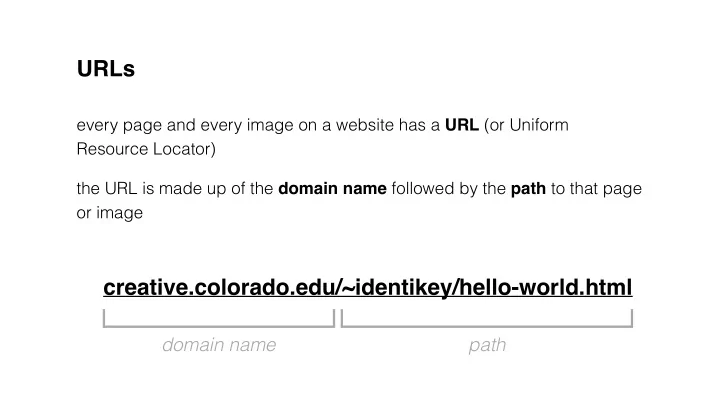
SLIDE 1 domain name path
URLs
every page and every image on a website has a URL (or Uniform Resource Locator) the URL is made up of the domain name followed by the path to that page
creative.colorado.edu/~identikey/hello-world.html
SLIDE 2 site structure & navigation
- every page and every image on a website has a URL
- every website is built inside directories on a web server
- each web page is a separate file on that web server (ends in .html or .js)
- sometimes when you go to a URL, there is no file listed in the URL
For example, we type: colorado.edu instead of colorado.edu/index.html
SLIDE 3
index.html
this is default HTML file that appears in a browser when a user invokes a URL, it is the main homepage of a site for usability and security purposes, it is a best practice to have an index.html page in every directory
SLIDE 4
creative server without an index page
SLIDE 5
examplesite index.html images logo.png movies cinema index.html listings.html reviews.html dvd index.html reviews.html music index.html listings.html reviews.html theater index.html listings.html reviews.html
subdirectory root
SLIDE 6 examplesite index.html images logo.png movies cinema index.html listings.html reviews.html dvd index.html reviews.html music index.html listings.html reviews.html theater index.html listings.html reviews.html
parent
the examplesite folder is a parent of the music folder
child
the music folder is a child
grandparent
the examplesite folder is a grandparent of the dvd folder
grandchild
the dvd folder is a grandchild of the examplesite folder
SLIDE 7
writing links
links are created using the <a> element users can click on anything between the opening <a> tag and the closing </a> tag you specify which page you want to link to using the href attribute
SLIDE 8
absolute links
hyperlink containing a full URL, which includes all the information needed to find a particular site, page or document or other addressable item on the Internet. <a href="http://www.colorado.edu/">Colorado.edu</a>
SLIDE 9
relative links
used when linking to pages within your own website. they provide a shorthand way of telling the browser where to find your files. if you are linking to a page within your own site, it is best to use relative links rather than qualified URLS. <a href="music/listings.html">Listings</a>
SLIDE 10
relative links
to move IN a directory, use a backslash “ / ” notation and the directory name:
movies/cinema/listings.html
to move OUT a directory, use the following notation: . . /
../../index.html