
SLIDE 1
Unit 6 Time Synergies and Adaptive Architecture Nicosia 2017 - - PowerPoint PPT Presentation
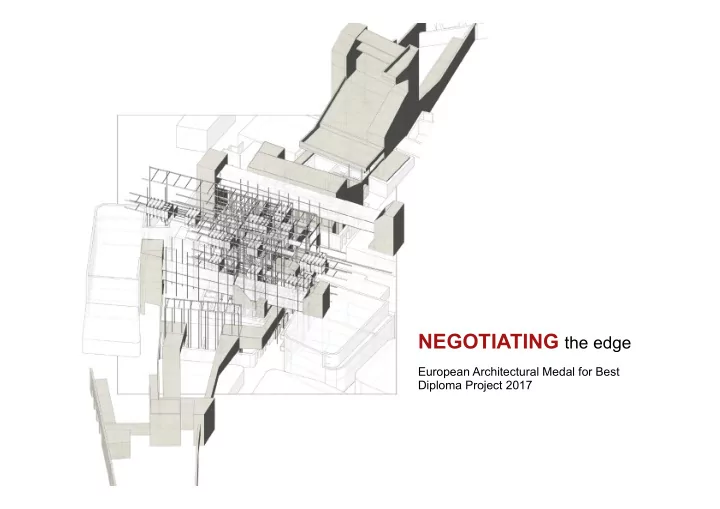
NEGOTIATING the edge European Architectural Medal for Best Diploma Project 2017 Unit 6 Time Synergies and Adaptive Architecture Nicosia 2017 Buffer zone penetrating the walled city Relationship between the edge of the buffer zone and the
based on the time development of the politics. The edge is continuously changing based on the relation of the two communities.
Forty, A. (2013). Words and buildings. London: Thames & Hudson.
Scenario 1: Re-unification of the two sides and abolishment of the buffer zone Scenario 2: Division continues but the relation of the two communities is calming down allowing the urban environment to intervene the buffer zone Scenario 3: The conflict between the two communities is becoming stronger making the United Nations to push the edge
environment]
Depending the conditions of the politics the authority of transforming the buffer zone changes: Scenario 1 – authority to the user group A Scenario 2 – a negotiation between the user groups A + B Scenario 3 – authority to the user group B
Hill, J. (2003). Actions of Architecture. London: Routledge.
Credits: Student: Andreas Prokopiou Tutors: Maria Hadjisoteriou Angela Petrou Yiorgos Hadjichristou Markella Menikou University of Nicosia 2017