Understanding Sports related Head Injuries and Concussions Anthony - - PDF document

understanding sports related head injuries and concussions
SMART_READER_LITE
LIVE PREVIEW

Understanding Sports related Head Injuries and Concussions Anthony - - PDF document

7/23/2015 Understanding Sports related Head Injuries and Concussions Anthony Luke MD, MPH Credit: Carlin Senter, MD and Elise Hammond, ATC UCSF Department of Orthopaedics Bay Area Concussion and Brain Injury Program at UCSF A collaboration


slide-1
SLIDE 1

7/23/2015 1

Understanding Sports‐related Head Injuries and Concussions

Anthony Luke MD, MPH Credit: Carlin Senter, MD and Elise Hammond, ATC UCSF Department of Orthopaedics
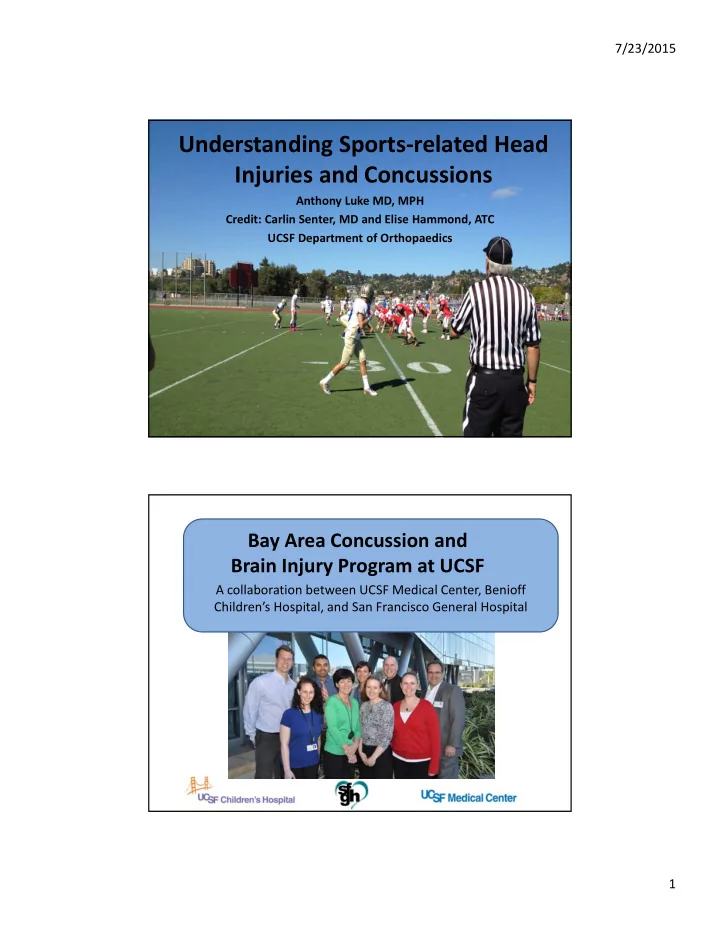
Bay Area Concussion and Brain Injury Program at UCSF

A collaboration between UCSF Medical Center, Benioff Children’s Hospital, and San Francisco General Hospital

slide-2
SLIDE 2

7/23/2015 2

Concussions are common Concussions are common

slide-3
SLIDE 3

7/23/2015 3

Concussion Numbers Increasing

Marin JR et al. Trends in visits for traumatic brain injury to emergency departments in the United States. JAMA. 2014 May 14;311(18):1917‐9.

We Miss Concussions

slide-4
SLIDE 4

7/23/2015 4

Objectives:

  • 1. Use the return to learn protocol.
  • 2. Use the return to play protocol.
  • 3. Discuss tough ?s with patients
  • 1. Preventive gear?
  • 2. How many concussions is too many?
  • 3. What are the long term consequences of

concussion?

Concussion Definition

  • Type of mild traumatic brain injury
  • Blow to head, neck, body  force to head.
  • Neurologic impairment within 48 hours of trauma.
  • Symptoms usually resolve in 1‐2 weeks

spontaneously but in some cases can be prolonged.

  • May or may not include loss of consciousness.
slide-5
SLIDE 5

7/23/2015 5

Physical Cognitive Emotional Sleep

Concussion Symptoms

http://www.cdc.gov/ncipc/tbi/Facts_for_Physicians_booklet.pdf. Accessed Nov. 9, 2008.

Pathophysiology: Acute neurometabolic cascade

Force to brain Ion fluxes; vasocon‐ striction Need glucose but less blood flow

Energy crisis

Giza CC and Hovda DA, J of Athletic Training, 2001. Vespa et al, J Cerebral Blood Flow and Metabolism, 2005.

slide-6
SLIDE 6

7/23/2015 6

Concussion clinic evaluation: symptom checklist

SYMPTOMS

s/p 6d Headache

5

“Pressure in Head”

3

Neck Pain Nausea / Vomiting Dizziness

2

Blurred Vision Balance Problems

2

Sensitivity to Light

2

Sensitivity to Noise

1

Feeling Slowed Down

3

Feeling like “in a Fog”

SYMPTOMS

s/p 6d “Don’t Feel Right”

5

Difficulty Concentrating

3

Difficulty Remembering

3

Fatigue / Low Energy

2

Confusion Drowsiness

2

Trouble Falling Asleep More Emotional Irritability

2

Sadness Nervous / Anxious TOTAL

35

Concussion evaluation: physical exam

  • Normal neck exam
  • Normal neurologic exam
slide-7
SLIDE 7

7/23/2015 7

Consensus statement on concussion in sport: the 4th International Conference on Concussion in Sport held in Zurich, November 2012. Br J Sports Med. 2013 Apr;47(5):250‐8 Consensus statement on concussion in sport: the 4th International Conference on Concussion in Sport held in Zurich, November 2012. Br J Sports Med. 2013 Apr;47(5):250‐8

slide-8
SLIDE 8

7/23/2015 8

Concussion Treatment

  • Cognitive rest
  • Physical rest
  • Medication

– Tylenol – Ibuprofen after first 72 hours

  • No driving
  • No Etoh

Case 1

17 y/o high school lacrosse player presents to your office with a concussion. He is a senior and his last high school game is in 4 weeks. He has no history of concussion, depression, or anxiety.

slide-9
SLIDE 9

7/23/2015 9

What is the likelihood that he will be back to play in his last game?

  • A. High: 90% of sports concussion patients are

better within 3 weeks of injury.

  • B. Moderate: 65% of sports concussion patients

are better within 3 weeks of injury.

  • C. Low: 25% of sports concussion patients are

better within 3 weeks of injury.

  • D. Zero: sports concussion patients should rest

from contact for at least 4 weeks post injury.

How Severe is my Concussion?

  • Concussion grading is retrospective

– Historically concussions were graded on the sideline based on amnesia and LOC at time of injury.

– American Academy of Neurology, 1997 – Cantu, 2001

– Studies have shown these factors not to be predictive

  • f recovery.
  • Only when the athlete recovers can you tell how

severe the concussion was

slide-10
SLIDE 10

7/23/2015 10

Symptom Resolution after Sport Concussion

  • 50% recovered and returned to play in 1 week;

90% in 3 weeks (Collins et al. Neurosurgery, 2006.)

  • 7‐10 days avg. symptom resolution.

(3rd International Conference on Concussion in Sport (2008). Clin J Sport Med, 2009.)

  • High schoolers take longer to recover based on

neuropsychological testing compared to college

  • athletes. (Field et al, J Pediatr, 2003.)

Case 2

16 y/o high school student presents to your

  • ffice with concussion sustained 3 days ago

during football. He reports headache, fogginess, and dizziness that is mild to moderate intensity at home but moderately severe at school. He is resting from sports.

slide-11
SLIDE 11

7/23/2015 11

What do you recommend he do with respect to school?

  • A. Continue school without adjustments.
  • B. Continue school but no test‐taking.
  • C. Attend ½ days of school for a week, no test‐

taking.

  • D. Rest from school until can tolerate 1‐2 hours
  • f work at home.
  • E. Rest completely from school for a week.

Return to Learn Progression

No school. OK to do light reading, little bit TV, drawing, cooking as long as doesn’t worsen symptoms. 15 min cognitive activity at a time. Return to full day of school.

http://www.chop.edu/service/concussion-care- for-kids/returning-to-school.html

30 min schoolwork at a time until can do 1‐2 hours. Return to ½ day of school.

slide-12
SLIDE 12

7/23/2015 12

UCSF concussion clinic school note Case 3

16 y/o high school student presents to your

  • ffice Monday morning with concussion

sustained playing soccer 3 days ago (Friday). She initially had headache, dizziness, and fogginess, but those symptoms resolved yesterday. She is now asymptomatic with a normal neurologic

  • exam. She has no deficits on balance testing.

She has no deficits on memory testing.

slide-13
SLIDE 13

7/23/2015 13

  • A. Today (Monday)
  • B. Tomorrow (Tuesday)
  • C. In 2 days (Thursday)
  • D. 1 week post injury (Saturday)
  • E. 2 weeks post injury

Assuming she remains asymptomatic, when would you clear her to return to full contact soccer games?

Concussion Legislation

  • 50 states have adopted youth concussion laws
  • California: education code 49475 (effective 1/2012)
  • 1. Athletes and guardians sign a concussion information

form yearly

  • 2. Athlete suspected of having concussion removed at

time of injury for the rest of the day

  • 3. Athlete can return only after cleared by healthcare

professional trained in evaluation and management of concussion

slide-14
SLIDE 14

7/23/2015 14

Concussion legislation

  • California Assembly Bill 2127 (in effect

1/2015)

– Adds to AB 25

  • FB full‐contact practice limits:

– No more than 2/week during preseason and season – These practices cannot exceed 90 minutes – No full‐contact in off‐season

  • Once clear must follow gradual return to play protocol
  • f at least 7 days under supervision of licensed

provider

Return to Play Progression

Light aerobic activity Sport specific activity Game play Non‐ contact training Full contact practice

Clinician clearance Asymptomatic

2nd International Conference on Concussion in Sport (2004). 2005 Br J Sport Med 39:196. Tuesday Thursday Wednesday Friday Saturday

slide-15
SLIDE 15

7/23/2015 15

Return to play activity examples

Step Objective Activities 1 Recovery No activity 2 Increase heart rate Walking, swimming, or stationary bike. < 70% max heart rate. No weights. 3 Add movement Skating drills in hockey, running drills in

  • soccer. No head impact activities.

4 Add coordination and cognitive load More complex drills (passing). Can start weights. 5 Restore confidence and assess functional skills by coaching staff Full‐contact practice 6 Normal game play Consensus statement on concussion in sport: the 4th International Conference on Concussion in Sport held in Zurich, November 2012. Br J Sports Med. 2013 Apr;47(5):250‐8

UCSF concussion clinic sports note

slide-16
SLIDE 16

7/23/2015 16

Case 3

The student athlete follows up with you as scheduled in the office on Thursday to consider full contact clearance for Friday. She did 1 hour

  • f high intensity non contact training earlier

Thursday afternoon. She felt good except for a very mild headache during the sprinting

  • workouts. The headache is now gone. Her

neurologic exam, balance testing, and memory testing is normal.

Return to Play Progression

Light aerobic activity Sport specific activity Game play Non‐ contact training Full contact practice

Clinician clearance Asymptomatic

2nd International Conference on Concussion in Sport (2004). 2005 Br J Sport Med 39:196. Tuesday Thursday Wednesday

slide-17
SLIDE 17

7/23/2015 17

What do you do next?

  • A. Clear her for full contact practice on Friday

followed by full contact game on Saturday.

  • B. Have her return to sport specific activity on

Friday, then do non contact training Saturday and see you next week to consider full clearance.

  • C. Recommend rest from sports over the weekend,

follow up with you next week.

  • D. Recommend rest from sports for one week,

follow up with you in 2 weeks.

Return to Play Progression

Light aerobic activity Sport specific activity Game play Non‐ contact training Full contact practice

Clinician clearance Asymptomatic

2nd International Conference on Concussion in Sport (2004). 2005 Br J Sport Med 39:196. Tuesday Thursday Wednesday

slide-18
SLIDE 18

7/23/2015 18

Symptoms during return to play

  • If symptomatic during a step of the return to

play protocol…

– Stop activity – Rest until symptoms resolve, at least 24 hours. – Resume return to play protocol at the step where athlete was last asymptomatic

Consensus statement on concussion in sport: the 4th International Conference on Concussion in Sport held in Zurich, November 2012. Br J Sports Med. 2013 Apr;47(5):250‐8

Case 4

30 y/o recreational rugby player comes to your

  • ffice with her 5th lifetime concussion. She

suffered this most recent injury when she took a relatively insignificant hit to the body during a

  • game. She immediately had headache,

photophobia, nausea and came out of play. Her 4th concussion led to headaches x 6 months and interfered with her ability to do her job. She recovered 3 months ago from that injury.

slide-19
SLIDE 19

7/23/2015 19

Should she retire from rugby?

  • A. Yes. An athlete with 3 concussions or more

should no longer play contact sports.

  • B. Yes. She likely has early onset dementia and

should stop playing contact sports.

  • C. Yes. She is showing a decreased threshold for

injury with increased severity of injury.

  • D. No. She can return as long as she wears a rugby

scrum cap for protection.

  • E. No. She can return as long as she plays a lower

risk position.

Is Concussion Really a “Mild” Traumatic Brain Injury?

http://www.bu.edu/cte/about/what‐is‐cte/

slide-20
SLIDE 20

7/23/2015 20

Chronic traumatic encephalopathy

  • Athletes and military personnel
  • Chronic, progressive depression, cognitive impairment,

aggression

  • Diagnosed at autopsy: tau protein deposition
  • Difficult to draw causality – no prospective data yet
  • Concerning association between professional sports

participation and long term neurologic/psychological problems

Gardner A et al. Chronic traumatic encephalopathy in sport: a systematic review. Br J Sports Med. 2013 Jun 26. Randolph C. Is chronic traumatic encephalopathy a real disease? Current Sports Med Review, 2014.

Prevention: Protective gear

Benson BW et al. What are the most effective risk‐reduction strategies in sport concussion? Br J Sports Med. 2013.

slide-21
SLIDE 21

7/23/2015 21

How Many Concussions is Too Many?

  • Individualized to athlete.
  • Concussion hx.

– Number. – Less force. – More frequent. – Increased severity of sxs – Increased duration of sxs. – Age: possibly more consequences if younger at time of concussion.

At the end of this workshop you will be able to:

  • 1. Use the return to learn protocol.
  • 2. Use the return to play protocol.
  • 3. Discuss tough ?s with patients
  • 1. Preventive gear?
  • 2. How many concussions is too many?
  • 3. What are the long term consequences of

concussion?

slide-22
SLIDE 22

7/23/2015 22

Keys to Managing Sports Concussion in 2015

  • Treatment is rest.
  • Gradual return to learn.
  • Gradual return to play.
  • Note for school and sports each visit.
  • Monitor for repeat injury.
  • No recommended protective gear
  • Association between concussion and dementia

(causality not proven)

  • Treat each case individually.

Thank You!

Credit: Carlin Senter, M.D. Carlin.Senter@ucsf.edu UCSF Sports Medicine