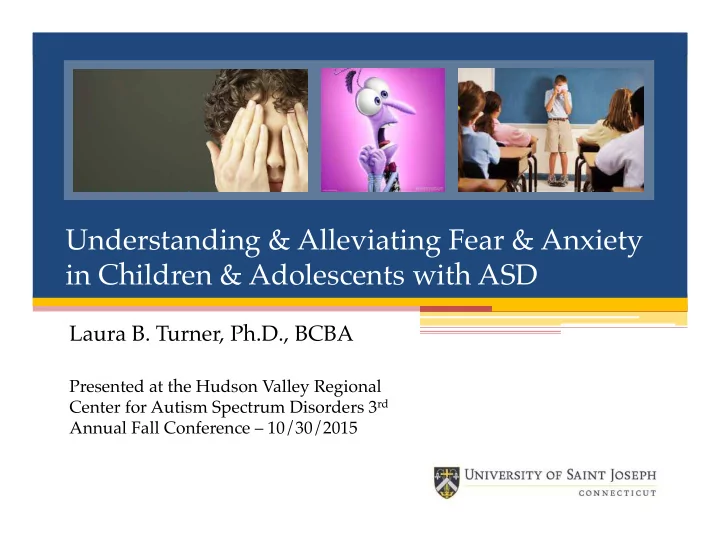
Understanding & Alleviating Fear & Anxiety in Children & - - PowerPoint PPT Presentation

understanding alleviating fear anxiety in children
SMART_READER_LITE
LIVE PREVIEW

Understanding & Alleviating Fear & Anxiety in Children & - - PowerPoint PPT Presentation

Understanding & Alleviating Fear & Anxiety in Children & Adolescents with ASD Laura B. Turner, Ph.D., BCBA Presented at the Hudson Valley Regional Center for Autism Spectrum Disorders 3 rd Annual Fall Conference


slide-1
SLIDE 1
  • Understanding & Alleviating Fear & Anxiety

in Children & Adolescents with ASD

Laura B. Turner, Ph.D., BCBA

  • Presented at the Hudson Valley Regional

Center for Autism Spectrum Disorders 3rd Annual Fall Conference – 10/30/2015

slide-2
SLIDE 2

The purpose of this presentation is to provide…

1. An overview on the etiology and prevalence of fear and anxiety in children and adolescents with ASD 2. An overview of Cognitive Behavior Therapy and common modifications for children and adolescents with ASD 3. Additional readings and resources for you to be able to learn more about these techniques

slide-3
SLIDE 3

Starting with Definitions: Fear and Anxiety

slide-4
SLIDE 4

Where does fear/anxiety come from?

  • Learning

▫ Direct experiences ▫ Indirect experiences: observing & listening to others

  • Genetic & biological factors (e.g., heritability, temperament)

Aktar et al., 2013; Askew & Field, 2007; Bandura, 1977; Dubi et al., 2008; Gerull & Rapee, 2002; Rachman, 1977; Watson & Raynor, 1920

slide-5
SLIDE 5
  • It depends on the individual’s cognitive and social-communicative

abilities

  • Verbalizations (content) & Vocalizations (volume, tone)
  • Facial expressions
  • Caution: Individuals with ASD can display atypical expression of emotional states, contextually-

incongruous emotional reactions, and unreliable and atypical fearful facial expressions

  • Body tenseness
  • Approach/avoidance behaviors
  • Noncompliance, aggression, self-injury & self-stimulatory behavior

How is fear/anxiety displayed by individuals with ASD?

Hagopian & Jennett, 2008

slide-6
SLIDE 6

With that caveat…anxiety disorders are highly prevalent among children & adolescents with ASD

  • Approximately 40% have an anxiety disorder (APA, 2013; Leyfer et al.,

2006; Muris et al., 1998; Simonoff et al., 2008; Sukhodolsky et al., 2008)

▫ Specific Phobia: 9% - 64% (5-16% of children/adolescents without ASD) ▫ Social Anxiety Disorder: 8% - 30% (7% of children/adolescents without ASD) ▫ Generalized Anxiety Disorder: 2% - 23% (<1% of children/adolescents without ASD)

  • Children with ASD have more intense fears than children with
  • ther developmental and intellectual disorders (Evans et al., 2005; Rodgers et

al., 2011)

  • Atypical presentation of fear (Evans et al., 2005; Gillis et al., 2009; Turner & Romanczyk, 2012)

▫ More likely to have fears related to medical/dental procedures ▫ Less likely to have fears of dangerous situations and items that could cause harm

slide-7
SLIDE 7

Rank Fear Item “A lot of fear” 1 Getting Blood Drawn 64% 2 Getting a Shot 54% 3 Getting Teeth Cleaned 36% 4 Making Mistakes 29% 5 Insects 29% 6 Finger Prick 28% 7 The Dark 16% 8 Doctor Exam 15% 9 Severe Weather 15% 10 Meeting Peers 14%

Turner & Romanczyk (2012)

Top 10 Fears Rated by Parents of Children with ASD

n = 41

slide-8
SLIDE 8

When to seek help?

  • Does the fear/anxiety interfere with the individual’s

ability to learn or gain independent skills?

  • Is the fear/anxiety abnormally intense?
  • Does the fear/anxiety interfere with everyday activities?
  • Are there associated dangerous behaviors?
slide-9
SLIDE 9

Seeking Help: A Psychological Approach to Overcoming Excessive Fear and Anxiety

  • Cognitive Behavior Therapy (CBT)

▫ Much empirical support for the effectiveness of CBT for children and adolescents without ASD (e.g., Kazdin & Weisz, 2003; Kendall, 2000) ▫ Growing body of support for the effectiveness of CBT for high functioning children and adolescents with ASD (e.g., Reaven et al., 2011; Wood et al.,

2015)

slide-10
SLIDE 10

What is CBT?

  • An approach that merges theory and techniques from behavior

and cognitive therapy

▫ Cognitive: Behavior is a function of faulty thinking and irrational beliefs (Beck, 1972) ▫ Behavioral: Behavior is a function of the environment (e.g., Skinner, 1938)

  • Underlying assumption is that fear/anxiety is learned
  • Emphasis on collaboration, goal setting, the present, frequent

measurement of progress, and parent involvement

slide-11
SLIDE 11

Step 1. Psycho-Education: Understanding Your Anxiety

  • Evaluating & developing

emotional competence

  • Identification of idiosyncratic

internal cues

▫ How do I know I’m anxious?

  • Identification of idiosyncratic

external triggers

▫ What situations make me anxious?

  • Linking behavior, thoughts

and feelings

▫ Self-monitoring

slide-12
SLIDE 12

Step 2. Teaching Alternative Skills

  • Specific Skills – Coping & Problem Solving

▫ Cognitive Restructuring

– Challenge irrational beliefs & faulty thinking patterns

▫ Positive self-talk, self-instructions ▫ “Worry time” ▫ Relaxation techniques, e.g.,

– Diaphragmatic breathing – Progressive muscle relaxation

  • Teaching Considerations

▫ Use prompts and reinforcers

▫ Teach to fluency in a calm state ▫ Program for generalization

slide-13
SLIDE 13

Step 3. In-Vivo Exposure* – Practice in Context

  • Considered the most important step!
  • Preventing escape from or avoidance of feared stimulus/situation,

until the stimulus is no longer associated with a fear response

▫ Note: This is correlated with more aggression in children with an ASD than typically developing children (Evans et al., 2005)

  • Developed out of the work on systematic desensitization (Wolpe, 1958)

Habituation *Considered evidence-based for the treatment of specific phobia in children with ASD (Jennett & Hagopian, 2008) Qualitative Ratings

  • f Anxiety
slide-14
SLIDE 14
  • Using small steps that progress to complete exposure to the feared

stimulus (shaping approach responses)

  • How To:

▫ Following a multi-component and individualized assessment, collaboratively develop a fear hierarchy

Graduated Exposure – Using a Fear Hierarchy*

*Considered evidence-based for the treatment of specific phobia in children with ASD (Jennett & Hagopian, 2008)

slide-15
SLIDE 15
  • How To Continued:

▫ Start with situation that elicits mild- moderate anxiety – ensure success! ▫ Provide prompts* (e.g., verbal, visual, model*) to engage in the approach behavior ▫ Provide contingent reinforcement* for absence of escape behaviors ▫ Ensure success before moving on to next step – measurement is key.

Graduated Exposure – Using a Fear Hierarchy*

*Considered evidence-based for the treatment of specific phobia in children with ASD (Jennett & Hagopian, 2008)

slide-16
SLIDE 16

Modified CBT for Children & Adolescents with ASD: A Few Noteworthy Studies & Manuals

Attwood & Scarpa, 2013; McNally Keehn et al., 2013; Reaven et al., 2011; White et al., 2015; Wood et al., 2015

slide-17
SLIDE 17

Modifications to CBT approaches with children and adolescents with ASD

  • *Match to cognitive, language and social-emotional abilities
  • Inclusion of social skills training (e.g., perspective taking)
  • Inclusion of adaptive skills training
  • Expansion of emotional education
  • Increased duration, number & frequency of sessions
  • Increased parent training & involvement

Attwood & Scarpa, 2013; McNally Keehn et al., 2013; Reaven et al., 2011; White et al., 2015; Wood et al., 2015

slide-18
SLIDE 18

Modifications to CBT approaches with children and adolescents with ASD

  • Incorporation of concrete language and examples
  • Addition of written and visual materials
  • Increased focus on flexible thinking
  • Consideration of motivation for change and to attend sessions
  • Inclusion of clear session schedules
  • Schedules & reminders for CBT homework

Attwood & Scarpa, 2013; McNally Keehn et al., 2013; Reaven et al., 2011; White et al., 2015; Wood et al., 2015

slide-19
SLIDE 19

Making it Collaborative by Incorporating Choice: An Example

“I’m afraid you’re going to cut my pinky toe”

slide-20
SLIDE 20

lbturner@usj.edu